

In the late 19th century, the bustling port of Newport served as a vibrant microcosm of the Victorian festive spirit. As Christmas approached, the town’s gas-lit streets transformed into a theatrical stage where commerce and tradition collided. From the "monster cheeses" and 100-pound cakes displayed in shop windows to the exotic delicacies arriving at the docks from the far reaches of the Empire, the local advertisements of the 1880s and 90s paint a portrait of a community that was both deeply traditional and surprisingly modern.
This article explores the sights, sounds, and costs of a Newport Christmas through the lens of original archival records. We delve into a world where "Home, Sweet Home" played on a midnight violin could be a public nuisance, where a high-end Christmas cracker was a vehicle for social satire, and where the "rebel hordes" of carol singers were a genuine test of local patience. Through these vignettes of shop decorations, global delicacies, and the gruelling journey of the midnight train from Paddington, we rediscover a festive season that was as competitive and outward-looking as it was cozy and candlelit.

Seen & Heard — Christmas Edition
Saturday 22nd December, 1894
In accordance with his custom, Mr Albert Spicer, M.P., will provide the Christmas dinner for the inmates and staff of the infirmary on Christmas Day.
Christmas is near at hand — but four days off — and many a tired and over-worked assistant and business man will be glad of the two or three days' rest. It is also welcomed by the writer of these notes as being the day when the multitude of young rascals who call themselves waits will have ceased their howlings. One thousand five hundred and sixty-three times have I been yelled at with the wish of
A merry, merry Christmas
And a happy new year.
and I'm heartily sick of it. I don't care if I never hear any more Newport waits this side of the silent tomb.
To add to the list of troubles during the last two or three days, nearly every band, brass, drums, and fife, or tin kettle, have been at work to help in making night hideous. One or two of these can play, but what have we done that they should continue to blast away after 11 o'clock at night? For the rest the more execrably they blast at you with their instruments of brass the better they enjoy it.
Two or three nights ago, one of these musicians started on the doorstep, just before midnight, to play a violin solo. The solo was "Home, sweet, home," and a more teeth-grinding performance one could not imagine. This vagabond also was insolent, and though there was a person lying ill in the house, he refused to "move on to the next street," and finished his unearthly scraping.
These are the "rogues and vagabonds," who by their evil "arts and devices" are hurrying our grey hairs with sorrow to the grave, and if Head Constable Sinclair would leave gipsy hunting for the nonce and look after these public nuisances, he would be conferring a benefit on the ratepayers. There can be no "peace upon earth," at least at Newport, till these rebel hordes have been made to cease from making night hideous.
Shop Decorations
Upholsterers
Christmas is a season at which the great majority of householders either improve the dilapidations undergone by their household furniture during the year, or clear out their old stock by the substitution of new. Not the slightest difficulty is experienced in this at Newport on the part of those who are possessed of the means of re-furnishing.
Messrs Lewis and Lewis, cabinet manufacturers, upholsterers, and carpet warehousemen, of 137 and 137a Commercial Street, are making a really exquisite display. There are but few persons who are aware of the splendid storage accommodation of this establishment. In addition to the ground floor the show rooms upstairs — and they number half a dozen — are packed with rich and costly articles of furniture. Some very pretty lines in bedsteads are on display, also some remarkably cheap lines in linoleum and floorcloths, carpets, blinds, and curtains. In fact at very reasonable charges householders may obtain at this establishment every requisite necessary in the way of furniture. A large number of fancy goods, suitable for Christmas presents, has also been laid in.
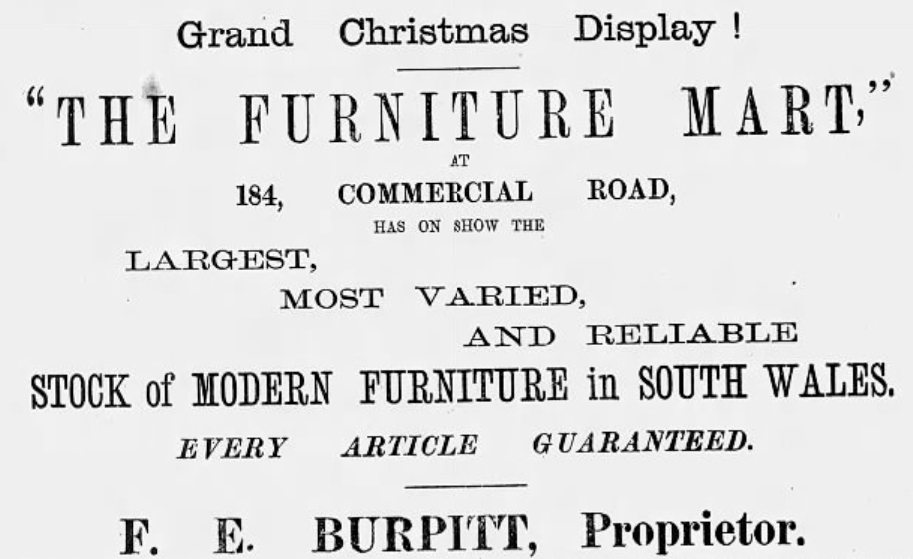
Mr F.E. Burpitt, of 184, Commercial-road, has a stock so extensive, and his orders just now are so numerous, that he has been unable to make anything like a display such as that of last year. Mr Frost, the enterprising manager, to use his own words, has spurned the making of an attractive window, whilst he had more lucrative business on hand. The furniture at this establishment is of exceedingly rich design in every department, and as the premises are so large the stock is one of the most extensive and varied in Monmouthshire. At present the proprietor is making some rich carpets, handsomely designed, and of exceedingly large proportions; in fact large enough to cover a good sized room. Numerous important public orders have been carried out by Mr Burpitt during the past year to the complete satisfaction of his patrons. Those persons who happen to be in want of furnishing requisites cannot be better served at any establishment in the town than at that of Mr Burpitt.
Mr E. German, of Skinner-street, has already succeeded in establishing, not only a reputation, but a lucrative business. His stack of furniture, if not so large as at other similar establishments, has been selected with great care, and quality blends with cheapness. There are numerous special lines for Christmas season, and there is no reason to doubt that Mr German will be remembered by a large number of friends and acquaintances who may find themselves in need of articles such as those which he has on offer.
Mr Herbert Handy, Commercial-street, has also a display of furniture of the most extensive nature. His dining and drawing. room suites are marvels of beauty, and the general stock is more than sufficiently capable of completely furnishing either mansion of cottage. Among the special lines we observe in the suites which are displayed in rows a magnificent American walnut wardrobe. It is of special make, and Mr Handy has been appointed the sole agent in connection with its sale. Among its peculiarities are that the trays may be drawn out to the full extent of the opened doors, and that the locking of one drawer at the left hand corner of the wardrobe also suffices to lock the doors and every other drawer in this magnificent piece of furniture, the price of which is 34 guineas. Mr Handy has carried out many important orders during the year, the latest of these being complete furnishing of a temperance hotel in North Wales. There is a great run upon the Ch'idema carpets of which Mr Handy is the local agent.
Messrs P. Freedman and Co., whose immense premises at No 1, 2, 3 and 4, Market-buildings we recently described at length, have an immense stock of furniture displayed, the special lines being numerous. This firm does business on the hire system. A small deposit, according to the amount of the purchase, has to be made, and then the furniture is forwarded to customers, who can complete the payment by weekly instalments. For instance, furniture the cost of which is £3. is paid for at the rate of 1s 6d. per week, whilst furniture of the value of £50 may be obtained by payment of instalments of 10s per week. The system is a convenient one for householders who have not sufficient ready cash at hand when they stand in need of new furniture and Messrs Freedman have already found from the amount of business done that it is also a popular one. This firm is now exhibiting a magnificent picture, depicting "Nelson's Victory". No charge is made to view, and no one should fail to see this grand work of art.
Wine and Spirit Merchants
If Christmas is noteworthy as being a season for eating, it is equally recognised as being one for drinking, and save in the homes of pronounced total abstainers there are but very few persons who fail to lay in a stock of drinkables in preparation, of course, to the means. On previous occasions we have referred to the immense boom recently experienced in the brewery trade, and this has naturally led to increased activity on the part of those engaged in it.
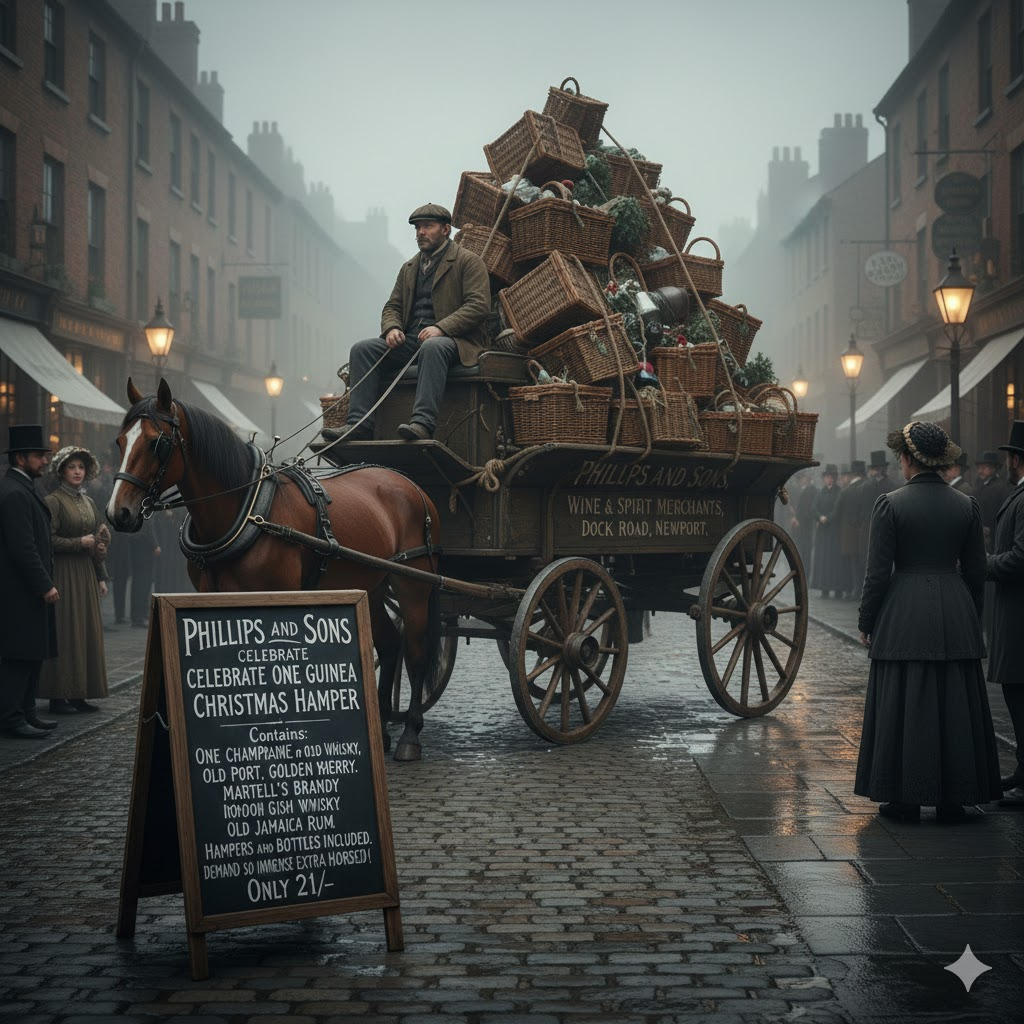
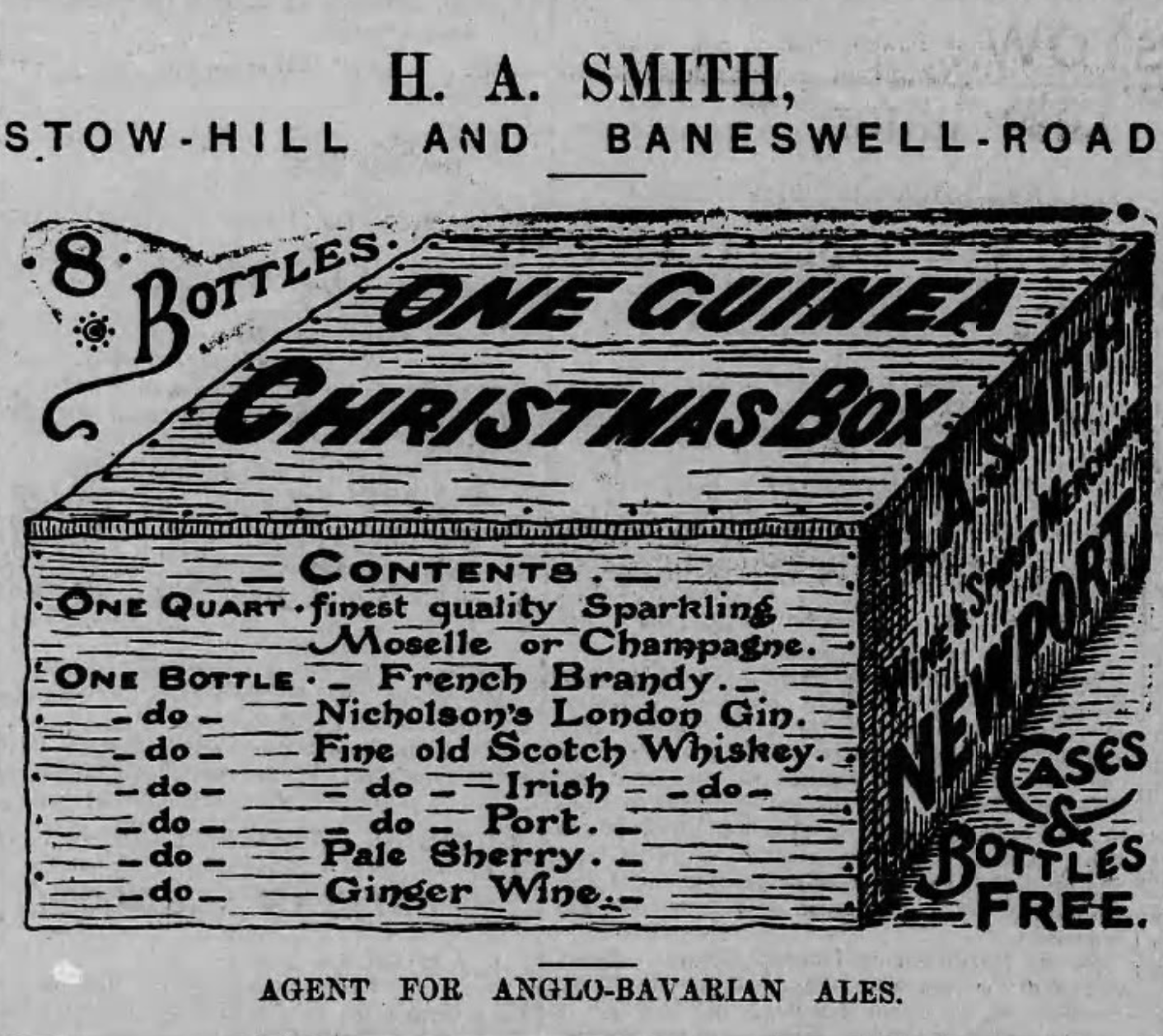
The business being done by Messrs Phillips and Sons is absolutely immense. We have it on their personal authority that during the past week, in spite of the large number of horses which they themselves possess, they have been compelled to hire an even larger number, so as to cope with the orders in hand. It appears but the other day that we wrote a detailed description of their new brewery establishment at Dock-road. Yet the premises have already been found too small for the expanse of the firm's trade, and a large addition has been arranged for, the work to commence directly the new year is in. Three new beer vats, each capable of holding 371 barrels of beer, are to be erected, in addition to the new collecting vessels and mash tubs. When these additions have are completed the brewery will be the most extensive in South Wales. The celebrated Christmas hampers, which consist of seven bottles of wine and spirits, the price being one guinea, are in great demand this year. In fact the orders are so large that many of them have had to be delayed owing to a wait of hampers. The wine, spirits and ale supplied by this firm are well known for the excellence of their quality, and the large number of licensed houses in all parts of Monmouthshire owned by this firm is in itself more than sufficient to maintain even in ordinary times a very extensive business. Messrs Phillips has recently issued a pretty illustrated circular in which their new brewery in Dock-road occupies a prominent position.
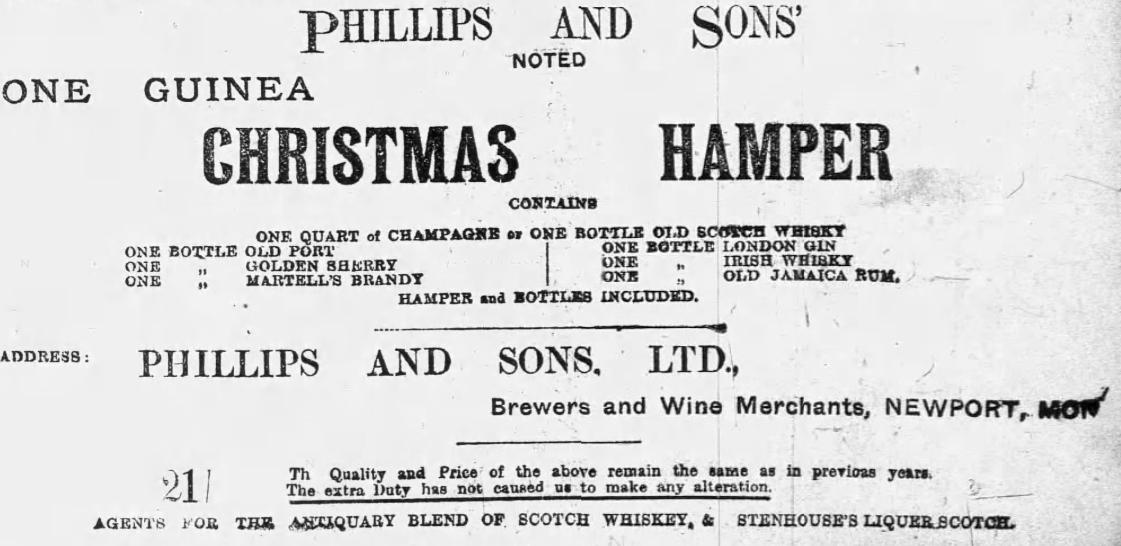
The Newport and South Wales Wine and Spirit Company, which will never be dissociated from the name of Harrhy, are also doing a very large amount of business. Their Irish, Scotch, and old malt whiskeys are of splendid brand, whilst the qualities of other kinds of spirits are so well known as not to s (sic) and in need of recommendation. The company's books are just now full of orders for their celebrated guinea Christmas hampers, which contain a bottle of champagne, old port, golden sherry, cognac brandy, Nicholson's gin, old Irish whiskey, and old Jamaica rum.
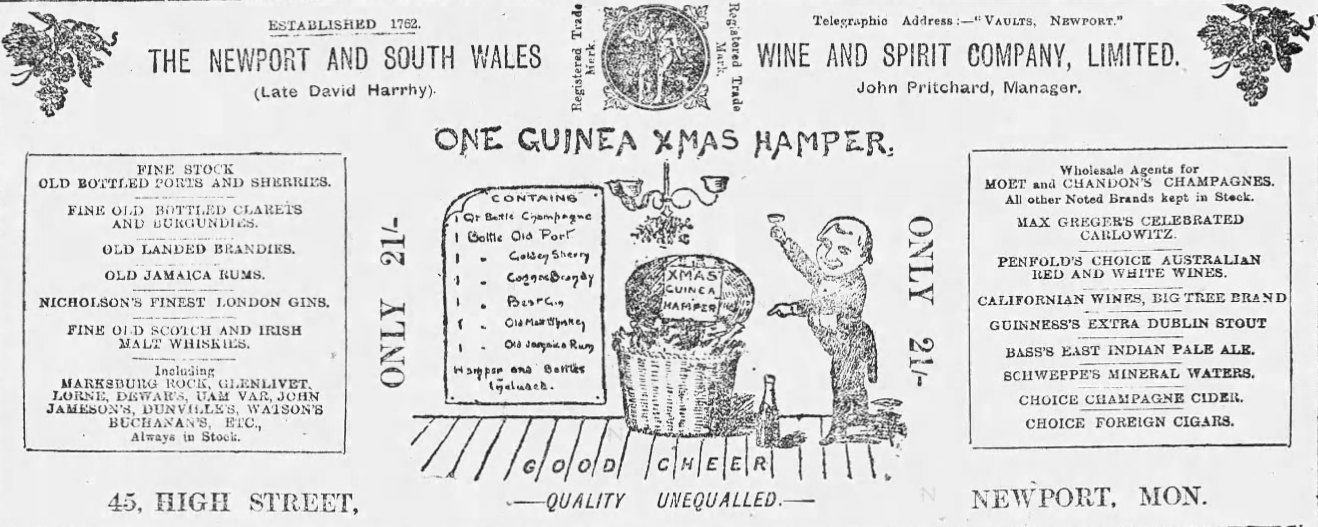
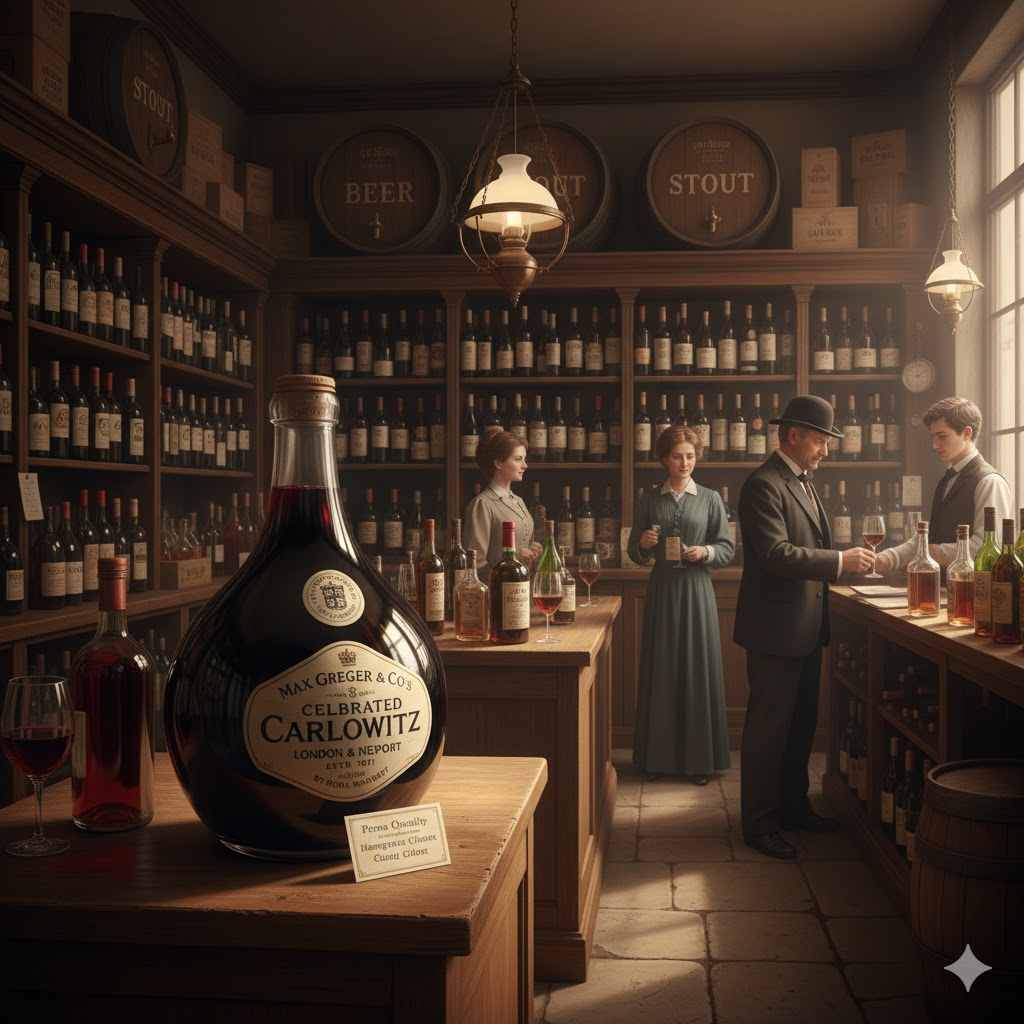
The company are agents for such firms as those of Guinness and Bass, and the ales consequently supplied are of prime quality. They are also the sole local agents for MaxGregor's celebrated Carolwitz.
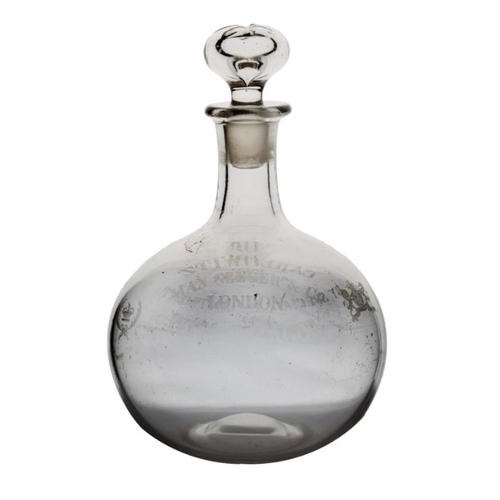
Lovers of sparkling champagne cider may easily assugae (sic) their thirst by giving orders for this drink, large bottles being 6s per dozen, and small ones 3s.
Mr R. B. Plummer, of the Royal George Hotel, Portland-street, has recently made two or three very lucky hits in purchasing public house property, which he has succeeded in disposing of immediately afterwards, leaving a large margin of profit. His latest venture is the taking of the Bunch of Grapes Hotel, High-street, his intention being to establish, if possible, a large retail trade in wines and spirits. His stock is of splendid quality, and, being a perfectly free house, the proprietor is enabled to purchase of any brewery or firm which may best suit his requirements. Mr Plummer has a lot of "go" in him, and he will doubtfully success in establishing an extensive business, where less enterprising proprietors would fail.
Miscellaneous
One of the prettiest windows at present in Newport is that of Mr W. Jones, stationary, bookseller, printer, etc. 159, Commercial-street. The proprietor has only recently been enabled to enter into his new premises, his shop now forming part of what is, perhaps, the most handsome block of buildings in the entire town.
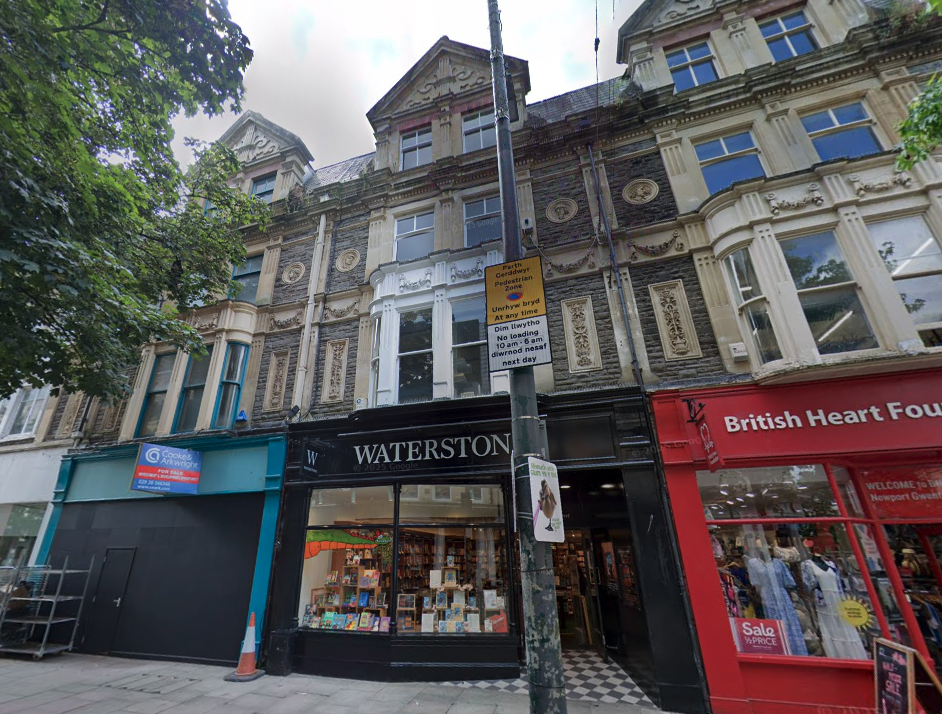
The windows are capitally adapted for the purposes of decoration, and the male and female assistants have taken full advantage of this. A considerable amount of skill has been displayed by them, and the magnificent assortment of articles, every one of which is admirable suited for Christmas presents, are exhibited to the best possible advantage.
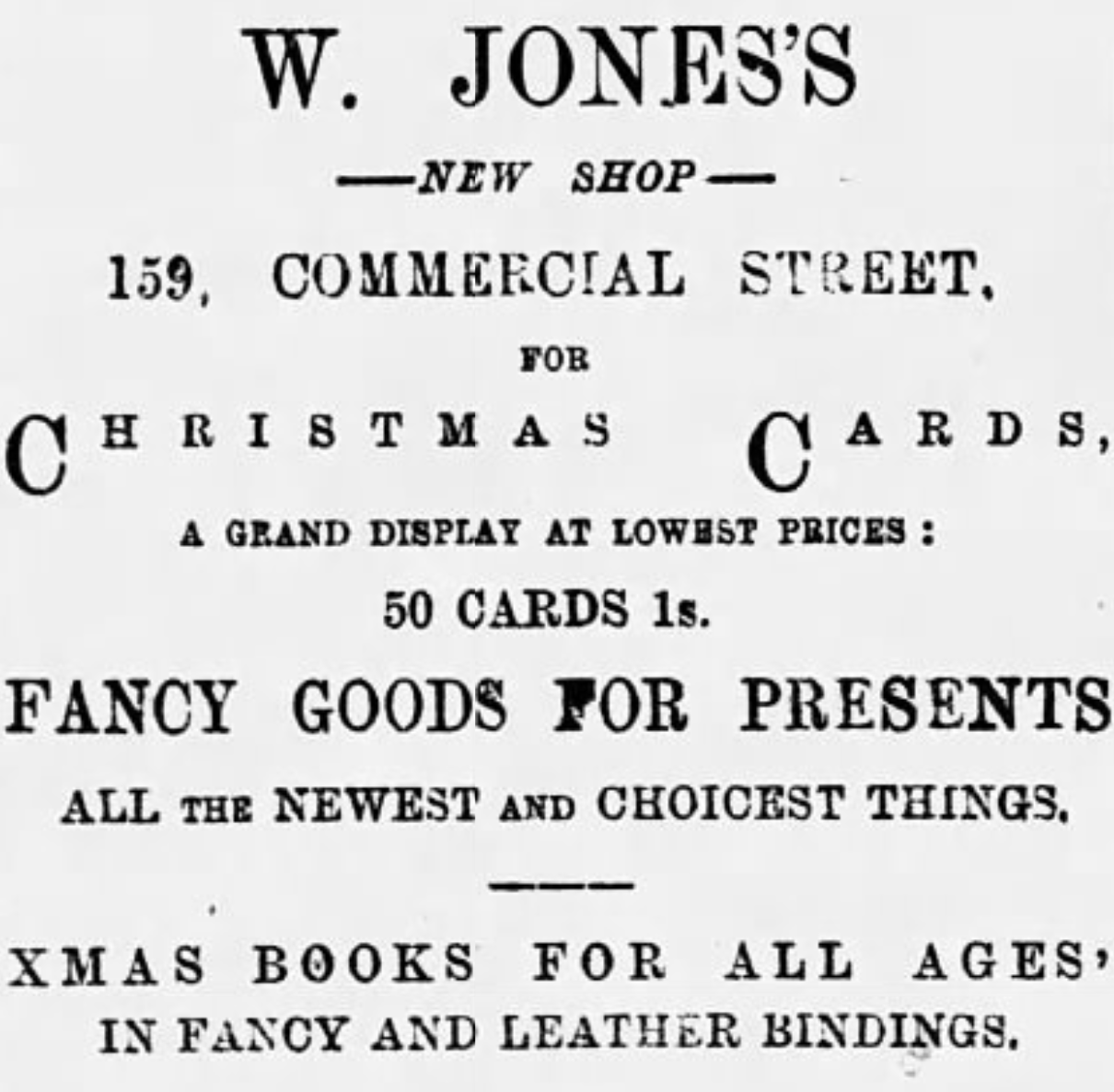
The stock is so large and varied, and prices are so low that we anticipate there will be but very few persons who do not purchase an article of some kind at this shop during the festive season.

Firms like Singer, and Wilson and Wheeler, boast of their prowess in the sewing machine line but at the establishment of Mr Jones a guaranteed patent lock-stitch sewing machine may be purchased for the exceedingly low sumo of 12s. 6d., and with an additional 1s. 6d. to bout a handsome stand is supplied with it. Christmas purchasers of novelties don't miss this establishment.
Christmas without music would be like pity without relief or mustard without beef.
The season is emphatically one for the merry song and the every enjoyable dance. The one must be indulged in without accompaniment whilst the other is sadly marred without the aid of a musical instruments. These instruments, over every conceivable kind, are readily obtainable at the shop of Messrs Thompson and Shackell, Commercial-street. Eminent as the reputation of the firm is, the exigencies of the age have induced them to adopt the hire system, and musical instruments, no matter how costly, may be easily obtained on payment of small weekly instalments. Printed music of waltzes, quadrilles and the most popular songs at present being rendered is practically being given away.
Mr J. Davies, 11 Tredegar-place, has also on hand a splendid collection of musical instruments. A pianoforte-harmonium, or American organ may be purchased from him on payment of 10s 6d per month, and in certain instances at even a lesser amount. It is stated that "music hath charms to sooth the savage breast," and after hearing the music extracted from a banjo by Miss Morgan at a charity concert on Thursday evening, and by her brother from a penny whistle, there can be but little doubt as to the truth of this. Lovers of music should therefor call in at the shop of Mr Davies.
A chance for the ladies! At the great majority of Newport shops the presents displayed are inly suitable for ladies.
Mr George Richmond, tobacconist, Westgate-buildings, will undoubtedly be largely patronised by the ladies, for his splendid display — unless our aunts, our sisters, and our cousins indulge in cigarette smoking — provide some very acceptable presents which ladies may make to their adored ones. Handsome meerschaum and briar pipes, match boxes of exquisite design, pipe cases, tobacco pouches, fragrant cigars, and some of the choicest made tobacco may be obtained by the fair sex who may be desirous of bringing their lovers into that frame of mind which so largely assists them in so momentous a matter as that of "popping the question."
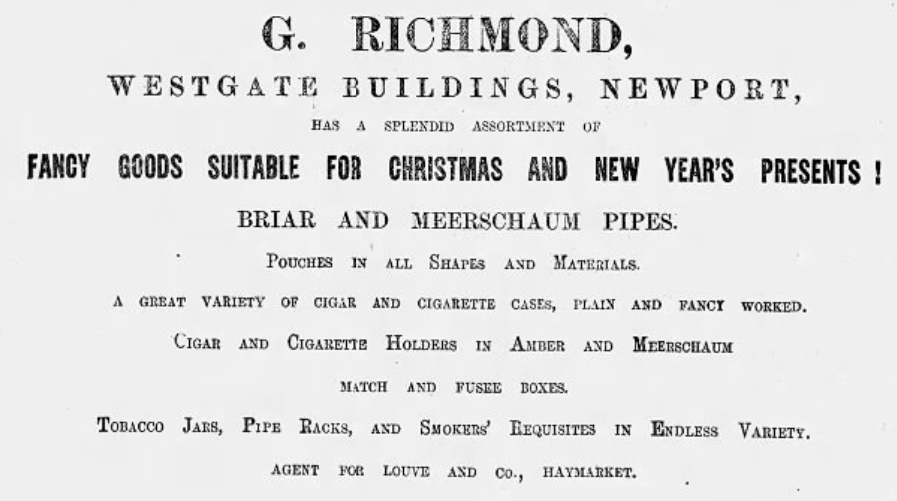
It is satisfactory to know that Mr Richmond, genuine Englishman as he is, is pushing his English made briars in preference to those of foreign make. The price are equal and in quality English made briars are superior. In consequence of this, the proprietor invariably advises his customers to patronise the home trade in preference to the foreign.
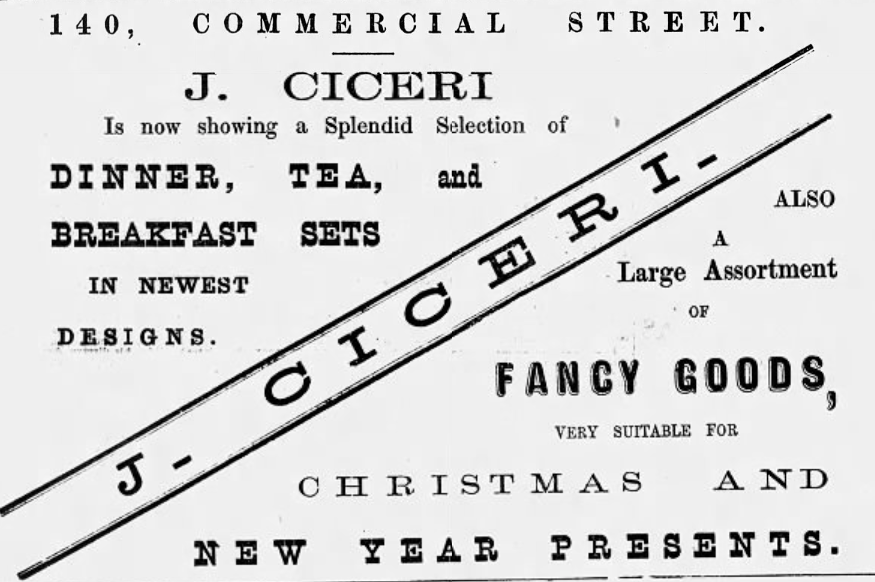
Mr J. Ciceri, 140 Commercial-street, is exhibiting a splendid selection of dinner, tea, and breakfast sets in all the newest designs, and at exceedingly low prices. He has a very large assortment of fancy goods suitable for Christmas and New Year presents.
Messrs I. T. Dando and Sons, Commercial-street, will open their studio during the Christmas holidays, and pursue their avocation as exponents of the art of high-class photography. Ladies and gentlemen get photographed at Dandos.
— South Wales Daily Times and Star of Gwent, December 21st, 1889 (Subscription Required)
Food
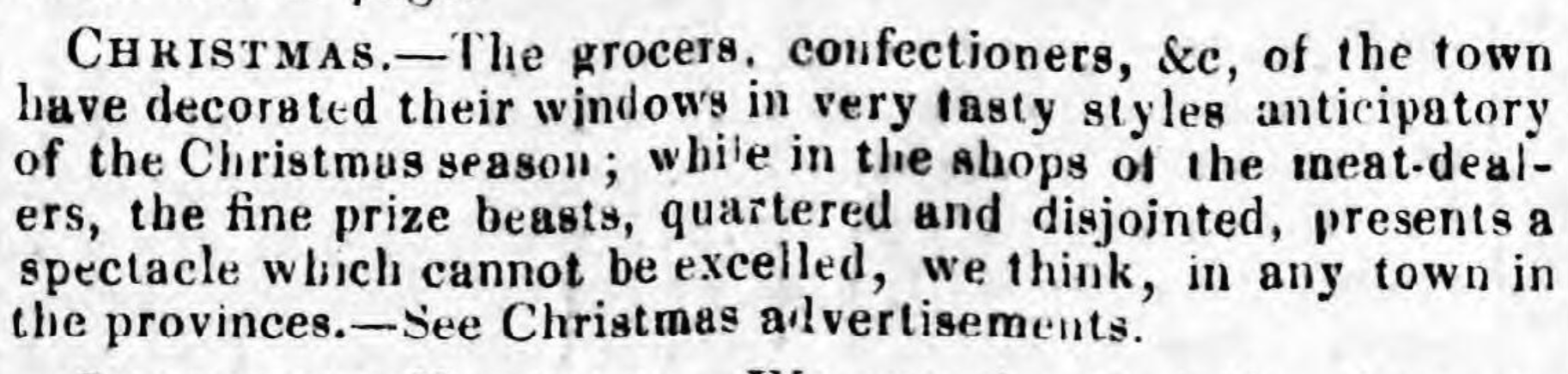
If you were walking down High Street or Commercial Street in late 19th-century Newport, you weren't just shopping for ingredients; you were witnessing a spectacle. The local grocers and provision merchants didn’t just sell food—they staged it.
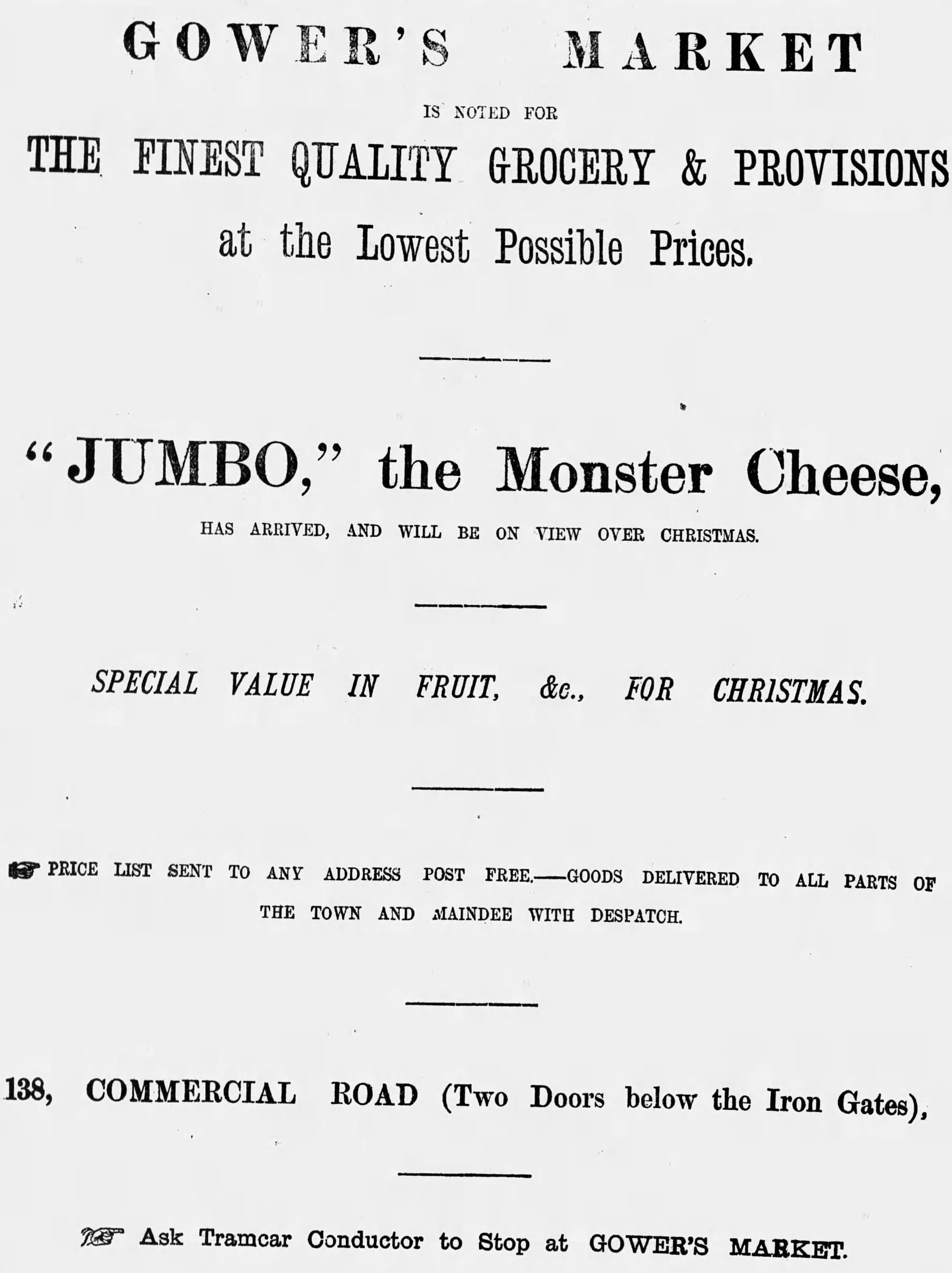
Competition between the shopkeepers of Newport was fierce, and they went to great lengths to turn their Christmas stock into a public attraction. Take Gower’s Market on Commercial Road (two doors below the Iron Gates), which proudly announced the arrival of "JUMBO," a "Monster Cheese" that was explicitly advertised to "be on view over Christmas." It seems viewing the cheese was as important as eating it!
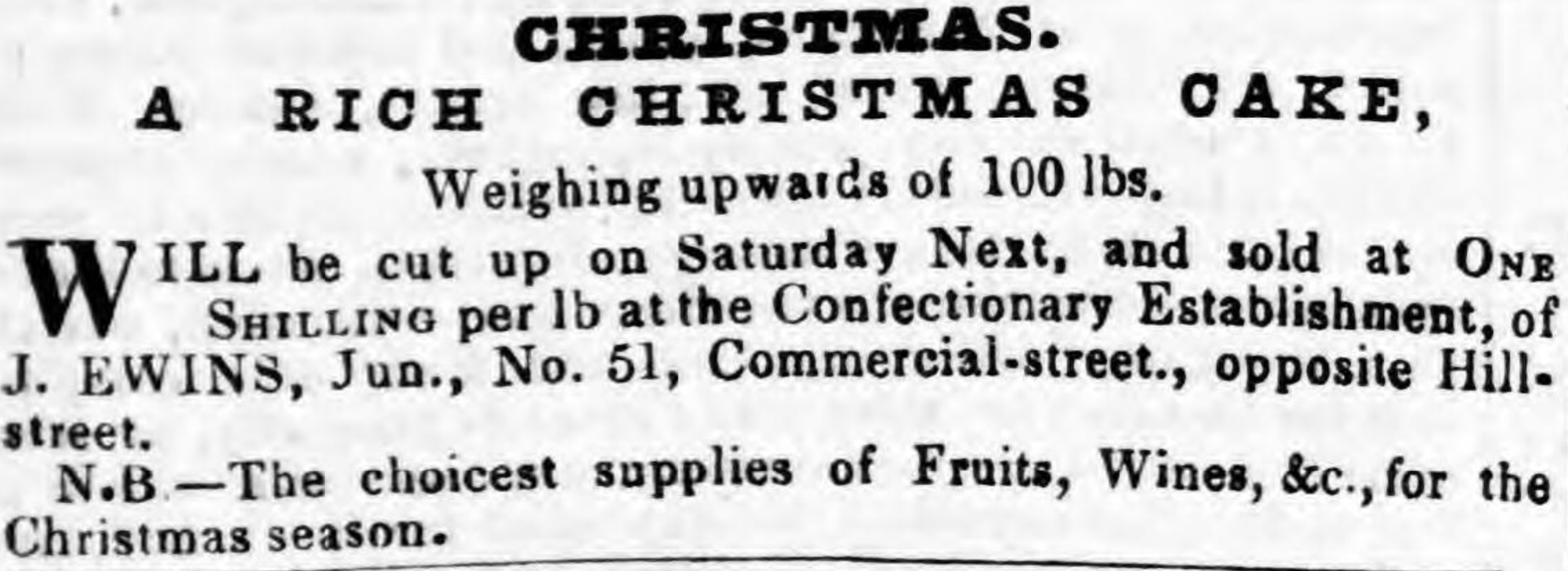
Similarly, J. Ewins, Jun. on Commercial Street made a theatrical event out of a "Rich Christmas Cake weighing upwards of 100 lbs," inviting the public to witness it being "cut up on Saturday Next" and sold at a shilling a pound.
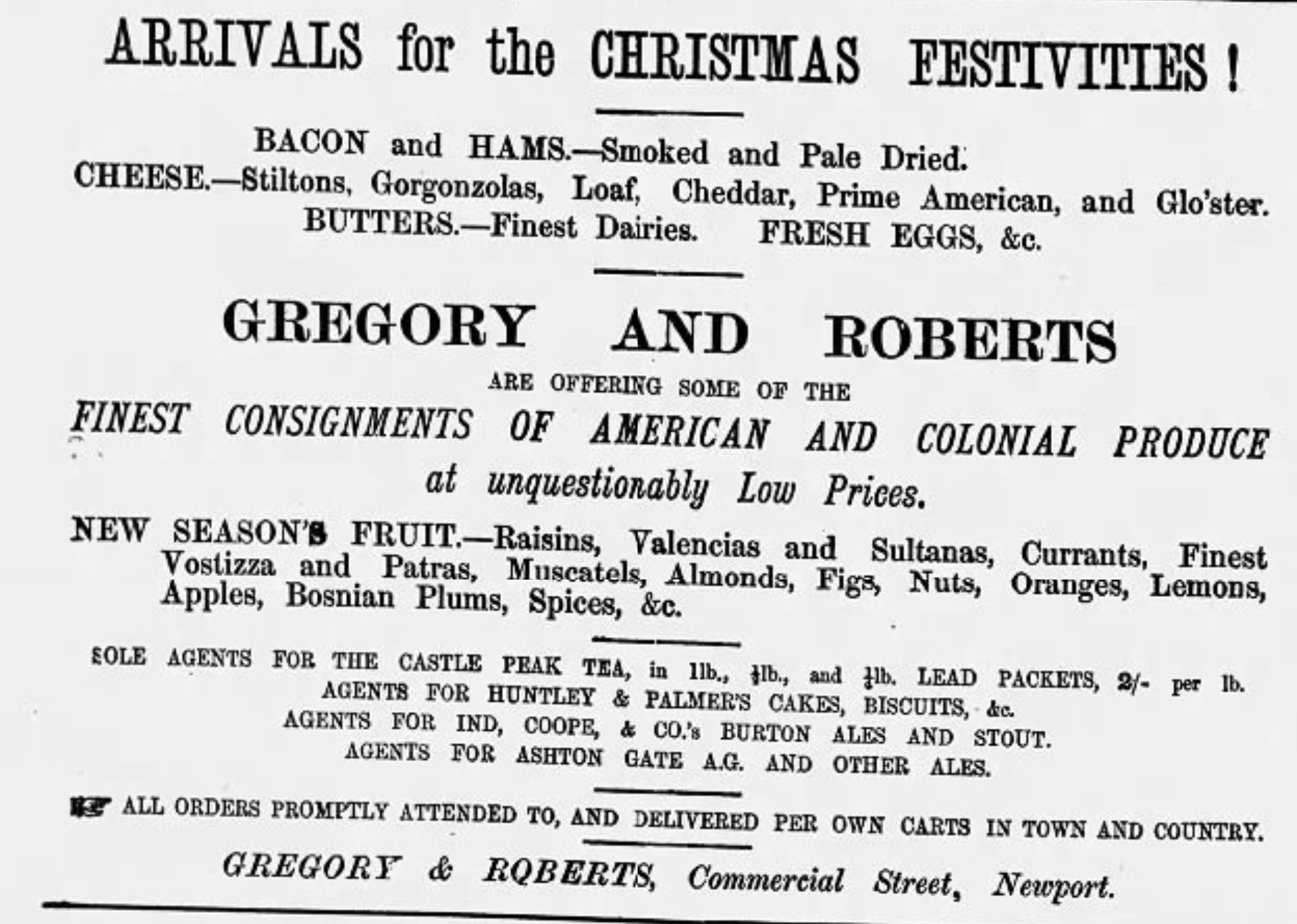
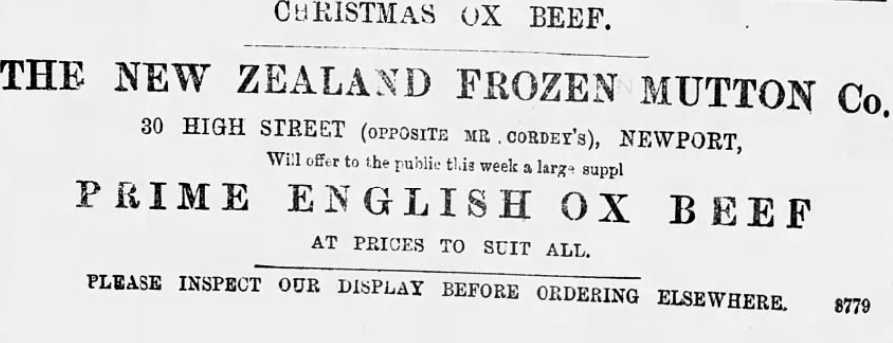
The adverts reveal a Newport palate that was surprisingly exotic, fed by the Empire’s trade routes. Gregory and Roberts boasted of "New Season’s Fruit" arriving for the festivities, listing specific delicacies like "Vostizza and Patras" currants from Greece and "Bosnian Plums," alongside American and Colonial produce. Meanwhile, Enoch Griffiths at 38 High Street was selling "Leather Tie Flour" and "Mazawattee" tea, though he was honest enough to admit that alongside his "Very Best" raisins, he also had a "Few Last Year’s left" at a discount!
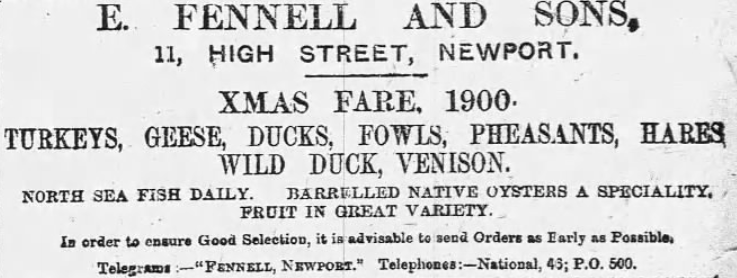
The meat on offer was heavy and game-rich. E. Fennell and Sons (11 High Street) offered a dizzying array of "Xmas Fare" including wild duck, hare, venison, and pheasants, alongside the traditional turkeys and geese.
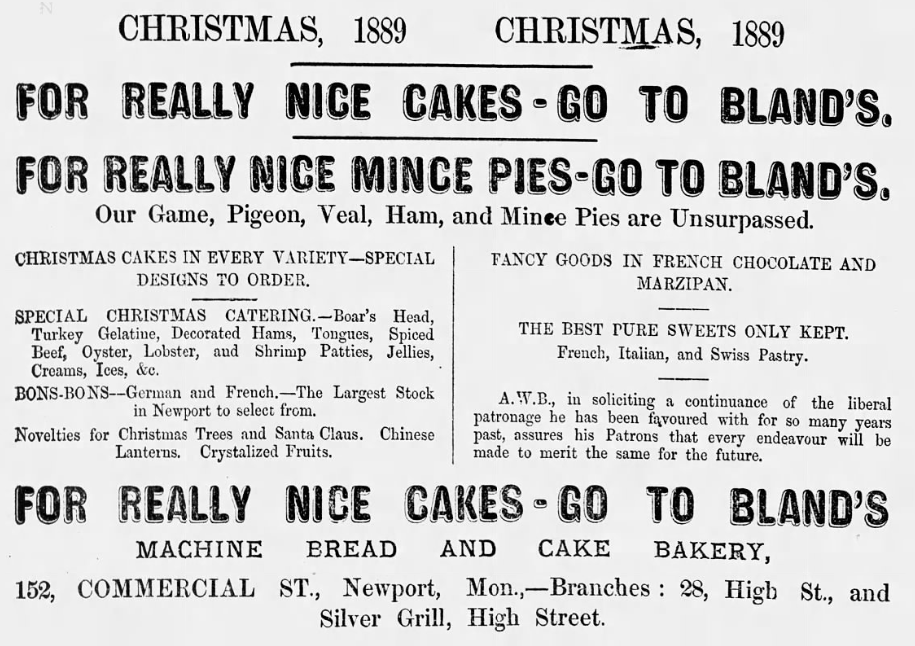
Interestingly, brand names could be misleading. The New Zealand Frozen Mutton Co. (opposite Mr. Cordey’s on High Street) was actually headlining their advert with "Prime English Ox Beef," urging customers to inspect their display before going elsewhere.
— South Wales Daily Times and Star of Gwent, 24th December, 1889 (Subscription Required)
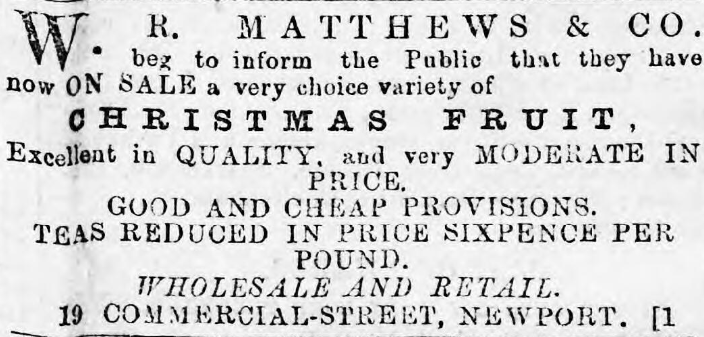
The tone of these adverts ranged from the obsequious to the amusingly blunt. While Henry Sheppard at the Golden Canister (141 Commercial Street) wrote long, flowery paragraphs about his "Christmas Exhibition" and his "feelings assuring him" of his sincerity, Bland’s bakery took a simpler approach. Their marketing strategy was to simply print the phrase "FOR REALLY NICE CAKES - GO TO BLAND'S" in giant letters twice. They also offered "Turkey Gelatine" and "Boar’s Head" for those wanting a true medieval centrepiece.
Navigating these shops was an event in itself. Gower’s Market even included specific travel instructions in their advert: "Ask Tramcar Conductor to Stop at Gower's Market." It paints a vivid picture of a bustling, gas-lit Newport where buying your Christmas goose required tram rides, "viewing" giant cheeses, and navigating the polite "begging" of shopkeepers vying for your custom.
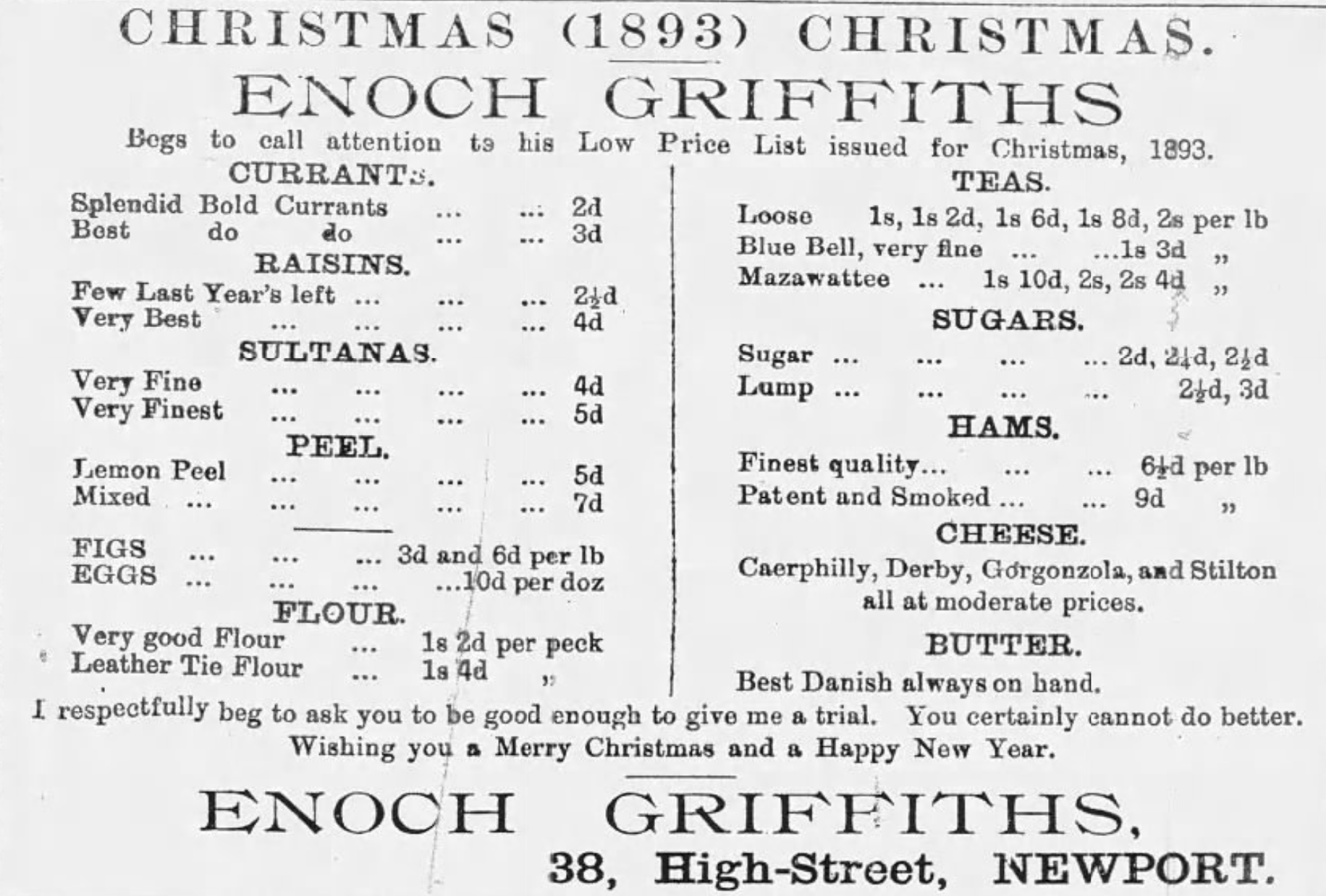
Based on the price list from Enoch Griffiths, 38 High Street
To understand the value of these goods, it is worth noting that a skilled tradesman in the 1890s might earn between 20 and 30 shillings a week.
- The Luxury Item: Tea. Even the "Blue Bell" variety cost 1s 3d per lb, with top-tier "Mazawattee" rising to 2s 4d. A single pound of tea could cost more than 10% of a weekly wage.
- The Staple: Sugar. Much cheaper at just 2d per lb (for lump sugar).
- The Treat: Christmas Cake. J. Ewins sold their rich cake for 1s per lb. A heavy 5lb cake for the family would be a significant investment.
- The Essentials:
- Eggs: 10d per dozen.
- Ham: 6½d to 9d per lb.
- Currants & Raisins: 2d to 5d per lb (essential for the pudding!).
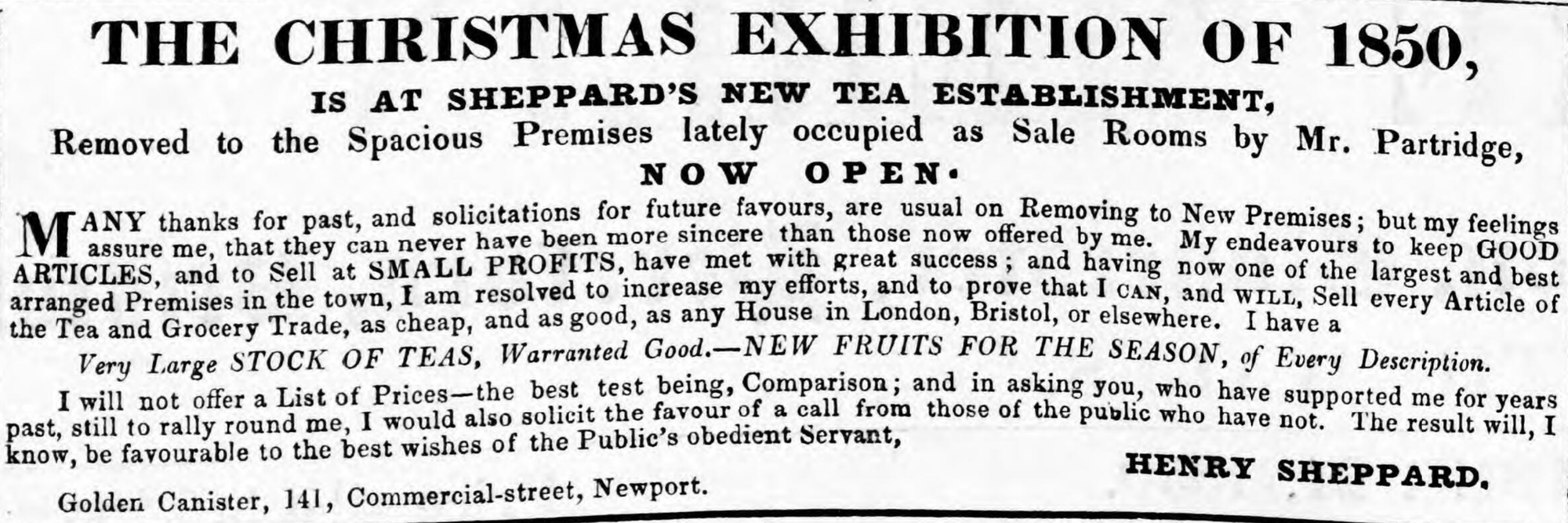
The Lost Larder
Some items listed in adverts might sound unfamiliar to the modern shopper.
- "Turkey Gelatine" (Bland’s, Commercial St) a fancy French dish where the bird is deboned, stuffed with forcemeat, pressed into a cylindrical shape, and poached in gelatin stock. It was a showstopper for the cold buffet.
- "Mazawattee" (Enoch Griffiths, High St) One of the most famous tea brands of the Victorian era. They were known for record-breaking advertising budgets and buying the most expensive tea crop in the world to generate publicity.
- "Vostizza and Patras" (Gregory & Roberts, Commercial St) These aren't brands, but specific regions in Greece famous for currants. Victorian shoppers were discerning about their fruit sources; "Vostizza" currants were considered the "Champagne of currants."
- "Leather Tie Flour" (Enoch Griffiths, High St) A specific grade or brand of flour, likely denoting the method of sealing the sack or a specific quality mark known to locals at the time.
- "Bons-Bons" (Bland’s, Commercial St) Bland’s specifies these are "German and French." In the Victorian era, "Bon-Bon" didn't just mean a sweet; it often referred to the Christmas Cracker (which was invented by a confectioner, Tom Smith, inspired by French bon-bons wrapped in twisted paper).
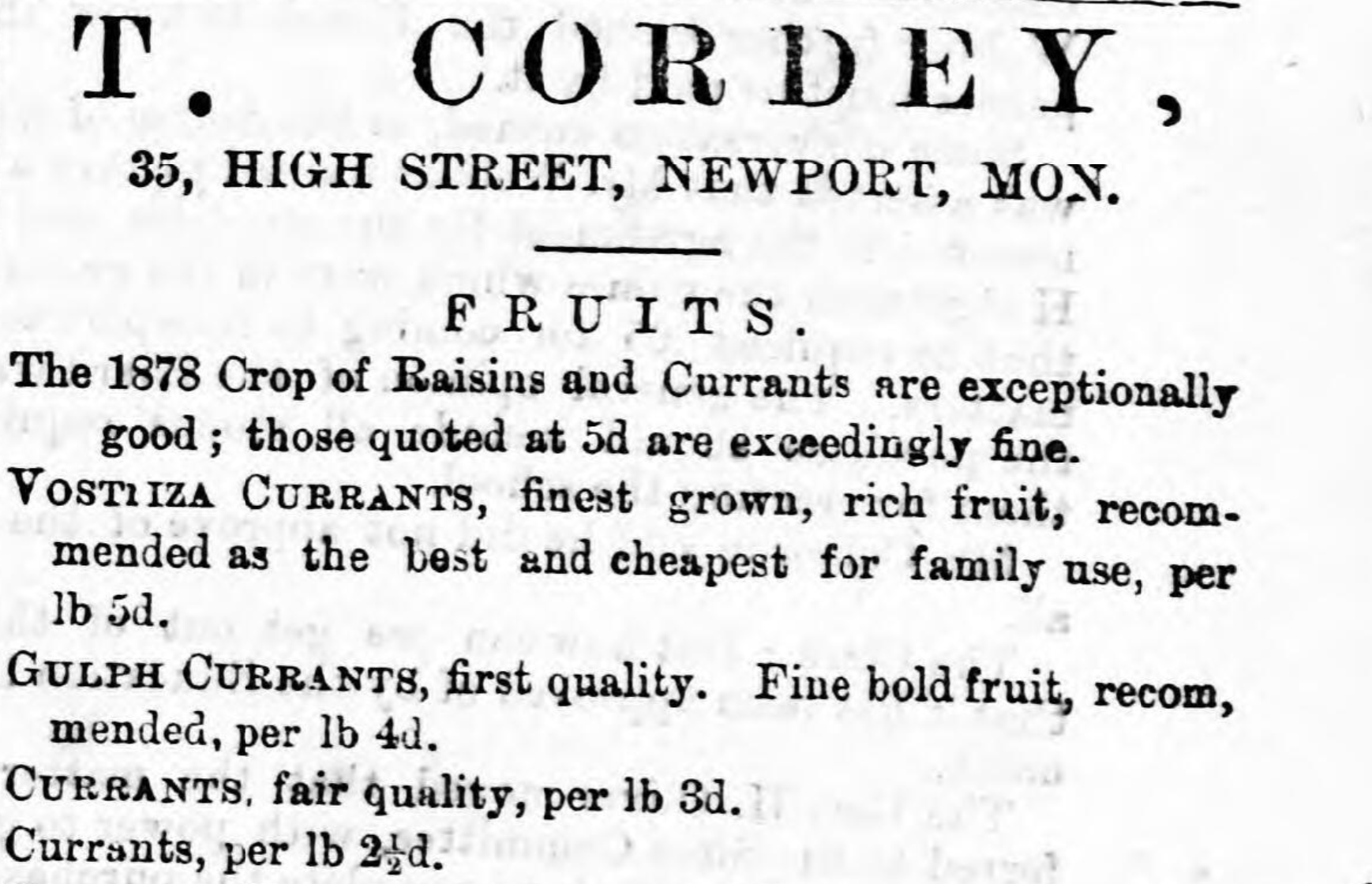
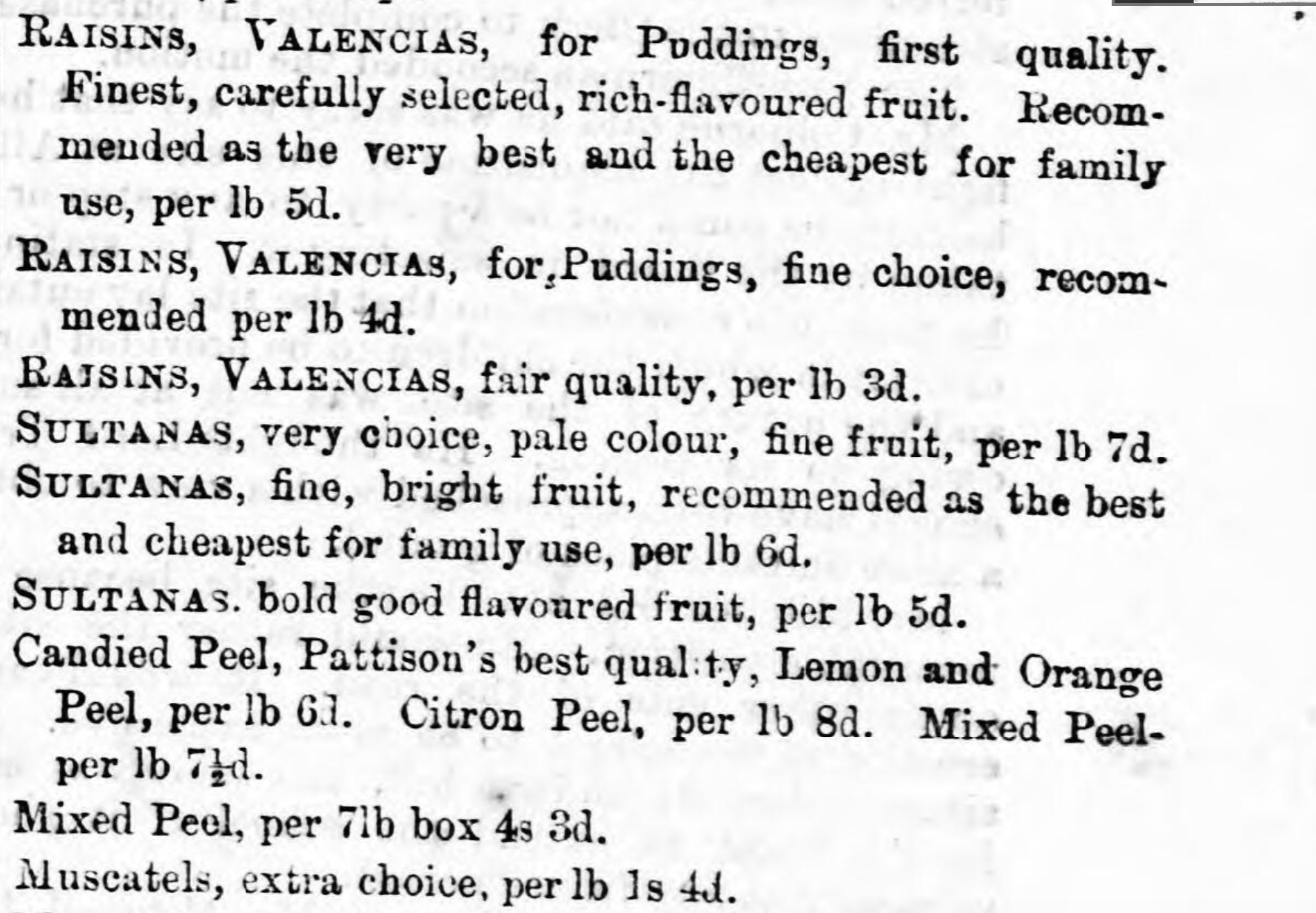

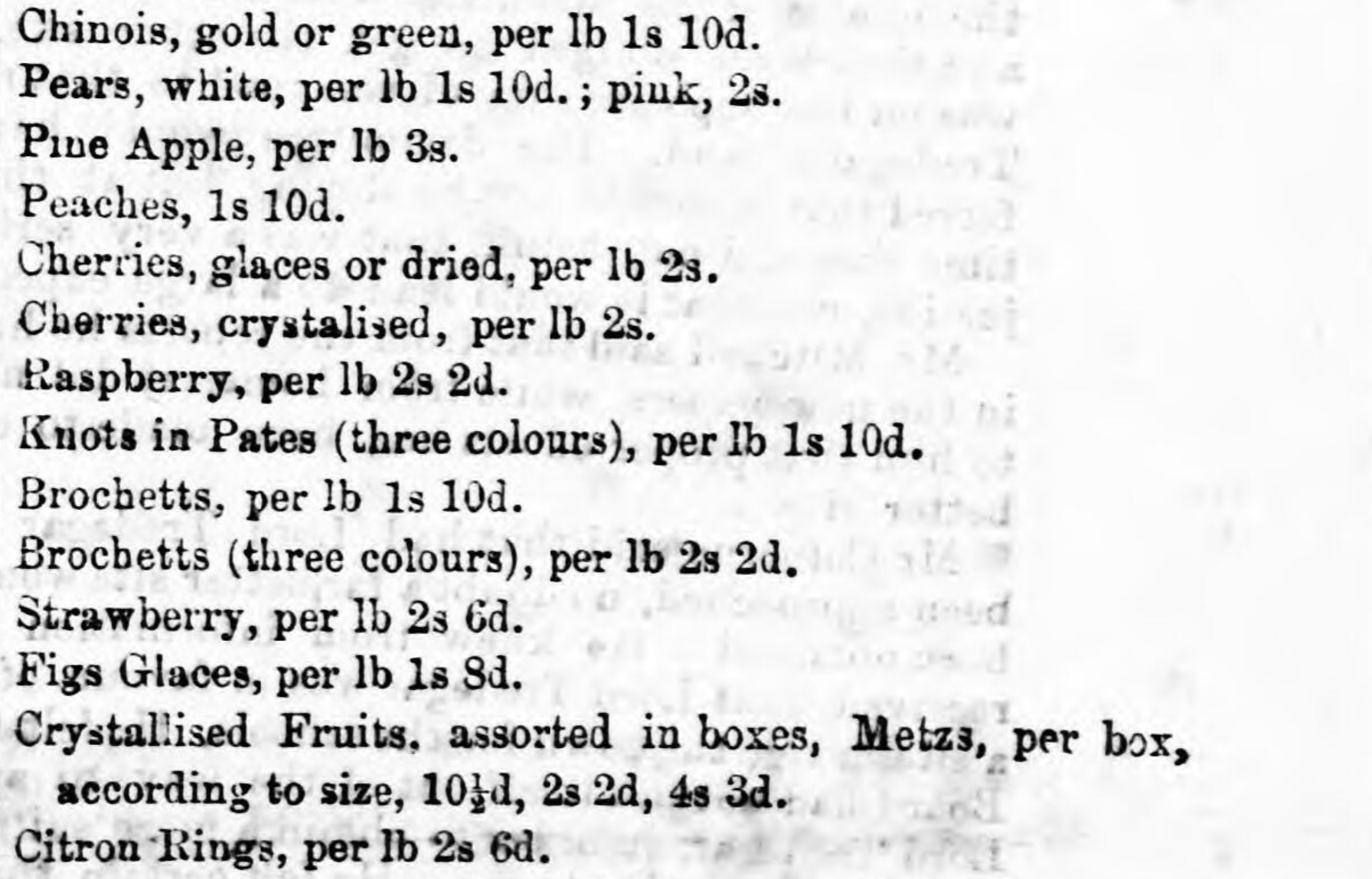
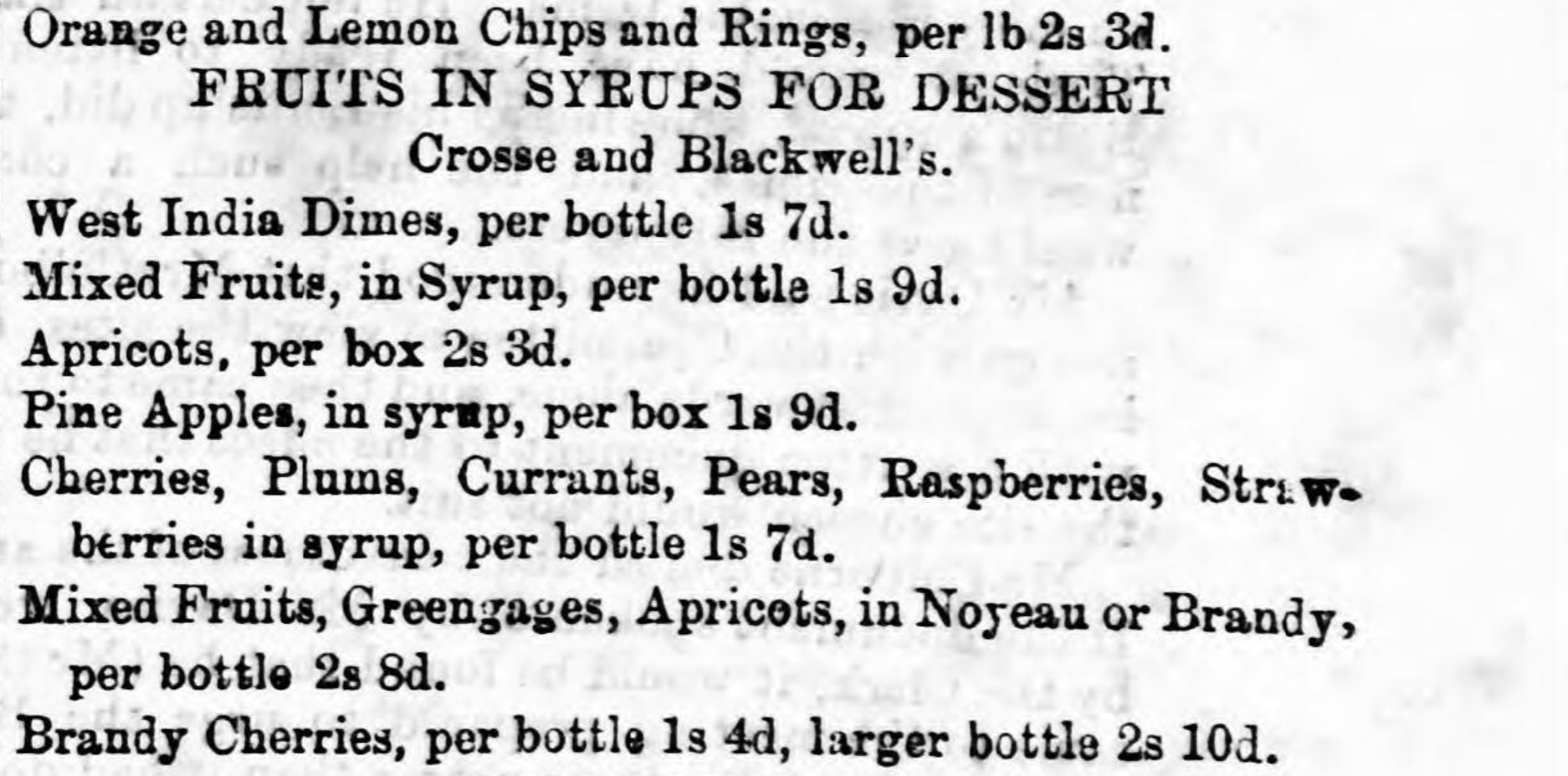
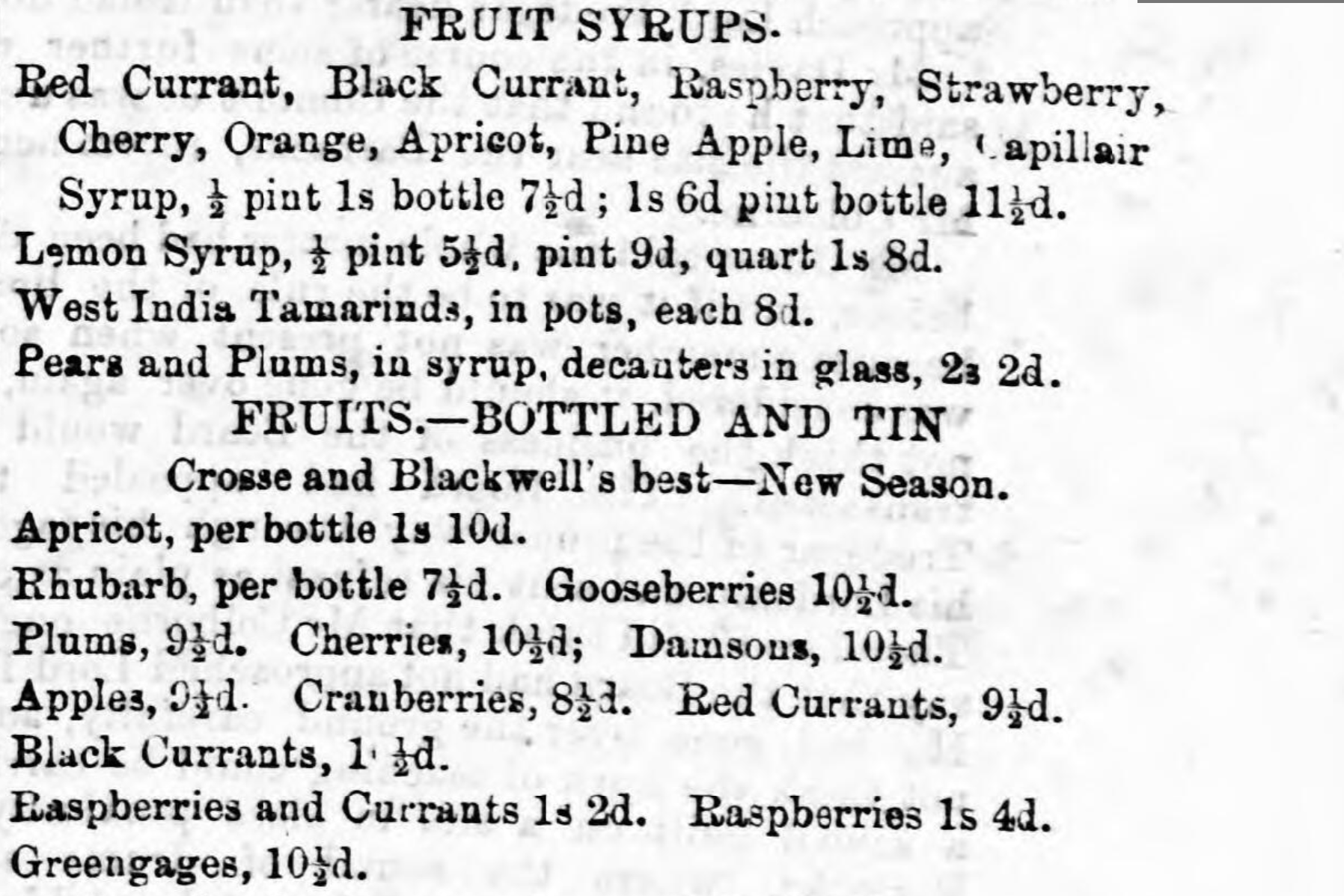
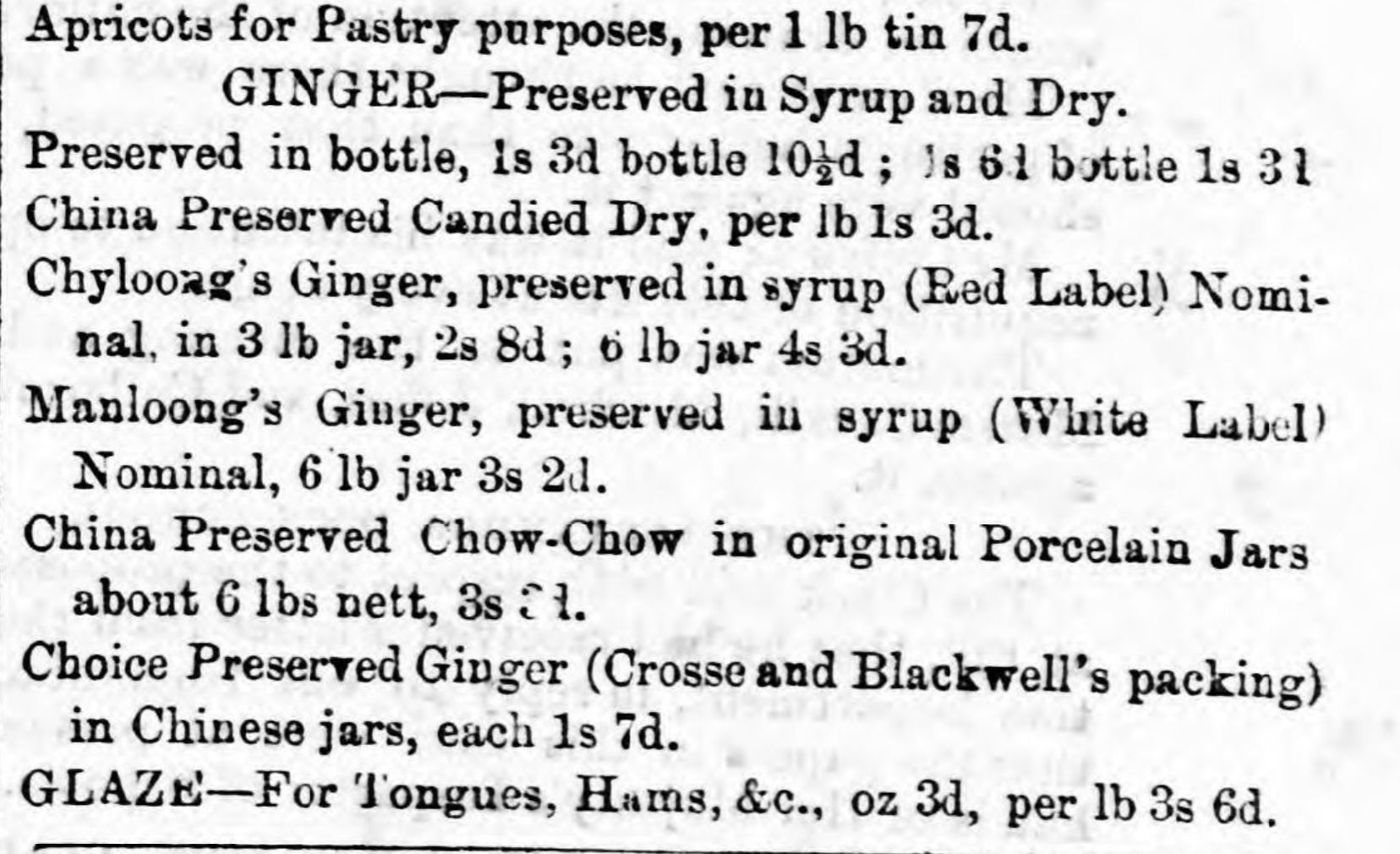
A very long advert published in the Monmouthshire Merlin on 20th December, 1878 sliced up for this article.
If other grocers were selling the main meal, T. Cordey at 35 High Street was clearly the place to go for the dessert course. His 1878 price list reveals a Victorian obsession with preserving the summer’s bounty for the winter festivities. The shelves were stocked with an array of "Fruit Syrups" ranging from Pine Apple to the curious "Capillair," alongside "West India Tamarinds" sold in pots.
What stands out is the global reach of his stock. Cordey offered specific Chinese luxuries that seem surprisingly cosmopolitan for 1870s Newport: "Chyloong’s Ginger" (Red Label) and "Manloong’s Ginger" (White Label), as well as "China Preserved Chow-Chow" sold in "original Porcelain Jars". He also catered to the French fashion for "Glaćes Fruits," selling elaborate confectionary oddities like "Knots in Pates" (in three colours) and "Brochetts," turning sugar and fruit into edible ornaments.
Some of the items on Mr. Cordey’s list are now extinct or known by different names.
- "Capillair" (Capillaire) A syrup originally made from the maidenhair fern, usually flavoured with orange flower water. By the late 19th century, it was a popular sweetener for adding to water or alcoholic punches.
- "Chinois" Cordey lists these as "gold or green." These were whole small oranges (often kumquats or unripe oranges) that had been crystallised or preserved in heavy syrup—a very fashionable decoration for cakes and puddings.
- "Chow-Chow" While today this often refers to a pickle, in a Victorian confectioner's list, "Preserved Chow-Chow" usually referred to a Chinese mixture of mixed fruits (ginger, orange peel, melon) preserved in heavy syrup.
- "Brochetts" (Brochettes) Fruits (often crystallised) served on small skewers or sticks, making them easy to eat as finger food at parties.
If you were a resident of Newport heading to High Street or Commercial Street to stock your larder, here is what a portion of your budget might have bought:
The Festive Centrepiece
- Rich Christmas Cake: 1s per lb (from J. Ewins, Jun.).
- A "Monster Cheese" (Jumbo): On view at Gower’s Market, sold by the slice.
- Turkey Gelatine: A deboned, poached showstopper for the cold buffet (from Bland’s).
Pantry Essentials & Fruit
- Tea (Mazawattee): Up to 2s 4d per lb—a high-end luxury from Enoch Griffiths.
- Tea (Blue Bell): A more modest 1s 3d per lb.
- Currants & Raisins: 2d to 5d per lb for your plum pudding.
- Lump Sugar: 2d per lb.
- Eggs: 10d per dozen.
Global Delicacies (from T. Cordey, 35 High St.)
- Chyloong’s Ginger (Red Label): Imported from China in porcelain jars.
- Chinois (Gold or Green): Crystallised small oranges for cake decoration.
- West India Tamarinds: Sold in pots for a tangy winter treat.
- Capillaire Syrup: An orange-flower flavoured fern syrup for festive punches.
Drinks & Indulgences
- The Guinea Hamper: 7 bottles of wine and spirits for 21 shillings (from Phillips and Sons).
- Sparkling Champagne Cider: 6s per dozen large bottles.
- Special Cigars: 7 for 1s (from W.J. Burt).
These advertisements do more than just list prices; they paint a portrait of Newport as a thriving, outward-looking port town at the height of its industrial power. The sheer variety of goods on offer—from "American and Colonial Produce" at Gregory and Roberts to "North Sea Fish" arriving daily at Fennell’s—reminds us that Newport’s docks were a gateway to the world. The "New Zealand Frozen Mutton Co." on High Street wasn't just a butcher; it was evidence of the refrigerated shipping revolution that was changing British diets forever.
Furthermore, the range of products highlights the stark social contrasts of the town. In the same week, a Newportonian could purchase a luxury "Rich Christmas Cake" for a shilling a pound or scrape by with "Last Year’s Raisins" for a fraction of the price. Shopkeepers had to cater to everyone: the wealthy coal magnates dining on venison and wild duck, and the dock workers looking for "Good and Cheap Provisions."
Ultimately, these scraps of paper reveal a Christmas that was vibrant, competitive, and surprisingly modern.
Gifts
If the food adverts of Victorian Newport appealed to the stomach, the gift adverts appealed to a very specific sense of practicality. While you could certainly find diamonds on Commercial Street, many shopkeepers were trying to convince the public that the true spirit of Christmas lay in leather leggings and coal buckets.

Romance may have been alive in Newport, but Smith’s (on Chepstow Road and Shaftesbury Street) was doing its best to dampen it. Their advert bluntly declared: "The BEST Christmas Gift, A Pair of SMITH’S FAMOUS BOOTS." No poetry, no flowery language—just the "wear guaranteed."

Similarly, E.J. Nancekievill at the corner of Market Buildings was pushing "Fancy Leather Goods of a reliable sort." While purses and pocket books seem standard, their suggestion of "Dog Collars" and "Leggings" as Christmas gifts paints a picture of a very muddy, outdoor Christmas for the recipient.
The prize for the least inspiring marketing slogan must go to Gabb & Son’s (115 & 116 Commercial Street). They didn't sell gifts; they sold "USEFUL ODDMENTS FOR PRESENTS." Despite the dry name, their stock was fascinatingly specific to the Victorian parlour. They suggested "Coal Vases" (ornate scuttles to hide unsightly fuel) and "Fire Suites" as ideal presents, alongside "Down Quilts" and "Fancy Chairs."

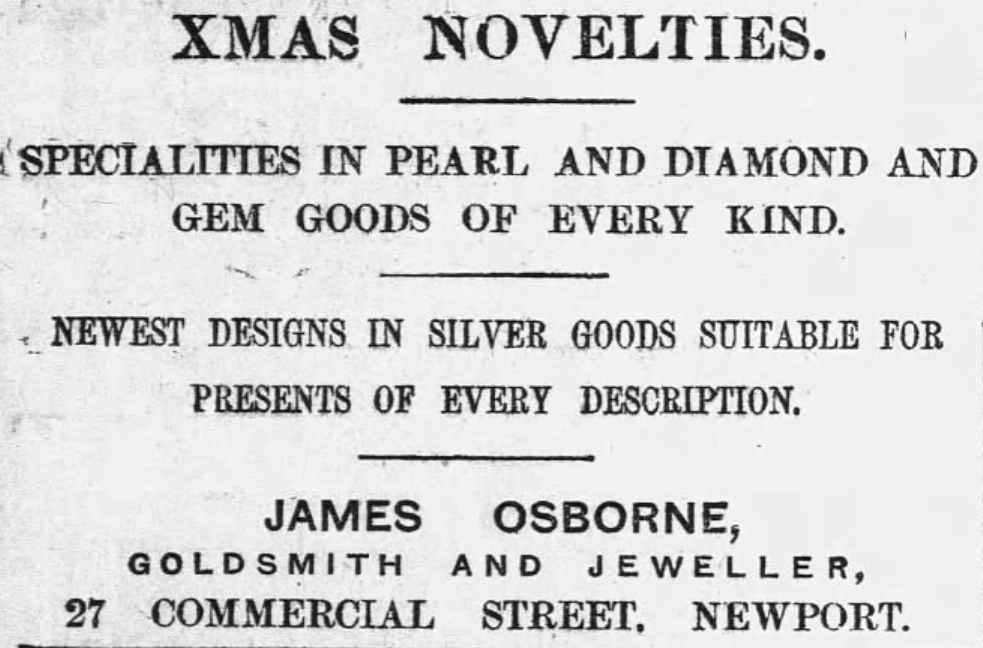
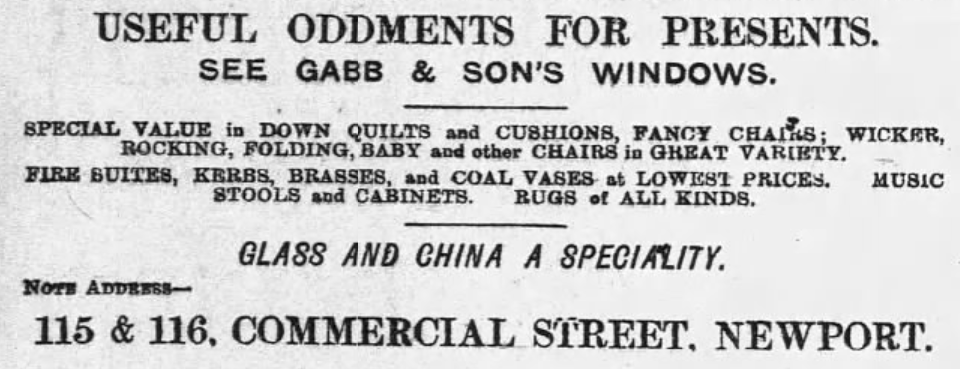
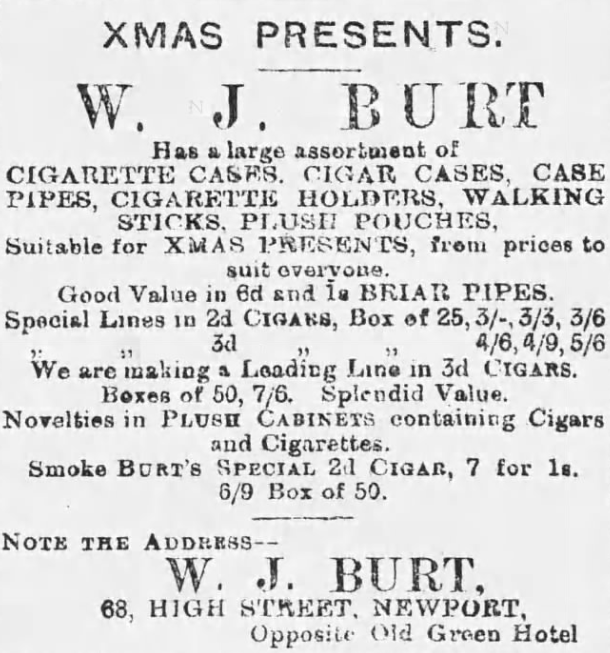
The tobacco trade was booming, and W.J. Burt (68 High Street) was ready to help shoppers navigate it. His advert is a study in "manly" accessories, offering everything from "Walking Sticks" to "Case Pipes." Most intriguing were his "Novelties in Plush Cabinets containing Cigars." This suggests a trend for elaborate packaging—giving a cigar wasn't enough; it had to be presented in a velvet-lined ("plush") display case to truly count as a gift.
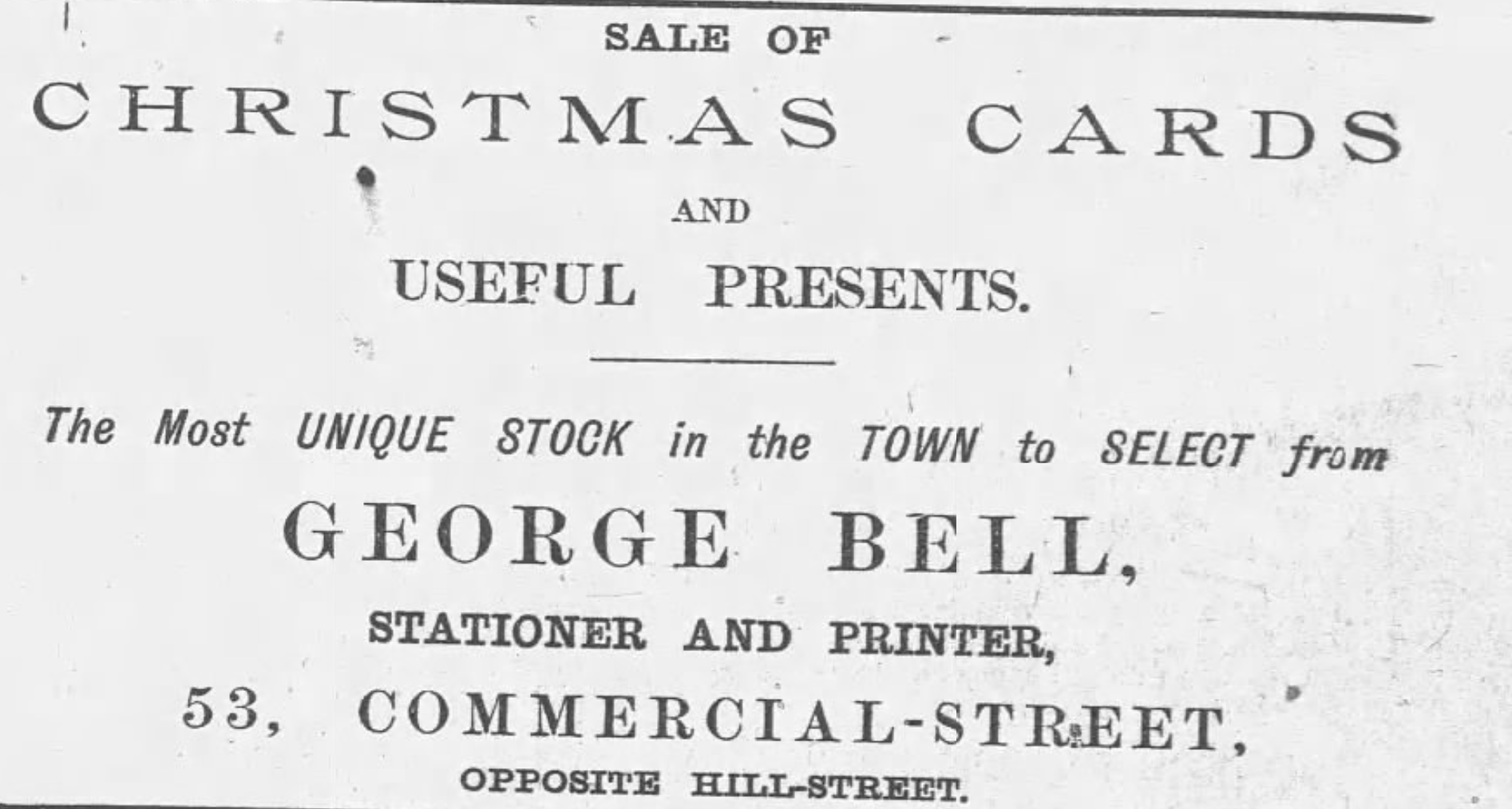
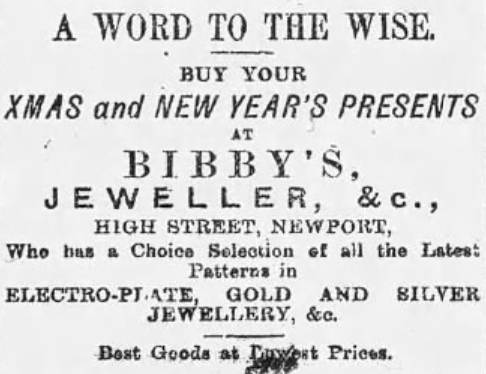
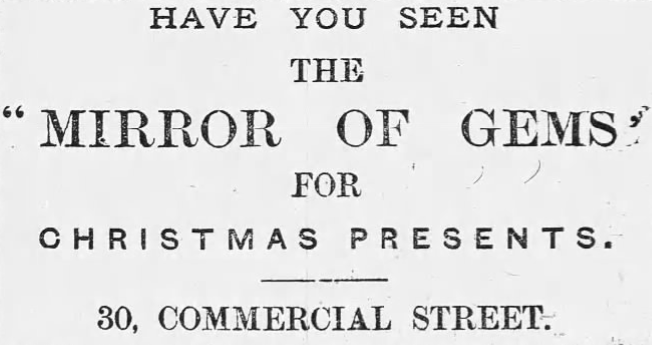
Of course, if you did want to dazzle, Newport had options. Bibby’s on High Street appealed to the bargain hunter with "Electro-Plate" (affordable silver-plated brass) alongside gold, promising a "Word to the Wise" about their low prices. Meanwhile, an advert simply titled "THE MIRROR OF GEMS" (30 Commercial Street) teased shoppers with a mysterious display, asking "Have you seen..." it? It suggests a specific, perhaps famous, window display designed to draw crowds during the festive promenade.
Victorian Gift Oddities
- "Coal Vases" (Gabb & Son’s) In a modern home, we hide the coal. In a Victorian parlor, the coal scuttle was a piece of furniture. A "Coal Vase" was often a Japanned (lacquered) metal box, sometimes hand-painted with flowers or landscapes, designed to sit next to the fireplace and look pretty while holding the soot. Giving one as a gift was a sign of middle-class respectability.
- "Leggings" (E.J. Nancekievill) Don't imagine the stretchy gym wear of today. Victorian leggings (or gaiters) were tough leather or stiff cloth covers worn over the shoe and lower leg to protect trousers and ankles from mud and splashes. A very practical gift for a Newport winter, though perhaps not the most exciting one to unwrap!
- "Plush Cabinets" (W.J. Burt) The Victorians loved "Plush"—a fabric similar to velvet but with a longer, softer pile. A "Plush Cabinet" for cigars would have been a tactile, luxury object, likely sitting on a sideboard to offer guests a smoke in style.
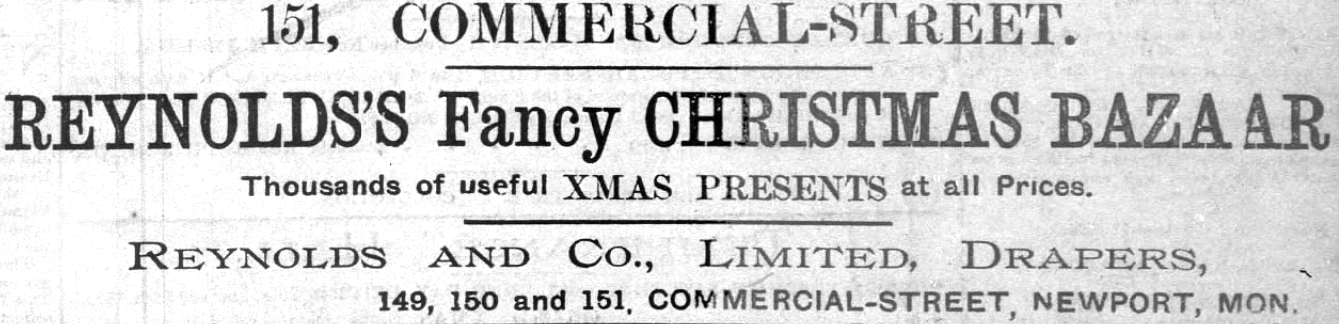
The Cost of Vice
- Cigars: W.J. Burt was selling a "Special 2d Cigar" at a deal of 7 for 1 shilling.
- The Comparison: To put that in perspective, remember from the food section that a pound of "Rich Christmas Cake" also cost 1 shilling. A Newport man had to decide: seven cigars for himself, or a pound of cake for the family?

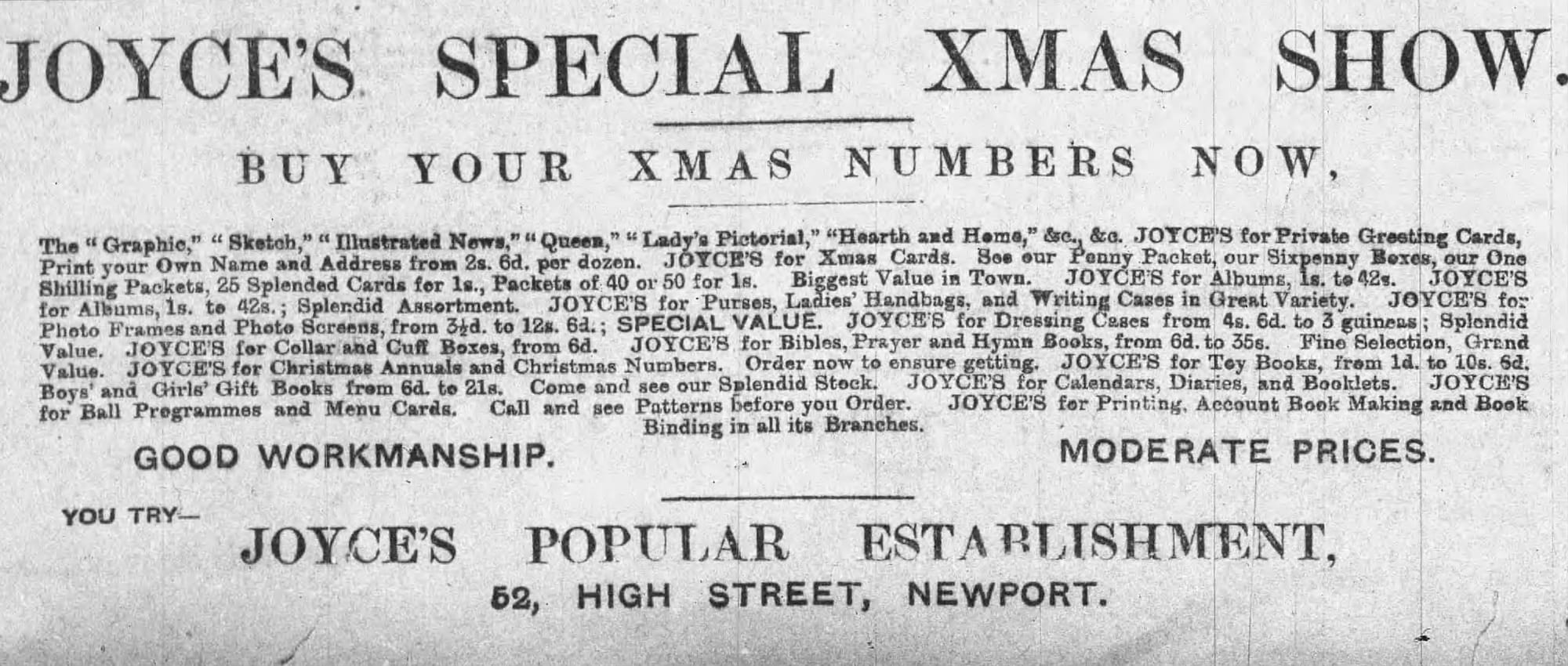
Shops in 1896
The 1896 report from the South Wales Weekly Argus and Monmouthshire Advertiser offers a captivating glimpse into a city gripped by festive fever, where "The Shopper" observed a profound faith in the local public’s generosity. Here's the full article.
So rapidly do the years slip by that it seems but a few days since we were making preparations for the Christmas of 1895; and now the Christmas of 1896 is nearly upon us. At this time peace and good will are—especially in Newport—are looking forward to due celebration of the happiest season of the year, and what could be without the giving and receiving of presents? The preparations made by Newport shopkeepers to supply these wants show that they have a large faith in the generosity of Newportonians.
Take the large establishment of Messrs. Cordey and Co. Every department is well filled, and if you are the head of the house, he will tell you that every single thing in the place would be a suitable present under some circumstances or other; this first thought of course is for the children, and in the bazaar we find for the girls dolls, dressed and undressed, dolls’ go-carts, dolls’ bedsteads, and dolls’ beds; and for the boys mechanical toys, among them fearful and wonderful creatures, which walk and climb and crawl; ducks, frogs, and fish which swim; and pneumatic-tyred bicycles which travel. There are toy books and games, new and old, for the children; exquisite china-ware and useful leather goods for their seniors. In the cabinet department there are extremely useful, and lovely presents—standard lamps, oak cabinets, writing tables, occasional chairs and tables, Japanese screens, what-nots, and such things that go to make the home comfortable and attractive.
No establishment in Newport is better known than "Cordey’s" the Monmouthshire and South Wales Supply Stores. Mr. Cordey’s premises have been enlarged by the addition of a new frontage to Cambrian Road, so that customers may enter either by the Cambrian Road or High Street entrances. To speak of the preparations made for the ordinary Christmas trade is unnecessary—it goes without saying that these are of the most complete character—but attention must be drawn to the abundance of toys provided for the children. In the case of lovely sweet stuffs, in the best form, the fancy boxes of crystallized fruits, biscuits and confections. In the decorations for the home, in the Christmas cards; in the leather goods, and in a host of articles, useful and otherwise, which are calculated to give pleasure in the celebration of Christmas.
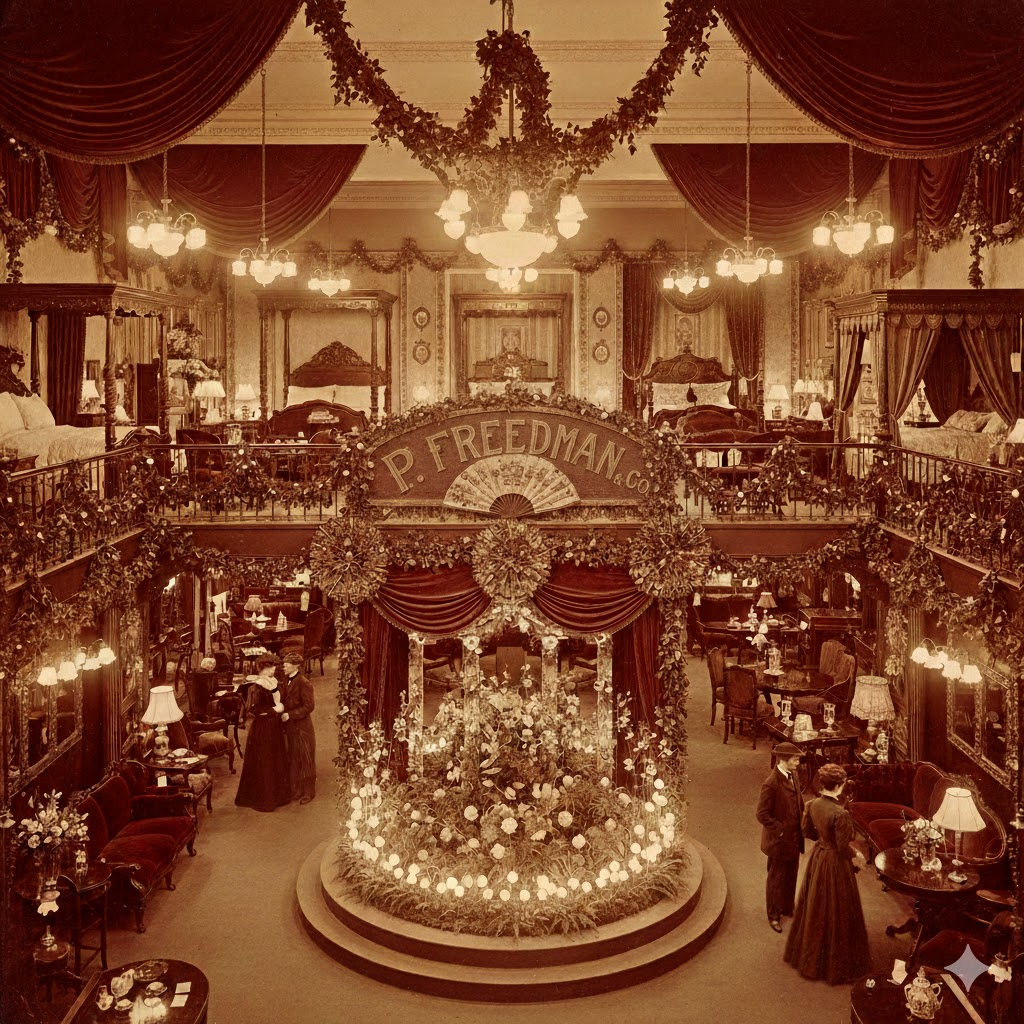
Amongst the prettiest and most artistically decorative business premises in the town are those of Messrs. P. Freedman and Co., complete house furnishers. Their direct and high character, are well-known throughout England and Wales. Those about to get married and those about to furnish new homes should visit this establishment, where they will find goods unequalled both in quality and price. Messrs. Freedman are large manufacturers and keep a large staff of workmen, and can depend on their manufactured goods to give satisfaction. Illustrated catalogues will be forwarded to any address and all goods are sent carriage free. There are 10 show rooms well filled with suites in saddlebags, velvet, and leather, loo tables, chiffoniers, side boards, overmantles, bedroom suites, toilets &c. The decorations for Christmas are uncommonly pretty. In the background there is an illumination representing furnished rooms, dining room, bedroom, &c, framed round with scarlet trimmings, with the name festooned with Chinese fans, holly, &c. Underneath is a platform, at the back of which are mirrors, and the platform forms a fairy garden of choice flowers and exotic ferns, &c. illuminated with reflecting and fairy lights on a scarlet background. The interior of the shops have also a charming effect, being laid out in style. The contents comprise good furniture suitable for Christmas presents, plants and fairy lights. Chinese lanterns &c, festooned from ceiling with scarlet art muslin, the whole being designed and arranged by Mr Kirwan Bult, who at any time will be pleased to give estimates for furnishing your house throughout.
Messrs. W. & A. Baker and Co. not only held their annual Christmas show, but also have their annual stock-taking sale at this time, and they have made great reductions in the matter of price. It is hardly necessary to speak of their large and varied stock as builders and general ironmongers—not even the capital of the Midlands can make a more attractive display — but to come to those goods which are especially suitable for Christmas presents we may point to a magnificent show of nickel-electro-plated goods, bronzes, artistic brass and iron work, including tea kettles or stands; lamp standards, coal vases, flower stands, fire screens, hall sconces, brass candlesticks with fancy shades &c. Among innumerable useful presents is the Bissel carpet sweeper, base rocking chairs, all the utensils necessary for the preparation and cooking of Christmas fare, including the celebrated Queen's pudding basin, with which neither cloth nor string is required.

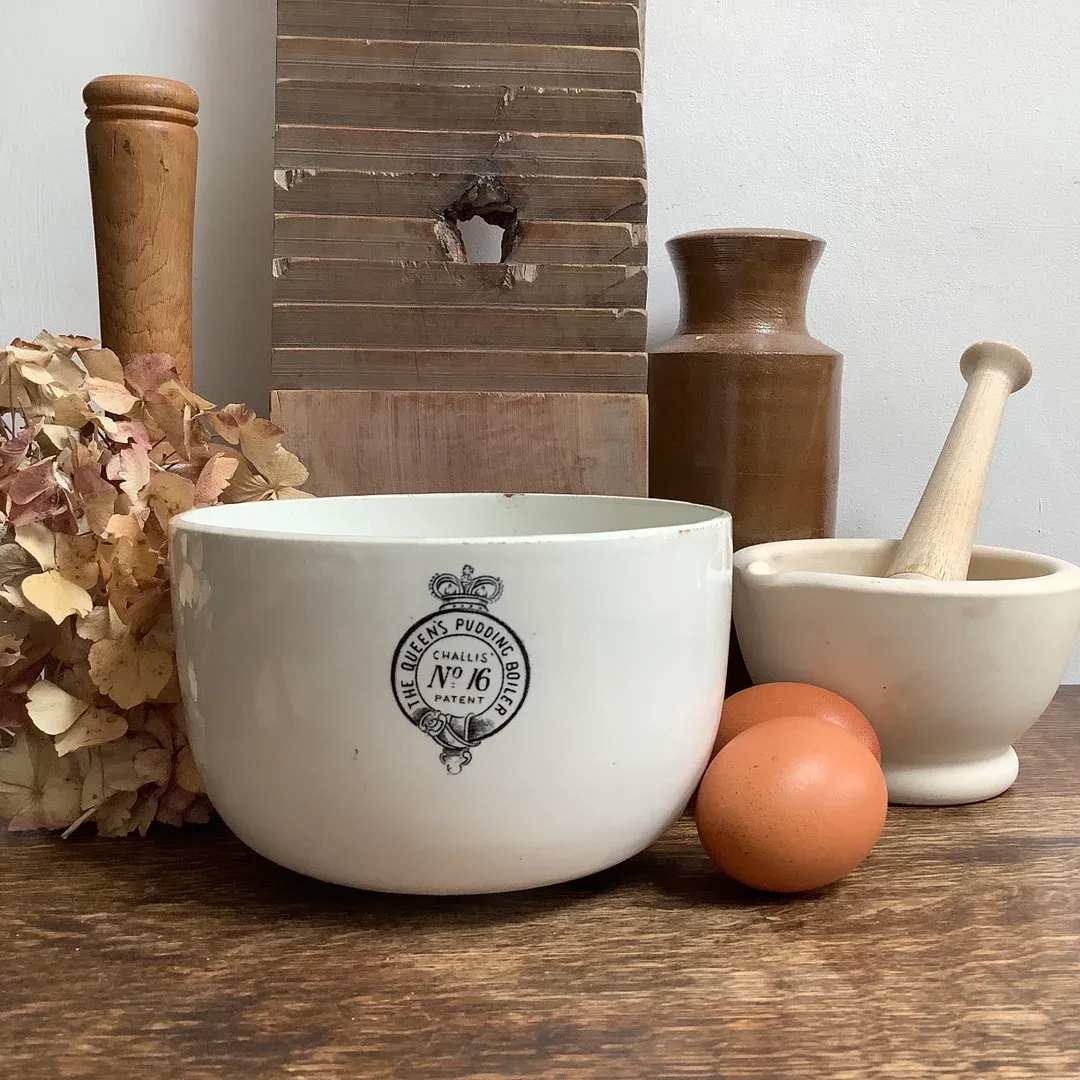
A Bissell carpet cleaner and a Queen's pudding basin
In addition there is a magnificent display of lamps of the best makes and most artisan designs, and among other articles which attract by reason of their beauty or usefulness are Benares trays of genuine native workmanship, brass feuders and brass furniture, cutlery, work baskets, and a little raisin stoning machine, which should prove a perfect boon to housewives, seeing that with it a child can without waste stone a bound of raisins in five minutes.
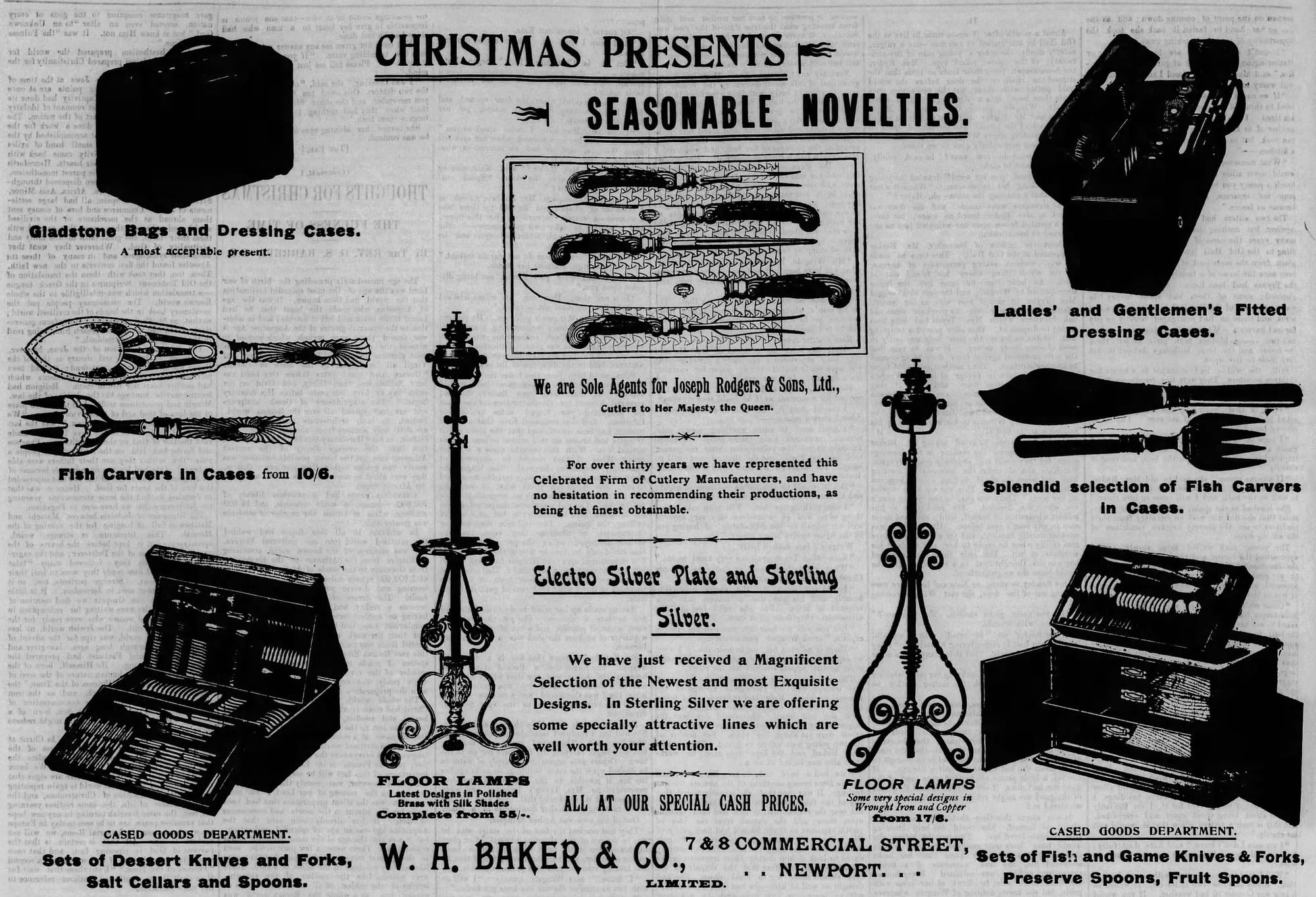
Christmas would not be complete without plum puddings, mince pies and frosted cakes, and Messrs. S. Bland and Sons, of Commercial Street, the Silver Grill, and the Muncado, appear to have made preparations to supply half Newport. A glance round their store rooms and manufactory was simply surprising. The decoration of frosted cakes at this establishment has become a fine art, and the products are calculated to delight the children. Messrs. Bland’s cakes need no praise from the point of view of quality, but the ingenuity and cleverness of the decorations are quite remarkable. Flowers and fruit are represented, and striking borders, designs, and devices are worked out in coloured sugars. One of the best attractions displayed was a picture of a winter scene in white sugar upon a background of chocolate. Such cakes are 'pleasant to the eye and good for food'; so is Messrs Bland's French and Genoese pastry. In addition they have sweets, chocolates, crackers, biscuits in dainty boxes and baskets, such as Santa Claus leaves in little stockings on Christmas morning; and so long as Newport children (and their elders) crave for cakes and sweets, so long Messrs Bland should enjoy a deserved popularity.
Mr Frederick Beckley, 81, Commercial Street, and 1 and 2, Llanarth Street, is carrying out the prophecy made at the notice of his opening—that his establishment would be one of the show places of Newport. His display of Christmas novelties is unique in character and quality. Among so bewildering a variety only a few can be mentioned. The art draped goods in photo easels, flower vases, pin trays, and wall pockets are very dainty and suitable presents for ladies; so are the delicately perfumed veil net cases and glove and handkerchief cases. There are also hand-screen cushions and tea cosies, in qualities and prices to meet the taste and pockets of all. Ladies’ opera bags are decidedly something new, and only need seeing to be appreciated. Mr Bentley has a big lot of toilet cushions in seix designs, each design in six colours. Ladies who
A very attractive window is that of Messrs. Laverton's, Commercial Street (late Lewis and Lewis). The show of hand-painted enamelled goods is particularly striking, and comprises very dainty little tables, stools, and flower stands. The painting is very artistic, and the general finish of these articles must commend itself to the public. On enquiry, we found the prices were remarkably moderate, in fact, just suitable for a really nice present for a lady’s drawing-room. A large and varied assortment of bamboo and wicker work comprising all the newest shapes in flower-stands, tables, chairs, bookcases, &c., are displayed in the showrooms. Table lamps in beautiful and artistic designs, with their many coloured shades, produced a very charming effect. A novelty was brought to our notice in the shape of grog tubs and other utensils which have been removed from well-known ships in her Majesty’s navy. The articles are of solid oak and ornamented with polished brass bands, and are useful as coal scuttles, stick, umbrella, or flower stands. In anticipation of cold weather, Japanese screens have evidently been made a special feature. It must be a very easy matter to select a present from the stock of Messrs Laverton's at 137, Commercial Street.
Tastes vary of course, but with the spread of education there are many persons whose ideal present is a book. Mr A W Dawson, Bridge Street, has made preparation for the probably demand by placing on his shelves a large stock of standard and current literature. Since last Christmas Mr Dawson has largely extended his business. He has taken in the whole of the basement for a printing office, he has laid down a valuable plant, and is now busily engaged upon letter-press and lithographic printing. In the latter department Mr Ernest Richards is giving the firm the benefit of his artistic ability and experience, this enabling them to turn out original work. Mr Dawson has this season been kept constantly employed in printing private Christmas cards. He offers a large stock of cards, toy-books, games, mechanical toys, leather goods, dressing cases, photograph albums, gilt and metal goods, and novelties in china and glass suitable for Christmas presents.
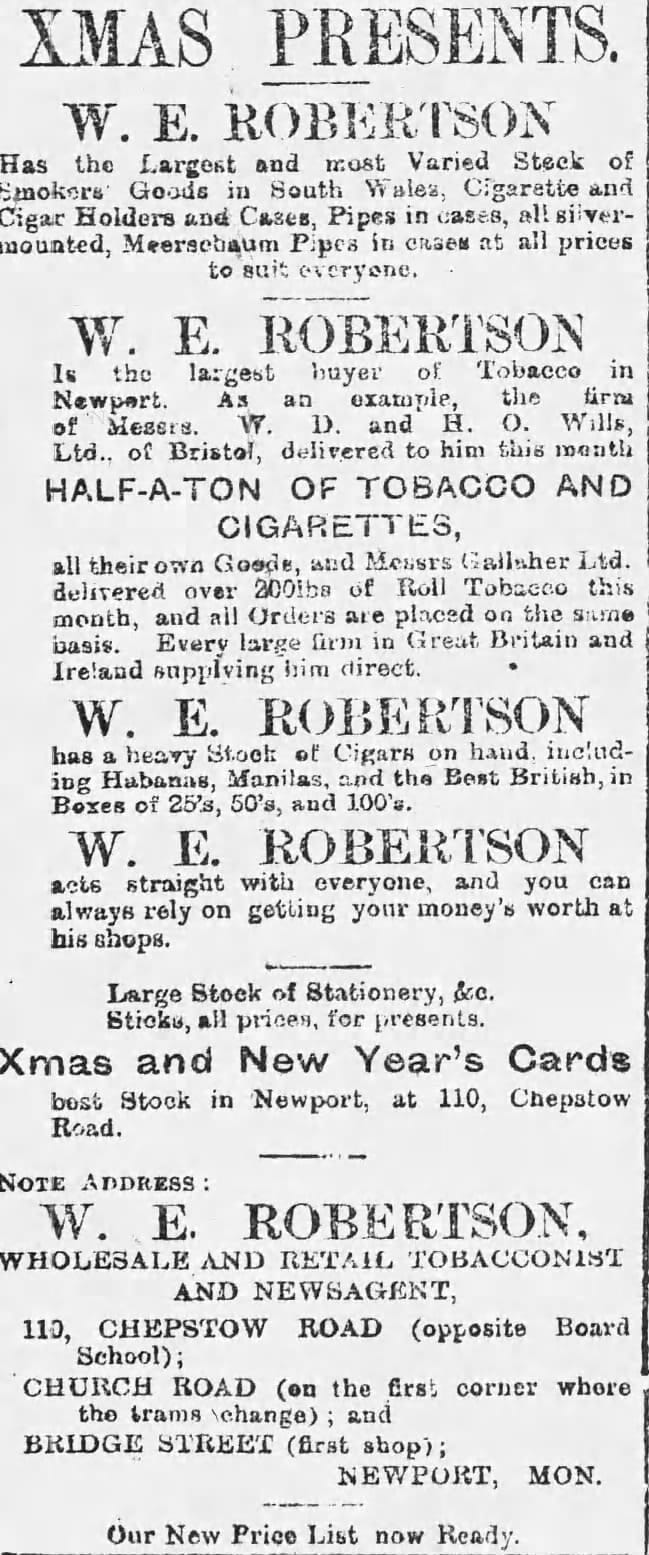
What is a holiday without tobacco? Nine-tenths of the adult male population of Newport would declare that Christmas would be robbed of half its joys if they were robbed of the soothing weed; therefore Mr Robertson, of Church Road and Chepstow Road, flatters himself that he is a public benefactor inasmuch as he enables men hungering for tobacco to satisfy their legitimate cravings. Mr Robertson will mend a pipe promptly and even more promptly will fill it; he keeps innumerable brands of fancy and packed tobaccos; and of Havana, Mexican, and British cigars, including the twopenny "Supremacy," which is claimed to be better than most threepennys; he offers pipes from a penny to a pound (or more), match-boxes, pouches, cigar cases, and everything that a smoker can desire.
Mr J. Davies, music dealer, Bridge Street, makes a point of keeping up to date with his supply of humorous songs, and he has a large assortment of musical instruments, so that he who would fain touch the light guitar or rival Paderewski, may there obtain the instrument he desires; while if the allurements of the banjo and concertina are great, here the musician may satisfy his soul.
Messrs. Bryan and Co., complete home furnishers, 159, Commercial Street, have a grand show of dining, drawing, and bedroom suites, and claim to offer the largest stock at the lowest prices in South Wales.
Everything required to furnish a house, from attic to basement, is offered by them—they will provide anything from a teaspoon to a piano, from a saucepan to a feather bed.
Among their multifarious articles, any one seeking useful presents would have little difficulty in finding what they required. Pianos and organs are among their specialities; they have a large stock of marble clocks and bronze ornaments; they offer easy chairs, writing tables, occasional tables — in fact they are prepared to supply all that is required for the cottage or the mansion.
Mr C. Ince, Jeweller, Bridge Street, has a very attractive show. It has been selected with good taste; it is tastefully displayed; and his establishment should not lack patrons during the Christmas season. Of watches, rings, bracelets, and other articles of jewellery he has a charming selection; his show of electro-plate is artistic; and whether a present is desired for gentleman or lady, for the family or for a friend, there is ample choice for the most fastidious. Silver cigarette and match boxes, serviette rings, silver tea sets, silver-mounted brushes, silver-mounted scent bottles, silver card cases, flasks and fruit knives — these are a few of the many suitable presents included in his stock, and those who would like to know more about the capabilities of his establishment would do well to consult the pretty list he has circulated. Mr Ince is also a dealer in antique silver, china, glass and pictures, and those who have a weakness for curios and antiques might do worse than inspect his stock.
Mr. L. S. Abrahamson, the well-known jeweller, pawnbroker, &c., of Bridge Street, is anxious to give bargains. He has bought two bankrupt stocks, he has a large accumulation of new jewellery and forfeited pledges, and he wants to clear part of them out during the Christmas season. He promises to accept any reasonable offer, and is prepared to cut profits down to the lowest margin. He claims to have one of the largest stocks in south Wales of diamond goods, new and secondhand; he has gold lever watches (forfeited pledges) by Renson, Russell, Hawley, and other well-known makers he has five hundred dozen ivory-handled table dessert, and carving knives; a large stock of electro-plate; rings, bracelets, brooches, and bronzes; and is anxious to act generously with his customers. He has made an alteration of his premises, so that the departments are entirely separate, and both the quantity and quality he demands attention.
At the chemist and druggist's shop of Mr A Smith, 5, High Street, a special point is being made of the famous American cough remedy, 'Frog in your Throat.' The proprietor also offers perfumes for Christmas in fancy boxes and cut bottles; and, beside catering for the vanities of the fair sex, provides also for the infirmities of poor humanity with his gout and rheumatic mixture.
At the music warehouse of Mr. T. H. Hutchinson, Clarence Place, are musical instruments of all kinds, from a brass whistle to a violin, from a melodeon to an organ; together with music in sheets or volumes, from a comic song to an oratorio. Mr. Hutchinson shows his patent barless piano frame, with which he expects to bring about a revolution in the manufacture of pianos. Those who require musical instruments can secure them here.
Messrs. Phillips and Son, brewers, wine merchants, &c. (who, by the way, are making good progress with their new malthouses near the Old Dock), have found that there is a great demand for their guinea hampers, and in addition they make up two and three guinea hampers. The bins in their extensive cellars are stored with the finest vintages of port and claret; they have a large stock of the best brands of champagne; and they offer Jameson’s Irish whiskey (guaranteed seven years old). They have a fine stock of the best Havana cigars in boxes of 25 and 50 suitable for presents; and with regard to their beers it is sufficient to say that they have never had better brewings, and that in open competition they obtained the orders for the Tredegar Show, Caerleon Races and the Coedkernew Jumping.

Messrs Fleming, Reid, and Co. have one of their ninety branch shops in Commercial Street, Newport, and there they offer the various products of their mills at Greenock. There are wools and woollen goods in all varieties, and useful presents may be found in the shape of hand-knitted gloves, slippers, stockings, and wraps.
Mr W. Townsend, general ironmonger, of Commercial Street, is making a special line of the Ansonia watches at 4s 12d. They are guaranteed time-keepers, lever movement, and are just watches for boys and working men. Mr Townsend makes a speciality of American goods, and offers a variety of articles, from a meat skewer to the latest American time-pieces. He has his usual attractive show of electro-plate, and case goods, table and pocket cutlery, and table lamps. Mr Townsend recently obtained a silver medal, the highest award, at the Dairy Show at Islington for his patent milk delivery, an invention which we fully described in the Argus some time since. It will suffice to say that when it is taken up by the milk trade it will save half the time and expense of delivery, it will prevent losses of cans and milk, and it will be inestimable boon to householders.
The Clarence Wharf Sawmills Co. are anxious to provide Newport with the yule log, and as modern fireplaces are not constructed to take the full log, they cut it in to convenient blocks, so that those who like wood fires now know where to obtain the necessary fuel.
The Bombay Tea Co., who have recently established a branch in High Street, do marvellous things, for they give away presents which seem to be worth more than their tea.
'A timely tip' is given by Mr Smith, boot seller, of Chepstow Road and Shaftesbury Street. It is to the effect that all should provide themselves with good boots, and that he is the man to provide them.
Everybody knows Leadbetter, the man who gives coal away whenever Cardiff play Newport but as these teams only play four times in the season, people who happen to be out of coal at other periods are expected to buy from him and pay for it. No one sells — or gives away — better coal.
Messrs. Trapnell and Gane have laid themselves out for a record Christmas. The main bedroom furniture usually occupying the ground floor has disappeared and tasteful curtains hung at intervals between the mirrors, pictures, and cabinets, which occupy the wall space on either side. The floor is gay with several rugs and carpets, while standing on them in picturesque confusion is an array of chairs, tables, lamps, screens, bamboo furniture, brass coal cabinets, coal vases, lamps, &c. Messrs. Trapnell and Gane extend a cordial invitation to all and surely a visit to their establishment, and an inspection of their magnificent rooms will go far to justify their claim to be regarded as leaders of fashion in furniture.
Mr Treharne Howell's chief attraction at this season is his large and varied selection of perfumes. He has always made a point of importing the finest scents, and this year he has had to further increase his stock to meet the growing demand. He also offers coloured smelling salts in cut glass bottles, toilet requisites, &c., and if anyone is troubled with cough or cold his "Eucalyptus Cough Mixture" is among the best of remedies.
Sweets for the children and indispensable, and Messrs G F Lovell and Co., who are large manufacturers, are ready, and willing, and able to supply pure sweets for the bairns. They make a feature of producing cleve and artistic figures in sugar, and these are sure to give delight to the little ones. They have sweets in baskets and boxes and many Christmas novelties, which can be secured at their shops at 54 and 125 Commerical Street, and that their stall in the Provision Market.
— South Wales Weekly Argus, 19th December, 1896
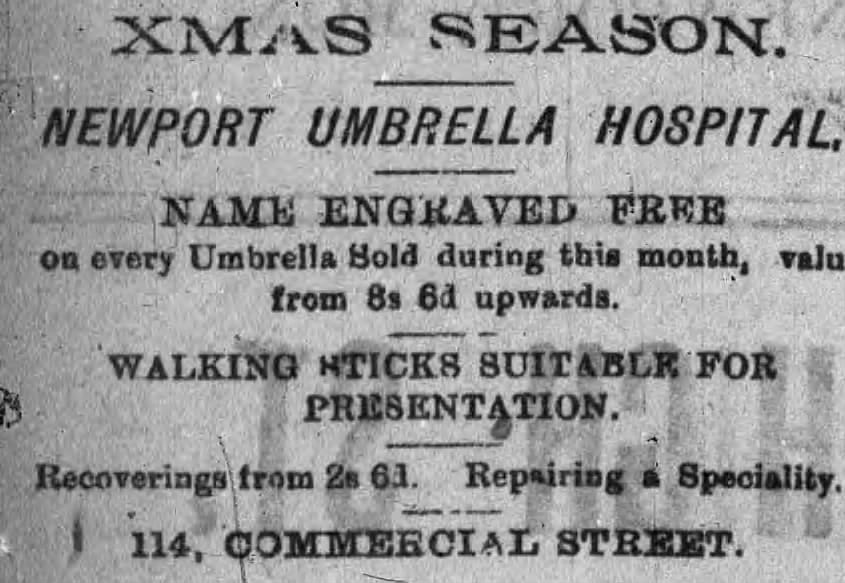
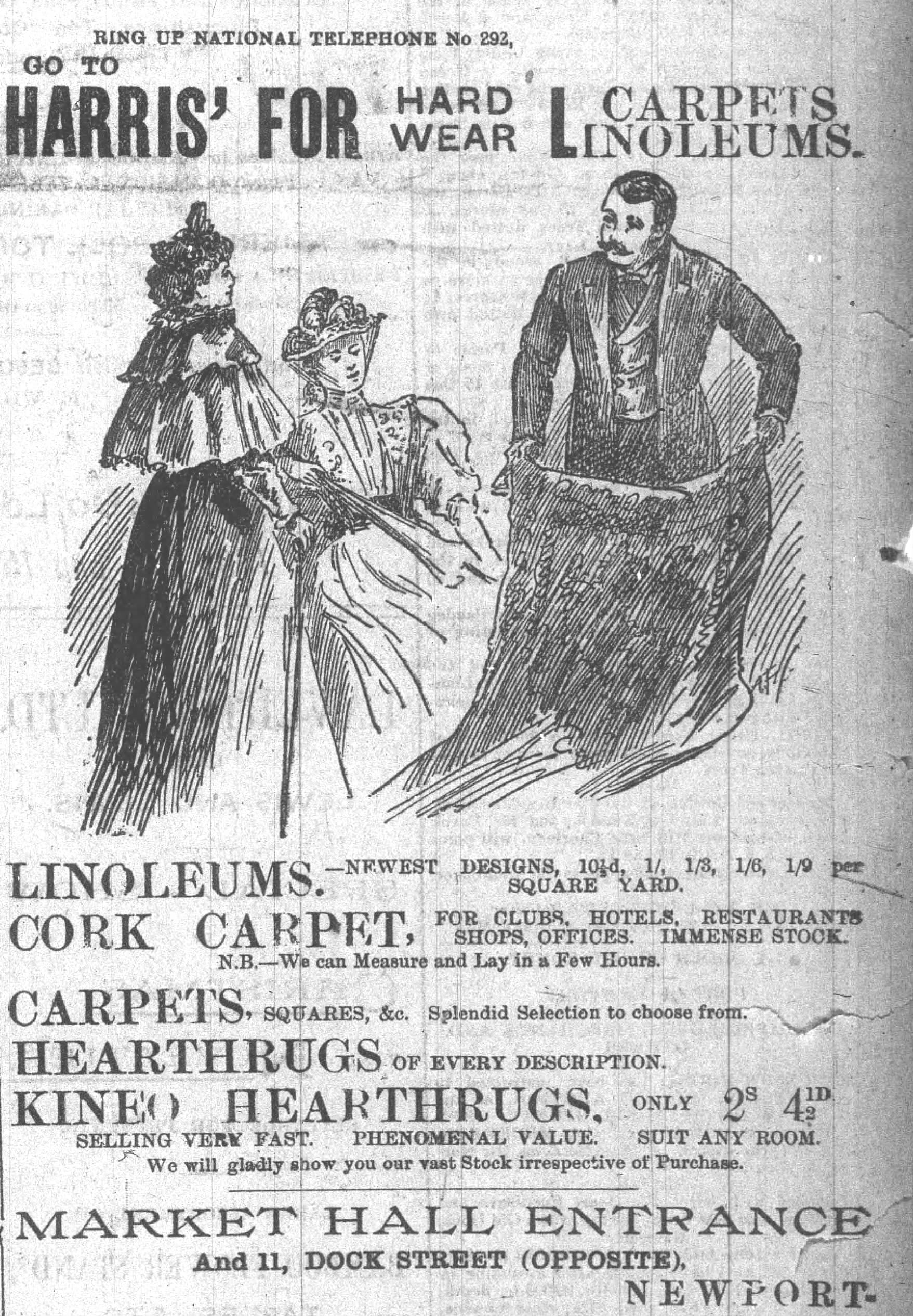
Shop Opening Times
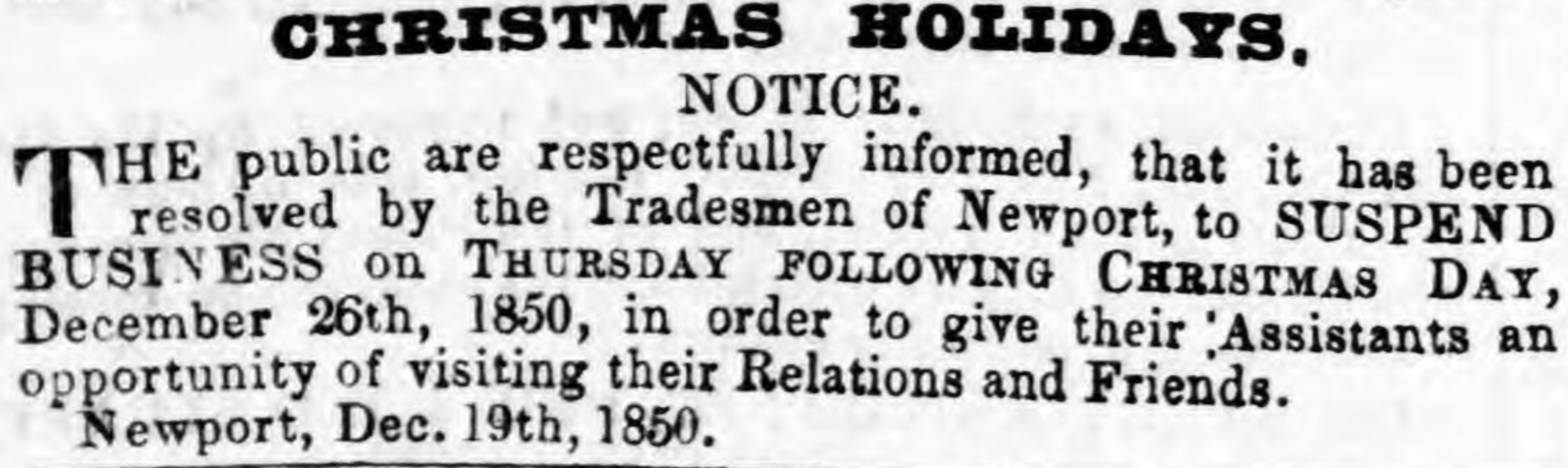
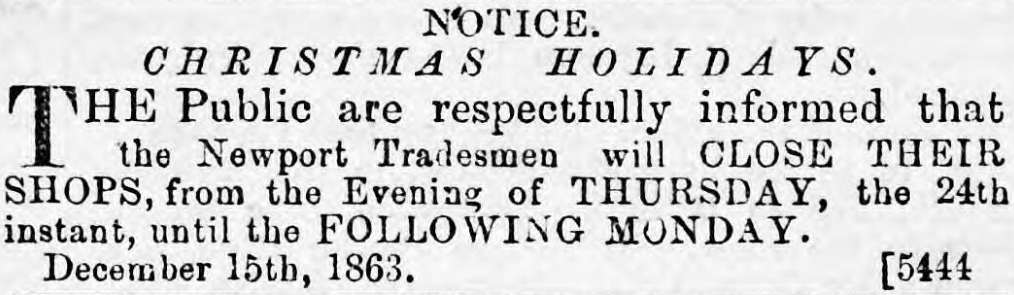
Public notices from the period indicate that Newport tradesmen collectively organised shop closures during the festive season. In 1850, local businesses resolved to suspend operations on December 26th, explicitly to provide shop assistants the opportunity to visit "Relations and Friends." By 1863, these closures could be quite extensive; one notice informs the public that shops would close on the evening of Thursday the 24th and remain shut until the "following Monday," resulting in a substantial break in trade.
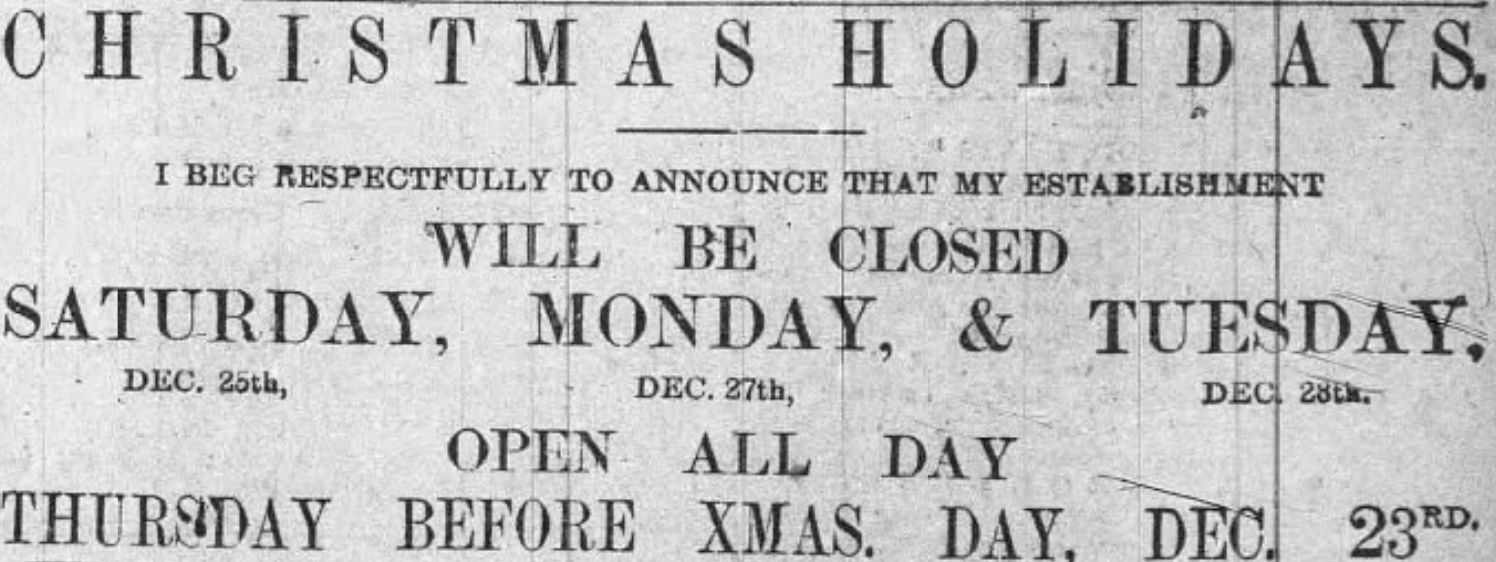
By 1897, some shops such Frederick Beckley of Commercial Street and Llanarth Street was closed the 24th — 28th December.
Christmas Crackers
In 1884, a large advert from Cordey's advertised no fewer than 60 different types of Christmas crackers including many from the inventor Tom Smith.
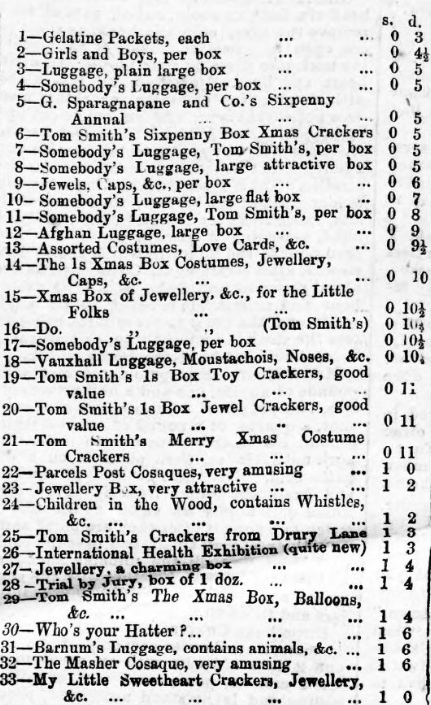
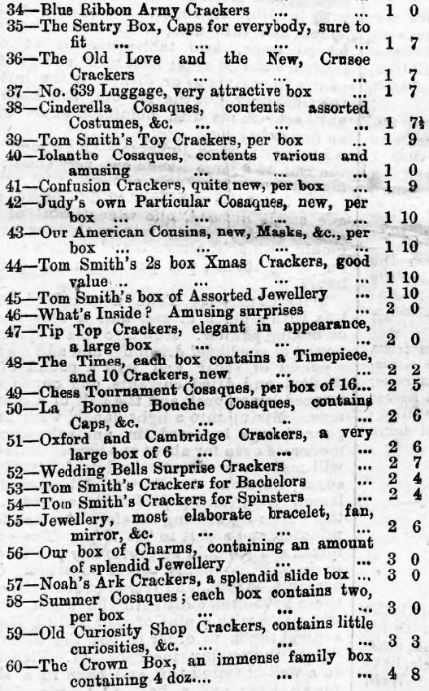
For the Victorian middle class, the Christmas cracker—often referred to by the more fashionable French term "Cosaque"—was far more than a simple table decoration. By 1884, these festive novelties had evolved into curated boxes of theater, satire, and social commentary, reflecting the specific interests and anxieties of the era.
A Reflection of Modern Life
The 1884 price lists reveal a Victorian public eager for crackers that mirrored their rapidly changing world. Far from being purely traditional, many crackers were surprisingly topical:
- The News & Science: "The Times" crackers were sold as a high-end novelty, with each box containing an actual timepiece alongside ten crackers.
- Modern Services: The "Parcels Post Cosaques" likely celebrated the then-recent introduction of the national parcel post service.
- Global Events: Manufacturers like Tom Smith and G. Sparagnapane capitalised on public interest in international affairs with titles like "Afghan Luggage" and the "International Health Exhibition" box.
Social Satire and Victorian Archetypes
Victorians used the Christmas table as a space for gentle social ribbing. The 1884 catalogs featured crackers specifically targeted at different social groups:
- The Single Life: There were dedicated boxes for "Bachelors" and "Spinsters," likely containing humorous gifts or "Love Cards".
- The Dandy: The "Masher Cosaque" poked fun at the "masher"—the stereotypical flamboyant, overdressed young man of the 1880s.
- International Relations: "Our American Cousins" crackers even included masks, allowing guests to play at being their overseas relatives.
Luxury and the "Immense" Family Box
While simple "Gelatine Packets" could be purchased for as little as 3d, the cracker market catered heavily to the Victorian love of opulence. Higher-end options like "Jewellery" boxes promised "elaborate" gifts such as bracelets, fans, and mirrors.
The pinnacle of the 1884 list was the "Crown Box," described as an "immense family box" containing four dozen crackers. At 4s 8d, it was a significant investment, ensuring that even the largest Victorian household could participate in the "snap" that defined their Christmas period.
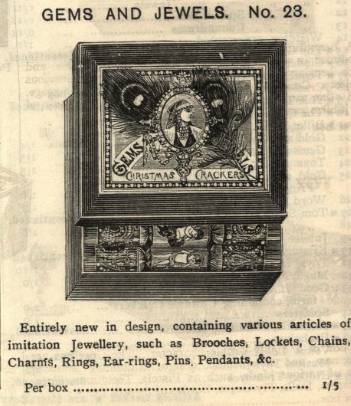
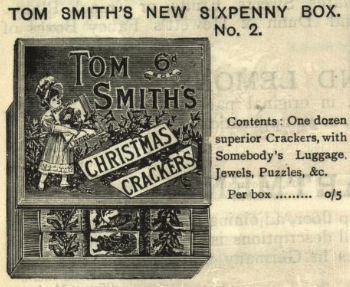
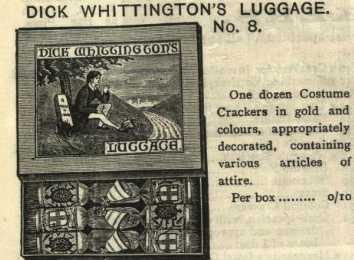
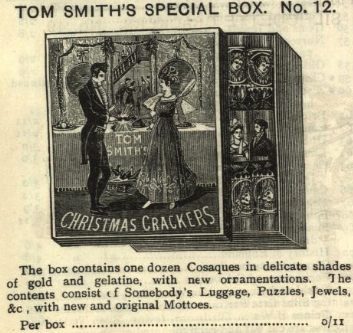
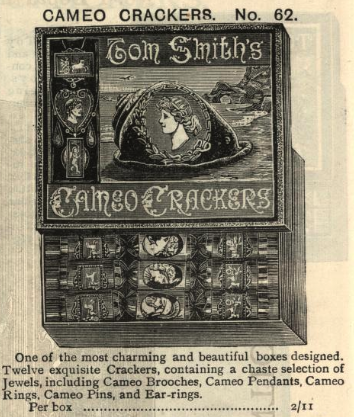
Here are examples of the types of crackers on sale taken from an Army and Navy catalogue from 1887 (Source: Archive.org)
Tree Ornaments and Traditions
While the Christmas cracker provided the "bang" for the Victorian Christmas, the tree remained the centrepiece of the home. An 1884 Cordey's price list for "Ornaments Suitable for Christmas Trees" provides a detailed look at how families decorated their evergreens during the peak of the Victorian era.
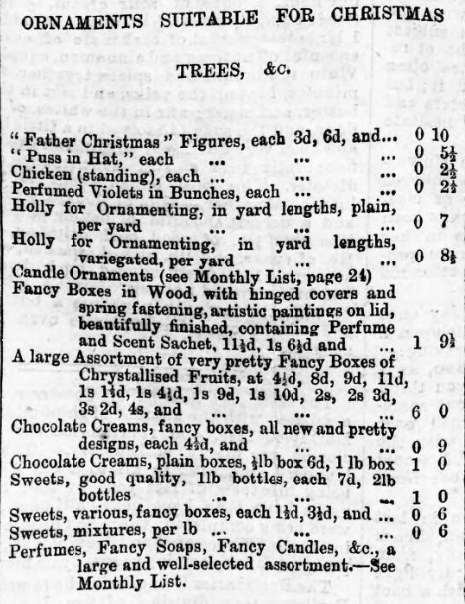
The Edible and Fragrant Tree
Victorian trees were sensory experiences, often decorated with items meant to be consumed or smelled.
- Sweet Treats: Crystallised fruits were a staple, with "Fancy Boxes" available in a massive range of prices from 4½d to a staggering 6s.
- Confections: Chocolate Creams were sold in both plain and fancy boxes, while various high-quality sweets were available in 1lb and 2lb bottles.
- Scented Ornaments: Beyond visuals, the tree was a source of fragrance. Families could purchase "Fancy Boxes in Wood" containing perfume and scent sachets for up to 1s 9½d. Bunches of "Perfumed Violets" were also popular, priced at 2¾d each.
Bringing Nature Indoors
Before the era of mass-produced plastic tinsel, Victorians relied heavily on natural greenery and representational figures.
- Holly Garlands: The 1884 list shows holly was sold "in yard lengths" for draping around the tree or home. Plain holly cost 7d per yard, while "variegated" holly (leaves with white or yellow edges) was a premium 8½d.
- Whimsical Figures: The tree was populated with small characters, such as "Father Christmas" figures (ranging from 3d to 10d) and the popular "Puss in Hat" (5½d). Standing "Chicken" figures were also available for 2½d.
Lighting and Luxury
The Victorian tree was a fire hazard by modern standards, lit primarily by real candles.
- Candle Ornaments: The list mentions specific "Candle Ornaments" designed to secure or beautify the tapers placed on the branches.
- Luxury Gifts: For wealthier families, the tree served as a display for high-end gifts. "Fancy Soaps," "Fancy Candles," and "Perfumes" were often hung or placed among the branches as both decoration and presents.
The Evolution of the Tree
By 1884, the Christmas tree had transitioned from a German novelty (popularised by Prince Albert) to a British necessity. The wide price range in this advertisement—from a 2½d chicken to 6s fruit boxes—demonstrates that the "Victorian Christmas" was no longer just for the elite; it was a commercialised holiday that even the emerging middle class could customise according to their budget.
Entertainment
Much like today, Christmas was a time for entertainment including pantomimes.
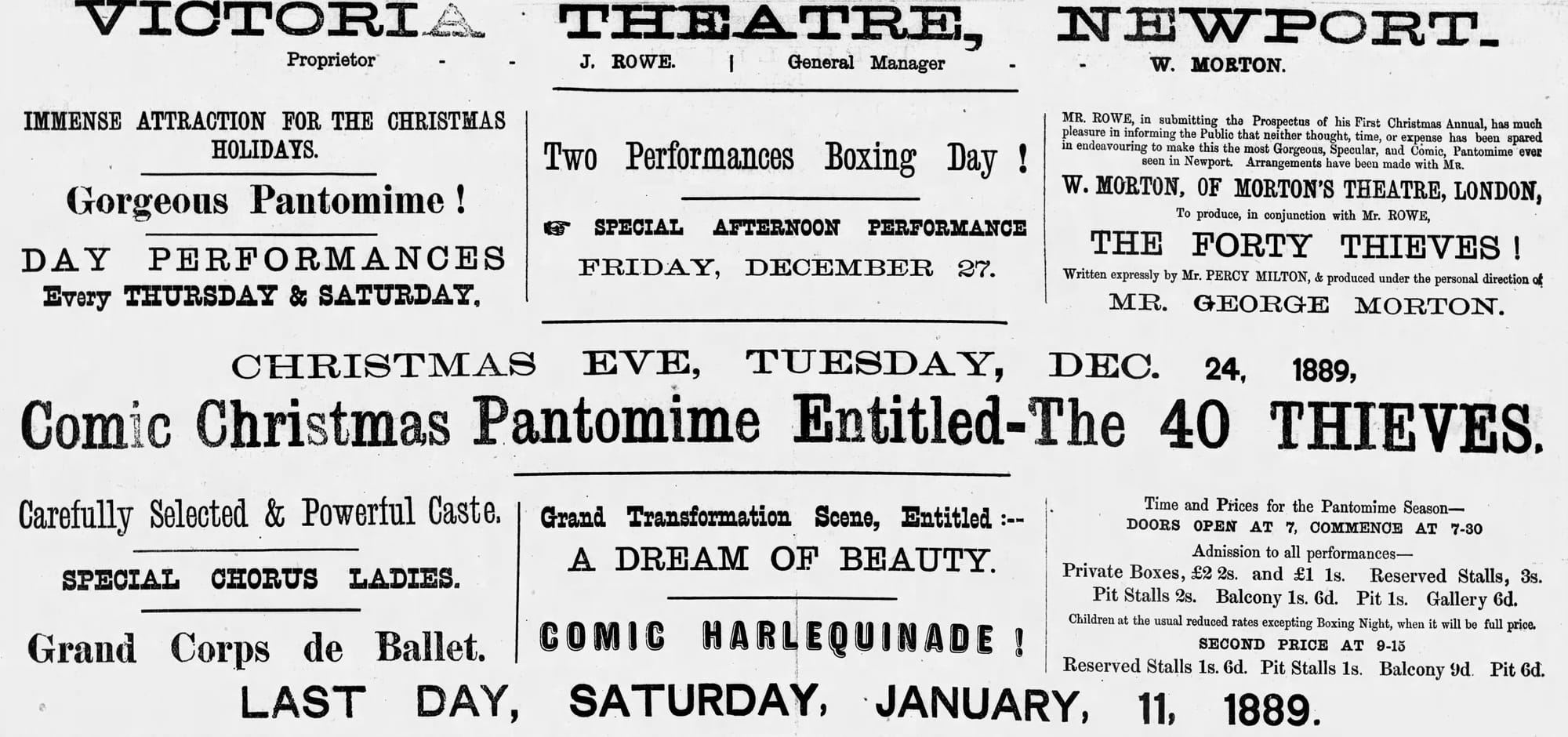
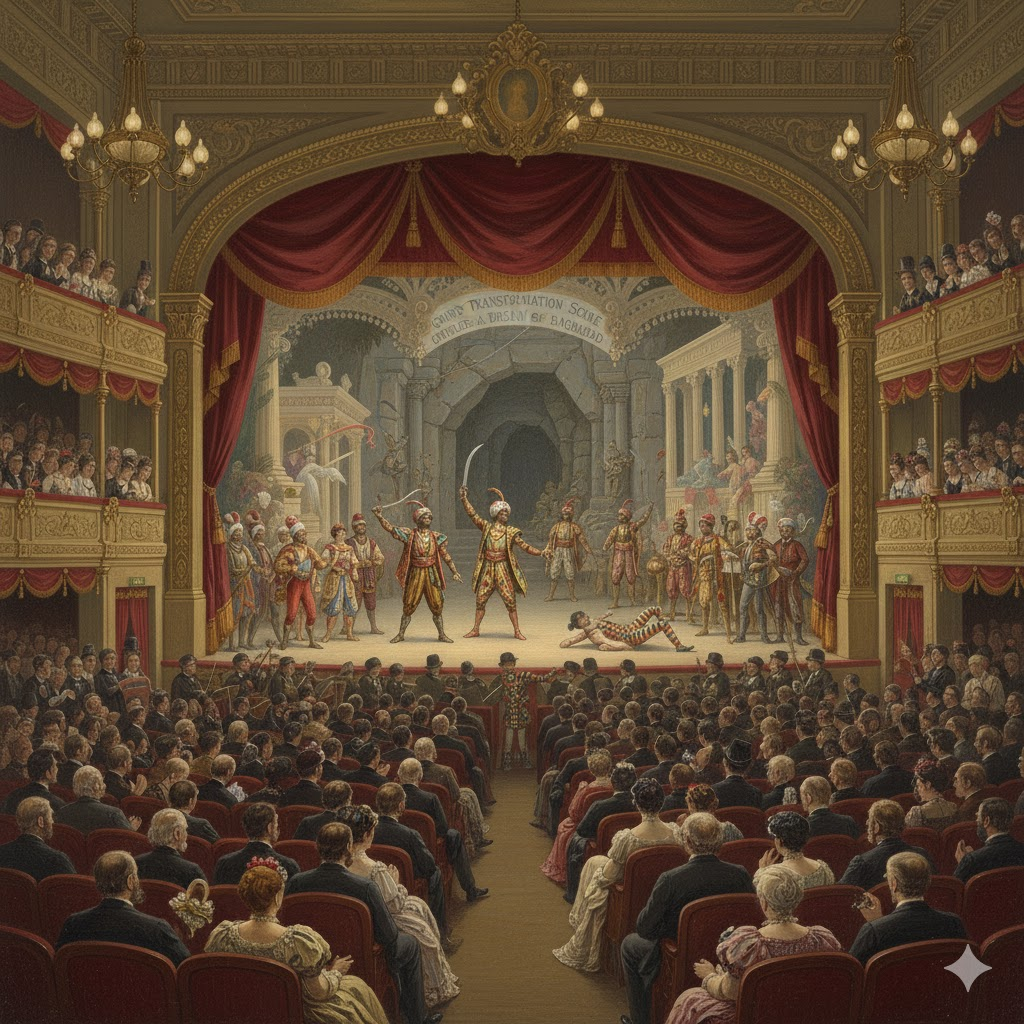
The Victoria Theatre, which burned down in 1896 and was replaced with the Lyceum Theatre, was showing the 40 Thieves pantomime in 1889. It featured a 'carefully selected and powerful caste (sic)', 'special chorus ladies' and a 'Grand Corps de Ballet'. Performances were on Christmas Eve with another two on Boxing Day.
This was how the Star of Gwent covered the opening of the pantomime:-
It was our privilege on Monday evening to sit mime through a full dress rehearsal of the gorgeous panto, "The Forty Thieves," which Mr James Rowe, the spirited proprietor of the "Vic.," aided by his enterprising manager, Mr W. Morton, has staged as the Christmas bill of fare. Children of tender age are familiar with the nursery lore of "The Forty Thieves," and thoroughly conversant with most of the incidents as written in the fable. Ali baba and Abdallah are names which will recall the story to their minds at once. Although for the purposes of a pantomime considerable alterations have had to be made in the story, little departure after all is effected in the real plot.
It is true the forty thieves are not cut-throats of modern days, for they partake of the gallantry and courtesy with which Dick Turpin and Claud Luval were wont to display when stopping coaches and robbing passengers on the "King's own highway."
In fact the Forty Thieves are forty pretty and fascinating young ladies, whose rich and varied costumes, during the course of the production, set them off to the best possible advantage.
The principals engaged are ladies and gentlemen of well known professional merit, and two or three of the ladies have passed their R.A.M. examinations. The musical portion of the pantomime is, therefore, at once guaranteed. Most of the songs are entirely fresh to a Newport audience, and we fully anticipate that their refrains will be sung and whiscled by street boys for months to come.
The ladies who constitute the special chorus are exceedingly tuneful, whilst the corps de ballet would do honour to a town of far greater proportions than Newport. The scenery reflects the highest possible credit upon the large staff of artiste, who have been engaged upon it for months past, and the transformation scene, which comprises nearly a dozen complete sets is more than worthy of the name "A dream of beauty." The harlequinade is something beyond funny, and cannot possibly fail to provoke shrieks of laughter. "The Forty Thieves" should bring a considerable amount of money into the coffers of the proprietor of the "Vic," not ease him of coin, as its title would serve to shew (sic).
— South Wales Daily Times and Star of Gwent, 24th December, 1889 (Subscription Required)
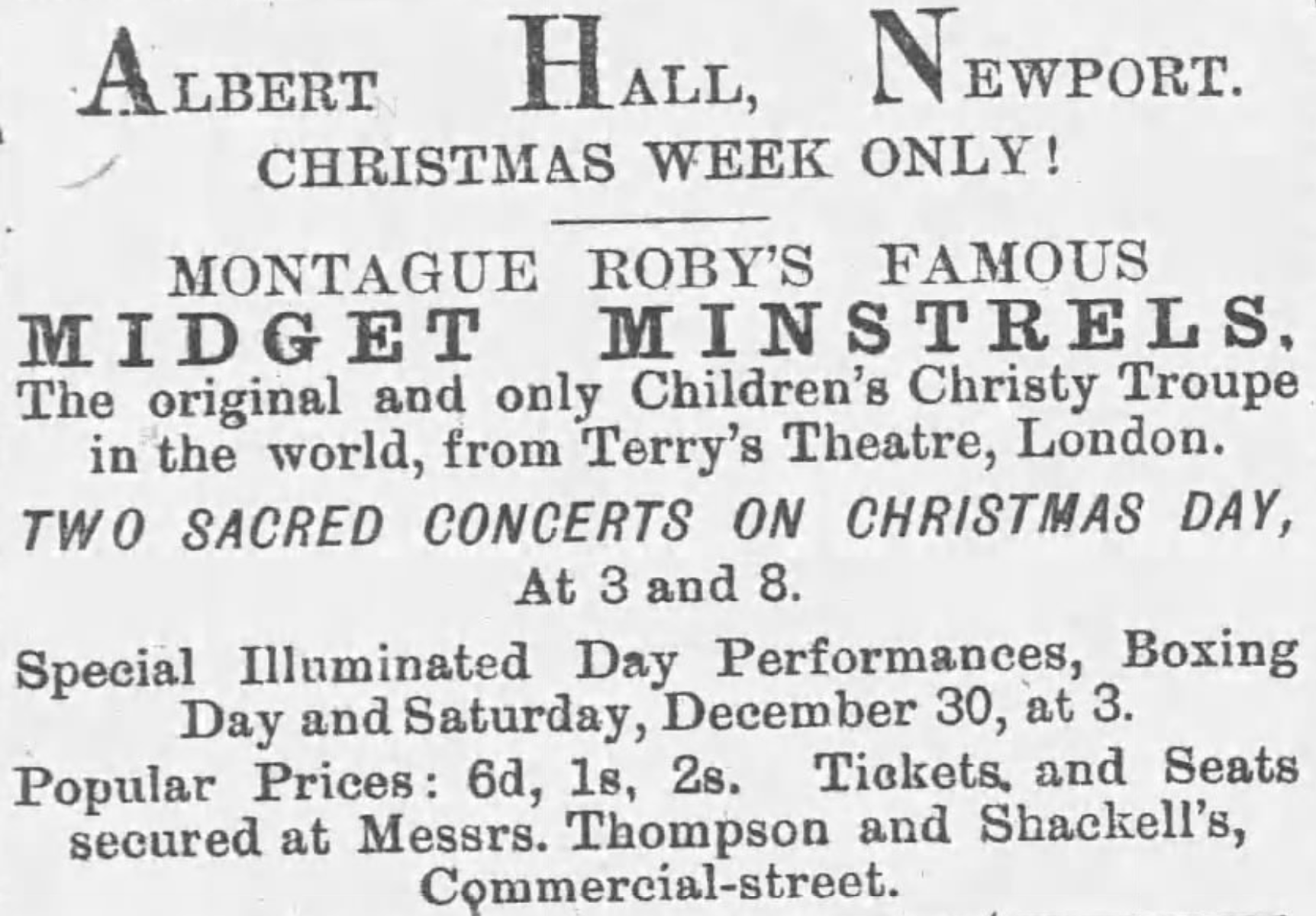
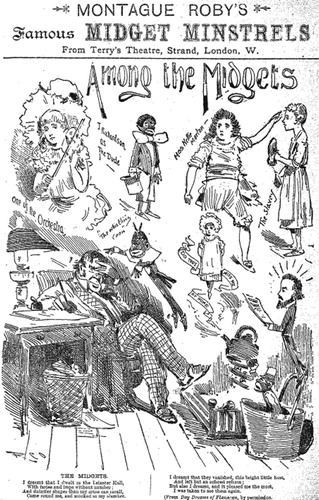
In 1893, the Albert Hall, used to be located on Stow Hill, featured Montague Roby's Famous Midget Minstrels — the original and only Children's Christy Troupe in the world. Christy's Minstrels were a 'blackface' group formed in Buffalo, New York in 1843.
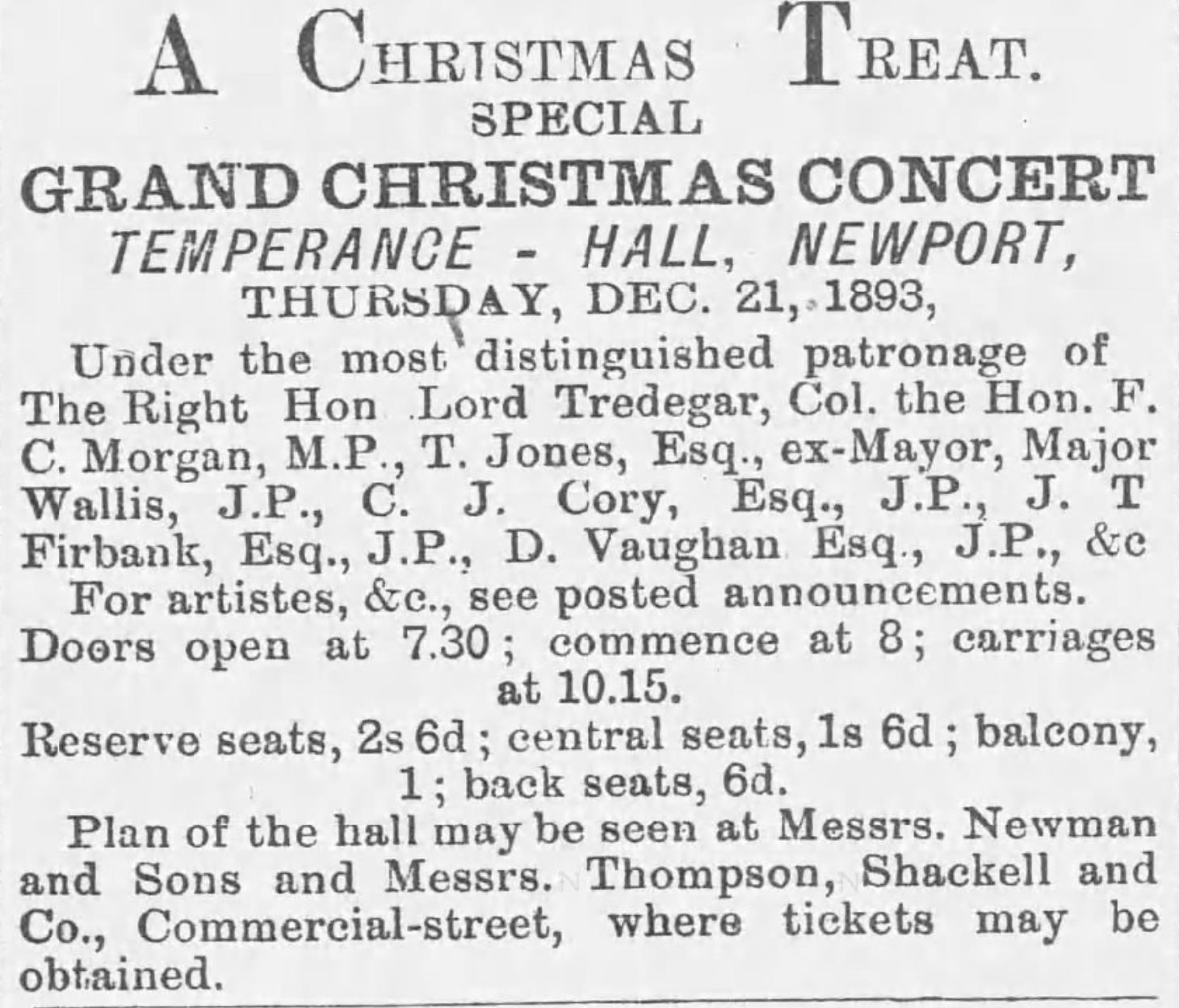
In Clarence Place in 1889 Keith and Tudor's Circus had performances on Christmas Eve and Boxing Day and featured Performance Horses, Juggling, Wire Walking, Tight Rope Dancing and Comic Clowns.

This was how the Star of Gwent covered the opening of the circus:-
OPENING OF THE CIRCUS SEASON. Messrs Keith and Tudor, who have erected a very cosy circus in Clarence-place, opened for a three months' season on Monday evening. The interior of the building was scarcely completed, but it was evident at a glance that nothing would be spared to promote the comfort and convenience of all sections of the community. Although Christmas amusements are not abnormally patronised on any evening prior to Boxing Day, a large audience assembled at the Circus on Monday as though to show their appreciation of the spirit and enterprise of the proprietors. The company all round is an exceedingly strong one, and the applause throughout the evening was loud and continuous.
Mr Wal'er Allen, in a dashing act of riding, shewed (sic) his superb horemanship, and was loudly applauded on retiring from the ring. Madame Keith, in her elegant performance on the tight rope, was seen to great advantage. Her dancing on the rope with baskets on her feet was greatly appreciated by the audience. Mr W. Tudor presented "the comic trick ponies," their performance doing great credit to that gentleman.
The American rider pleased the audience very much in his great bar act. while the clown Nimble Walter caused roars of laughter by his tricks. His little game with Joey, the artful pony that jumps when he likes, was very amusing. M. Jules Poole, the famous jagger, was exceedingly clever in his tricks, his performance being highly appreciated by the audience.
Miss Lydia in her fancy act of trick riding was applauded to the echo. Charlie Keith greatly amused the audience by his funniosities (sic), his tricks causing roars of laughter. The brothers Rowe, from the Alhambra and Empire Theatres, London, must be seen to be properly appreciated. Their entertainment cannot fail to find favour with spectators, Mr W. Tudor's great jockey act in jumping from the ring on to the horse's back was loudly redemanded, his horsemanship being exceedingly clever.
The renowned musical clowns, the Leombarto brothers, included in their performance playing on watering teapots, Mrs Leombarto's playing upon string bring very clever. Misses Langslowe and Clements, in their performance in walking upon double wires, were loudly applauded, and brought a very enjoyable evening's amusement to a close. There will be day performances on Thursday, Friday, and Saturday, at 2.30.
— South Wales Daily Times and Star of Gwent, 24th December, 1889 (Subscription Required)
Travel
For those living away from home, getting back to Wales for Christmas involved a serious test of endurance. The Great Western Railway advertised a "Special Train" departing London Paddington at 10:00 p.m. on Christmas Eve. This late-night service wasn't just a short hop; it was a marathon run calling at Newport, Cardiff, and Swansea, before pushing all the way out to the far western terminus of New Milford (Neyland) in Pembrokeshire.
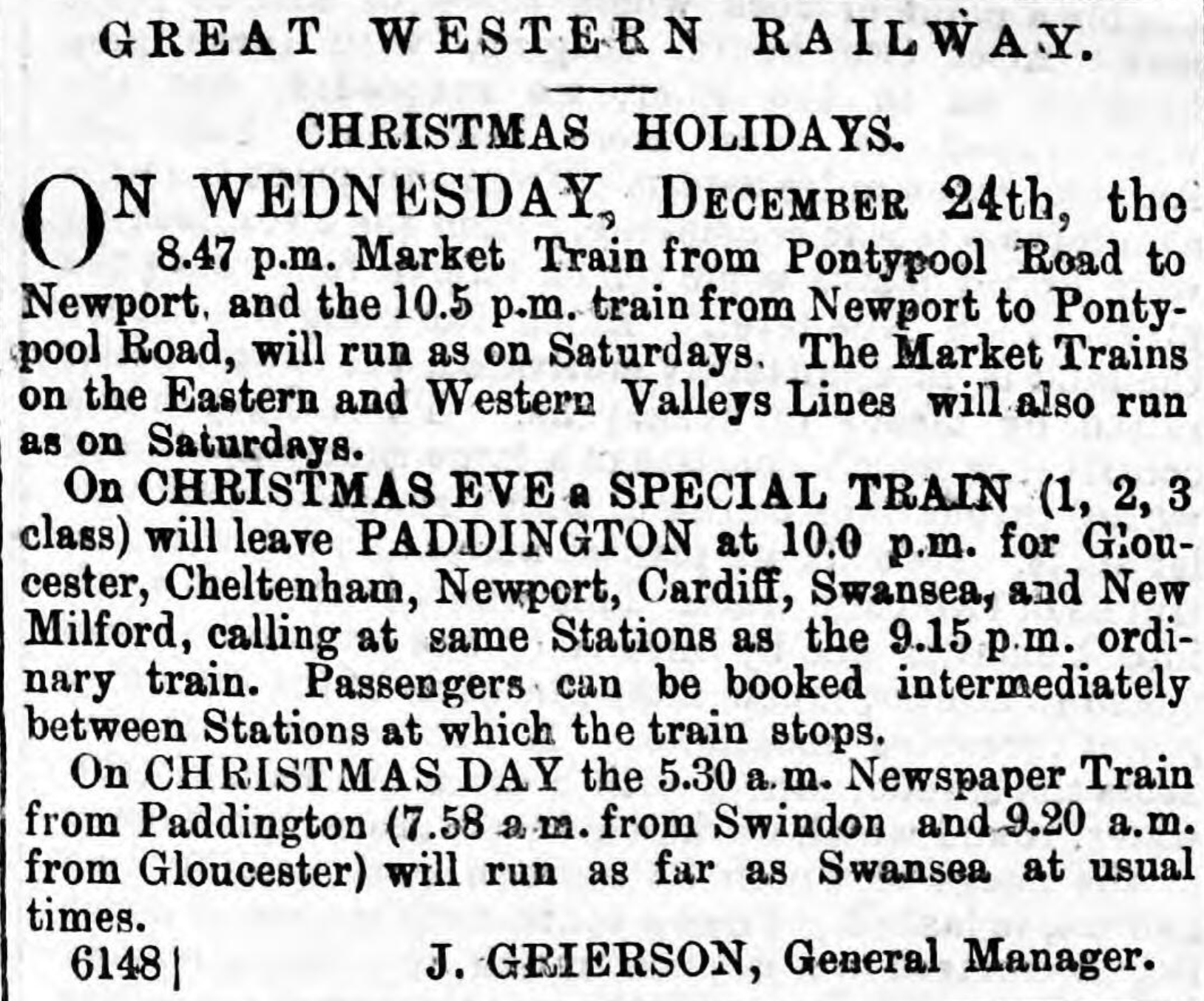
Given the rolling stock of 1884, passengers boarding in London faced a long, rattling night in the carriage, traveling through the darkness to arrive in Newport in the small hours—or, for those continuing to West Wales, arriving bleary-eyed on Christmas morning itself. The service was democratic, however, open to "1, 2, and 3 class" travellers, ensuring that everyone from the wealthy merchant to the returning labourer could make the journey.
Even on Christmas Day, the line didn't fully sleep; a 5:30 a.m. "Newspaper Train" from Paddington still ran as far as Swansea, ensuring the morning news reached the industrial towns of the south. Being two years before the Severn Tunnel opened, the trains still needed to go via Gloucester.
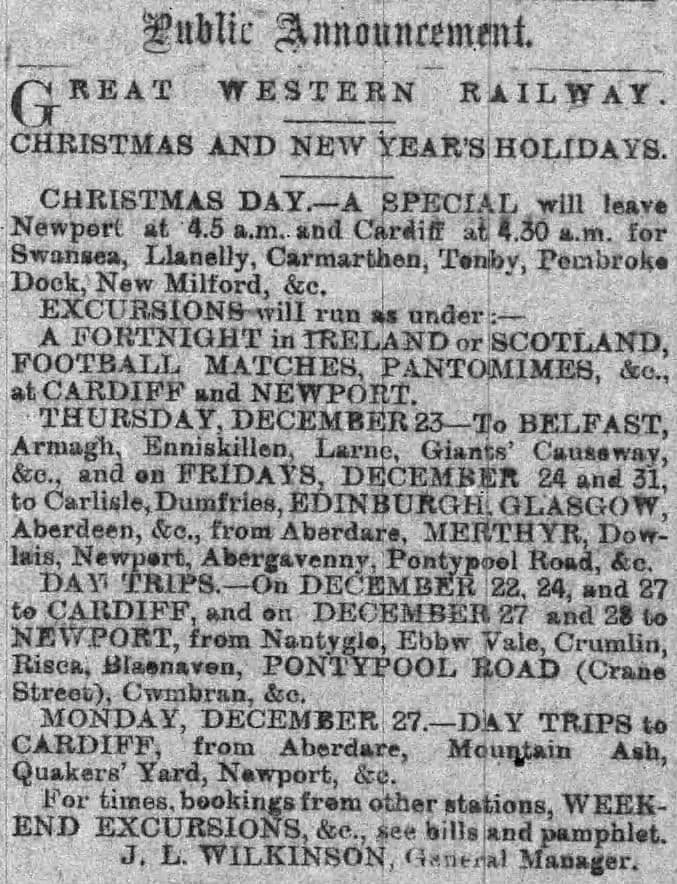
Also running on Christmas Day in 1897 was a train leaving Newport at just after 4am heading as far as New Milford (Neyland). There were also Christmas trips over the Christmas period bringing people into Newport from the valleys.
Ultimately, the festive spirit of Victorian Newport was defined by a unique blend of grand spectacle and local community ties, where "Monster Cheeses" and guinea hampers served as both commercial triumphs and shared holiday milestones. As the midnight trains from London steamed into the station and shop windows glowed against the winter mist, these archival records reveal a city that was as ambitious in its trade as it was traditional in its celebrations.
By looking back at the vibrant offerings of Gower’s, Cordey’s, and Phillips & Sons, we see more than just a list of goods; we see the origins of the modern Christmas rush, rooted in a period of remarkable growth and festive wonder that still resonates in the city’s history today.


Member discussion