

Welcome to another issue of The Newport Cornucopia where we dig through the newspapers archives for interesting news articles and adverts. All articles are posted verbatim and most headlines are original (headlines in quotes are my own).

'Newport New Omnibus Service'
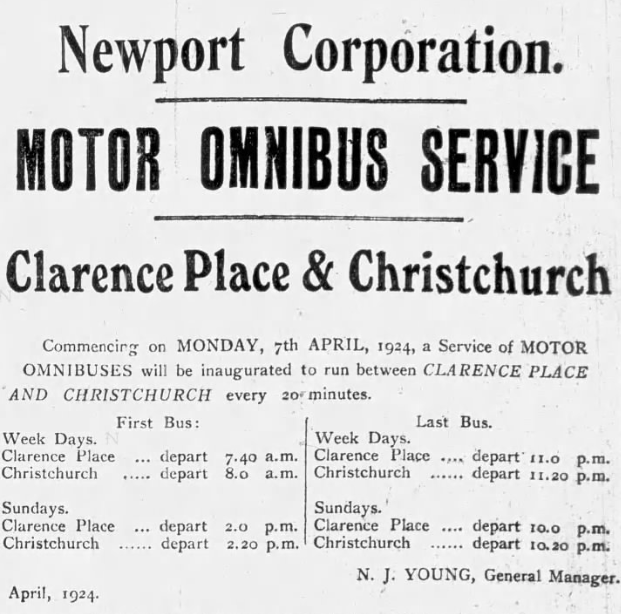
Although the Newport tramway system is one of the best in the Kingdom, there are various residential districts which are not directly served, as the permanent tramway line does not run near them. Among them are Christchurch-hill, Barrack-hill, Bridge-street, Fields Park-road, etc. In these districts the residents have to walk considerable distances to the cars, and as a consequence it was felt that a large amount of potential revenue was being lost.
To obviate this, and to provide for the convenience of the public, the Newport Corporation are starting a series of bus services, which it is hoped will, if successful, be gradually extended to other districts. The first of these omnibuses was tried on Wednesday and proved exceedingly satisfactory. A regular 20 minutes service will be inaugurated on Monday next from Rodney-road, Clarence-place, to Christchurch-road. The route will be Rodney-road, Caerleon-road, Church-road, Christchurch-hill to Summerhill-avenue, Summerhill-avenue, Woodland Park-road and Christchurch to the borough boundary (about one mile from the church at Christchurch). The return journey will be over the same roads, and the fares will be — Clarence-place to Christchurch-road, 3d.; Clarence-place to Clevedon-road, 2d.; Fairoak-avenue and Christchurch, 2d.
Later int he week it is hoped that a similar server will be established on the Bridge-street route. The roads served will be Bridge-street, Godfrey-road, Serpentine-road, Fields Park-road and King Edward VII-avenue to the Corporation boundary. An inclusive fare of 2d. will be charged.
The first bus from Clarence-place to Christchurch will start at 7.40 a.m., and the first from Christchurch to Clarence-place at 8 a.m., arriving at the latter place about 8.15.
— South Wales Argus, 5th April, 1924 (Subscription Required)
St Woollos Church-Yard
To the Editor of the Monmouthshire Merlin
SIR,—As a constant reader of your journal, I cannot but have witnessed your readiness at all times to give publicity to well-founded complaints of nuisances and other matters affecting the comfort and well-being of society and I am therefore induced to solicit a space in your columns for a complaint respecting what many residents in the neighbourhood consider an improper burial in St. Woollos's churchyard.
On Monday afternoon last, my attention was directed to a newly-dug grave, close to the left entrance from the countryside into the churchyard, and very contiguous to the residences of many inhabitants. I found that the grave-digger had ended his task, and on examining the open grave, I found that it was only about three feet deep! so that when the coffin was placed in it, the corpse would be within eighteen or twenty inches of the paws of ravenous dogs.
I enquired of the grave-digger the reason of this unseemly mode of interment, when I was edified by the announcement that "it was only a dried up old woman to be buried there, who was too aged to be offensive when putrid!"
She had, the grave-digger further informed me, requested to be buried in this grave-upon her family. And so, regardless of the health and safety of the living, the wish of the dead was respected, and the old woman was just covered over with a few inches of earth in this heathenish style.
For my own part, Mr. Editor, being a resident in the locality of the churchyard, I cannot think this mode of interment consistent, judicious, or healthy nor do I think the request of the dead should be so outrageously attended to, to the injury, perhaps, of the living.
I have written the foregoing with no desire to reflect further than deserved, either on the functionaries of the church, or the friends of the deceased. I hope that if the body be not disinterred from the shallow pit—I cannot call it a grave—there will at least be some desire manifested by the authorities to prevent the recurrence of such an outrage on decency and propriety.
Your obedient servant,
A LOOKER-ON.
Monday evening, July 31.
— Monmouthshire Merlin, 5th August, 1843

'A Grand Concert with Ernesto Cavallini'
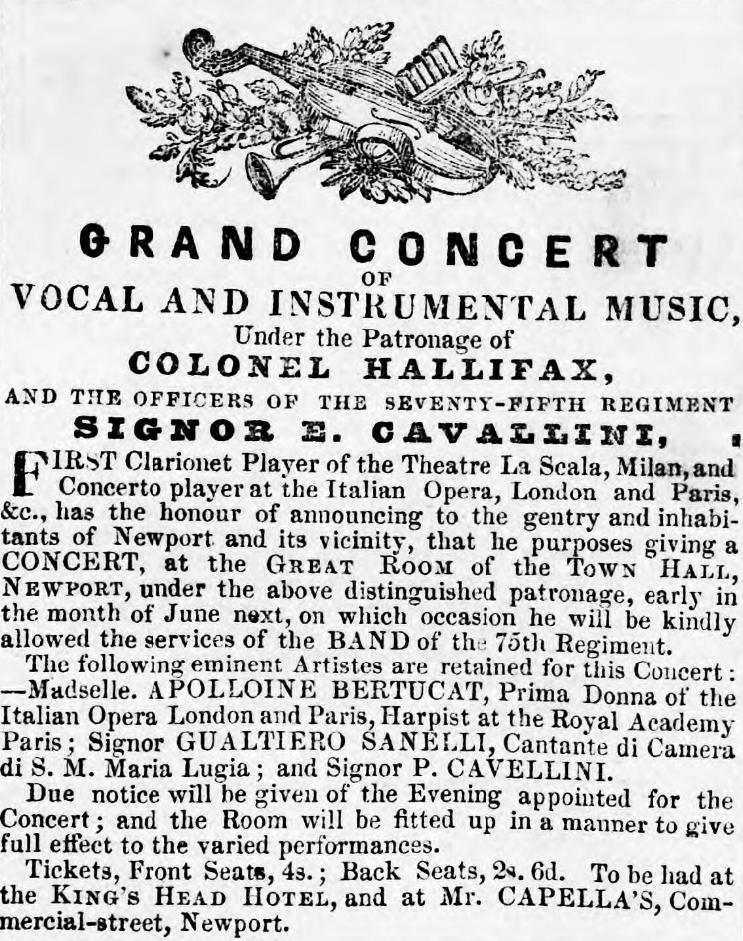
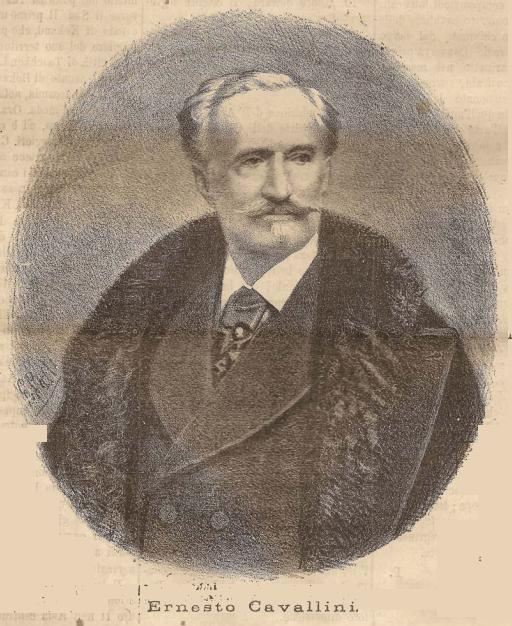
Ernesto Cavallini was a celebrated 19th-century Italian clarinetist and composer, born in Milan and trained at the Milan Conservatory, who became principal clarinetist at La Scala and later taught at the conservatory while also spending many years performing in St Petersburg. Renowned for his virtuosic technique and expressive style—earning him the nickname “the Paganini of the clarinet”—he continued to perform on an older six-key boxwood clarinet and nevertheless deeply influenced composers of his time, notably inspiring Verdi’s famous clarinet writing in La forza del destino. As a composer, Cavallini is best known for works such as Adagio and Tarantella, Adagio Sentimental, his fantasies, and his 30 Caprices for Clarinet, as well as significant repertoire for the E♭ clarinet; his music reflects the influence of Rossini and remains an important part of the clarinet’s Romantic-era legacy
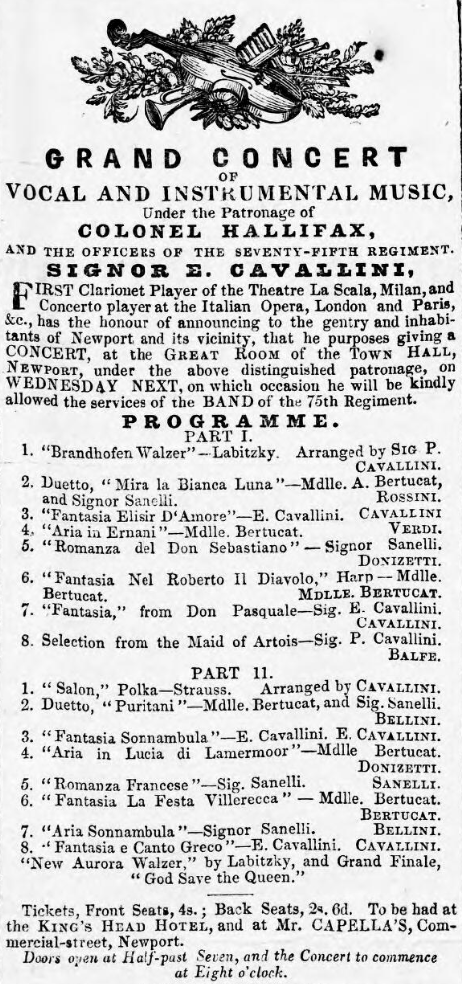
In a review of the concert it appears as though it wasn't a success.
On Wednesday evening last this singularly gifted artist, whose fame as the prince of clarionet players, had travelled before him, made his bow to a Newport audience, and the anticipations, however great, that might have been entertained of his extraordinary powers, were more that ratified; we regret, however, to say that though rich the musical treat provided on this occasion, for his audience "It proved, alas! no benefit to him," as the large room of the Town-hall was but thinly attended.
'Till Robbing'
It appears that there are now in town some young scoundrels trained to the art of till-robbing, two instances of which occurred during the week. The plunderers, in prowling about, mark such shops as happen to be without any person behind the counter, creep slyly round for the cash, and are so expert that they have escaped after being noticed from the parlour.
— Monmouthshire Merlin, 24th May, 1845

Caution to Passengers on Tram
On Tuesday morning last, as Margaret Parry, aged about twelve vears. daughter of John Parry, of High street. Pillgwenllv, hay-cutter, was going along the tram road near the Waterloo turnpike gate. some glowing embers from one of the locomotive engines caught the child's dress, and burnt her hack so much. as to occasion serious wounds the poor child's hands also were severely scorched in trying to extinguish the fire. A gentleman hearing her screams, ran to her assistance, and by rolling her on some grass near, prevented her being burnt to death, for the fire had burst into a flame around her, and a sister, who accompanied her, was so much frightened as to become totally helpless. We have since learned that the gentleman, to whose prompt aid the girl, probably, owes her life, is James Birch, Esq.
— Monmouthshire Merlin, 31st May, 1845
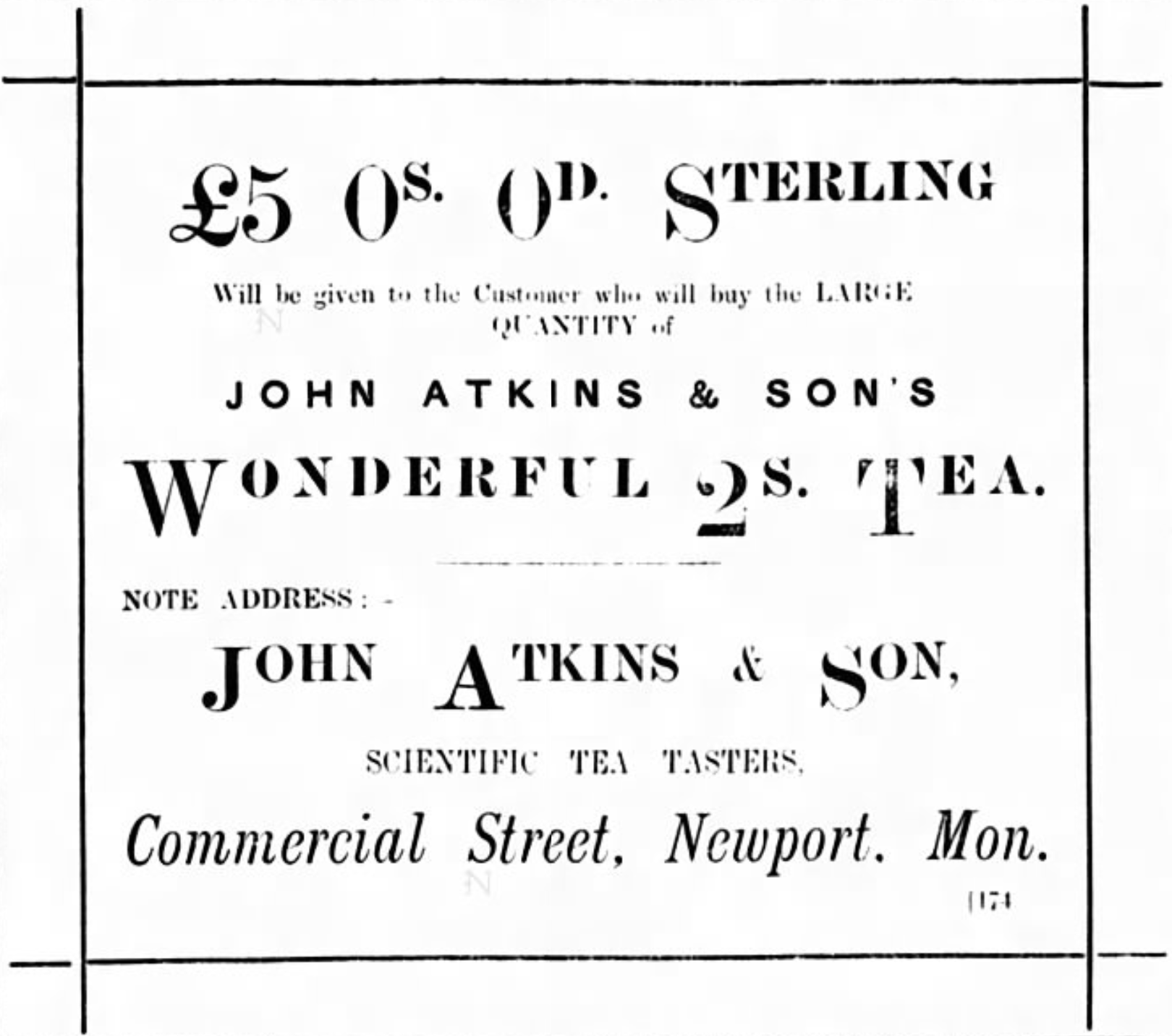
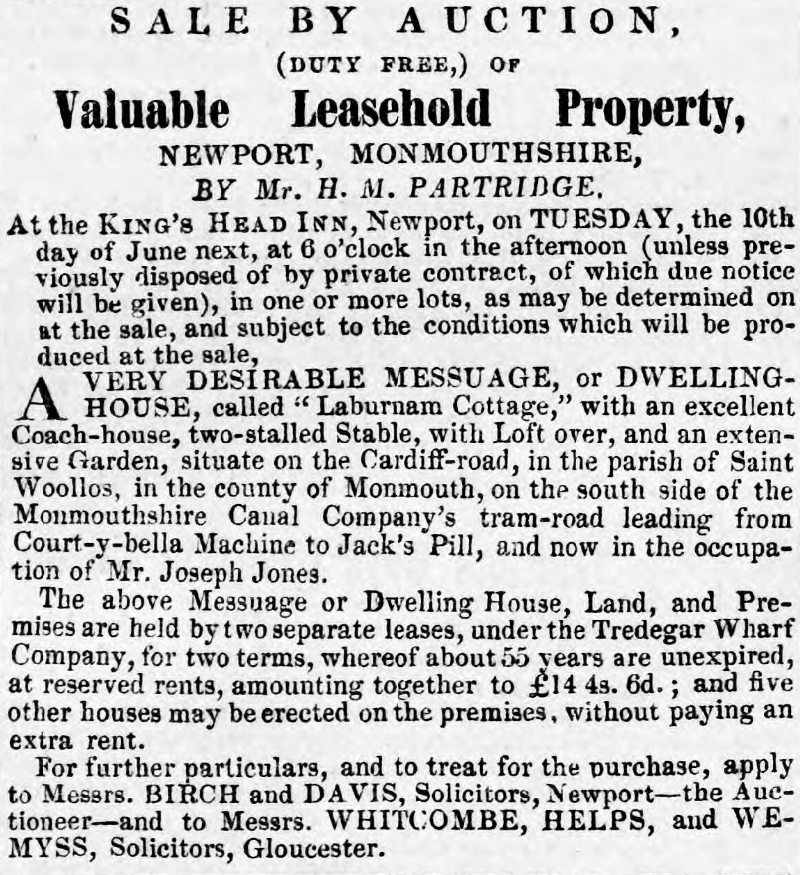
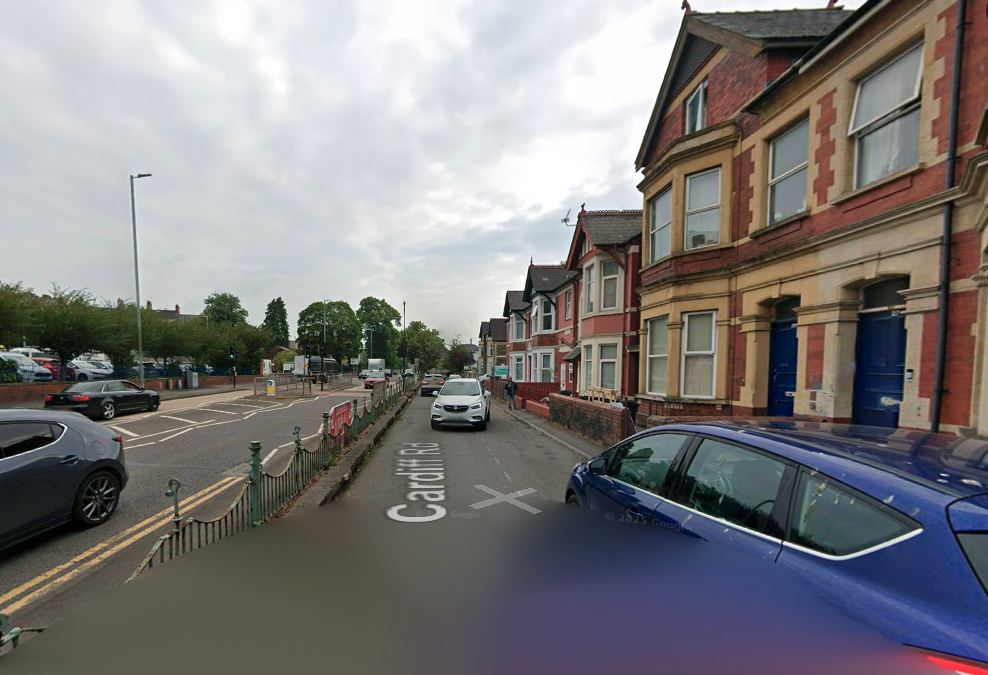
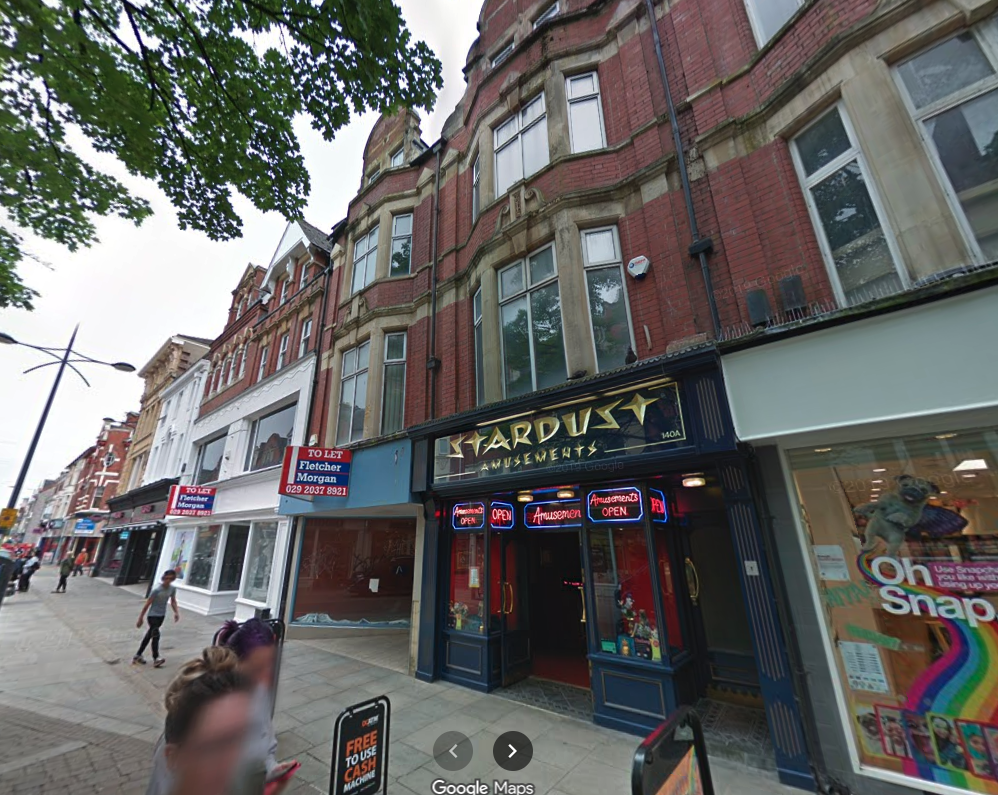
The house mentioned in the advert is number 496 on the Welsh Tithe map of 1840. It's directly opposite the Royal Gwent Hospital.

The houses are on the right is where the house was located.

The unusual number of thirteen prisoners appeared in the dock this morning.
The first refractory subject called upon was— James Phillips, who had foolishly allowed beer to master and befool him, one night last week, and had been ruminating over his folly in the cells of the station house ever since.
The police-officer having stated that the prisoner had been a very passive drunkard, his Worship dismissed him from custody with a very kind admonition.
Mary Ann Jones, a very frail and fallen creature, was charged with obstructing Sergeant Huxtable, and using violent and disgusting language towards him on Thursday midnight last.
Sergeant Huxtable and P.C. Pennimore proved the charge, and his Worship, after some. severe, and it is hoped, useful, admonitory remarks, ordered her to be fined in the mitigated penalty of 5s, or be imprisooed 14 days in the Usk House of Correction, with hard labour.
Milian Harborough, a disagreeable-looking sinner of the feminine gender, was charged with being drunk and disorderly in the street on Sunday morning last.
P.C Hewish stated that he found the prisoner taking a nap in the door-way of Mrs. Harrhy's house, about three in the morning, and as she reported herself drunk and homeless, he lodged her in the station-house cell.
As the prisoner pretended that she could not speak English, a Welsh colloquy ensued between her and Mr. Edwards, whose abilities in the Cambrian vernacular, severely tested those of the prisoner.
His Worship at length settled the case by observing that the prisoner was a real vagrant and disorderly person, who had twice received shelter in the Refuge for the Destitute, from pretending to be in fits, and bad been in different prisons a number of occasions. His Worship now ordered her to be fined £2, or be imprisoned two months in the House of Correction at Usk, with hard labour; adding, that if she was ever brought before the Bench on similar charges, ahe should be convicted in the full penalty of £5 or receive six months' imprisonment.
Jeremiah M'Carthy, a renovator of decayed and sleepy, i.e., nap-less gossamers of the four-and ninepenny and other classes, was charged with being drunk and disorderly, and assaulting Mrs. Jenkins, wife of the landlord of the Bush Inn, on Friday morning last.
Mr. Jenkins proved enough of the charge to warrant a con. viction, and added that the prisoner's wife had told him how rejoiced she was her husband was in "limbo," where he ought to be kept for life.
A voice: An' sure, my honey, it's no such thing; barrin' the drink, he's a jewel of a husband, the bliggard (sic). The speaker was discovered to be the wife, with blackened eyes, swollen nose, and discoloured face.
The prisoner said he knew nothing of the affair—he never did know what he was at when he was drunk.
Mr. Jenkins begged the Bench to deal leniently with the prisoner, and his Worship, after many words of serious counsel to the beer-besotted renovator, fined him 5s, or 14 days' imprisonment at the House of Correction at Usk.
John Alexander, a shrewd-looking fellow, dressed in a striped blue frock, was charged with obtaining goods under false pretences. It appeared that on Wednesday morning last, the prisoner went to the beer-house of Dominique Bordessa, with an order for four quarts of beer, purporting to be the order of Mr. Noah Bowen, anchor-smith, for whom he worked, and for whom he had frequently taken such orders to Bordessa's house. Soon afier the four quarts had been drunk, the prisoner returned with the same slip of paper, or order, for four additional quarts, which were to be added to the first quantity, by adding the word "ditto" to the first order. This was also executed, and it was subsequently found that the order was forged.
Mr. Noah Bowen said the prisoner was not working for him on Wednesday, nor did he order him to obtain any beer whatever. He had written no order at all that day, and the order produced was not in his hand-writing, nor had he ever seen anything of it before.
The prisoner said he didn't write the order, nor did he know who did; and he was then sent to await his trial in Usk, for obtaining goods under false pretences.
William Price, a ferocious-looking fellow, with a fiery head, was charged with assaulting his step-mother.
The Mayor said the parents of the prisoner would not press the charge against him, and he might deem himself fortunate in finding them so forgiving for had the case been heard, he (the Mayor) would have done his duty in the extreme sense of the word. The prisoner was discharged.
Charles Cable, John Ellis, Francis Bosaith, John White, John Mark, and John Williams, were charged with having left the ship Zenobia, George Sutherland, master, of Liverpool, without leave.
The charge proved against the prisoners was not that of leaving their vessel, but of neglecting to do their duty on board the ship. the charge was clearly sustained, and after the case had. occupied several hours, the prisoners were sentenced to 14 days imprisonment at Usk, with hard labour.
— Monmouthshire Merlin, 20th May, 1843
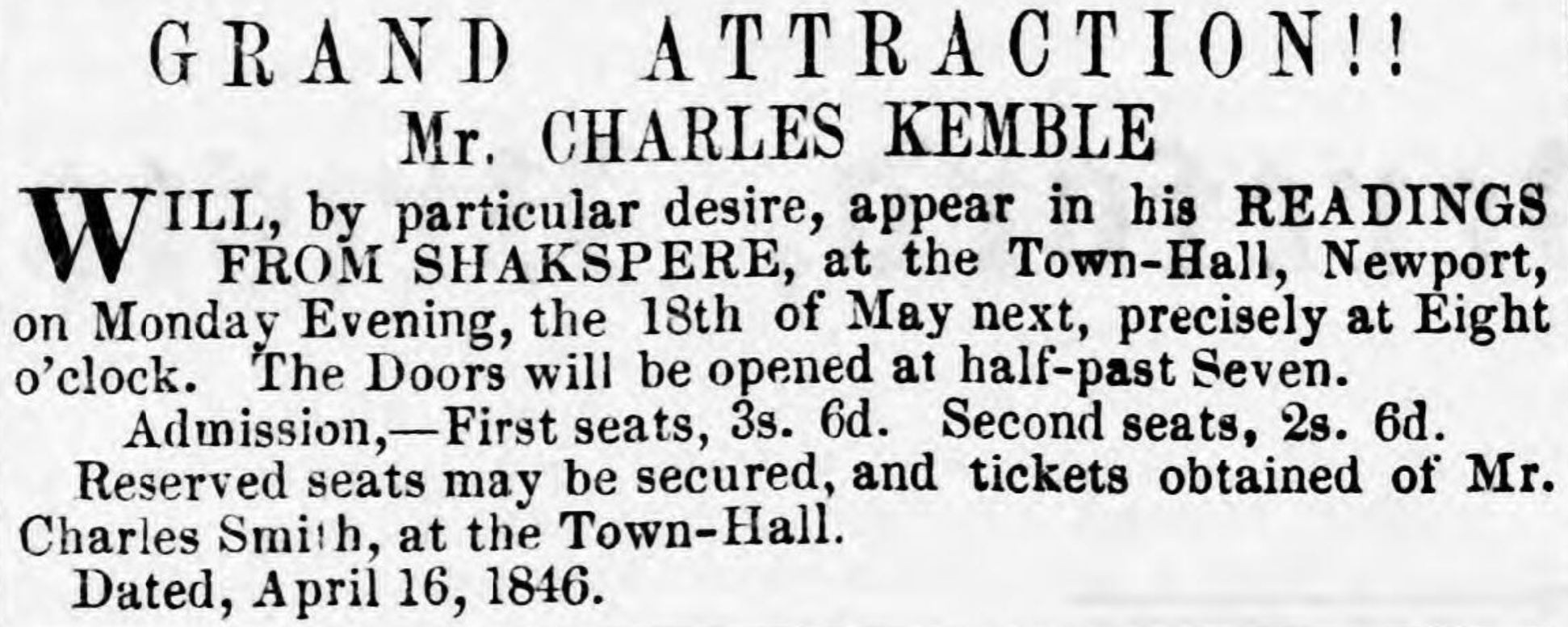
Charles Kemble (1775–1854) was a distinguished British actor and a key member of the famous Kemble theatrical dynasty, serving as the younger brother to the legendary Sarah Siddons and John Philip Kemble. Though he spent the early part of his career in the shadow of his siblings, he eventually won independent fame for his skill in comedy and romantic roles, such as Charles Surface and Ranger, as well as for his "incomparable" portrayal of Cassio in Othello. Beyond acting, he made a lasting impact on theatre history by introducing historical accuracy to set and costume design with his 1827 production of Cymbeline. His later career included managing the Covent Garden Theatre—which brought significant financial trouble—and a successful American tour with his daughter, the actress and author Fanny Kemble.
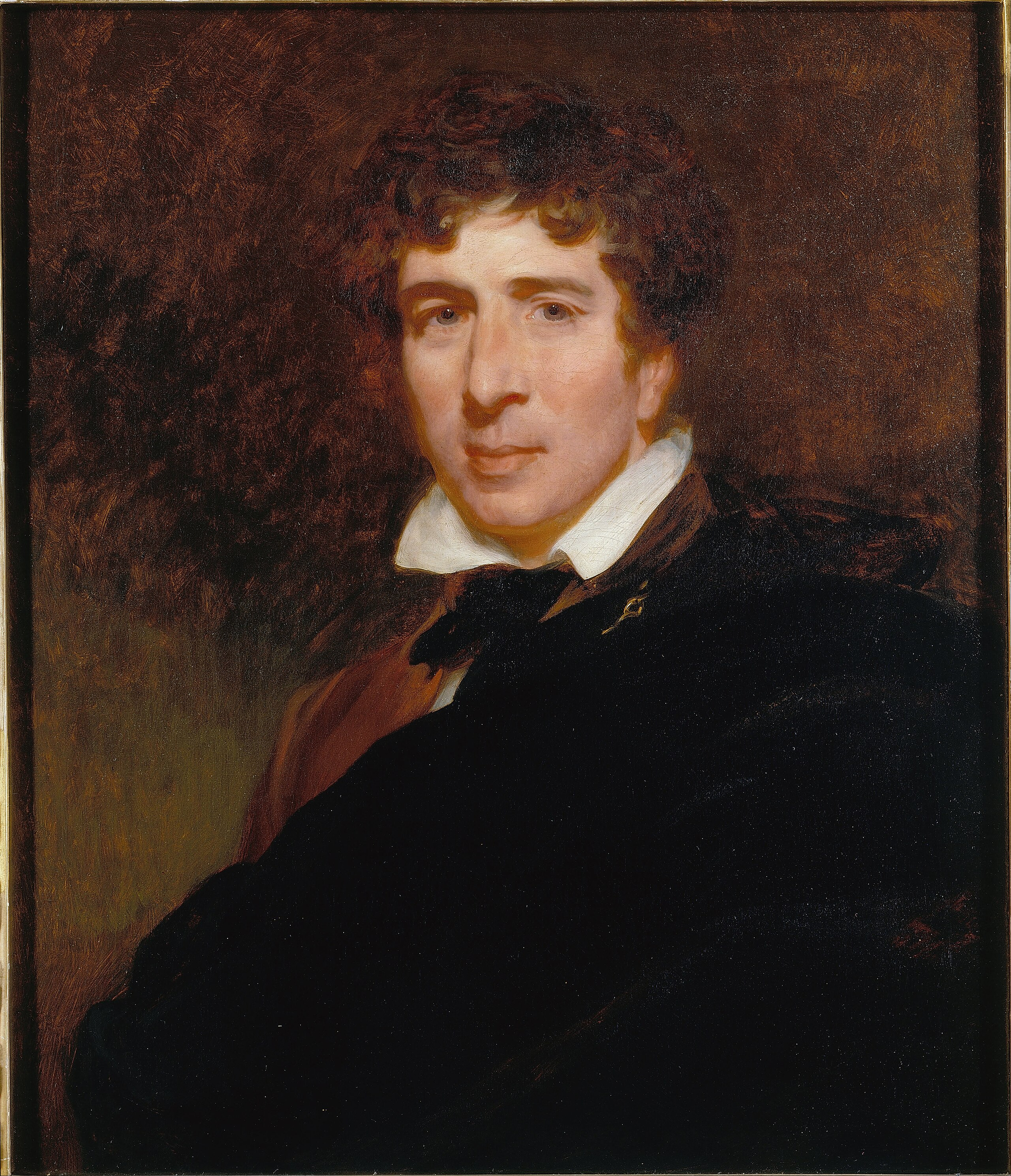
The Monmouthshire Merlin, reported on his visit in the 23rd May, 1864 edition.
Mr. Charles Kemble visited this town on Monday last, and read, to a full and most respectable audience, the popular play of Romeo and Juliet, making rich selections of the principal scenes, and at once maintained the integrity of the action, and gave the most forcible and finished specimen of the artistic force and feeling of the great dramatist. We are happy to say that the receipts were amply sufficient to defray the expenses on the occasion, notwithstanding the unpropitious state of the weather, and other inopportune circumstances, which were not foreseen. We understand that Mr. Kemble will visit Newport again shortly, when he will read his favourite play of Othello. The reading was received with the greatest demonstrations of approbation.

'The Rendezvous'
The inhabitants residing in the neighbourhood of a place called the "Rendezvous"—a beer-house on the canal side near the Moderator bridge—have sent up complaints to the magistrates against the intolerable nuisance which that house presents. Crowds of sailors at all hours of the day, many of them drunk, fill the rendezvous with uproar, and congregate about the door to the great annoyance of every well-conducted person, eilher residing or passing that quarter.
These reckless sons of Neptune are as usual generally in company of some Susans of Deptford, or Sals of Pillgwenlly, and the language of the party, uttered in no minor key, is, we understand anything but calculated to form the style of the young or to improve the morals of the more mature. This unseemly, though perhaps characteristic mode of spending the day, is sometimes varied by a set-to on the spot, or a pitch battle across the water; the victor being brought home in triumph, to "swing the flowing bowl" again; The Mayor and Magistrates have ordered the police to prevent the public being thus annoyed, and the force do their duty, but crowds of these hardy fellows "who have taken on" to serve the Queen, fancying they have a right to get up a breeze with impunity, and not yet having the fear of the cat and bilboes before their eyes, defy police authority.
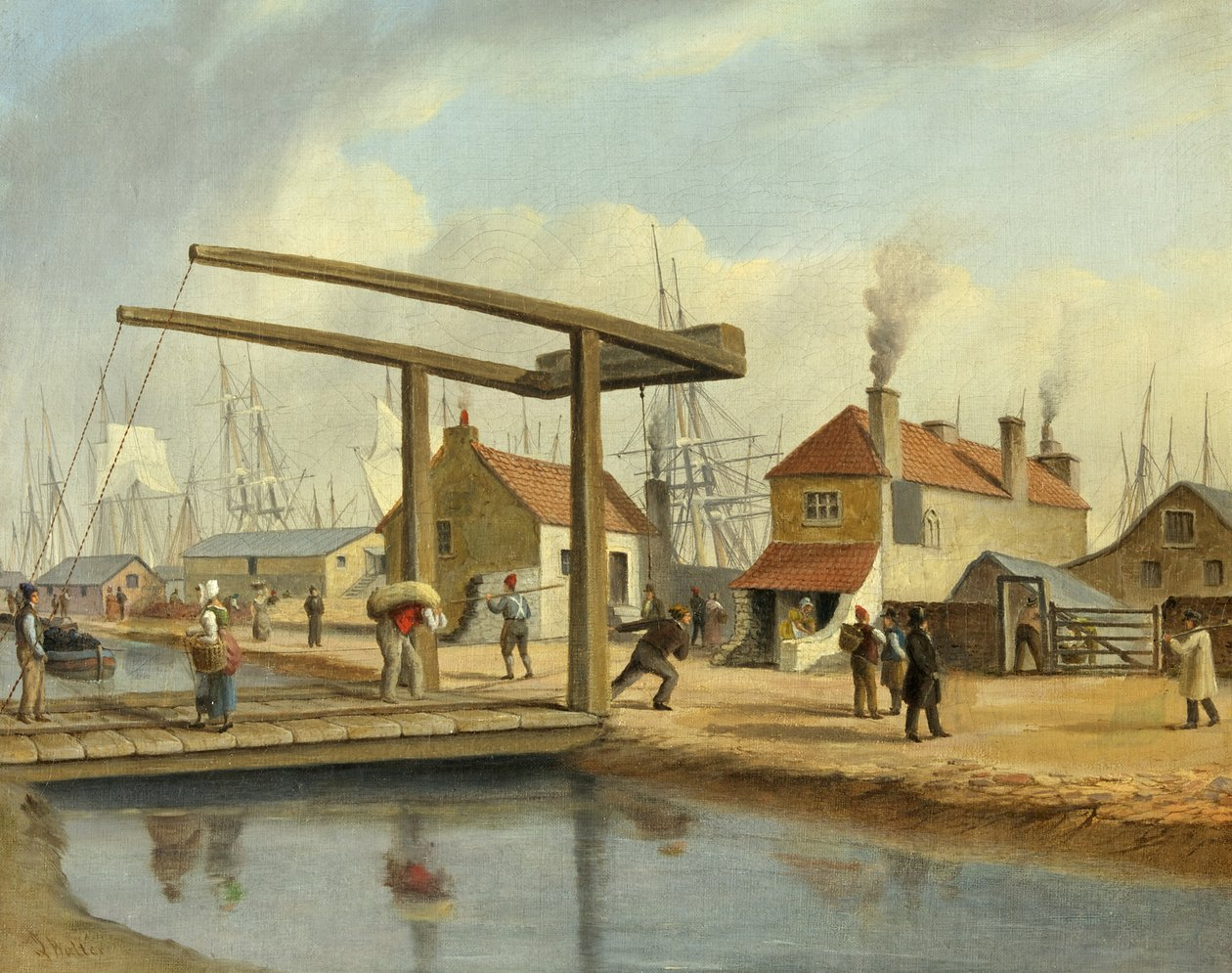
It will, however, be found by those who can be identified as ringleaders, that the rendezvous is no sanctuary against the civil power, as one or two have already felt; and that their courage may be cooled by stopping their grog at Usk, together with sharp exercise on the tread mill.
It does not appear that in the absence of the captain (to whom the mayor will write on the subject) that any competent authority is uniformly left to preserve proper order in the rendezvous, during that officer's stay in Bristol. This state of things must be prevented in future, more particularly as we learn that the recruiting for the navy proceeds more briskly in this town than any other port in this part of the kingdom.
— Monmouthshire Merlin, 14th June, 1845
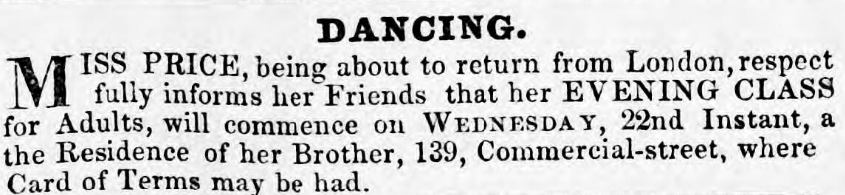
The house mentioned in the advert is the empty property next to Stardust in the image below.
Drainage and Public Health
This subject, annually pressed by us upon the attention of those who have the power to remedy the most injurious effects of bad drainage, recurs to us this season, backed by the complaints of a number of inhabitants residing in and near localities where this. the chief defect in Newport, most seriously affects them.
We are informed, that in Ruperra-street, damaged and insufficient drains are overflowing and poisoning the residents; while we need not point to Cross-street, Fothergill-street, Friars'Fields, and a host of other places, where fever periodically makes numerous victims among the residents. While we press this matter earnestly upon the attention of landowners, we would also call upon those who suffer from the pernicious cause, to use every endeavour, by fresh water, lime, and general clean. liness, as far as possible, to avert the horrors of fever.
— Monmouthshire Merlin, 5ht June, 1847
The Blind
We understand that on Tuesday last, the inmates of a Blind Asylum in Bristol were favoured with a pleasant trip to this town, per packet, which they greatly enjoyed. Although deprived of the gratification of looking upon the varied scenery of their trip, and the delightful landscape views from the eminences of Newport, we understand that they appreciated highly the njoyment, which their other senses permitted them to realise.
— Monmouthshire Merlin, 5ht June, 1847
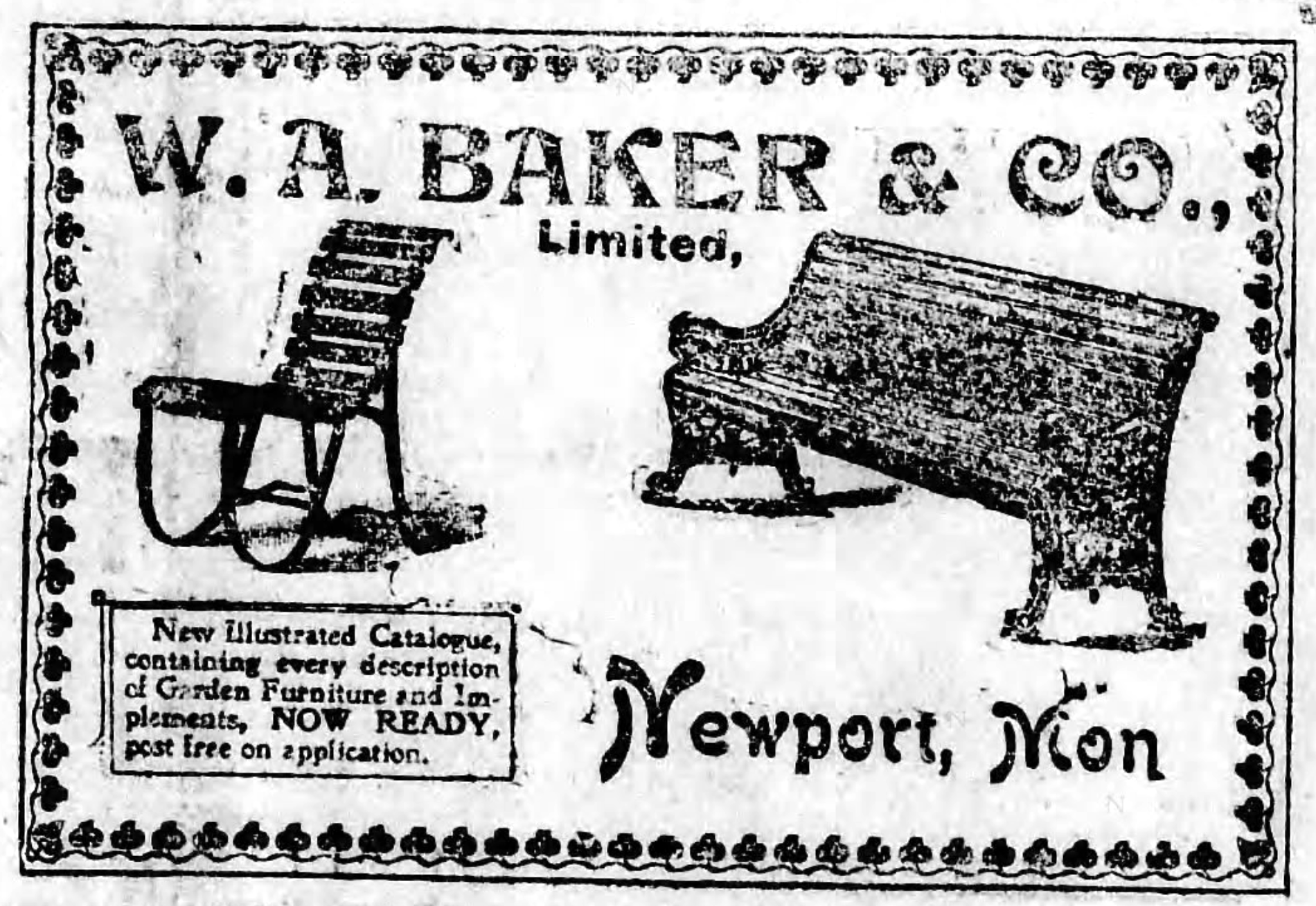
Police Accommodation at Pill
Superintendent Sinclair presented his fortnightly report. He drew attention to the lack of accommodation for the single policemen lodged at the Pill Police-station, Temple-street. Seven men were located there, and they had but one sitting-room, in which they had to cook, and dry their clothing.
Mr. Griffiths asked if any additional men had been located at the station. The Superintendent replied that formerly four or five men had been kept at the station, but it was now found more convenient for the purposes of police duty to increase the number to seven. In answer to further questions the Superintendent said there was sufficient bed-room accommodation, but the sitting-room accommodation was inadequate. The lack could not be supplied without additional buildings. It was not obligatory to lodge the men at the station, but it was a great convenience to have them there. They were charged a shilling a week for their lodgings.
The Surveyor said there was room far an extension of the present building. He believed it was contemplated when the building was erected, twenty or twenty-five years ago, that an additional wing should be erected when required. It had been suggested that the spare land should be used for a mortuary, but there was a great objection to that. The matter was referred to the Public Works Committee.
— Monmouthshire Merlin, 6th April 1877
'MP Hall Returns to Newport'
Wednesday last was the day appointed by the friends of the newly elected M.P. to celebrate his return, by a splendid public entry, chairing, and dinner, in the town which so eminently contributed to his success. A friend, who is no stranger to the getting-up of electioneering pageantry, has informed us that the coup d'ceil was equal to any thing he had ever witnessed,—the fine bright morning proving an useful auxiliary to the general effect.
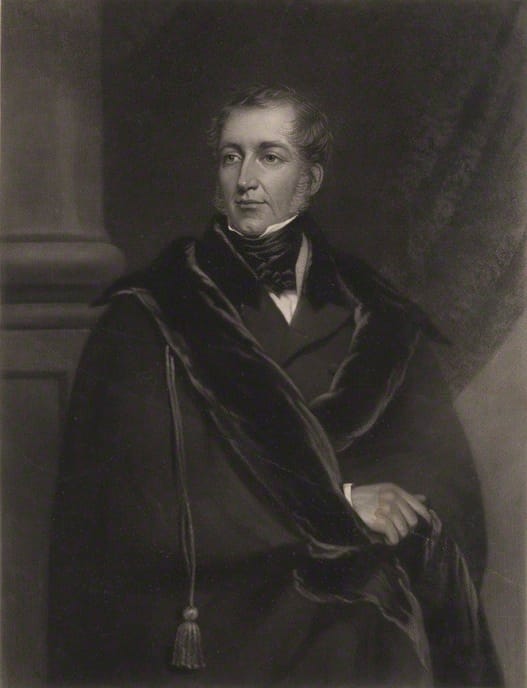
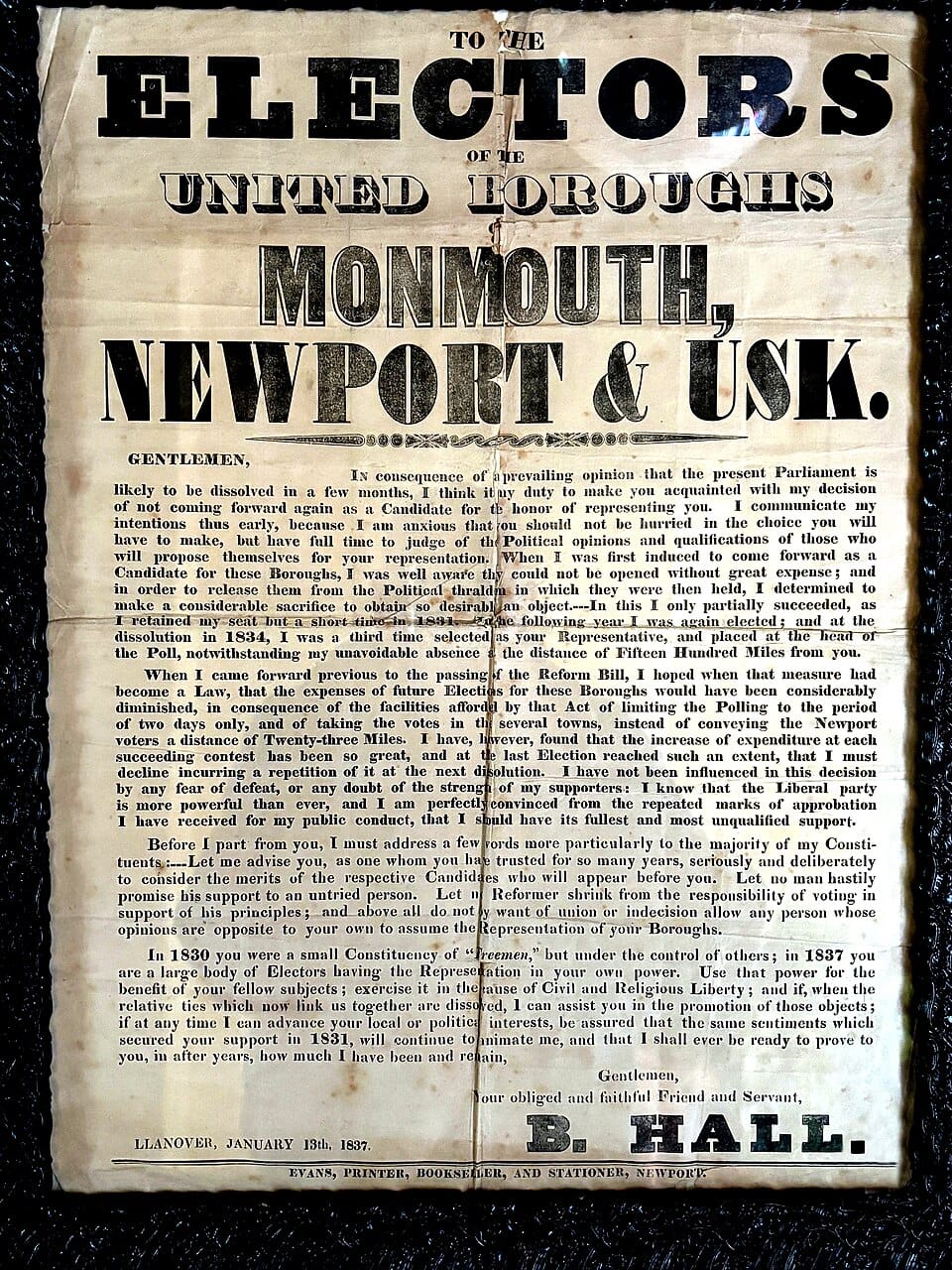
Benjamin Hall, 1st Baron Llanover, served as the Whig Member of Parliament for the Monmouth Boroughs constituency (which included Monmouth, Newport, and Usk) from 1831 to 1837. A committed reformer, he first won the seat in 1831 by challenging the long-standing dominance of the powerful Somerset family, defeating the Marquess of Worcester. Although briefly unseated following an election dispute, he regained the position in 1832 and held it until 1837, during which time he campaigned for church and local government reform and supported the Reform Bill before moving on to represent Marylebone in London.
Mr. Hall was met at the turnpike gate, on the Monmouth road, about twelve o'clock. He was accompanied by several country gentlemen and a body of friends from the boroughs of Monmouth and Usk. A discharge of cannon, placed on the banks of the Usk, above and below bridge, announced to the inhabitants the commencement of the day's festivities. On the crown of the bridge a splendid chair, covered with crimson velvet, awaited the arrival of the new M.P.
When Mr. Hall made his appearance, the ringing of bells, the firing of cannon,, the music of the bands, and the cheering of the countless multitude assembled to receive him, produced an effect that must have been witnessed to be conceived and stoical, indeed, must have been that being who could have beheld unmoved the spectacle of a free people, exulting in the triumph they had achieved, and paying to the champion they had chosen a homage princes might have envied.
When Mr. Hall entered the chair a procession was speedily formed, headed by a full band, the line of pedestrians 'being interspersed with numerous flags and banners, bearing appropriate inscriptions. Immediately preceding the member, the reform fleet was exhibited, consisting of the models of vessels bearing the names of—The Royal William, Lords Brougham, Grey, Russell, and other staunch reformers. The procession moved along the High-street, up Stow Hill, thence, by Court-y-Bella, into the Commercial Road. On his progress through the town Mr. Hall was presented, opposite the house of the Rev. Thomas Boddington, with a goblet of wine, Mr. Edwin Griffiths officiating as cup-bearer.
It would be a vain task to attempt to describe all the contrivances resorted to by the inhabitants to give eclat to the scene. The vessels displayed their gayest colours. Some houses were literally covered with wreaths of flowers and crimson favours; others bore ornamented medallions, with mottoes expressive of the gratulatory feelings of its inhabitants. In several places magnificent banners fluttered across the street.
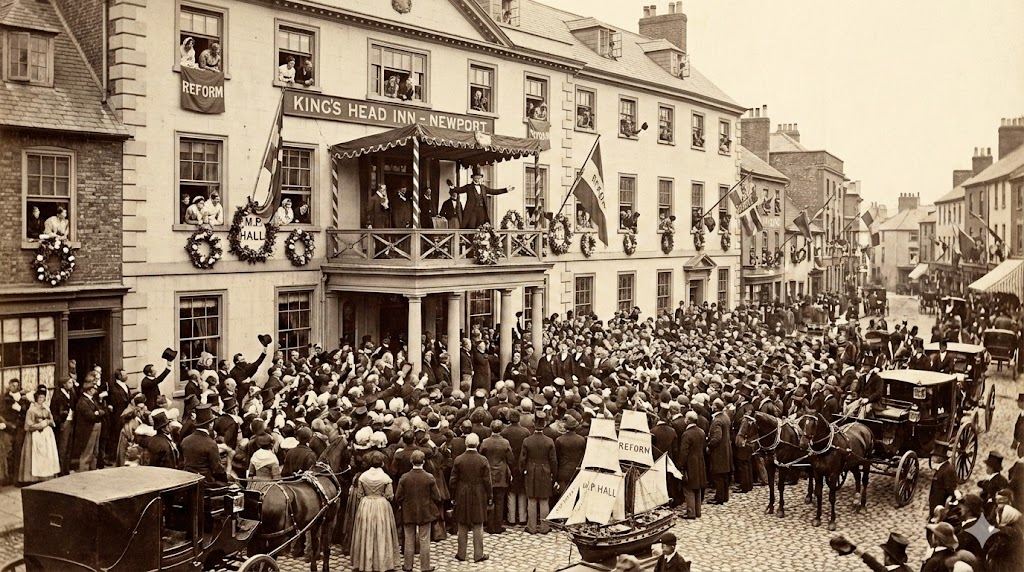
In short, each householder, with few exceptions, appeared to outvie his neighbour. The streets were literally thronged with human beings, the population of the borough being increased by visitors from the towns of Chepstow, Caerleon, Pontypool, and Cardiff, and the neighbouring villages, and even Bristol furnished her quota of the spectators.
On his arrival at the King's Head Mr. Hall descended from the chair, and mounting a platform, erected for him over the portico, delivered an eloquent and energetic address. The street in front of the King's Head was at this time filled by a dense mass of at least 10,000 persons, whilst the windows and even the roofs of the houses were covered with spectators.
[The article goes into great detail about elegant dinner that followed]
— Monmouthshire Merlin, 14th May, 1831


Member discussion