

Welcome to another issue of The Newport Cornucopia where we dig through the newspapers archives for interesting news articles and adverts. All articles are posted verbatim and most headlines are original (headlines in quotes are my own).

New Omnibus
The enterprising "prince of whips," Mr. Charles Phillips, always desirous of pleasing the public, has just launched a new omnibus, which runs to and from the railway stations, the King's Head, the Westgate and his own comfortable quarters—the William the Fourth. The new vehicle is tasteful and commodious; it is built on a new principle, and turned out of hand in first-rate style. When drawn by the two showy horses just added to the menace, and these "tooled" along by their master "Charley," a desire to be on the box, or snugly seated within, is the prevailing wish among pedestrian spectators.
— Monmouthshire Merlin, 9th June, 1854
Mad Dogs
A correspondent invites atten- tion, and not without sufficient reason, to the dog nuisance. In the early part of the week, a lad, in the employment of Mr. Bland, grocer, Commercial-street, was bitten twice or thrice severely by a savage brute, Which, as was fitting, was killed immediately after the occurrence. But, in this matter especially, "prevention is better than cure."
If snarling curs are permitted to ramble about the streets, they should be muzzled or, failing this precaution, it were to be desired that same half-dozen policemen should be armed with the weapons and the authority to shoot them. It is but poor compensation to a person bitten and driven half mad, it may be, by a ferocious dog, to be able to fix a fine upon the owner after the mischief is done.
We trust, at any rate, that the usual precaution will be at once taken by our vigilant Chief Superintendent of Police.
— Monmouthshire Merlin, 20th April, 1861
'Newport Sewers'
To the Newport Local Board of Health.
"Gentlemen,—In compliance with your instructions, conveyed to me through Mr. Woollett, I have made the requisite investigations as to the drainage of Newport, and I beg now to report to you the result, and to hand you the accompanying plan and sections, upon which the sewers which I propose for the drainage of the borough, are shewn.
Those sewers which are shown in dotted red lines are already constructed, and will form part of the general system of sewers. The new sewers I propose, are shown in solid red lines the direction of the fall of each sewer is indicated on the plan by small arrows. The sizes of the sewers, and their rates of inclination, are shown upon the sections, upon which I have also marked (by small black lines) the depths of the deepest cellars. All the cellars will admit of being drained into the sewers.
The place I have selected for the out-fall, is at the extremity of the borough, near the Waterloo Coal Wharf it will enter the Usk at that point, at a level (reckoning to the sill) about ten feet below high water of spring tides which rise, at Newport, about thirty-eight feet: therefore' during the last six or seven feet rise of spring tides, the outfall will be closed.
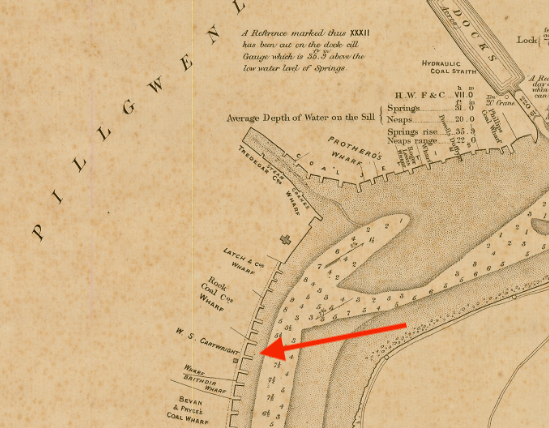
This position for the outfall is the best that can be chosen within the jurisdiction of the Board, and the level I have adopted will, should the extension of the town in that direction, at some future period, require it, admit of the main sewer being continued at the same rate of inclination (viz., one in one thousand and seventy-five) farther down the Usk; and, if continued for a mile in that direction, the sill of the outfall would still be not more than fifteen feet under high water of spring tides. The main sewer begins at the north end of the Marshes road, opposite to the overflow of the Mill-pond or dam, and continuing along that road, passes under the Monmouthshire canal at a sufficient depth, thence along the Canal-parade, Canal-terrace, Queen's-parade, and Potters'-street, to the outfall into the Usk.
The next sewer of importance passes along High-street, Commercial-street, and Commercial-road, and joins the main sewer at one end opposite Newport bridge, and at the other end, and New-street. Owing to the undulations of the ground, and to prevent its being-laid at too great a depth, this sewer is made to fall from near Union-row, in one direction towards the main sewer at Potters'-street, and in the other direction, towards Griffin-street; and from Thomas-street it also falls in one direction towards Griffin-street, and in the other direction to its junction with the main sewer, near Newport bridge.
The other street sewers communicating with these and with each other, will be sufficiently understood by a reference to the plan and sections—the arrows on the plan denoting the direction of the fall, and the rates of inclination being always shown on the sections. The arrangement of all the levels is such, that the whole system can be flushed from two points-the main sewer from the mill-pond, at the north end of the Marshes road, and the higher level sewers, from the high ground lying up to the Union Workhouse, where some provision for obtaining flushing water will have to be made.
The sewers I propose, are of four sizes, viz., three feet, three feet nine inches, four feet, and six feet in height; but all are to be egg-shaped, and narrow in the bottom section. The whole of the sewers are to be built of brick, in mortar, with a sufficient number of ventilating shafts and side entrances to make the sewers easily accessible. There are within the borough several old drains, which appear to have been originally laid along field ditches, without regard to the mode in which buildings were subsequently to be erected over them: these drains generally pass obliquely under the buildings (often in the most crowded parts of the town), they are uncomformable to the lines of streets, and highly objectionable in a sanitory point of view.
In constructing the sewers, the old drains may, in some cases, have to be cleared out and stopped up, but in other instances, they may be made useful in carrying off storm waters. Including an allowance for rendering the old drains innoxious, I estimate the cost of constructing the sewers shown on the plan and sections, including ventilating shafts and side entrances (but exclusive of the cost of land, or the compensation for land, if any), at twenty-eight thousand pounds.
I am, gentlemen, Your very obedient servant,
"JOHN HAWKSHAW."
— Monmouthshire Merlin, 16th June, 1854
'Pauper Burials'
SIR,— Permit me, through the medium of your most valuable paper, to call the attention of the Guardians and Rate-Payers of the Newport Union to the very disgraceful and careless manner in which the funerals of the paupers of this union are conducted—from the facts, that on the 27th day of March last a child was buried from a house in Commercial-road, and was carried from there to St. Woollos Church with four towels, instead of webs, and a white toilet cover for a pall, it being stated by the man in attendance, on inquiries, that he did not find such things for parish coffins; and on the 31st instant, I was quite horror-struck at seeing two corpses being carried from the Hospital, near the church, on a bier, underhand, and without a covering, as though they were parcels of furniture instead of two fellow creatures; and on arriving at the grave, only one web was supplied to lower them to their last resting place.
I therefore think, if these disgraceful sights are allowed to continue, it will be requisite to inform the Poor-Law Commissioners of the occurrence, as I consider the poor-rate quite adequate to allow for common necessaries being supplied for the funerals of the poor.
I remain, Sir, yours truly,
A RATE-PAYER.
April, 1849
— Monmouthshire Merlin, 14th April, 1849

A Refractory Pauper
John Frederick Jones, a man short of bones, as he'd lost his left arm, though with the one left he could cause some alarm, wai charged that he had, when with cwrw half-mad, kicked up such a row with his heels, arm, and tongue, at the union-house lately, that the poor, old and young, were very much frightened to know what he meant, as he seemed on the governor's harm to be bent. The charge was now proved, and...
he was removed, for a fourteen-days' diet of water and bread, hard labour, single cell, and a queer sort of bed, in the prison at Usk
...where he'll think, when he's cool, that he's been a pot-valiant but stupid old fool.
— Monmouthshire Merlin, 14th April, 1849
Robbery from a Shop
James Smith, a ragged, dirty, and hungry-looking fellow, was charged with stealing half-a-pound of cheese from the shop of Miss Morgan, High-street. Tne complainant stated that she had been frequently annoyed and robbed by a lot of idle and dishonest vagabonds, coming into her shop, and asking to buy bread and cheese, tobacco, &c„ and when supplied, running off without payment. The prisoner was one of that class, he having obtained cheese and tobacco of her last Saturday, and started off before paying for them. Other evidence was given, and the prisoner was committed to take his trial at the next Usk sessions tor larceny.
— Monmouthshire Merlin, 14th April, 1849
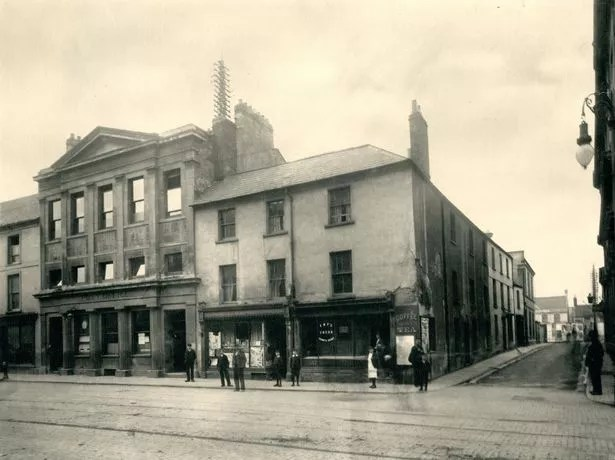
Miss Morgan's Shop
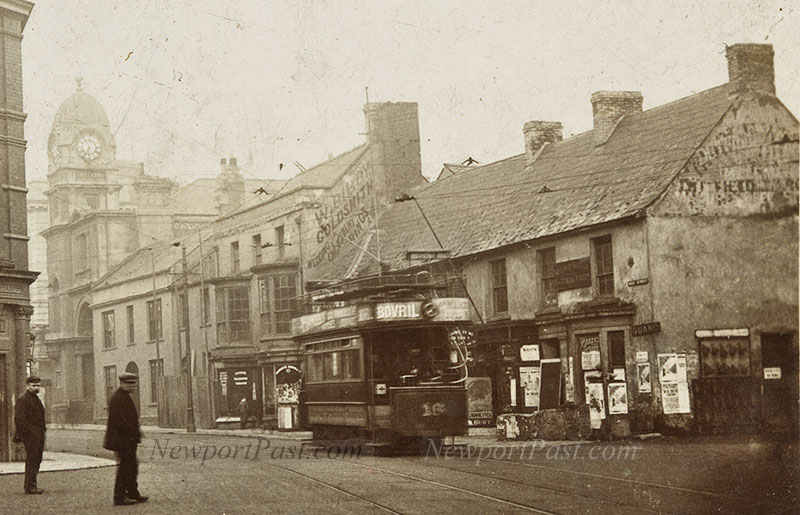
Miss Morgan's clothing shop was at 64 High Street which was on the corner of Thomas Street. The photos above and below show the corner but this would have been at least half a century after the crime had been committed.
'Trespassing in Christchurch'
William Small was summoned for Mmmitting a trespass by walking over some garden ground, belonging to Henry Buckler. The defendant said he done no injury, and was afraid to turn back, the defendant's brother was threatening him so strongly. Ordered to pay the expenses 4s.
— Monmouthshire Merlin, 27th April, 1861
'Bets the Cripple'
Elizabeth Jenkins, alias Bets the Cripple, and Mary Lester, alias the Leicester Duchess, were brought up again, charged with having brutally assaulted with an iron scraper the head of Thomas Jenkins. It appeared that the parties resided in Friars' Fields, and that this was a general quarrel, in which all parties deserved blame alike. The magistrates therefore dismissed the case.
— Monmouthshire Merlin, 24th July, 1847
The Irish Consul
Thomas Welsh, a jaunty-looking Irishman, whose pig and horse-dealing transactions between his countrymen and the Newport folk have affixed to his name the sobriquet of "Tom, the Irish Consul," was charged with having been flourishing his shillelah in a state of drunkenness, during a paroxysm of which happy state, he had brought the aforesaid shillelah into sudden contact with the head-piece of poor Ned Miles.
Miles, who is supposed to be the genuine "Miles's Boy*," did not feel the milk of human kindness changed to gall in his bosom, and knowing that "To err is human—to forgive divine," he pitied the erring Consul, and declined to prosecute.
The magistrate, therefore cautioned Tom against a repetition of his improper freaks, and discharged him from custody. " Now, thin, may ye live for iver, yer wertcbip (sic), cried Tom; "for it's yersilf is the raal gintleman, afther all (sic)". Blarney, Tom, blarney: go on." And the Consul, giving his best bow benchward, made his exit.
— Monmouthshire Merlin, 24th July, 1847
Lock Your Tills
William Dewsbury, who gave a different name when taken into custody, was charged with stealing money from the shop till of Mr. Lewis, Stow Hill. The prisoner, as we stated last week, was seized at the moment of pocketing the money he had been observed to take from the till. He denied having taken any money, saying he had been trying to get a biscuit! but he afterwards gave up four shillings. Mr. Dewsbury was ordered to be imprisoned two months, with hard labour.
It is surprising there should be such carelessness evinced by shop-keepers, in regard to their tills, as to leave both shop and till quite unprotected, thus offering an inducement to the hordes of thieves who prowl about, of which they are not slow to avail themselves.
— Monmouthshire Merlin, 24th July, 1847
Bowling Him Out
Carmey Young, a sweet-meat seller, was charged, on the information of P.C. Evans, with causing an obstruction in the narrow part of High-street, with his tray of sweets. After Evans had proved the case, Young accused the officer of having "bowled" with him and because the officer was beaten, and he would not play again, he was threatened by Evans that he would be down on him some day. Young also complained that others were permitted to "hawk the streets," and why shouldn't he; but he was willing to abstain from going into the streets, if others were prevented also. Evans denied the "bowling" transaction.The Mayor said he saw no harm in playing at "bowls;" for he had had many a game. (Laughter.) Nevertheless, the streets, and especially High-street, must be kept clear. Cautioned to keep out of the street in future, and case dismissed.
— Monmouthshire Merlin, 26th May 1854
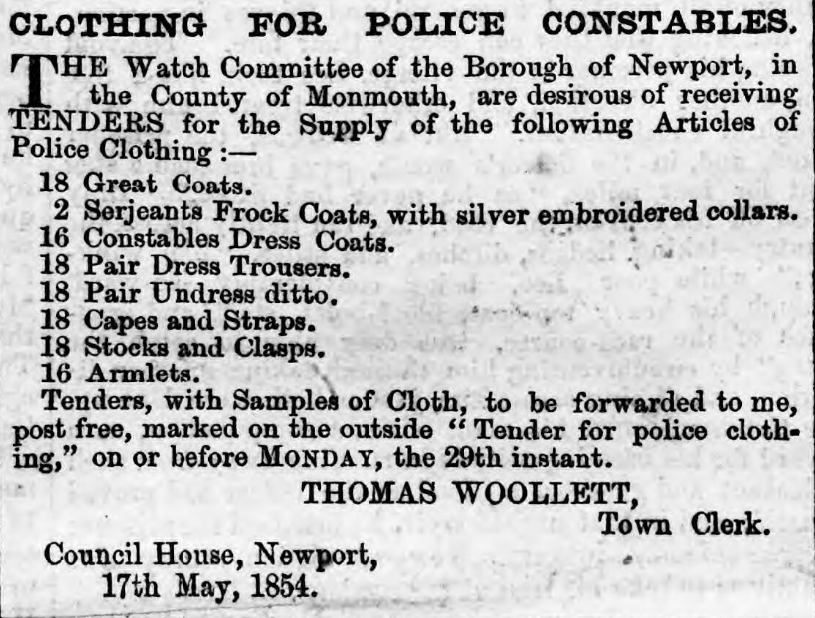
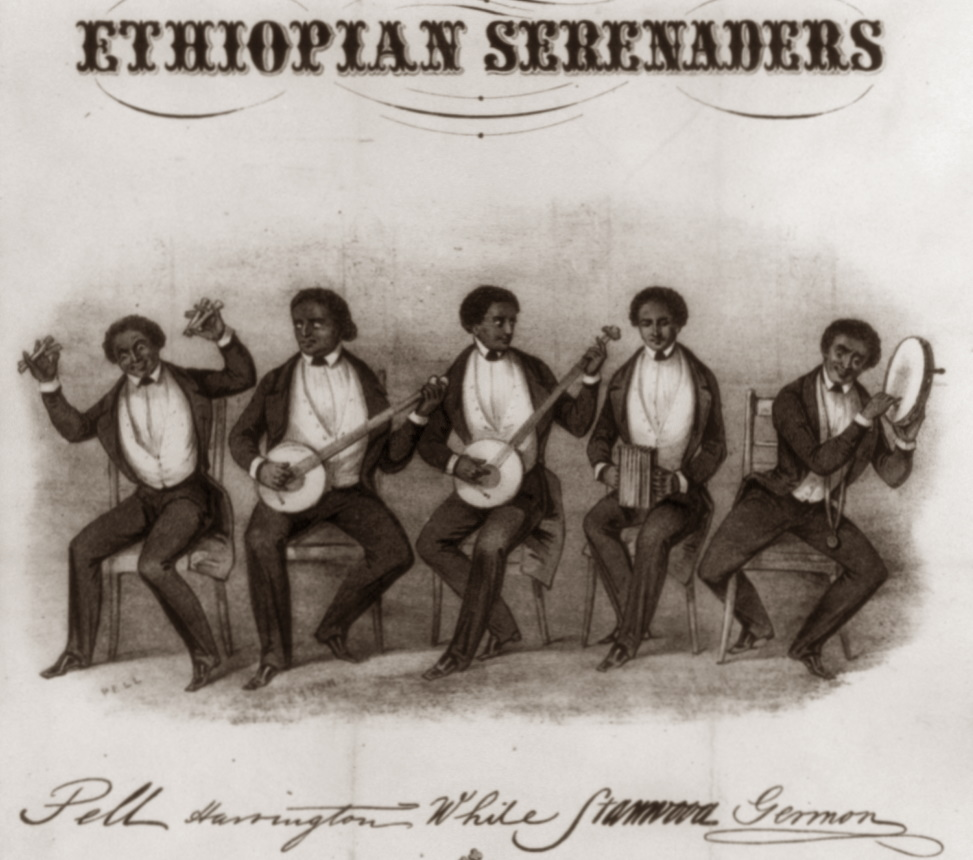
'Ethiopian Serenaders'
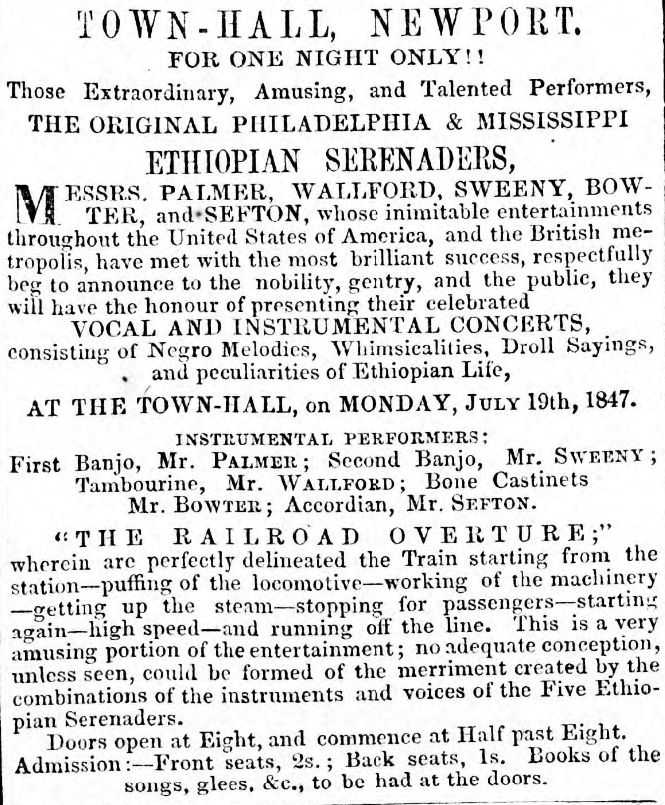
The Ethiopian Serenaders was an American blackface minstrel troupe successful in the 1840s and 1850s. Through various line-ups they were managed and directed by James A. Dumbolton and are sometimes mentioned as the Boston Minstrels, Dumbolton Company or Dumbolton's Serenaders.
They performed at the Town Hall for one night and featured 'Negro Melodies, Whimsicalities, Droll Sayings, and peculiarities of Ethiopian Life'.
Trap-Doors in Pavements
Mr. Iggulden called attention to the iron trap-doors which were fixed in the new pavement outside the premises of Mr. Evans, in High-street, adjoining the Coach and Horses. He considered them dangerously large, likely to cause accidents. Mr. Davis said they should be large enough to admit the passage of barrels into the cellar. Mr. Rennie would not allow a single trap-door, if he could help it. Those now complained of, should never have been permitted. The surveyor should have prevented it.
Mr. Evans had great doubt whether the surveyor has power to prevent it. It would be all exceedingly hard case if that Board were to prohibit the tradesmen of the town from getting into their cellars. How were they to carry on their business if so prevented?
Mr. Rennie said the Board had purchased the old premises on which the building and pavement now stood, and other persons had no right to make holes in the pavement for their private use. It was the property of the Board, who could do what they liked with it; and could prevent persons from converting that into a dangerous nuisance, which was purchased to make improvements.
Townsend said there was great danger attending the opening of any cellar into the street, through the pavement. If people would go on doing work underground, which should be done "on deck," it ought not to be at the risk of breaking other people's legs or necks.
Mr. Davis warmly protested against the injustice and unfairness of disallowing Mr. Evans to have those cellar traps, now that his building had been completed, and while he was, moreover, prevented from having any back-way into the premises.
Mr. Batchelor considered those cellar-traps very dangerous to the public.
Mr. Davis said other traps were also dangerous, in other parts of the town but it was unjust that after they had seen the plans of the new premises, and had allowed the owner to lay out a thousand pounds in erecting them, they should now ruin his property.
Mr. Lyne: But is not the owner of that property ruining ours?
Mr. Davis: Not a bit of it.
Mr. Iggulden said he had merely done what he considered to be his duty, as a public man, in bringing matter forward. He had been struck with the idea that the traps in question were much too large for the pavement — larger, indeed, than most others. As the Corporation purchased the ground, they had a right to regulate the appropriation of it for public uses.
Mr. Townsend mentioned some narrow escapes he had witnessed at the point referred to, previously to the widening of the street, and showed that, as the improvement had been effected to prevent similar accidents in future, it was wrong to allow any one to cause still greater danger to persons using the pavement.
The Mayor did not see how they could well interfere now; the matter having been sanctioned and completed. Mr. Batchelor said it had not been sanctioned yet.
Mr. Rennie remarked that similar trap-doors would not be found in the new Oxford-street, London nor, indeed in any quarter where public street-improvements were proceeding.
Mr. Knapp condemned trap-doors strongly, having met with an accident through one some time ago. They were dangerous, and should not be permitted.
The Mayor: Well; we have been sitting an hour and a half, on just three minor points of business and if we take a similar time on the remaining business, we shall not get away until eight or nine o'clock. (Hear, hear.).
Mr. Homfray stated that he had fallen into a cellar Newport, on one occasion, through the trap-door giving way under him.
Mr. Rennie, with a view to bringing the matter to a conclusion, would move that the surveyor be directed to see that no trap-doors be used in the pavement of the new buildings in High-street.
Mr. Davis would advise Mr. Evans against comply with the order, if made; for it was the most gross thing he had ever heard of in his life. Mr. Rennie was surprised to see Mr. Davis, who could usually keep his temper so well, get into a pet on this occasion. The Board had given as much for the property it was worth, and for what? Why, for the purposes of improvement. Were there any openings in the pavement there before? Were the Board to pay money to cause a greater nuisance than existed before, in a spot where they were professing to make improvements? He would not sit at that Board to be told that, because he could not agree with the propriety of placing those dangerous traps in pavement, he was therefore taking an advantage of the man who had sold them a portion of his property. They had not given the owner the money, that they might improve his property, by endangering the public safety, but that they might be enabled to improve the street. Now, they were to be told, forsooth! that they must not prove the street, but make the small pavement they had gained by their purchase, a dangerous nuisance instead. He would tell Mr. Davis that he had no interest in desiring to injure the owner of the property but he could not consent to have that which the Corporation bought for a public benefit, converted into a public danger.
Mr. Knapp said he would second the motion for refuse the use of the trap-doors in question; for he should hold himself as really accessory to murder, if any loss of life was occasioned by them.
Mr. Davis said he was able to keep his temper as well most men; but he could not help getting warm, when, he saw an injustice of the kind now recommended. Rennie had not recommended them to try if the size of trap-doors could not be diminished; but would do with the doors altogether. The Board, it was, that made the offer to pay for the property. Mr. Evans had not pressed it upon them. They had shut up his back-way, now would refuse to him what every shop, he would bound to say, in town, possessed.
Mr. Rennie: The traps were not there before.
Mr. Davis went on to contend against the injustice 0f preventing the trap-doors being used, and said he should move a direct negative to the motion, if it was pressed.
Mr. Latch suggested that it should first be ascertain what improvement might be made in the traps. The matter then dropped, without a division, on the understanding that the surveyor direct his attention to it, all report at the next meeting.
— Monmouthshire Merlin, 2nd June, 1854


Member discussion