

Welcome to another issue of The Newport Cornucopia where we dig through the newspapers archives for interesting news articles and adverts. All articles are posted verbatim and most headlines are original (headlines in quotes are my own).

Large Egg
Mr. Chapman, builder, has an egg, the produce of a Spanish hen, 3 inches in length, 61 inches in circumference, and weighing 4 1/2 oz.
— Monmouthshire Merlin, 7th May, 1852
Macarte's American Circus
Dos Works School
Distribution of Rewards
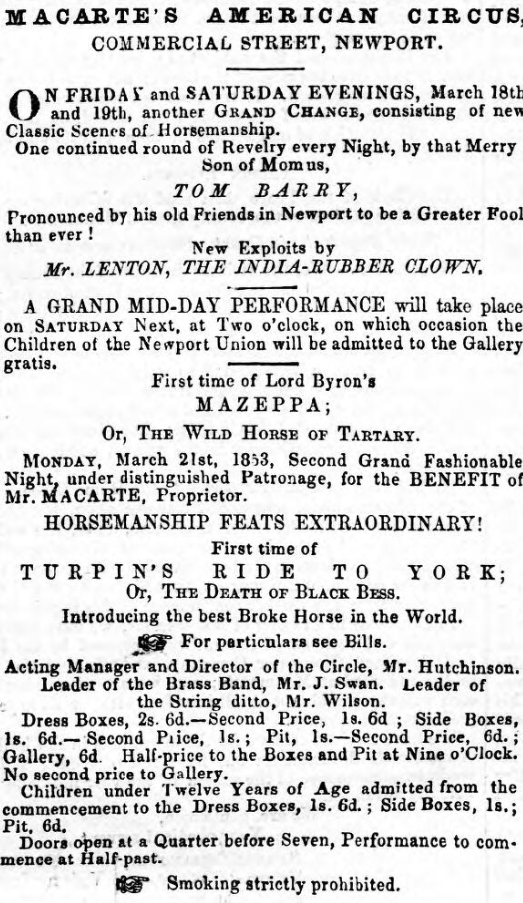
The annual examination of the children of these schools having been brought to a close, T. Cordes, Esq (the Examiner), attended at the school room to distribute three silver medals and several beautiful books as rewards to those children who distinguished themselves in the several classes.
There were also present — F. J. Mitchell, Esq., R. W. Hamilton, Esq., the Rev. Canon Hawkins, and several ladies. 336 children were in attendance.
Mr. Cordes addressed the children, pointing out to them the advantages of education, and urging them to spare no effort to obtain it. Referring to the Sunday School, he said that he hoped to see a larger number attending there than had been the case previously. Many of them attended other schools; but there was also a large number who went to no school at all on the Sabbath, and it was these latter that he should like to see availing themselves of the school held in that room.
Mr. Cordes then ordered the table of merit at the end of the room to be uncovered, which was done, disclosing the names of three boys whose general good conduct and attainments entitled them to receive the three silver medals. In the Works' Schools, Frank Cullen and William Moss, and in the Day School, Henry Spencer. These boys being called to the platform, received each a silver medal in a neat case.
Mr. Cordes, referring to the tablet, remarked that among the names there would be found those of many who had since grown up to manhood, and who had maintained the same good character which had earned for them in their school days a place on that board and he trusted those that were now receiving the medals would do likewise.
Several handsome pocket knives were also distributed to the boys whose attendance at the school had been the best there were among them five boys who had not been absent a single night throughout the year, and these received a somewhat better knife than the others, who had lost some three or four attendances during the same period. The rewards were then distributed, consisting of a large number of beautifully-bound books.
The Rev. Canon Hawkins then addressed the children, expressing great pleasure at what he had seen that evening, and hoping on a future occasion to meet them again. The whole of the rev. gentleman's remarks were listened to with great attention by the children and at the close hearty cheers were given for the ladies and gentlemen present, and for J. E. Lee, Esq., and family, who were unfortunately out of town. The National Anthem was then sung, and the Rev. Canon Hawkins pronounced the benediction.
— Monmouthshire Merlin, 7th May, 1870
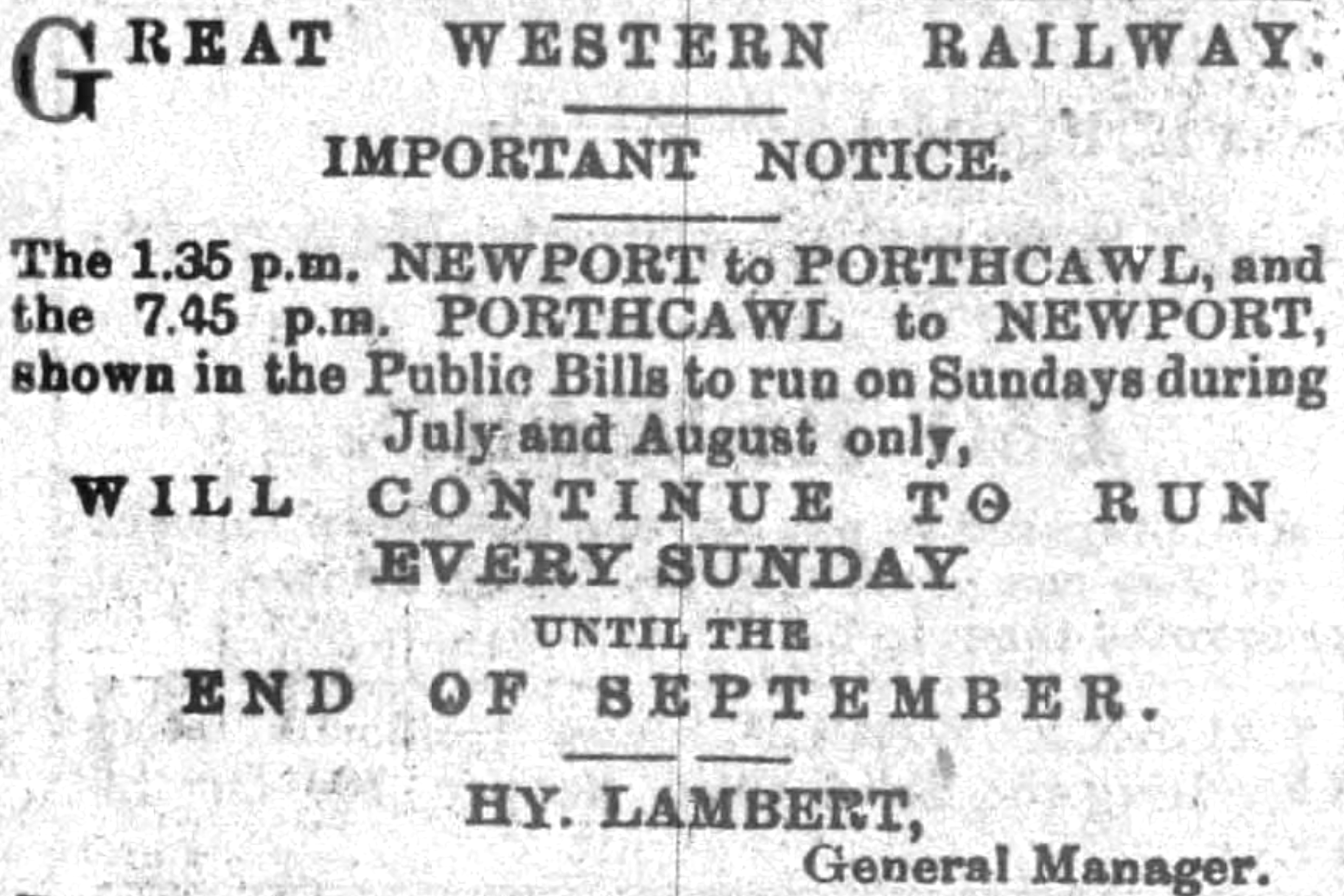
A Station-House at Pillgwenlly
The inhabitants of Pillgwenlly, numbering from seven to eight thousand, are at length in possession of a police station, a great necessity for which had long been experienced. Three of the police force will reside there, who, however, will still divide their duties between Newport and Pill, until the general force is increased.
The extending population of Pillgwenlly, and the insecurity attached to a single policeman, perhaps, bringing a prisoner out of some of the lawless affairs which now and then occur in Pillgwenlly, together with the necessary exposure of property in that place, render it requisite the force should be made more effective in point of numerical strength, that Pillgwenlly might share its proportion of protection arising there-from.
The new station is near "the well," and will soon, it may be hoped, become a terror to evil-doers in the locality.
— Monmouthshire Merlin, 13th January, 1849
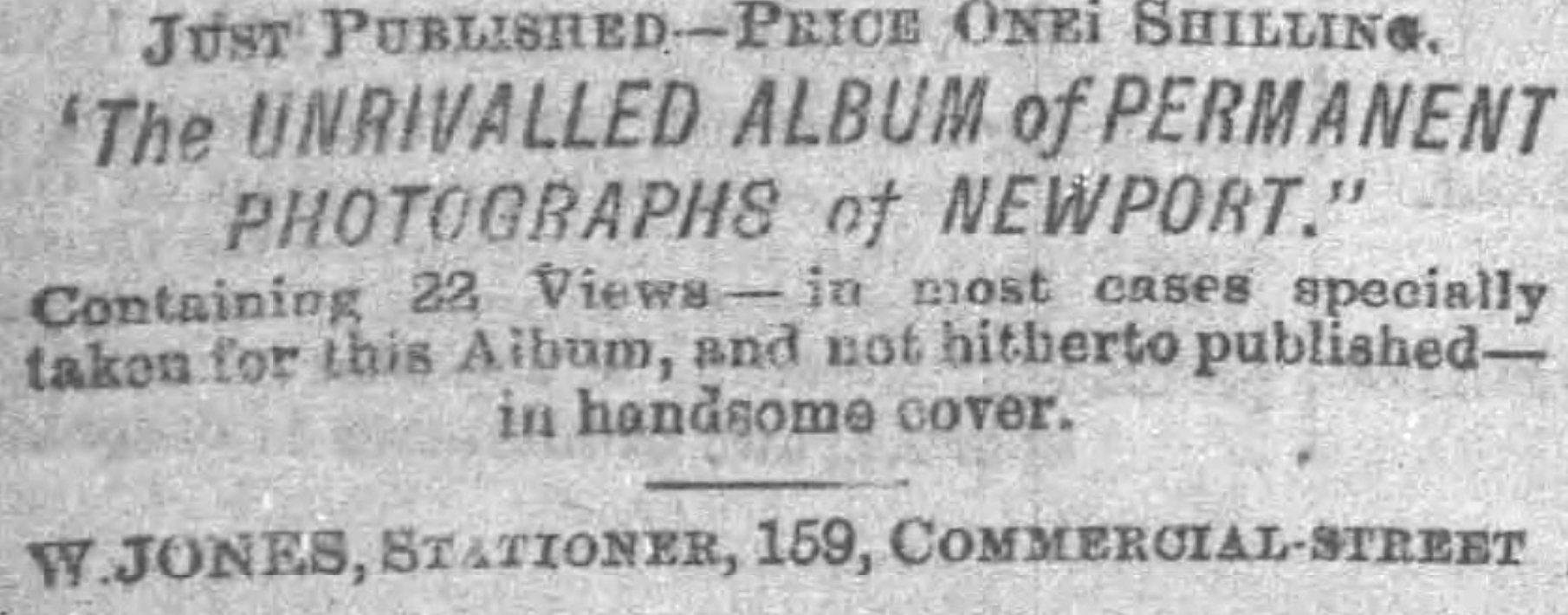
'Trading Shoes for Coal'
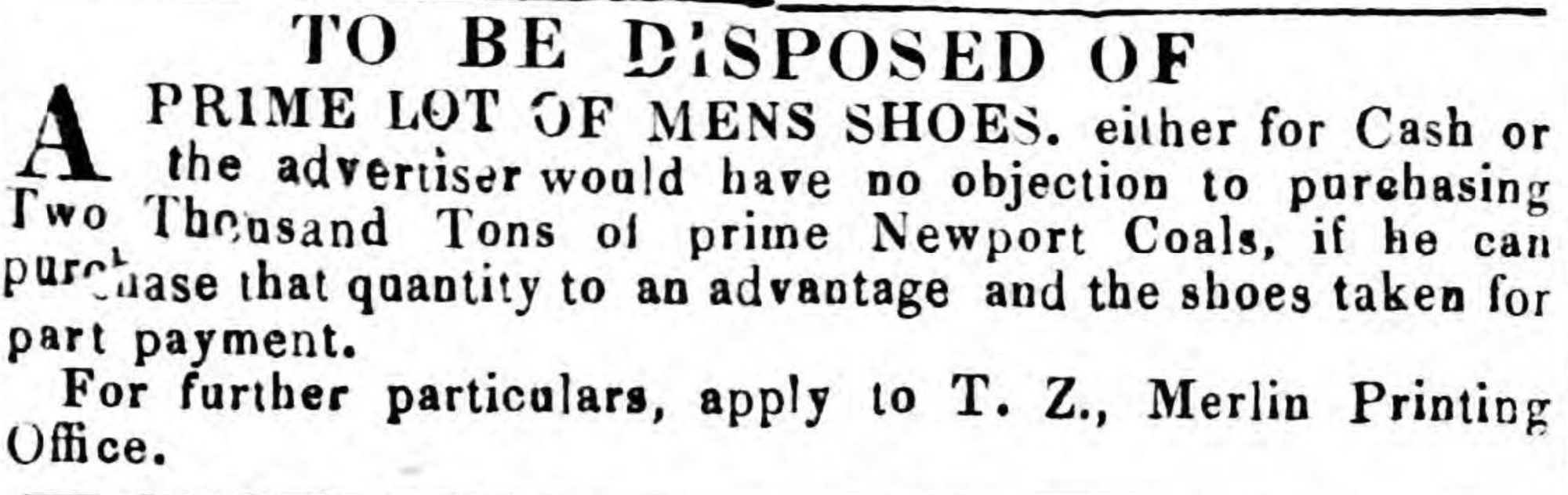
An interesting advert from an 1843 edition of the Monmouthshire Merlin where the advertiser with a 'prime lot of mens shoes' is happy to either sell for case or to purchase two thousand tons of prime Newport Coals if the seller will give a discount for taking the shoes.

A Brotherly Re-union
Jacob Morgan, whose face indicated something relative to broils and chops, being cut up and "cooked" in a nasty manner was charged with the Christmas casualty of drunken and disorderly condllct. Sergt. Hill said Jacob had only just come from West Bromwich to see his brother in Newport, whom he had not shaken hands with for six years before, and in keeping up the Christmas festivity, and the pleasures of the brotherly re-union, they fell a-fighting in so violent a manner, that Sergeant Hill felt himself justified in locking one of them up, the other running away. Fined 5s., and 6d. for a night in the station. Heaving a long-drawn sigh, and appending the moral, 'Twas the drink that done it!" Jacob paid the costs of his very foolish conduct.
— Monmouthshire Merlin, 30th December, 1848
Robbery
Last Wednesday evening, whilst Mr. Oldridge, boot and shoemaker, Commercial street, was taking tea with his family, some thieves entered the shop, and carried off property to the amount of £4 or £5. The police succeeded in apprehending, the same evening, two suspicious characters, who were found concealed in the cellar of the Half-way Beer house, Pill-road.
— Monmouthshire Merlin, 6th January, 1849
Stealing a Supper and a Pair of Boots — "All Serene"
William Cockeral was charged with stealing a pair of boots, the property of John Davies, lodger at the Bird in Hand beerhouse. Mr. Cathcart prosecuted, and Mr. Owen defended.
Last Saturday night, prisoner was at the Bird-in-Hand, having a glass of beer. By and bye, a Mies Cresswell, it was stated, brought in her supper and a glass of ale but going directly after to draw a pint of beer for a customer, she found, on her return, that prisoner had devoured her savoury supper. She asked him to pay for it. "All serene." says he. "Pay for the supper," quoth the indignant young lady. "All serene," was still his reply; and he was then walking off "all serene," when he was stopped in the passage, and down dropped a pair of boots, which had just previously been thrown down under the settle whereon he sat, by a lodger, who was then slumbering "all serene" in his domicile.
P.C. Goold was called in by the landlord, and took the prisoner into custody. Committed to take his trial at the Sessions.
— Monmouthshire Merlin, 4th February, 1853
Stealing Trousers
Stephen Conroy was charged with stealing two pair of trousers—one from the doorway of Solomon Galland's shop, and the other from the outside of Henry Hazell's shop, Pillgwenlly. Mr. Cathcart prosecuted.
The prisoner was seen to unhook Galland's pair, and carry them off, by Sarah Hall, servant of Mr. James, surgeon. She gave information, and Galland and a young man named Fromberg, pursued the thief. The trousers were picked up by Galland in Albert-street; and the man was caught by Fromberg behind a door in a house near the spot. He acknowledged committing the theft, saying he had been driven to rob by want. When Sergt. Lloyd was searching the prisoner at the station, he found a pawnticket for the other pair of trousers pledged at Mr Stocker's. The garments were now identified by the two prosecutors; and the prisoner was committed for trial in both cases.
— Monmouthshire Merlin, 4th February, 1853
Stealing Turnips
Two decently-dressed women, one being the servant of the prosecutor, and the other carrying an infant in her arms, were charged with stealing turnips from a stack, the property of Mr. Philip Williams, farmer, Crindau. Mr. Woollett was attorney for the prosecution. P.C. Moore proved seeing the prisoner Power bringing turnips into town. He stopped her, and subsequently found that they came from Crindau, where, on enquiry, the servant (the other prisoner) acknowledged, first, having given the turnips, and then, that she had told Power to take them. Mr. Williams gave her into custody.
Mr. Williams now said he had turnips of the kind produced, in store. The servant had no right to give any away, though Mrs. Williams sometimes gave some away, and ordered the servant to give them to the applicants.—Case dismissed.
— Monmouthshire Merlin, 18th February, 1853
Stealing Oranges
Hannah Lewis, a little girl, was charged with stealing thaee oranges from the shop of Mrs. Edwards, stationer and fruiterer. Mrs. Edwards said she had frequently missed things, but she did not know that the prisoner had stolen them; and she did not wish now to press the case. Seriously admonished by the Mayor, and discharged.
— Monmouthshire Merlin, 18th February, 1853
Vagrancy
Dennis Barrett, for begging at Michael-stone-vedw, was sent to prison for a month. In his possession was found sufficient bread and cheese for a month's consumption.
— Monmouthshire Merlin, 2nd July, 1859
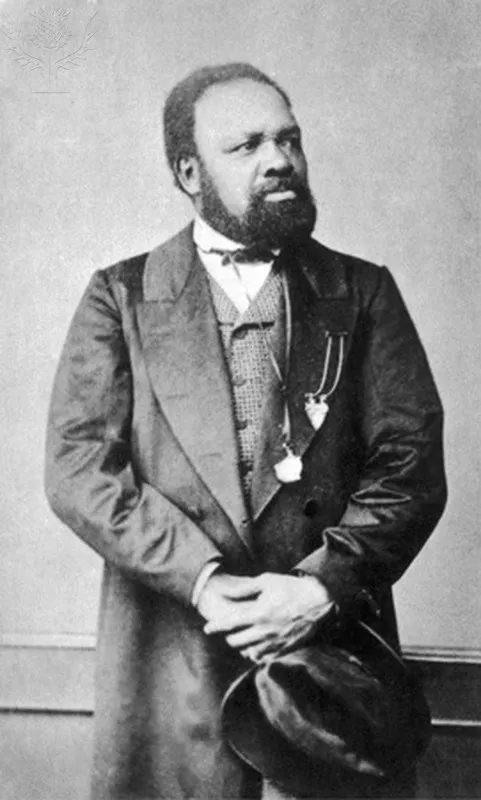
Ira Alridge — The African Roscius
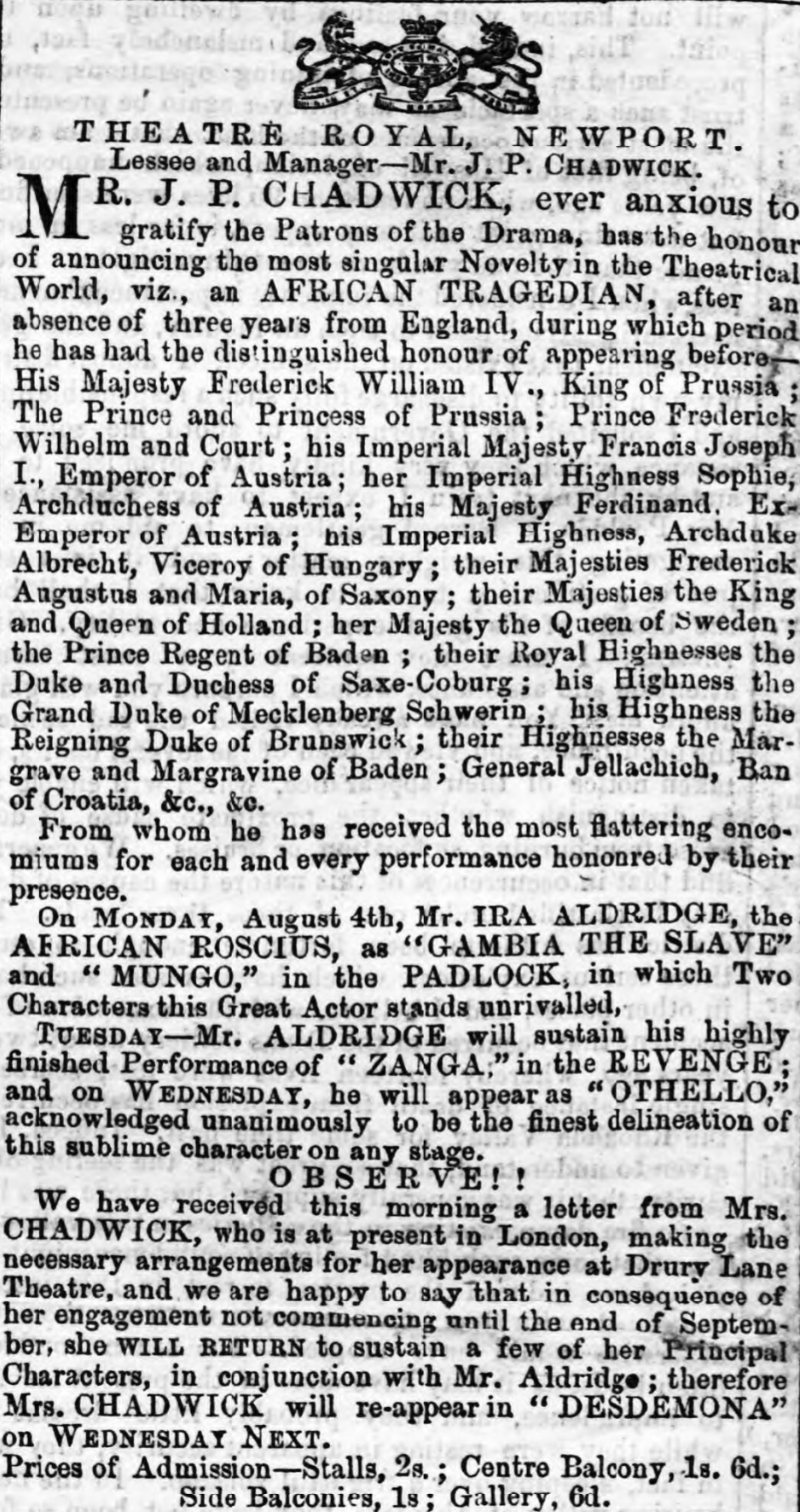
Ira Aldridge (1807–1867), known as the ‘African Roscius’, was a pioneering African-American actor who left New York for England in 1824 to escape racial prejudice. Renowned for his Shakespearean roles, particularly Othello, he toured extensively across Britain and continental Europe, earning critical acclaim and eventually receiving British citizenship in 1863. Throughout his career, Aldridge used his platform to advocate for the abolition of slavery, leaving a lasting legacy as both a celebrated tragedian and a dedicated activist before his death in Poland.
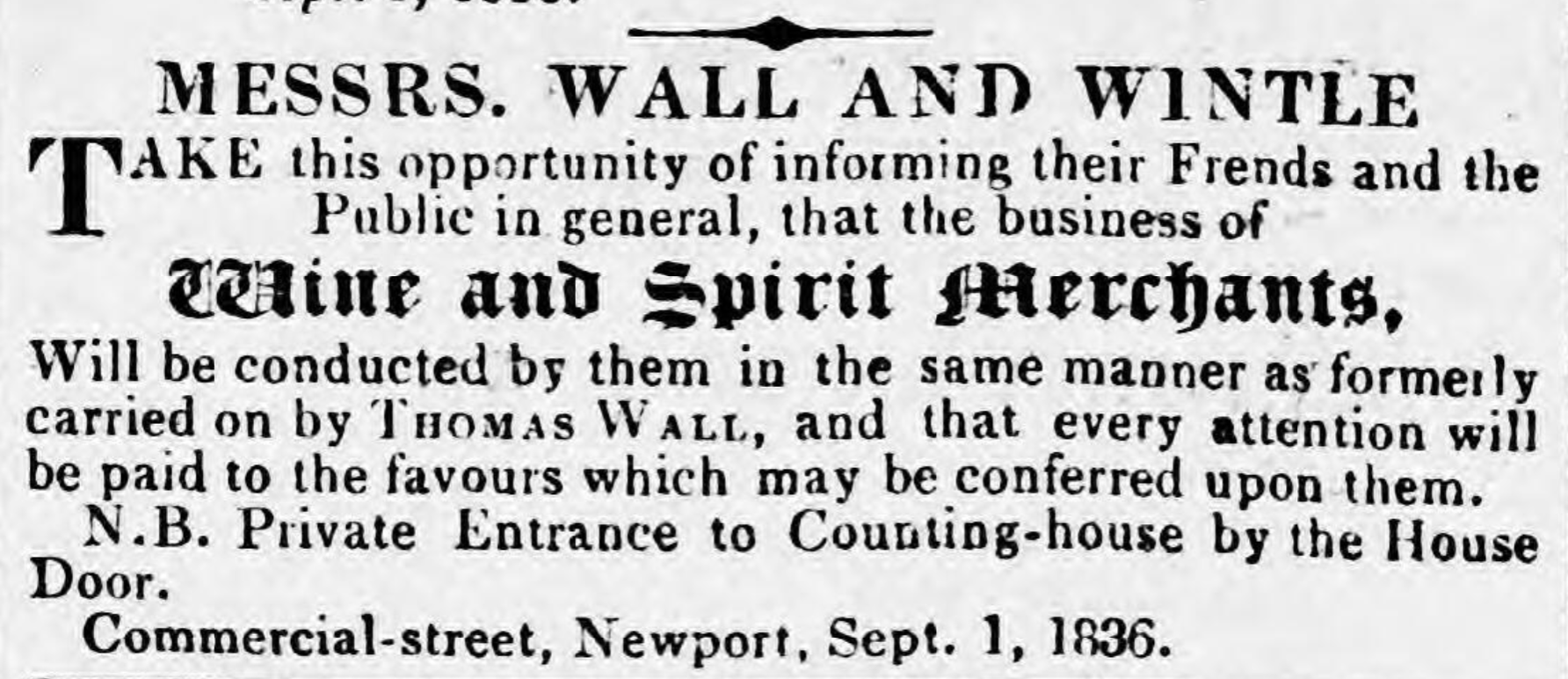
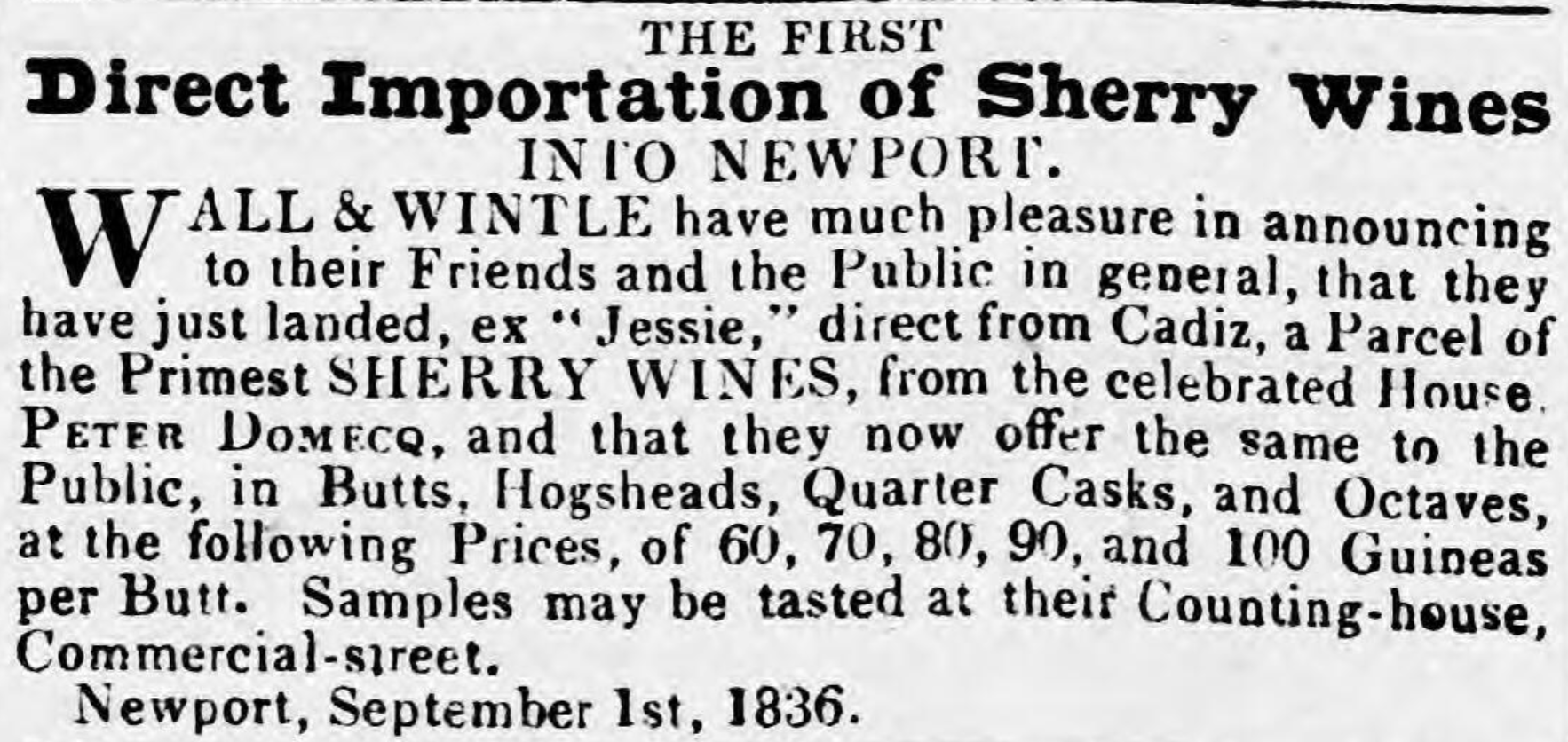
'The First Direct Importation of Sherry Wine'
'Discussion of Friar's Fields and a New Market'
Alderman Mullock remarked that this was a very important subject, and he trusted it would receive due consideration from the Board. Mr. Townsend coincided, and was of opinion the Board would do well to ascertain if they could obtain the property at a fair and reasonable value.
Mr. H. J. Davis said it was all very well to speak of the desirability of purchasing the property, but where was the money to be obtained?
Mr. Townsend: Oh, get it by hocus pocus, as it has been done before.
In answer to the Mayor and other gentlemen, Mr. Graham explained the conditions under which the property would be sold, conformably to the advertisement published in this journal.
Mr. H. J. Davis did not mean to say but what it would be a great advantage to the town, to get possession of the property. Where, however, were they to obtain the money? Mr. Townsend said "Get it by hocus pocus" but that seemed to be a very curious way.
Alderman Homfray: Could we not pay the money back in the same way? (Laughter.)
Mr. Townsend: You may laugh; but time will tell you that many things I have said are right, and that all I have stated has not been frothy and worthy of no weight.
Mr. Moore inquired if there were any power vested in the Town Council to borrow money for such a purpose. The Town Clerk could not upon that point see his way clear at present.
Alderman Homfray said the points they had to consider, if a purchase were contemplated, were the value of the property, the rental of it, and the improved rental that could be made by the Corporation. If no improved rental could be made, then there would be little utility in buying the property.
Alderman Mullock thought their first consideration would be what they should be enabled to make of the property, supposing they came into possession of it. The next would be the price, and whether their object could be obtained, if for instance the ground were required for a market.
The Town Clerk: You would be empowered to raise money for a market.
Alderman Mullock continued After ascertaining the price, their succeeding consideration would be whether they might look forward to a return upon the money invested. It would prove a very important property if they could get hold of it; and the present appeared to be the time for obtaining it, if they desired to devote it to any public purpose.
The late Mr. Beaumont used to say — "If ever a fire should break out in Friars'-fields, for God's sake do not extinguish it."
The prevalent opinion was in favour of the conversion of the property to some public and useful purpose, and it behoved them to take the matter into serious consideration.
Mr. H. J. Davis thought it right to hint, with regard to the question of a new market, that they must be prepared to buy out the Duke of Beaufort's interest in the old one, and for which he (Mr. Davis) knew £ 11,000 had been asked.
Mr. Brown: I wouldn't be afraid to fight the Duke of Beaufort upon that.
Mr. H. J. Davis: You are a very bold man. You don't mind fighting anybody but there are rights and interests which Parliament will always protect; and the Duke of Beaufort must be consulted.
Mr. Brown: He would not have a leg to stand upon. It would be a parallel case to the Rhymney railroad. When one company would not accommodate the district, another was permitted to do so.
Alderman Homfray: A market could only be erected subject to the purchase of the Duke's rights.
Mr. Townsend said it was well for Newport that it had a few bold men at the Board. Notwithstanding Mr. Davis's statement that the Duke of Beaufort must be consulted, he told Mr. Davis that the Duke was subject to the laws of his country. But those sort of men would do anything. He was one of those who would willingly fight along with Mr. Brown in the matter.
Alderman Homfray: The Duke of Beaufort is subject to the laws of bis country as well as any one else but while he is subject to the laws of his country, he is also subject to their protection.—Mr. Townsend having made an allusion to Aunt Sally and "the forensic power and ability of the Duke," Alderman Homfray continued—I think you had better not treat the subject as between the Duke of Beaufoit and the town, but as between the Lord of the Manor and the town.
Mr. Townsend: I am aware of it; but as Mr. Davis is always menacing us with this big man, if he were as big as a lion I would have a shy at him if he offended me. Other observations of Mr. Townsend called up.
Mr. Davis, who demanded protection from the Mayor from the insults of Mr. Townsend, and declared he would not be continually insulted there with impunity. He might retort upon Mr. Townsend, but he had never thought proper to descend to do so.
The Mayor interposed, suggesting to Mr. Townsend the expediency of divesting his remarks of anything personal. Presently, however, Mr. Davis again complained of personal insult. The Mayor threatened to leave the chair if Mr. Townsend persisted in a course offensive to any gentleman present, and Mr. Townsend exclaimed ho would not be put down by Mr. Davis or anybody else.
Ultimately the matter of the sale of Friars'-fields was referred to the Public Works Committee.
— Monmouthshire Merlin, 9th July, 1859
Report of Committee on Private Streets
GENTLEMEN,—The Committee having carefully examined a portion of the streets, at present exempt from the rates for road repairs, and which are claimed by the Tredegar Wharf Company and others as private property (the ownership of which it was no part of the duties of your committee to inquire into), unanimously recommend to your Board as follows:-
That COMMERCIAL-ROAD, from the Salutation Inn, in a straight line, to the Railway Gate, near unto the public well at Pillgwenlly, be taken to, when and so soon as the pavements on both sides shall have been efficiently repaired and improved, to the satisfaction of the Town Surveyor, as well as properly channelled, in accordance with the channelling now being laid down in Commercial- street, and that the Board pay towards the cost of the said channelling the sum of £150, it being estimated to cost £350.
That RUPERRA-STREET, one of the principal thoroughfares of the town, be channelled on the pavement side, and that the side next the market be curbed and channelled, and the path be made up with suitable material, your board contributing half the estimated cost of the channelling, or £50, and then taken to by your Board.
That BOLT-STREET be slightly altered, both road and pavement, and the side next the Monmouthshire Railway and Canal Company's works be paved and channelled, and that the Company be invited to complete the same as early as possible, and whilst these works are being carried out.
That CANAL-TERRACE (a very short street leading to Dock-street) shall be efficiently repaired, so as to enable your Board to receive both streets at the same time.
That TEMPLE-STREET have the pavement put in a good state of repair, and then be taken to by the Board.
Also, that NEW-STREET, POTTER-STREET, CHURCH-STREET, HIGH-STREET, SPEEDWELL-STRRET, and CASTLE-STREET, be taken to by your Board as soon as the pavements are completed and repaired.
With regard to GRANVILLE-STREET, we desire to see the pavement already commenced speedily completed, the roadway itself properly metalled, and that Mr. Murphy's railway be permissively allowed to remain as it is. This street then taken to by the Board.
The ROAD from GRANVILLE-STREET to LOWER CROSS-STREET your Committee report as being in a most disgraceful state. When visiting this spot we were told that Mr. Powell claimed as his property that portion between his premises and the railway. If such be the case, then we recommend your Board to call on Mr. Powell to put the same in proper condition but in any case we urge your Board to get the question of right ownership speedily settled, with the view of affording the public a highway so necessary for the convenience of trade.
From RUPERRA-STREET into DOCK-ROAD, and part of WINDMILL STREET, and the property of Mr. T. F. Lewis, we recommend that Mr. Homfray should accompany us, and meet Mr. T. F. Lewis on the spot, to settle upon the proportion of work to be performed by each party. At present this locality is in a bad state.
HENRY SHEPPARD, Mayor.
JAMES BROWN.
— Monmouthshire Merlin, 9th July, 1859


Member discussion