

Welcome to another issue of The Newport Cornucopia where we dig through the newspapers archives for interesting news articles and adverts. All articles are posted verbatim and most headlines are original (headlines in quotes are my own).

Capture of a Sturgeon in the River Usk
During the past day or two Mr. Edgar Fennell, of High street, has had on view at his shop a fine sturgeon, which was netted in the river Usk near Caerleon. The presence of sturgeon in local waters is exceedingly rare. The one in question was seven feet long, and it weighed 140lbs.
— Monmouthshire Merlin, 30th May, 1884
House with Fruit Trees For Sale on Lliswerry Common
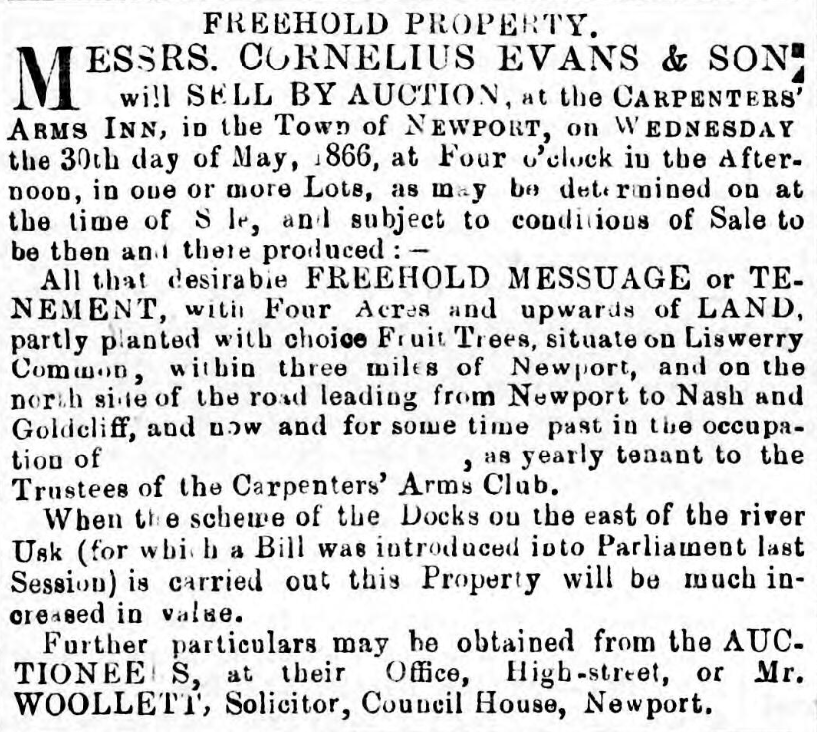
An advert published in the Monmouthshire Merlin on 26th May, 1866 offered a house with over four acres of land including 'choice fruit trees'.
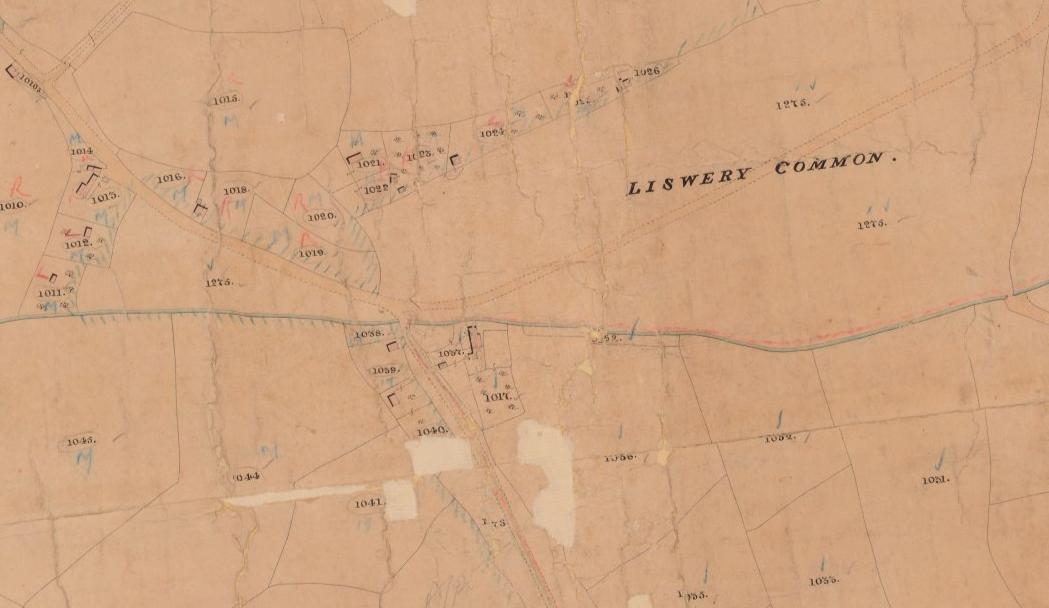
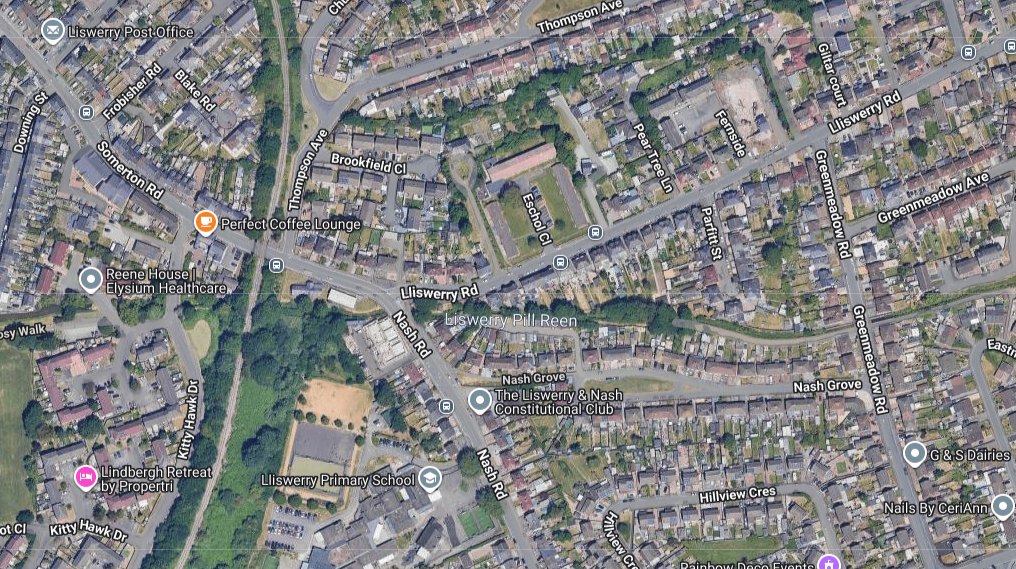
The common has long gone although the outline of it can still be seen when comparing the tithe map from 1840 to a modern day aerial shot. Thompson Avenue is at the northern edge, Lliswerry Reen at the bottom and Lliswerry Road bisecting it.
Carpenters Arms Club
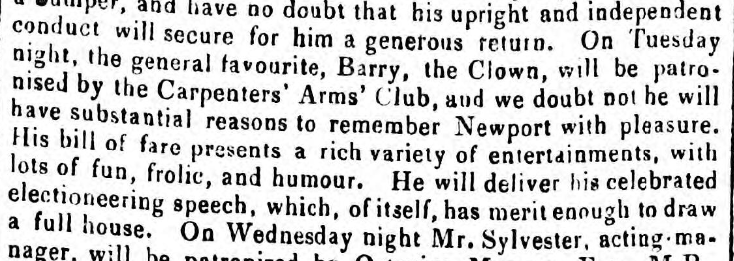
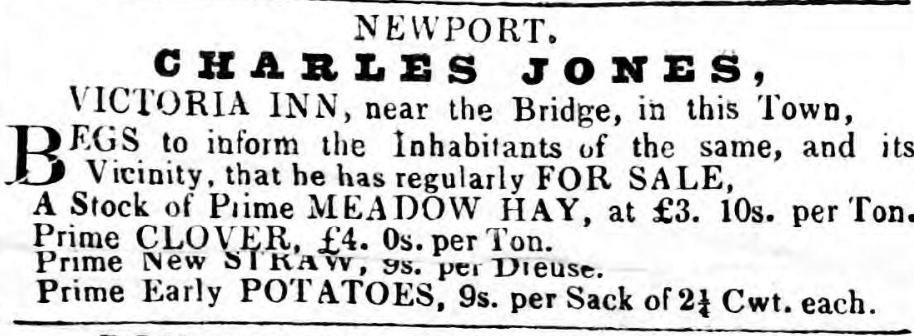
Mentioned in the advert above is the Carpenters Arms Club and then being the owner of the common. There are a few mentions of the club but I'm not sure exactly what it was other than being a club of 'gentlemen and tradesmen'. In 1842 there was a mention of Barry the Clown visiting the club when Cornwall's Circus was visiting the town.
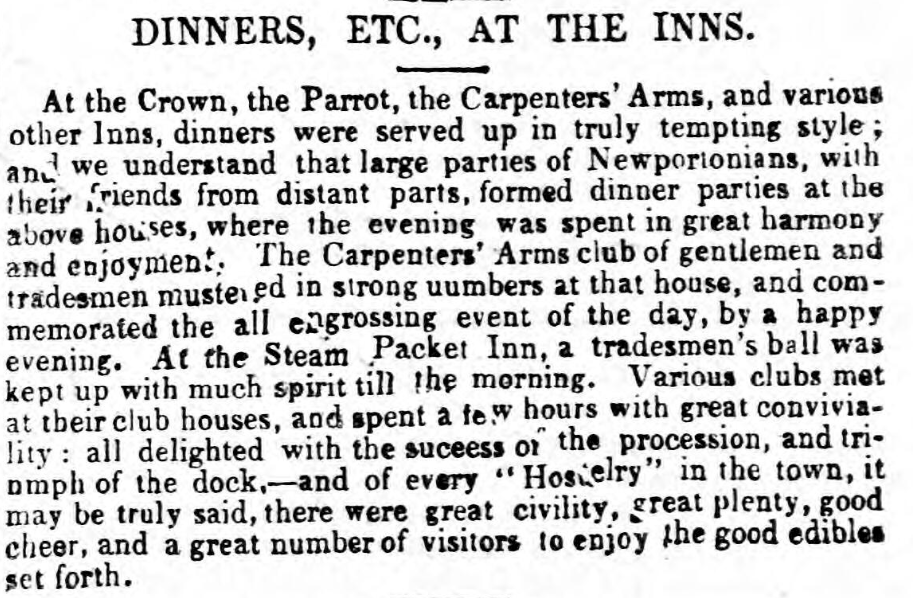
There was another mention in 1842 about a dinner being held at the club along with ones at the Crown and Parrot.
There was a mention of one of the members in the death notices in 1848 being one John Morgan who was a corn and provision merchant.

There were a couple of mentions of John Morgan such as a partnership with William Townsend being dissolved in 1832 and him becoming insolvent in 1838.
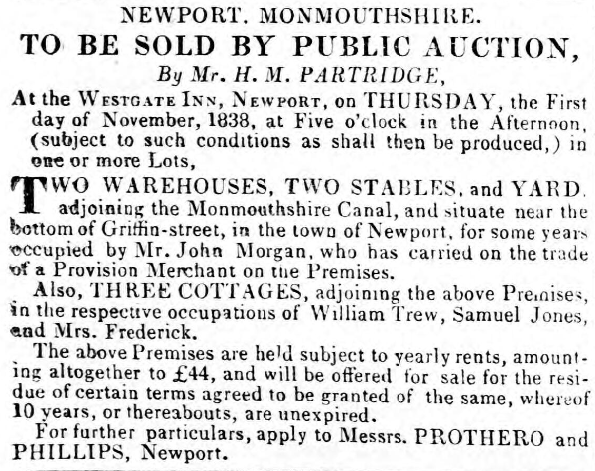
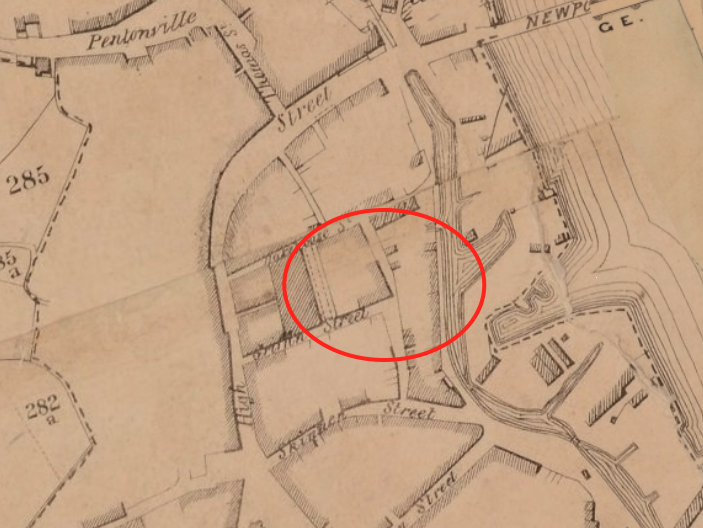
An advert associated with the insolvency places him at the end of Griffin Street near the canal.

Foul Language
Elizabeth Bragg was charged with using threats and bad language towards Sarah Higley, living on Stow-hill. It appeared that abusive language had been freely bandied between complainant and defendant, and both were bound over to keep the peace for three months.
— Monmouthshire Merlin, 20th September, 1856
Stealing Clothes
Margaret Madden and Harriet Langdon were charged with stealing an apron that had been hung out to dry. Rebecca Tucker said she hung a blue apron in the back yard to dry, and she afterwards saw Mrs. Madden untying the apron from the line. Harriet Langdon was with her. She threw the apron to Harriet Langdon, who carried it to Mrs. Madden's house. She said it was hers, and therefore she had a right to take it. The apron, which was described as of the full value of one penny! was produced, and complainant swore it was hers. The elder defendant, however, persisted in saying that it was her property and Mr. Champ, who appeared for her, talked of an action in the County Court to adjust the difference. The case was dismissed.
— Monmouthshire Merlin, 20th September, 1856
Crimping
Thomas Bryan, described by the police-officers as a fellow hailing from the "Rose and Shamrock" beerhouse, Canal-side, whose only known pursuit was that of inducing sailors to leave their vessels, and go to tbis house, was charged with being found at night with a bundle of seamen's clothes in his possession, of which he could give no satisfactory account. There being no evidence to prove that the things were stolen, Bryan was discharged—being advised by the Magistrates to leave the town, as he was well-known to the police, and would probably get into trouble if he remainad.
— Monmouthshire Merlin, 18th December, 1856
A Good Natured Simpleton and a Dishonest Tramp
John Purnall, a tramp, was charged with stealing a pair of cord trousers, the property of John Hopkins, labourer, Caerleon. In the evening of Tuesday, the 8th instant, the prisoner and prosecutor met at the St. Julian's Inn and drank together.
Prosecutor had a bundle, containing a pair of trousers and some victuals. Prisoner left the inn first, and took the bundle with him. Prosecutor followed and overtook him before he got to Duckpool-farm, and prisoner gave up the bundle. They walked on together, and the prosecutor, with the greatest simplicity imaginable, asked the prisoner to hold his bundle until he went into a field for a few minutes. When he came back the prisoner was gone. He went towards Mr. Firbank's brick yard, and sat down for about ten minutes. Prisoner then came on wearing prosecutor's trousers. When told that he had better take the trousers off, he did so and having put on his own, he ran off again with prosecutor's trousers. On the same night the prisoner sold the trousers to a clothes dealer in Skinner-street, Newport, for 3s. 6d.
Prisoner was further charged with stealing a pair of trousers, a vest, and a handkerchief, the property of James Morris, fisherman, Caerleon. On the night of Monday, the 7th inst., the prisoner slept at Morris's, and breakfasted with him next morning. After breakfast they went out, and Morris locked up his house. On Tuesday night Morris did not go to his own house, but slept at his sister's. On Wednesday morning when he went home, he found the door open. He went to his tearoom, and saw that h's box had been broken open, the trousers, vest, and kerchief taken out, and an old pair of trousers left. On reaching the house he found he had lost the key of the door, and he supposed prisoner must have taken it from his pocket on Tuesday morning whilst they were drinking together at the White Lion, and the Bell. Witnesses were called to prove that prisoner sold the vest and kerchief, and pawned the trousers in Newport. Prisoner was committed for trial on both charges.
— Monmouthshire Merlin, 18th September, 1874
Stealing a Sheep's Caul
William Evans was charged with stealing a sheep's caul from the public slaughter houses. A butcher named Davis said he was at the slaughter houses about ten minutes to six on Friday evening. Prisoner was there and appeared to have something under his coat. Just as the man was going out of the gate witness stopped him and took from him the caul produced. George Baker, the superintendent, said he gave prisoner into custody. The man had no business in the slaughter house. The caul was the property of William Allan and would be worth 1s.
A good many petty thefts had been committed at the slaughterhouses. P.C. Widcomb said he received the man into custody about half-past six. He was very drunk and made no reply to the charge. Prisoner elected to be tried by the Bench and pleaded guilty. He said he was very sorry for it. He had had some beer. Superintendent Huxtable said he had been twice before charged with theft, but neither case was sustained. Prisoner was sentenced to fourteen days' hard labour.
— Monmouthshire Merlin, 18th September, 1874
'Assaulting a Wife at the Battle and the Breeze'
Eugene McCarthy was charged with assaulting his wife, Mary McCarthy. The facts, as spoken to by the complainant and a police-officer, were as follow:-
The prisoner had been married about six months; and soon after his marriage, had left his wife, and associated with a prostitute. About two months ago, he came back, and took his wife out of a situation which she had obtained. After remaining a few days, he again deserted her. She learned one evening that he was at the "Battle and the Breeze," a low beer-house in Cross-street, and on going there, she found him and his female companion in the house.
On her asking him to go home, prisoner attacked her in a brutal manner with his fists, and also assaulted his own mother, who went with complainant to try to get him home. The worthless fellow was sharply reprimanded by the Bench, and ordered to be imprisoned for three months at hard labour.
— Monmouthshire Merlin, 18th December, 1856
'Assault at the Battle and the Breeze'
Daniel Neale was charged with sealing a cap, the property of Henry Harrhy, and with assaulting him. Defendant had been taken into custody on this charge, and the police had a warrant against him or assaulting, with two others, John Roach. John Barrett, one of the party, was therefore brought up, and the two were first charged with the assault upon Roach.
John Roach said, I was at the Battle and the Breeze beer house on Christmas eve. As I was having a jug of beer with a young man, the defendants came in and took the jug from my companion. He and Barrett were going to fight, and I made him drink to keep the peace with Neale and Barrett. At eleven o'clock we came out, and the defendants followed us. After speaking, Barrett struck me on the face, and kept on for about five minutes. They then set on my companion, and knocked him down. I went to my house and got a cane, with which I struck Barrett. Neale kicked me and knocked me down, and in the row I lost 3s. 9d.
Henry Harrhy was then examined as against Neale for the assault and theft in Cross-street, last week. He had lost his cap, and was struck a violent blow on the mouth. Never spoke to the man before that light. Was sure Neale was the man. Neale was fined 5s. and costs, or fourteen days, for assaulting Roach the other case was dismissed. Barrett was dismissed, as ioach appeared to have given him a violent blow.
— Monmouthshire Merlin, 24th May, 1856
Hubbub in the Market
There are many persons in this trafficking world who make a great parade of doing good to their fellow-creatures, while, in the stead thereof, they but benefit themselves.
Of this class of self-worthies was an old lady who, on Saturday last, in a junta of cherry-ripe women in our market, assembled for the purpose of taking into consideration the necessity of upholding the price of the cherry in the market, violently declared she would not stick to the standard of "tuppence the pund (sic)," but out-sell them all at a penny per pound, for the benefit of the cherry-eating part of the community. This determination she avowed with oaths, and rushing to her basket, she set up so terrible a concert of "cherry-ripe" cries- "here they are at a penny a pund, buy who will," &c., &c., that all the penny-provided boys in the market flocked to buy.
A sage old philosopher was attracted by the hubbub, and went along with the crowd, wisely supposing he might pick up a few crumbs of wisdom even from a cherry market competition. He narrowly watched the noisy old woman, as she vociferated, "Sold agin, to a nice young genelman (sic), with seventy pounds a-year," and at length detected the clamouring she-philanthropist holding the scales in which she so liberally weighed out her cherries, by her finger and thumb, so placed on each side that she could make "a thumping pound" out of twenty cherries. And thus our keen-sighted old observer detected the secret by which the woman could afford to laugh at the competition of her neighbours; and having pondered awhile on this novel mode of appearing generous, he followed one of the cherry-buying urchins, and begged him to weigh his "pound of cherries." This was done, and they did not even weigh half-a-pound. Determined, as Shylock, who would have his "pound of flesh," the disappointed youngster and the philanthropist resolved on exposing the artful vendor, and thus get full weight.
Back, therefore, they proceeded, and the lad laid open his statement, demanding more cherries, and stating that the discoverer of the beam-trick was the old gentle- man by his side. Out fled the "cherry-ripe," and tore after the strange little man, vowing she would have his blood but he having a nimble pair of heels, scampered through the market at a steaming rate; and after a long run, escaped minus only one skirt of his rusty black coat.
Our philosopher told the tale with much glee, but added that a beautiful moral might be drawn from the occurrence, which was—"Never trust an open professor of charity to all men, further than you can see him."
— Monmouthshire Merlin, 6th August, 1842
Something Novel
There is now lying in our Dock a fine ship, carrying Austrian colours, and owing to the disturbed state of her country, has two nine-powders mounted on her broad decks, while she has also in the state room on deck, about twenty muskets, two or three blunderbusses and foreign pieces, and a bright complement of highly-tempered Turkish blades.
Her well-exercised crew look a bold and daring band, just the sort of men who could keep the decks of so fine a ship to themselves, under the direction of an intelligent and active commander. Among other fine vessels now in the Dock, is a Dutch East Indiaman, which is attracting great attention.
— Monmouthshire Merlin, 30th September, 1848

Melancholy Circumstance
There are some occurrences which tend to make men believe in the foreshadowing of coming events, as afforded by dreams and that which we are about to narrate will appear to belong to that class; for here we find a father and a husband in the next county, at Merthyr, dreaming for two or three consecutive nights that some hurt was about to befall his family; and scarcely has he apprised his wife (who recently resided in Newport) of his dreams and apprehension, before an only son is suddenly lost from his mother's side by drowning, almost before her eyes. The particulars of the sad event, are as follow:—
A man named Longfellow, working at Merthyr, sent a letter to his wife in this place, saving that he was very much distressed in mind, as he had had a dream for two or three nights, in which he saw himself suddenly surrounded by some great trouble, which was occasioned either by injury to her or their only child—a very interesting boy of five years old. He therefore begged her to come to Merthyr, that he might be relieved from his forebodings; and he particularly cautioned her to avoid all danger on the way.
Anxious to free her husband's mind from its distress, and to show him that herself and his darling boy were well and happy, she on Wednesday morning settled her affairs in Newport, packed up her goods, and placed them all ready for her departure but before she went, she bade her neighbours good bye. While at the house of one, taking some refreshment, to which she went accompanied by her little boy, she was talking of her journey, and did not perceive the absence of child for a few minutes. In the interim, he had stolen out, and with his bread and cheese in hand, was talking to a woman, saying he was going away presently, for his mother had washed and dressed him for the journey; and then the little merry-hearted fellow ran off, saying he was "going to say good bye to Johnny," who had been his playmate. Nothing more was heard or seen of him alive.
This was close by the canal, near the Dock Tavern bridge, over the canal. Then the mother came out to look for him, and became alarmed at the absence, remembered her husband's dreams, and ran screaming here and there, but no one could give her hope or tidings of her lost one. Shortly after, a cap was seen floating on the canal; and then the people cried out he was drowned. This was but too true.
A raft of timber was being taken along, and the boatman, in drawing up his pole and hook from the water, after pushing the raft along, drew up the ill-fated child He was quite dead and though some persons thought if the usual means were resorted to, he might have been rescucitated, others shook their heads mournfully, and said, it was doomed—it could not be otherwise! The wretched mother—frantic and heart broken, clasped the inanimate corpse of the dear child she had just before beheld vigorous and bounding with joy and health but all her terrible grief could not restore him. It was, indeed, a pitiful spectacle and it is but harrowing up our own feelings further to describe it. The jury—humane men—who sat upon the inquest, threw their shillings into one heap, and sent the foreman to place it in the poor mother's hands while their rough condolence, meant to be conveyed to her, was broken in so like sobbing, and tears stood in their as their own dear little children at home.
The name of the unfortunate boy was John Longfellow, and he had just entered his sixth year. As his body lay upon the table in one of the apartments at the Dock Tavern, where the inquest was held, his fair, curly locks fell back over his head, and his face, clean and still ruddy, had a pleasant expression upon it, as it he had had no struggle in his dying moments. No one heard him scream or call out; and it is supposed he slipped into the canal, unseen and unheard, and never rose again.
— Monmouthshire Merlin, 30th September, 1848
A Voracious Cat
A few evenings since, a gentleman in Newport sat down to his supper, which had been carefully spread by direction of his housekeeper. He was somewhat fastidious, however, and did not approve of what had been provided the kind housekeeper bethought her of a fine duck, which had been sent from the dinner table that day, and which left the table still in tempting order, would he like that? He thought he should, and Mary, the maid, was ordered to bring up the delicacy.
The help had not been gone from the room many moments, however, when they heard her, apparently in great distress of mind, "kiss"-ing the cat most vociferously, and at last screaming out, "Oh la! the nasty cat has eat up all the duck 'Twas suspicious, certainly, how the cat could have swallowed the duck, bones and all, so that not a vestige could be found but it was, nevertheless, true that the duck was gone, and Mary said she should never forgive herself for allowing the cat to be able to get into the pantry so easily though it was a nice quiet pussy, too.
The master noised and stormed, and said the offending cat should be killed at once; but Mary prayed so earnestly that poor grimalkin might be spared, that her prayer was granted—not withstanding the extraordinary animal has been declared guilty by Mary, on several recent occasions, of having eaten up whole tarts, devoured two legs of mutton—bones and all and destroyed several valuable articles in the house, such as a beautiful lamp, three nice chimney ornaments, a mirror, and sundry pieces of china.
— Monmouthshire Merlin, 7th October, 1848


Member discussion