

Welcome to another issue of The Newport Cornucopia where we dig through the newspapers archives for interesting news articles and adverts. All articles are posted verbatim and most headlines are original (headlines in quotes are my own).

'Clothes Found'
Mr. Hopkins, the Superintendent of Police, has in his possession one coat, two waistcoats, one pair of trowsers (sic), one shirt, one pair of shoes, two handkerchiefs, two pairs of stockings, and one pair of gloves, which were found a day or two since and are supposed to have been stolen.
— Monmouthshire Merlin, 11th April, 1840
Stow Fair
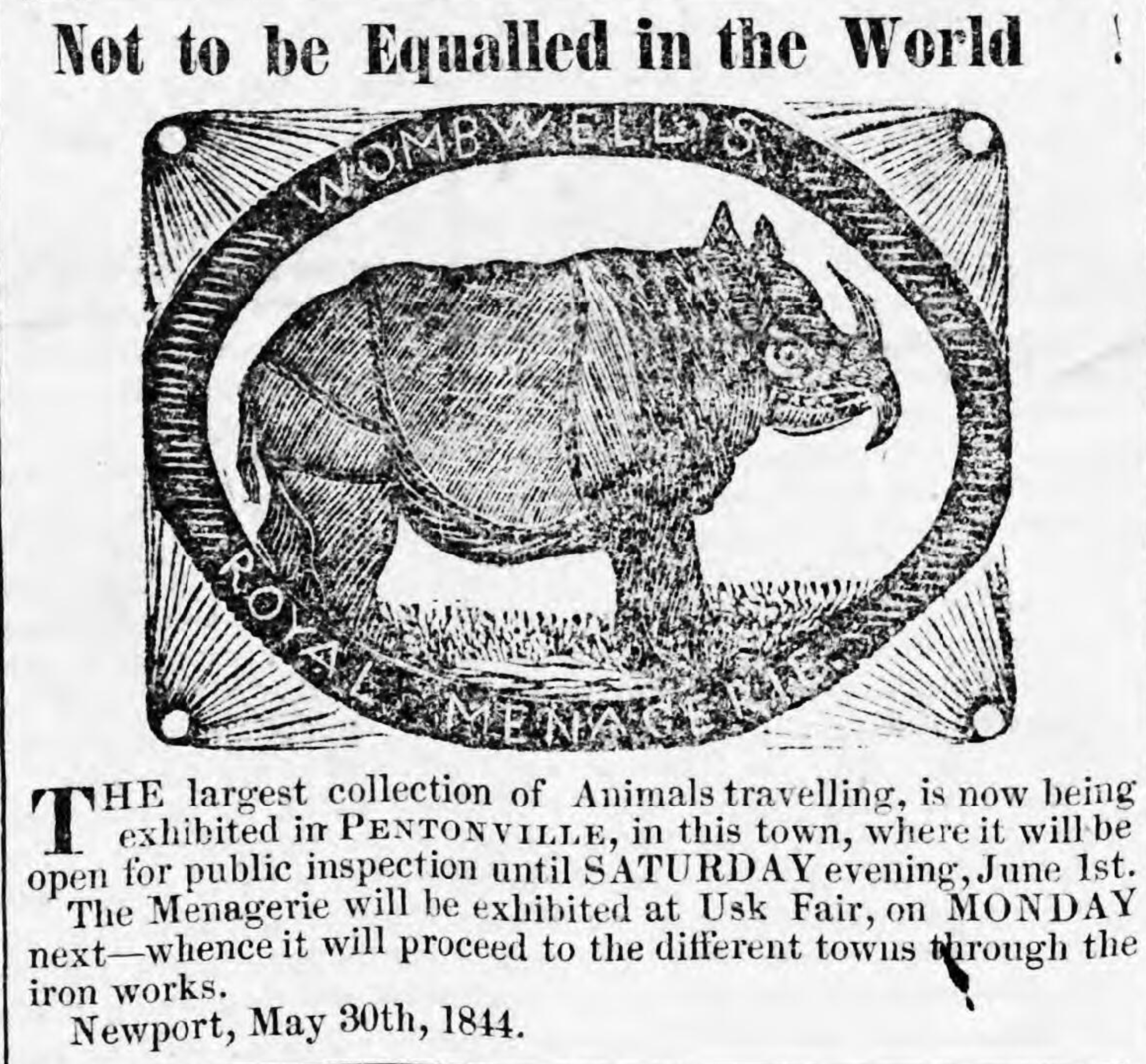
Last year, a large number of thimble-riggers, drunken and fighting brawlers, and other characters of reckless notoriety, altogether amounting to about thirty, were punished for offences immediately connected with Stow fair; while this year, not a single case has occurred. The fair was well attended by our police force in various styles of apparel—the active superintendent being well mounted as a stout English farmer; but so forcible is stringent punishment as an example in some cases, that the horde of thimble riggers, and the usual fry of little gamblers, together with the fight and row-loving class, took praiseworthy care to keep themselves out of the way of law.
— Monmouthshire Merlin, 8th June, 1844
Stow Pound
We have heard frequent complaints from various quarters, respecting the unsuitable situation of Stow Pound. It lies in a dark and unfrequented road leading from Stow Hill turnpike gate to the Cardiff road, near the Waterloo, and blocks up a mass of fiilth at one end, enough to poison, by noxious exhalations in warm weather, the whole population of a village. From the frequency of pound-breach of late, the attention of the public has been drawn to the bad situation of the pound. It is said the pound should be in the immediate neighbourhood of the highway, and of inhabited houses. Several spots have been mentioned, all of which are so situated; but we would suggest a spot which we think much superior.
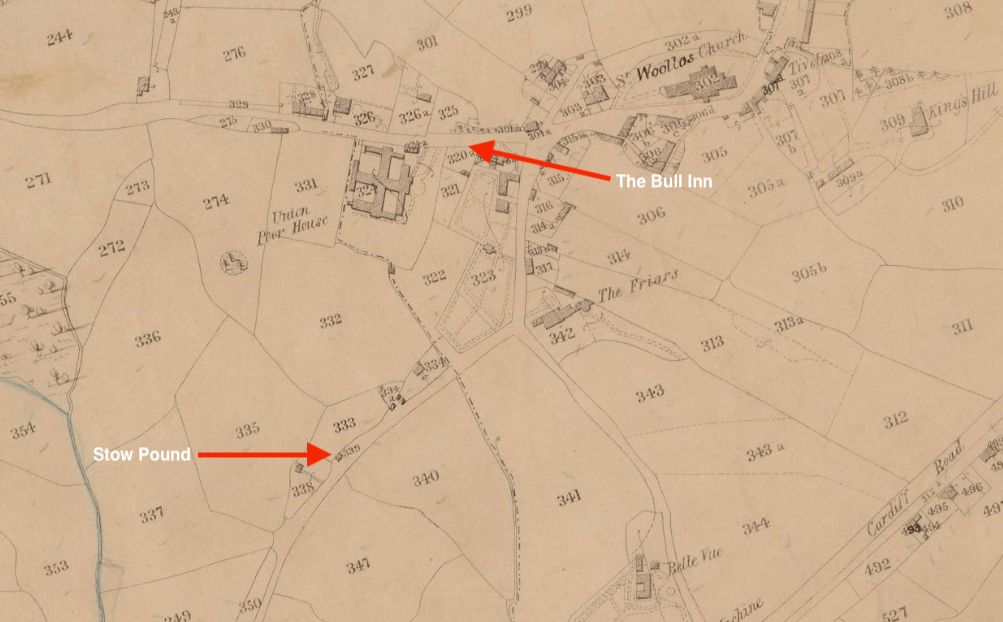
There is a large yard contiguous to the Bull Inn, a considerable portion of which is unoccupied. The landlord of the Bull is the pound keeper. Let the pound, then, be erected in his stable yard. The cost of such erection would be but trifling because it would not require any additional materials to those now forming the old pound, and those might be soon removed, and speedily re-erected.
There are so many persons whose cattle are "upon the parish," in consequence of which much trespass and damage of property is almost nightly occasioned, that the matter has become one of great importance; and as we think in all cases, "the first cost is the least," we would certainly recommend that the proposed alteration,— with improved locks, bolts, and bars,—be immediately carried into effect, that pound-breach—become so common a crime, and almost thought to be a right—may be effectually checked by the safe detention of the trespassing cattle, and, consequently, that trespass, except purely accidental, may shortly become of rare occurrence.
— Monmouthshire Merlin, 8th June, 1844

The Eel Fishery
An old man of respectable demeanour, named James Davies, was convicted in a trifling penalty and the costs, for having, with other persons, against whom summonses are issued, unlawfully turned up the mud in a dry reen, in the Wentlooge Level, belonging to the Commissioners of the Court of Sewers, and upon the property of Sir Charles Morgan, for the purpose of taking eels, whereby banks and dams of mud had been raised, which would cause a necessity for an increase of two feet of water, before the lands; cows, cattle, &c the reen was designed to supply, could be watered.
This manifest injury to the property has been frequently occasioned by persons looking for eels in the reens, and has caused complaints to be made to the commissioners and Mr. Traherne Rees, surveyor of the Wentlooge Level, for the Commissioners of Sewers, stated to the Bench, that his object was, not so much to punish the defendant, as to warn him and others, of the impropriety and illegality of turning up the reens, as stated: and he hoped such persons would be careful to abstain from such practices in future, as he was determined all who should be discovered so illegally acting should be proceeded against. The defendant thanked the Bench and Mr. Rees, and promised never to offend in a similar manner.
— Monmouthshire Merlin, 1st June, 1844
Refreshments by the Fireside
Catherine Hughes, the sister of the notorious Mary-the-Cripple, of Friars Fields, was summoned together with one Mary Griffiths, — neither of whom appeared —having erected tents on the roadside from Caerleon, on the first of May, (Caerleon fair day,) for the purpose of selling beer, &c, Constable Hopkins proved having summoned each defendant, and proved the offence against them.
Mr. Coles said that no party had a right to sell beer in two places under one licence. The defendants had committed an offence, and were now fined 20s. each, and costs, or one month's imprisonment.
— Monmouthshire Merlin, 1st June, 1844
'Thimble Riggers'
Mr. Superintendent Hopkins had orders from the Magistrates to take all thimble-riggers, and gamblers of every description into custody, whom he might find at Stow fair, on Thursday next.
— Monmouthshire Merlin, 1st June, 1844
Robbery From a Garden
Margaret Allen was charged with stealing growing broccoli. Fined 2s. the value of the property, and 2s. costs, or in default 14 days' imprisonment.
— Monmouthshire Merlin, 23rd April, 1870
'Six Strokes from a Birch Rod'
John Davies, ten years of age, was charged, with stealing 2s. from a shop at Machen. The boy pleaded guilty. The Bench stated that the case was clearly proved. He would be fined 2s. and costs, and receive six strokes with a birch rod by PC Benfield.
— Monmouthshire Merlin, 23rd April, 1870
Disorderly
Mary Jane Smith, a disor- derly prostitute was charged with making a disturbance and using obscene language in Oliver-square. Chief Superintendent Huxtable said this was the ninth offence against the accused. Sentenced to one month's imprisonment with hard labour.
— Monmouthshire Merlin, 23rd April, 1870
Unlicensed Cabs
Byron Briggs was summoned for plying for hire with two cabs, the same not being licensed. Chief Superintendent Huxtable said on the 13th of January last an inspection of cabs was made by the Board of Health. Amongst the cabs Mr. Briggs produced three—one passed examination, that was a hansom, No. 14 the next that came up was a four-wheeler, which the Council refused to license, not being in proper repair also a hansom was rejected. Since then those two cabs had been working without a licence.
The only license Mr. Briggs received was for one cab. They were both working on Saturday last. Had spoken to the driver about them several times. One of them had been repaired in part — new tires put on the wheels, but no repairs to the four-wheeler and had they been properly repaired, defendant should have had a license.
Defendant, in reply to the Bench, remarked that he had done everything he considered right to put the cabs in proper order. The licenses were generally applied for by sending to his house, and he always paid the money. He expected that possibly had he anything to pay they would send for the money and he should have paid. Chief Superintendent Huxtable said he had frequently told the driver to mention the circumstance to Mr. Briggs. The Mayor You are fined 10s. including costs and I trust you will look after your license in future.
— Monmouthshire Merlin, 23rd April, 1870
A Narrow Escape
On Monday morning private Eyres of the 10th Hussars very narrowly escaped being killed by his horse falling back upon him in Westgate-street. The animal ridden by Eyre is a very spirited mare, and in the habit of plunging. The skill with which Eyres managed his refractory steed, in coining from his stable in Corn-street, a few minutes previously to the accident, was observed with admiration.
The poor fellow was taken up senseless, and conveyed to the guard room at the Westgate, where he lay for some time in great pain, it requiring several persons to keep him steady. The army surgeon was called in, who ordered Eyres to be taken to the hospital and in about a quarter of an hour, he had sufficiently recovered to walk thither, supported by two of his comrades. The injury sustained was in the region of the ribs, but is not we understand of a serious nature.
— Monmouthshire Merlin, 11th April, 1840
'Suicide in the Union-House'
An event of a shocking nature occurred this week at our Union-House. A female named Julia Allen, of somewhat prepossing appearance, and aged about 23, was received into the Newport Union House on the 3rd of December, 1842. She belonged to the Baptist society, and was the daughter of a respectable man of the name of Allen, who is an agent, &c., residing in Commercial-street. Her father had married a second wife, and family matters rendering the stay of the daughter at home unpleasant, the Rev. D. R. Stephen, pastor of the Baptist chapel, who is a Guardian of this Union, procured an entrance for her into the Union-House, where, through his intercession with the kindly governor, she was engaged as an assistant in light household duties, which she performed with alacrity and cheerfulness.
She occasionally exhibited an intractable and irritable disposition when opposed but her conduct in general was good. On the 10th of June last she obtained leave from the board to visit her friends but on that occasion, she stayed out some hours beyond the proper time; and on subsequent enquiry, it was found that she had visited a house of ill-repute in Cross-street. It was also ascertained that she at times visited the gardens of Floriday, at which place it was conjectured she met a young man to whom she was attached. Before she came into the house, Dr. Brewer had attended her for an unsound state of mind, and since she had become an inmate, her spirits had frequently been dejected, her health at intervals affected, and her intellects at periods very weak. She had once or twice spoken of having made her peace with God, and said she should put a period to her existence and on another occasion she informed a female pauper in the house, that if she needed anything to procure aboition (sic), she (the deceased) would give her some powders.
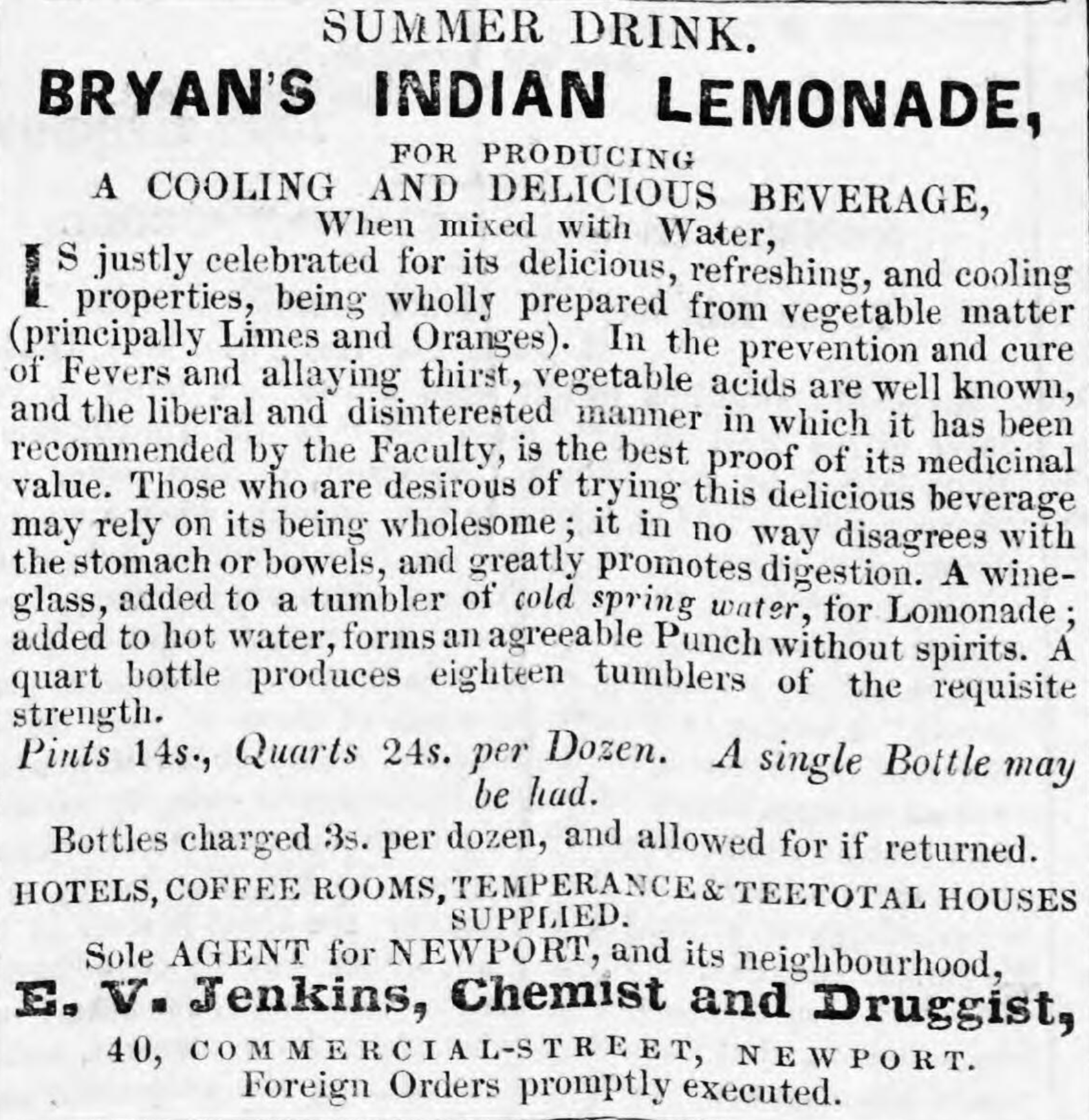
On Monday and Tuesday last she had leave to visit her friends for two days. On Tuesday evening—supposed to be returning from Floriday's gardens—she called at the shop of Mrs. Jones in High.street, where she had frequently been before and as she wore her own clothes when allowed to visit her friends, Mrs. Jones did not know her to be an inmate of the Union-House.
She here purchased two pennyworths of the essential oil of almonds-which contains prussic acid, and is the most deadly poison-alleging that it was for her mistress, a lady in the neighbourhood of Newport, who required it for scenting hair oil. Possessed of this deadly drug, she proceeded to the shop of Mr. Phillips, druggist, to whom she exhibited it, and wished to know if it were poison and framing a lie for the purpose, observed that she enquired because her little brother had been playing with it, and her mother feared the child had drunk some.
Mr. Phillips informed her of the nature and powers of the oil, and at once desired her to carry home a strong emetic. This she refused to do, trying she would first see her mother, and then left the shop. She then went to the Union House, and was admitted soon after seven o'clock, in high spirits. She was searched when she entered, but nothing of a suspicious nature was found upon her. She brought in two cucumbers, some gooseberries, and currants, a portion of which she earnestly pressed the governor to take.
During Wednesday morning she was cheerful and industrious. About twelve o'clock the nurse in the sick ward observed her apart by the window eating gruel, and almost immediately after heard her cry out as if in agony. She was taken extremely ill, and trembled violently. On being laid upon the bed, she grew worse; and the governor, being sent for, came immediately into the sick ward. He smelt the oil, and knowing its deadly qualities, at once rightly conjectured she had taken poison.
Indeed, her appearance at this moment confirmed his suspicions — her eyeballs were fearfully swollen — her face was empurpled, and her limbs quivered excessively. Surgical assistance was at once procured, but too late for as Mr. Wm. Brewer, jun., preceding Mr. James Hawkins by a few minutes, entered the room, he heard her last convulsive gasp. A post mortem examination of the body was made on Thursday evening, by Messrs. William Brewer, junior, and James Hawkins, when the presence of poison was proved and at the same time an inquest was held on the body before W. Brewer, Esq, coroner and a reapectable jury, when the substance of the facts related above was given hy the witnesses, and a verdict found that—"The deceased destroyed herself by poison in a fit of insanity."
Julia Allen, who has thus rushed unbidden into the presence of her Judge, was a person of superior education for her grade of life. Some manuscripts, found in her box, indicated an imaginative mind. an exceedingly retentive memory, and some poetical taste. A pre-determination to destroy herself had no doubt for a long time existed, and circumstances affecting her reputation which had transpired, seemed to make death appear to her a desirable thing. The following letter was found immediately after her death:—
"You need not ba surprised—the scandal has borne heavily on me, together with many other things that have been said since I have been here—all of which I die with a clear conscience, to appear before God. May the Almighty have mercy on my toul."
In a pocket-book were found several manuscript poems, chiefly on blighted affections and wasted happiness, while one, among other pieces on death, was entitled The Pauper's Death-bed," commencing thus:—
Tread softly bow the head,
In reverent silence bow
No paping bell doth toll—
Yet an immortal soul
Is passing now!
These, together with copious notes of, and commentaries upon, a large number of sermons she had heard from the Revds. Messrs. Stephen, Thomas, Evans, &c., were written in a neat and graceful handwriting by the deceased and were found, with a quantity of powders and pills, among her effects.
— Monmouthshire Merlin, 5th August, 1843
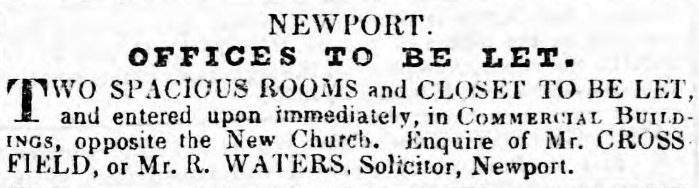
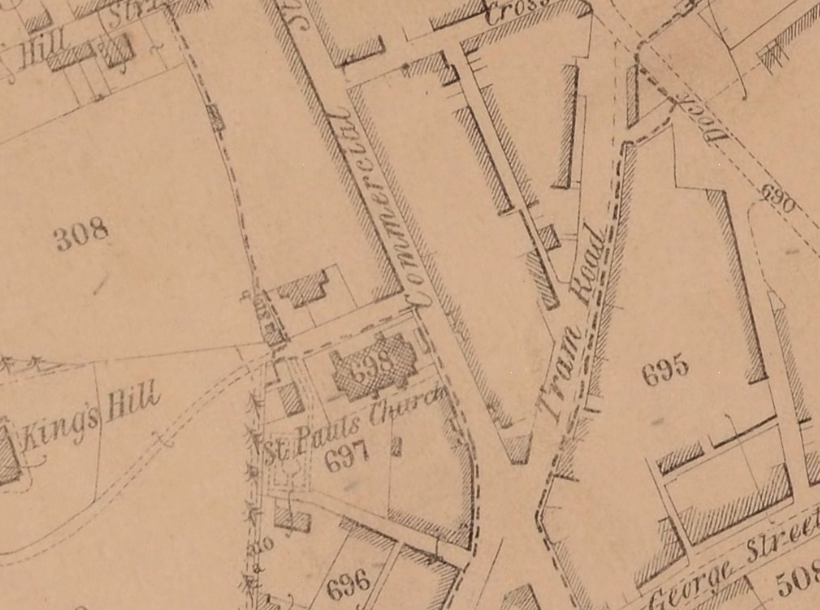
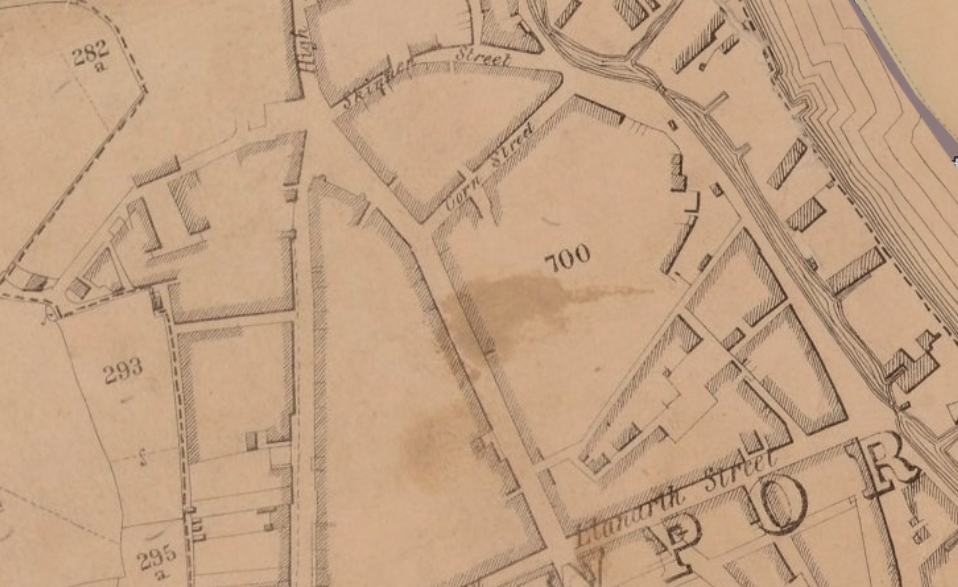
The map below shows the 'New Church', aka St Paul's, which had been consecrated in 1836. Commercial Buildings would have been opposite this church.
'Ramo Samee The Indian Juggler'
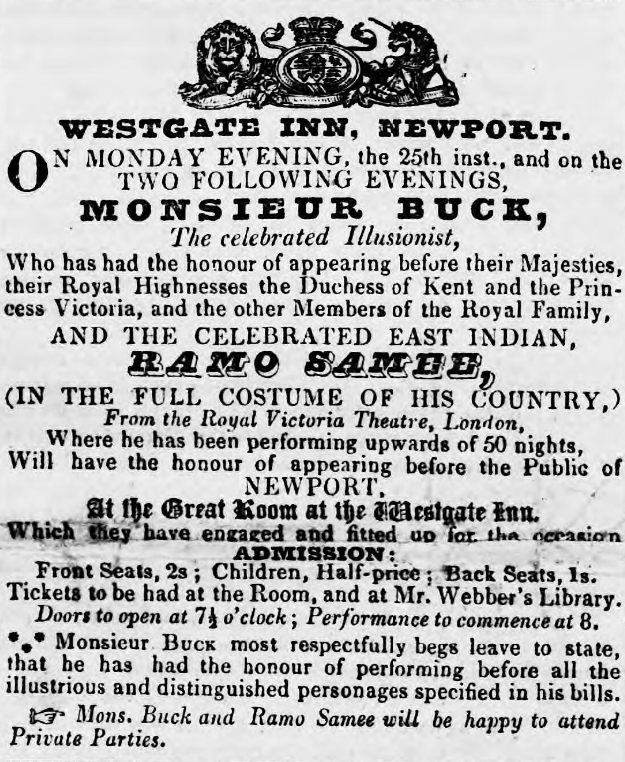
Ramo Samee was an Indian juggler, sword swallower, and magician, who performed throughout Europe in the 1800s. He is considered by some to be the first modern professional juggler.
Samee traveled to England between 1809 and 1814 where he gained recognition as a juggler and for his sword swallowing skills. Samee toured the United States from 1817 to 1819, performing in New York City and Boston. In 1822, Ramo was the "chief attraction" at the Royal Gardens Vauxhall Theatre in Kensington, where he was noted for his sword swallowing. He was a frequent performer at the Royal Coburg Theatre (now the Old Vic Theatre), where an image of him titled "Theatrical Reflection" still hangs backstage to this day. He visited the Westgate Inn in 1836 and he continued to perform until the 1840's. (Source: Wikipedia)
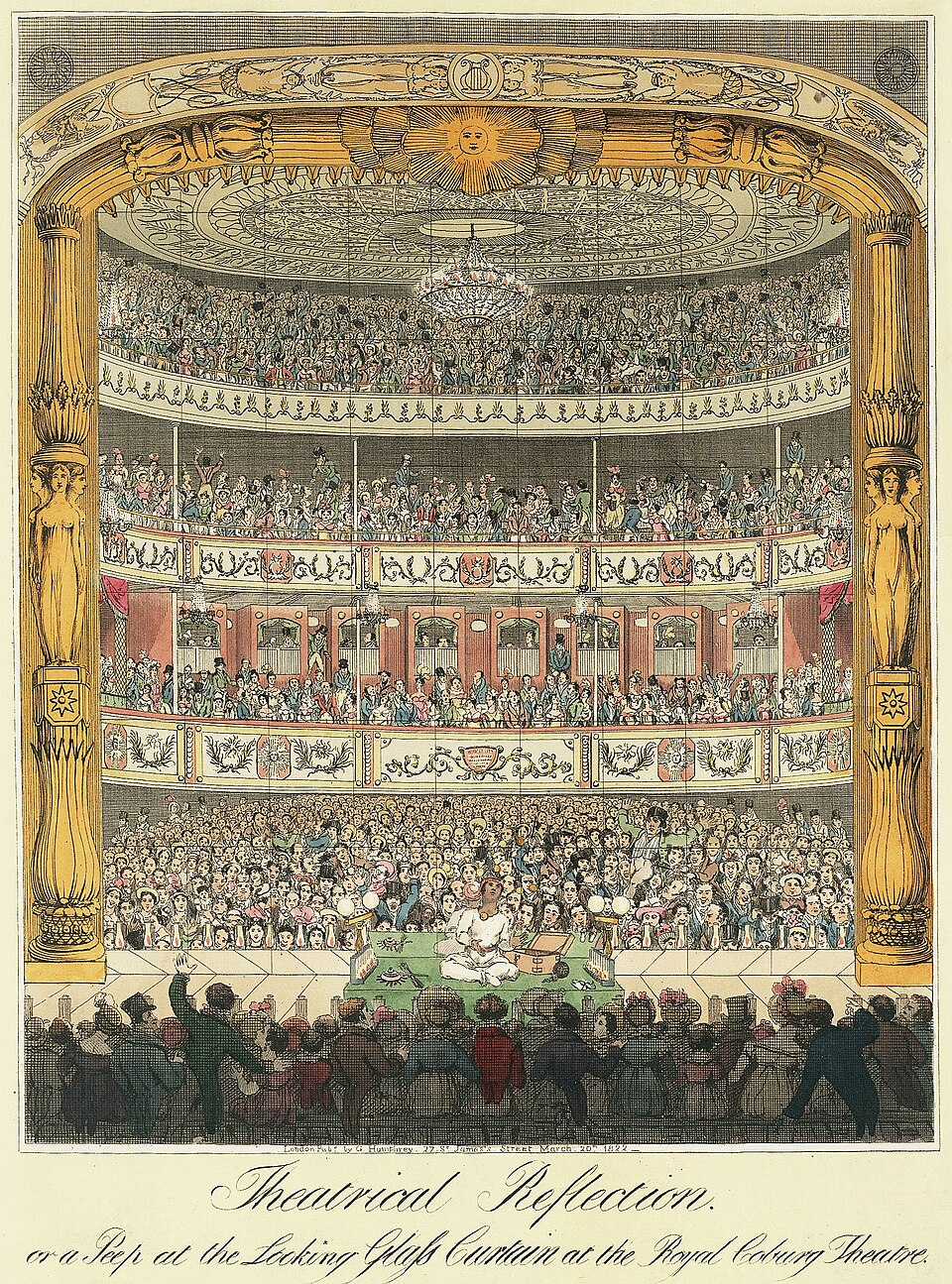
A Mad Cow
On Wednesday evening a cow, in an alarming state of madness, rushed through the streets, pursuing all who attracted her attention. She threw down a man in Llanarth-street, and another in Commercial-street, who was taken up stunned and carried into the shop of Mr. Herbert Williams, druggist, to have a cut in his head dressed, which he received in the fall. Mrs. B. Thomas was knocked down by the furious brute, which thrust at her with its horns, but, we are happy to state, inflicted no wound. She was, however, so frightened, as to require medical assistance. Her dress was, deranged and torn.
A horse belonging to Mr. Lewis, of Tydee [Risca], was gored in one of his haunches by the wild animal, in its precipitous course.
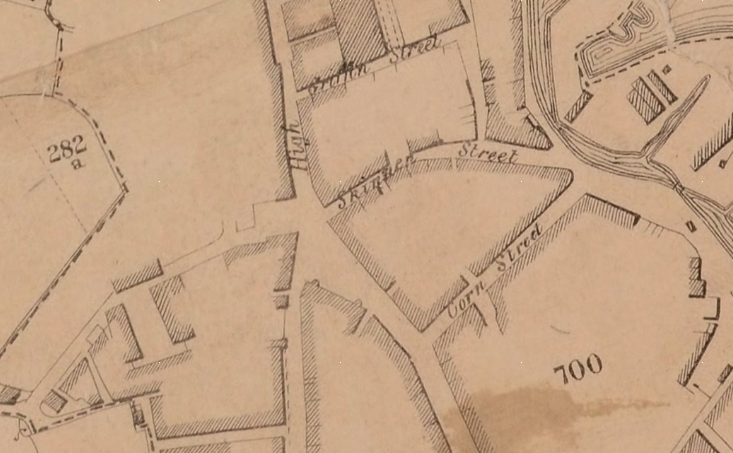
She at length ran into the foundry, in Skinner-street, where, after doing some damage among the moulds, she was captured and bled, and, when it was considered sire was sufficiently exhausted to warrant no further apprehension of danger, driven out to be slaughtered.
She was, however, still unmanageable, and it was found necessary to cut the throat of the poor creature, and let it bleed to death in the street. It is to be hoped that more caution will in future be exercised in driving cattle, by not allowing them, whilst in a state of irritation, to come within the preeincts of the town.
— Monmouthshire Merlin, 11th April, 1840
Where Was the Gas Yard?
An advert in the Monmouthshire Merlin on the 5th May, 1838 there is a mention of a place called the Gas Yard? Do you know where that is?
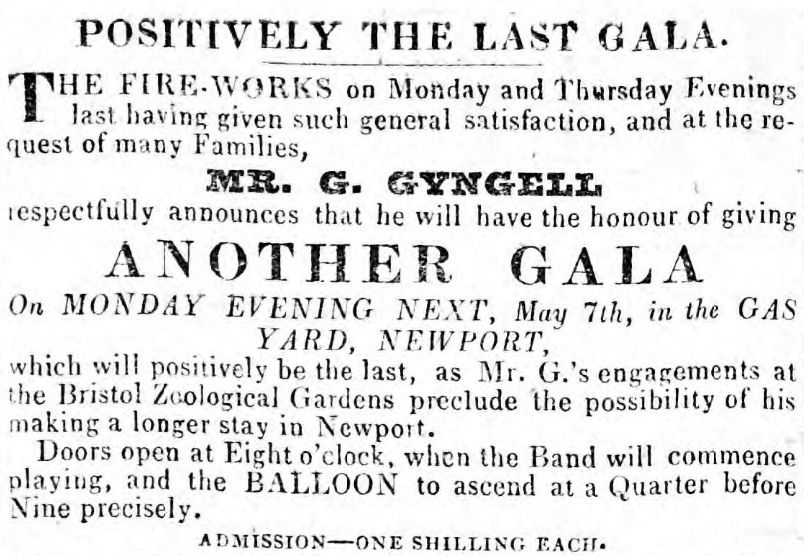
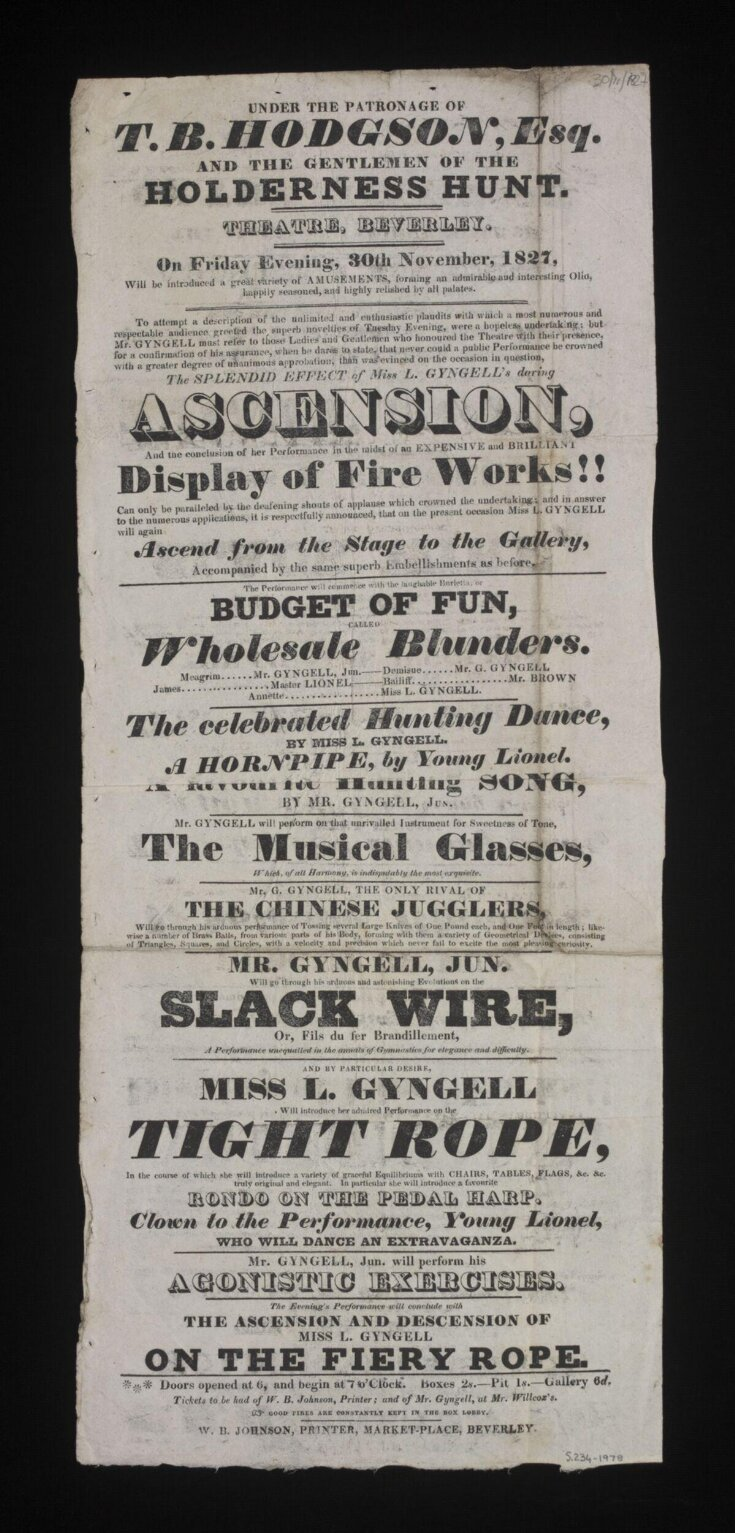
G Gyngell was a performer and juggler who had been performing with his wife since at least 1827.
Eastonterris
A gentleman extremely fond of peripatetic wanderings in the beautiful localities surrounding Newport, was recently strolling along the road betwixt Maindee Common and Fair Oak cottage, when he discovered, upon the first of a small row of houses, painted in glaring colours, the following: "Eastonterrris." After puzzling his brain a long time, and puffing hard at his Havannah in thought profound, he at length translated the very mysterious word to signify Easton Terrace!"
— Monmouthshire Merlin, 8th June, 1844


Member discussion