

Welcome to another issue of The Newport Cornucopia where we dig through the newspapers archives for interesting news articles and adverts. All articles are posted verbatim and most headlines are original (headlines in quotes are my own).


Lost and Found
On Friday night last, the sister of Mr Potter, Clarence-place, lost a gold watch near the house and a search for it was unavailing. Next morning, handbills were being prepared offering a reward for the discovery of the missing article when a heap of fresh-swept dirt near the door having been accidentally kicked about, the watch was found among the sweepings, where, no doubt, it had fallen on the previous night.
— Monmouthshire Merlin, 9th March, 1850
Nanny Lacy
Large numbers of our towns-folk to whom a female maniac, known by the name of Nanny Lacy, may have proved a source of public annoyance in church yards and gardens at night, and in the streets by day, will hear with some sort of pleasure, that after threatening to cut the throats of four or five women in the Union House, and to hang herself, she has been removed to the asylum at Devizes, where, we hope, the poor creature may recover the light of reason she has lost.
— Monmouthshire Merlin, 8th June, 1844
Hydropathic
A "Ratepayer" suggests that instead of allowing the waste water to run about the streets when dis charged from the Water Works main, it might, at a little expense, be directed into the sewers, with good effect; and the waterpipe in Ruperra-street is instanced as one where this useful diffusion of the waste element might be desirably carried on.
— Monmouthshire Merlin, 31st March, 1854
New Manufactory
A very extensive rope manufactory is being erected on the east side of the Usk, a little beyond the bridge, for Messrs. Knapp and Co., of this port. Messrs. Pearce and Westcott are the builders.
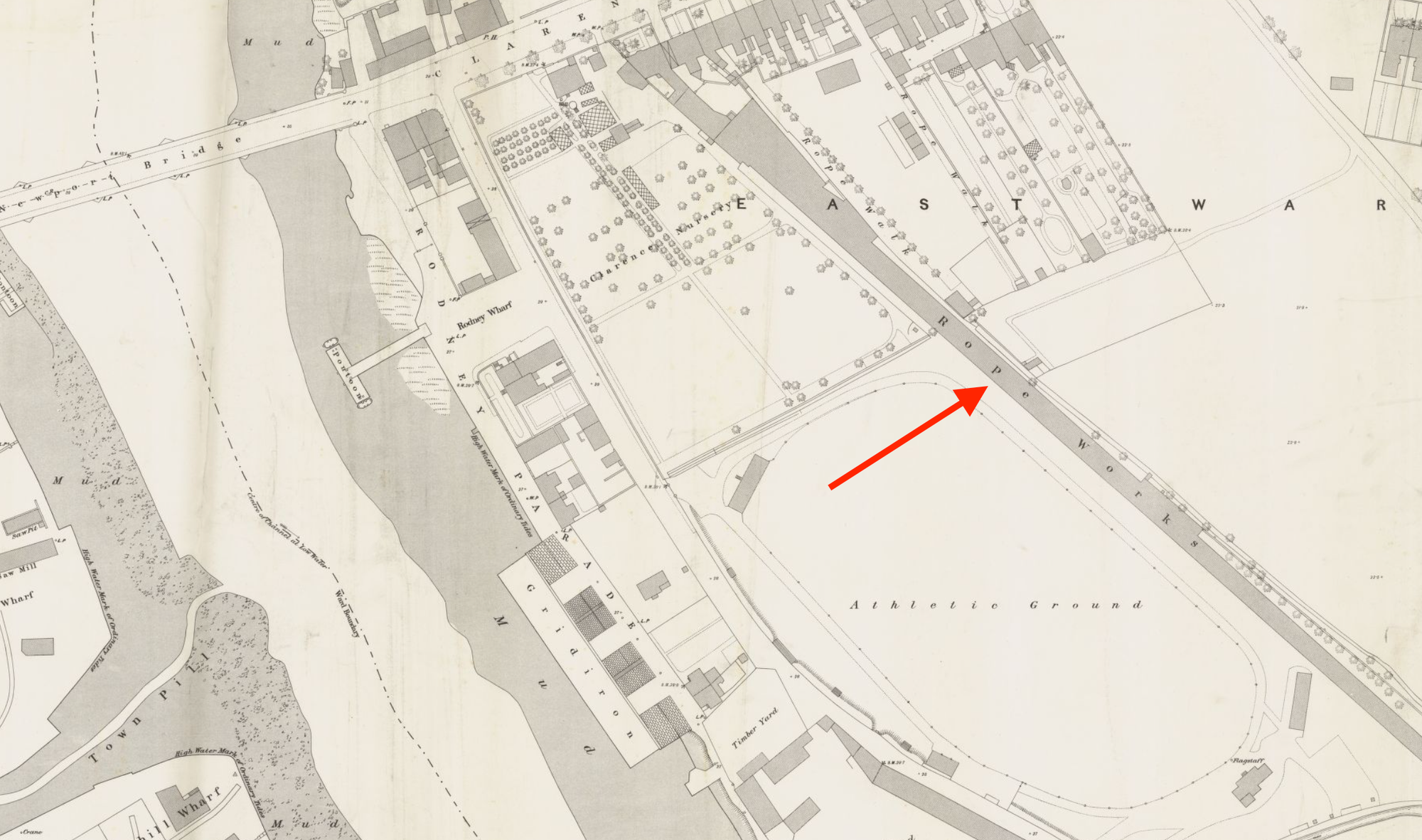
The works are being erected on improved principles, and will give employment to a considerable number of persons.
— Monmouthshire Merlin, 19th March, 1852

'Stealing Growing Peas'
William Evans, Joseph Simmons, and Timothy Clements, three little boys, were charged with Stealing growing peas, from a field belonging to Mr. Gregory, St. Woollos. George Holloway, prosecutor's bailiff, proved siting the boys picking the peas, and added that there had been many peas lost, and the fences had been much damaged by trespassers. The parents of the boys were in court, and they were ordered to pay 2s. each costs, upon which the children were dismissed after a few words of admonition from the Bench.
— Monmouthshire Merlin, 8th August, 1863
'Rescuing Pigs from a Pound'
Job Edmunds was charged with rescuing pigs from the pound at Bassalleg. Defendant said he was "guilty that he shook the lock, and the pigs came out; but he paid the poundage and offered to pay the damage."
George Vines said he found the pigs, on the 16th July, in his "tatur" field, and imponded them. Afterwards he found they had been taken away. He had had the damage valued at 15s.
Cross-examined: You offered to pay me 5s. after I had obtained the summons. The pigs had been in the potatoes three times that week. Elizabeth Barrett proved seeing the defendant hit out the staple of the pound door with a hammer and chisel. He went in the pound and drove the pigs out.
Defendant: I had the damage valued at os.
Chancellor Williams: I have seen the valuation of four men, and the average is 9s. Ordered to pay £1 damage, and expenses.
— Monmouthshire Merlin, 8th August, 1863
'Causing Obstruction with a Basket of Vegetables'
George Derrett was charged with causing an obstruction in Mill-parade, by placing baskets of vegetables on the pavement. Inspector Williams proved the offence.
— Monmouthshire Merlin, 8th August, 1863
'Stealing a Blanket'
Mary Ann Luckman wis charged with stealing a the property of William Powell, George-street. Caroline Powell, prosecutor's wife, spoke to the blanket, and Mrs. Dixon proved that prisoner had pledged it with her on Saturday morning.
It appeared from the statement of the police, that the prosecutor keeps a house of ill-fame, and the prisoner is one of the unfortunate girls living there, and where she had been three nights. P.C. Cowley apprehended the prisoner, and after denying she knew anything of the blanket she admitted that she had pledged it. The prisoner was then charged with stealing a shawl and bonnet, the property of Margaret Rickets, of Cardiff. P.C. Cowley proved finding the bonnet and shawl in prisoner's possession.
Prosecutrix, whose calling seemed to be the same as that of the prosecutrix in the previous case, identified the articles. Prisoner pleaded guilty to both charges, and after a consultation, the Mayor said the Bench did not feel disposed to pass a heavy sentence, believing that the prosecutors would not have taken prisoner into their houses but to further their own interests. They should therefore only order the prisoner to be detained one day. ("Applause in the body of the court.)
The Bench declined to make an order for the restoration of the blanket; and Powell before obtaining it had therefore to pay 3s. to the pawnbroker—the amount for which it was pledged. Ricketts obtained her property, as it had not been pledged, but the Bench refused to grant any expenses for attendance from Cardiff.
— Monmouthshire Merlin, 8th August, 1863
'Stealing a Watch'
Emily Lewis (24), a prostitute, was indicted for stealing a silver watch, the property of David Griffiths, a fireman, at Newport, on the 19th May last. Prisoner pleaded not guilty. Mr, Greeney prosecuted. The robbery took place in the Great Eastern beerhouse, Dock-street, where the prisoner stole a watch from pro- secutor in a bedroom. P.C. Fitzgerald proved the apprehension of prisoner, and obtaining the watch from her.
She had admitted having it, but said she would not give it up till prosecutor had paid her the eighteen-pence he owed her.
The jury found the prisoner Guilty. She was sentenced to four calendar months' imprisonment with hard labour. Prisoner threatened to summon prosecutor for the eighteen-pence he owed her after she came out of prison.
— Monmouthshire Merlin, 7th July, 1866
The Bid-Ale Nuisance
Catherine Hughes, sister of the hideous Cripple of the Fields, was charged with selling beer at her house on the 25th ult., without a license.
James Franklyn proved, hesitatingly, he had drunk and paid for beer in Hughes's house on the day stated, with a number ot other persons.
James Wall, whose knowledge of a similar case a few court days since was so very limited, was again produced as a witness; but though he very gravely assured the Bench he'd tell 'em all he seed and knowed on't, he could merely say, in reply to many questions, "What I can't say, I can't say, and that's flat."
Mr Hughes and Mr Hawkins severely censured the conduct of Wall.
The Mayor convicted Hughes in the penalty of five pounds and the expenses.
Hannah Thomas was charged with selling beer, on the 1st of July, without a license.
The Mayor ordered defendant to pay a fine of five pounds, and the expenses. The notorious Walford was charged with the same offence and, after being several times remanded, was this day fined in the sum of five pounds and costs.
— Monmouthshire Merlin, 29th July, 1843
The Market Question
TO THE EDITOR OF THE MONMOUTHSHIRE MERLIN
SIR,—I believe every one must admit that the proper situation for a market is in the centre of the population. Many persons now living no doubt remember when the site of the present market was very favourably situated for the requirements of the town. Since that period the place has vastly increased, and now we find the market placed at nearly the extreme eastern end of the town.
Surely this is most inconvenient. It is evident that the Town Council should not allow so favourable an opportunity as the present to pass for arranging matters to the satisfaction of all parties concerned.
Verily, the members of the said Council are a lot of slow coaches, or they would have grappled with the question and settled it long ago.
Why not at once purchase the present market and the manorial rights of the Duke of Beaufort, and have erected on that central and most eligible site, the Friars' Fields, a convenient market, suitable for the requirements of this important town.
I strongly deprecate extravagant outlay on the erection of a market, and suggest such a building as that at Gloucester, constructed principally of glass and iron, light and elegant in appearance, at the same time substantial, desirable, and convenient, sacrificing nothing to ornamentation.
The site of the present market, and of the old ruins lately cleared away in High street, would probably return in ground rents sufficient to pay a fair interest on the amount to be paid to the noble Duke why, therefore, need there be any difficulty in the way? I say, pay off the noble duke, and go in for a market in Friars' Fields, but let there be no delay about it. I know from experience, that a market erected and managed economically, and affording proper facilities to the public, will yield a handsome return for the outlay.
Yours truly,
A NATIVE OF NEWPORT, AND A LARGE RATEPAYER.
— Monmouthshire Merlin, 15th August, 1863
Stabbing Case
At a music saloon, at Pillgwenlly, kept by a man named Warnken, and which is frequented hy seamen and prostitutes, a case of stabbing occurred a night or two since. A sailor named Burns, according to his own statement, accidentally jostled against another named Mansfield, when the latter drew a sheath knife and aimed a blow at Burns, who evaded it by jumping aside. Mansfield again attacked Burns, when the latter was less fortunate, receiving a severe flesh wound in the thigh. The accused was brought before the Mayor and Air. L. A. Homfray, at the Borough Police Court, yesterday (Friday), and committed for trial at the assizes.
— Monmouthshire Merlin, 7th July, 1866
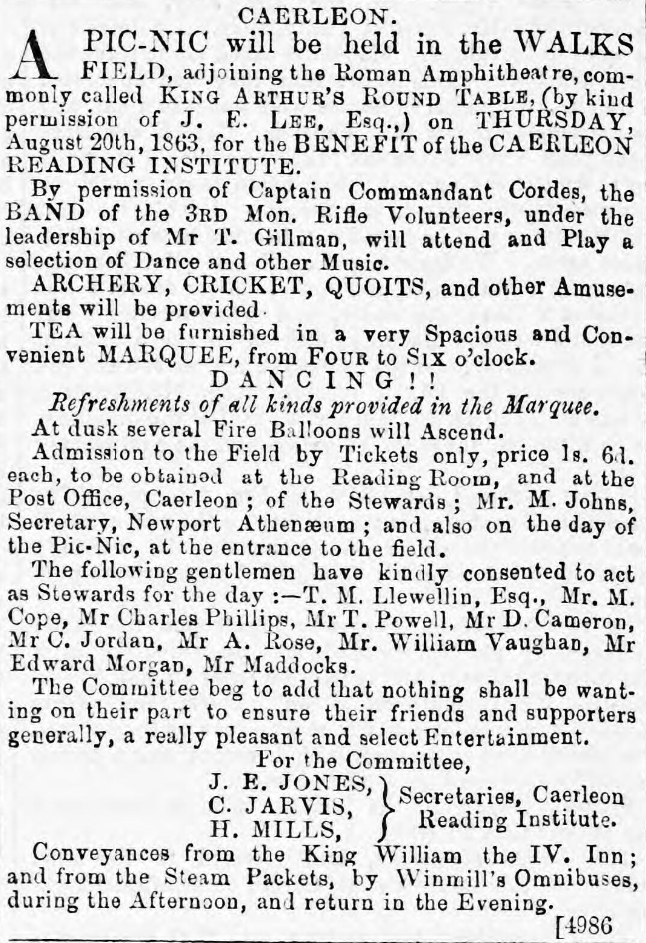
'Caerleon Picnic'
Fashionable Wedding
On Thursday the nuptials of Miss Jane Isabella Morrison, second daughter of Martin Morrison, Esq., of Victoria Place, Newport, with G. A. Daniel, Esq., solicitor, Frome, were celebrated at St. Woollos Church, by the Rev. Canon Hawkins, who was assisted in the ceremony by the Rev. A. Daniel father of the bridegroom. A considerable number of the principal inhabitants of the town assembled at the Church to witness the marriage ceremony; and the children of the Girls' Ragged School in Dock-street, an institution in which the bride has shown a warm interest by frequent visitation, and active exertion on its behalf, stood on each side of the pathway leading to the western entrance to the church, bedecking it with flowers as the bridal party moved towards the door.
A wreath of evergreens was stretched across Victoria Place, and from it was suspended a banner with the words "God bless the happy pair." After the conclusion of the marriage ceremony the bride and bridegroom, with their friends, returned to Mr. Morrison's residence, where a splendid dejeuner (prepared, we hear, under the direction of Mr Napper, of this town) was laid.
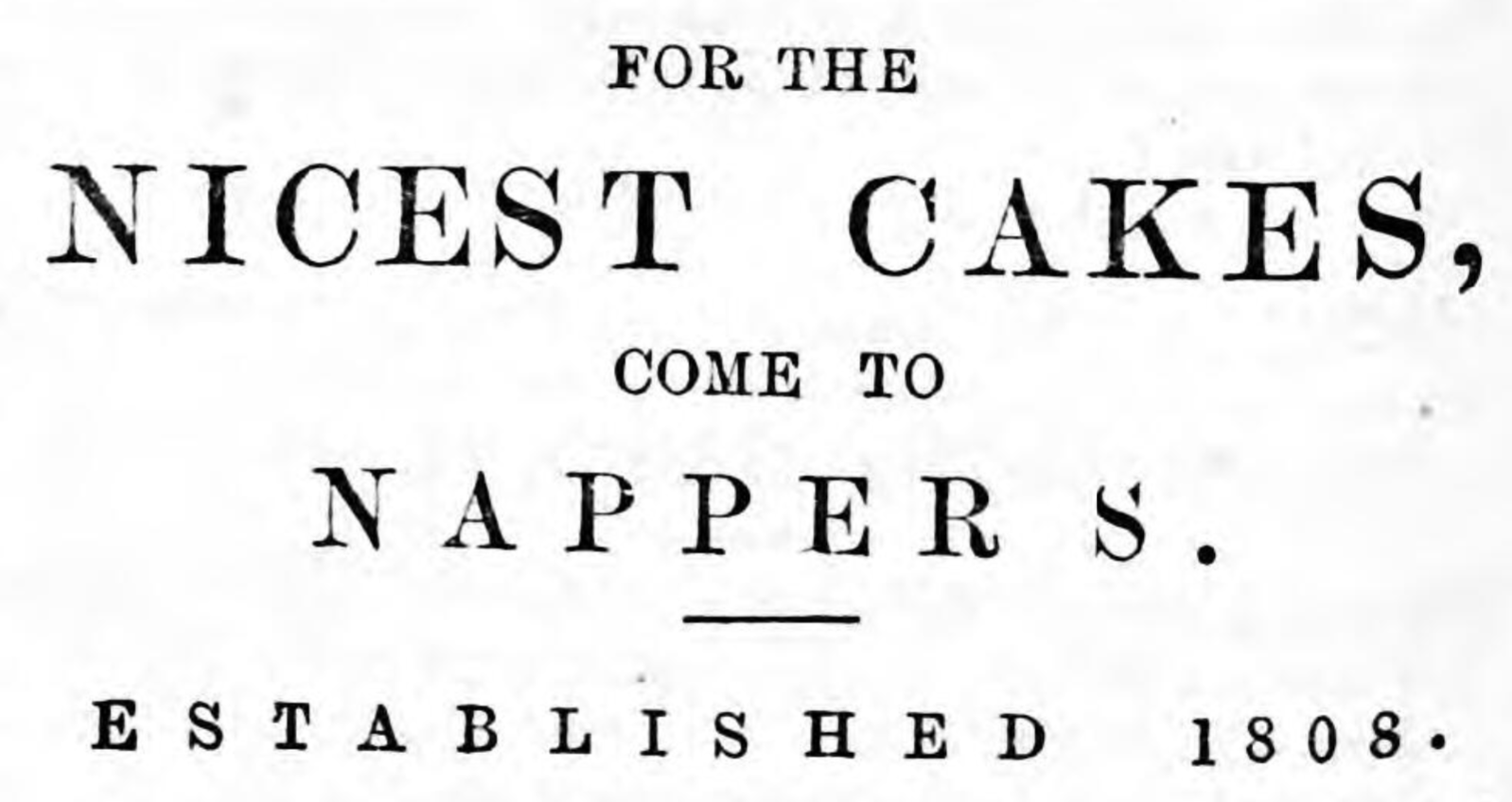
Festivity and friendly greetings prevailed for a time, and in the afternoon the newly-wedded couple departed for a tour, amid hearty congratulations and ardently.expressed wishes for their future happiness.
— Monmouthshire Merlin, 7th July, 1866
Mothering Cakes
Sunday next being Mid-Lent the confectioners of this town have, we perceive, filled their windows with the usual display of richly-embellished and tempting compounds incident to the period, and which are known us "Mothering cakes." Our tradesmen evidently do not expect the ancient custom to full into desuetude, but rather that a goodly host of the "children of larger growth" will seek to please the "auld folks at home" by presenting to them one or more of these ornate specimens of the confectioner's art.
— Monmouthshire Merlin, 10th March, 1866
Mothering Cakes
The windows of our confectioners are generally adorned about this time with attractive displays of "mothering cakes," or huge mountains of sugar, cake, candied lemon, &c., exhibiting occasionally grotesque and strange devices, which are intended, according to ancient usage, as presents by children to their mothers, preparatory to the Easter festivities and holidays.
Commercial-street, this week, presents windows adorned after this fashion in great and ingenious variety; and we may add that we hope the desire of the confectioners so amply to cater after the good old custom, will be appreciated extensively by the customers who are thus provided for.
— Monmouthshire Merlin, 1st April 1848
Mothering Cakes
The annual period has returned, when confectioners adorn their windows with "mothering cakes." We have never seen, however, so excellent a show as the present. Though the cakes in the windows of Mr. Napper, Mr. Ewins, sen., Mr. Jones, Mr. Martin, Mr. Hartshorn, &c., &c., look rich and tempting, there is not such a display to be found anywhere, as at the establishment of Mr. James Ewins, jun., Commercial-street, where Mid-Lent cakes, among which are Sayer's Royal St. James's, are as gorgeously and chastely decorated as though they were made for a royal bridal occasion.
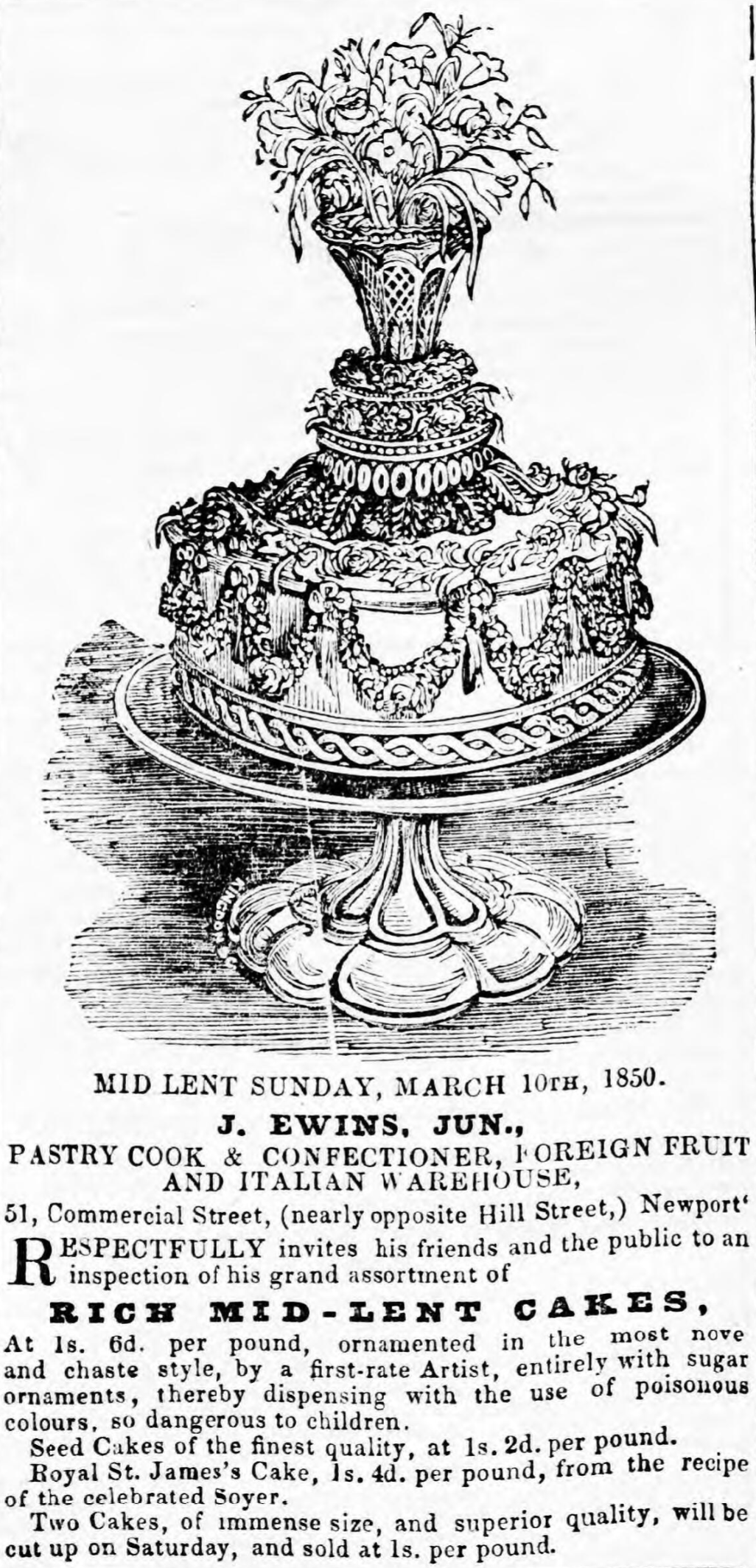
The crowds of persons who are attracted by the unequalled display in Mr. Ewins's window, afford a pretty strong indication that the popular "taste" of seeing is best gratified there and we would trust, for so enterprising a proprietor, that the taste which is best satisfied by eating, will be amply exhibited as well.
We should not omit to notice, that Mr. Ewins has fitted up a delightfully cool and pleasant upspringing fountain of water in the shop, which, in the coming summer, will be a fitting accompaniment, in a place so well stored with fruits, wines, and delicious confectionary.
— Monmouthshire Merlin, 9th March, 1850
Mid-Lent Sunday
The usual period for the display of mid lent, or mothering cakes has this year been rather anticipated by our confectioners, in consequence of the Prince of Wales' wedding. For the same reason, too, there seems to have been more than the customary amount of preparation, both in point of quantity and excellence.
Mr. Ewins, in Commercial-street, has on sale a large and varied assortment, in addition to his enormous bride cake; and his brother, Mr. J. Ewins, jun., High-street, has an excellent show, with a very handsome device in the centre of his window. Mr Thomas, we perceive, announces in another column, a bride cake, which is now on view in his shop window, and surrounded by a large variety of smaller cakes, forms, from its elegant design, an attractive ornament.
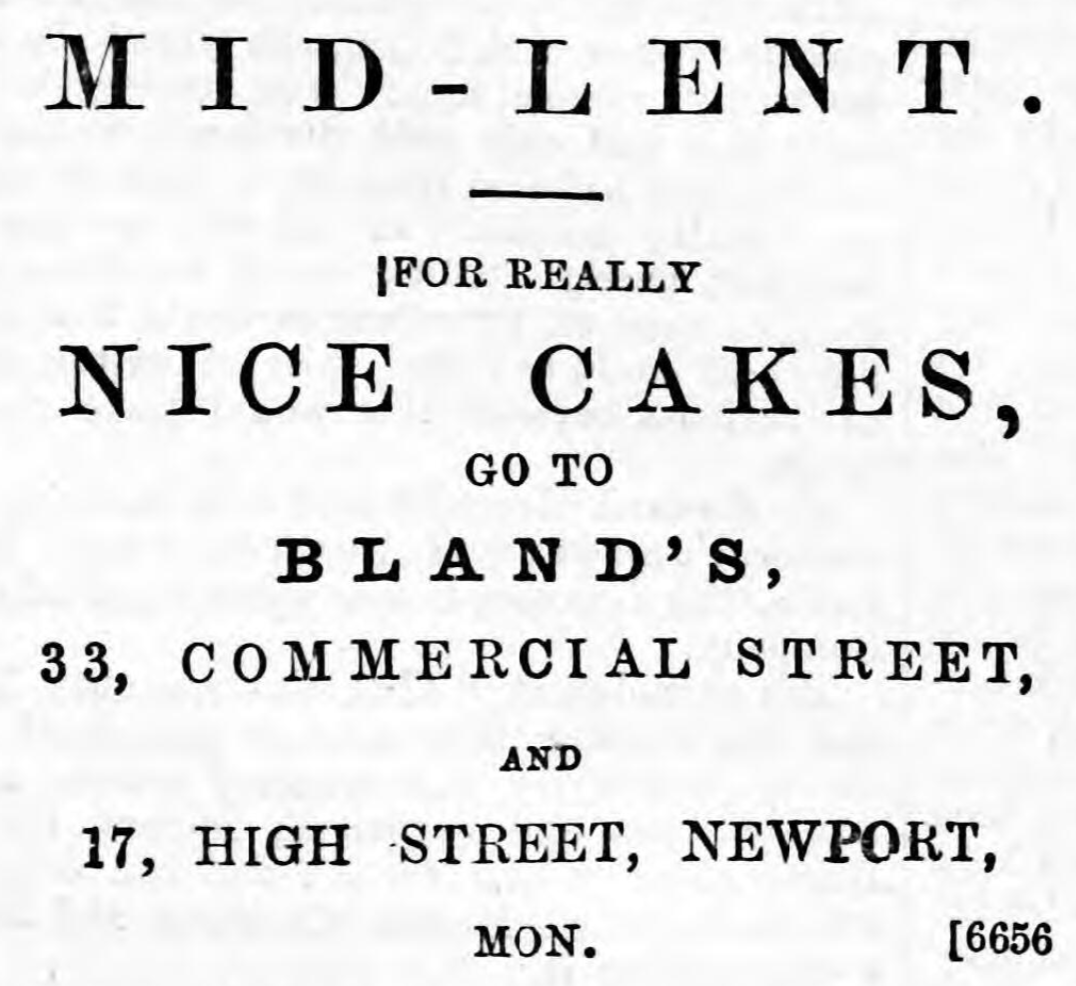
Mr. Bland, too, is not behind either as to profusion or the exercise of taste in his displays. Mr Napper, however, is clearly entitled to precedence, if in no other respect, for artistic effect. The paintings on the top of his cakes are gems in that style of art, and some of the horticultural designs are so finely executed as to make one almost lose sight of the confectionery in admiration of the representations of the fruit—something like a desire to grasp at the shadow, regardless of the substance. In the centre is a cake weighing about 120 lbs, on which stands an ornamental pedestal, bearing an elegant vase, enriched with elaborate cornucopias and Cupids, and filled with lilies, orange blossoms, the trailing jessamine and other flowers, the whole being covered with a profusely decorated canopy. The effect is very beautiful.
But the whole of the establishments present distinctive features, which merit the highest encomiums upon the parties to whose skill and taste the admirable effect produced is attributable. We can only desire that all who admire the beautiful appearance of our confectioners' shops may be enabled to gratify their palates, with a taste, at least, of the tempting luxuries.
— Monmouthshire Merlin, 7th March, 1863
Mothering Cakes
The old custom of confectioners exhibiting gaily-decorated cakes, of a "monster" kind, in their windows designated "Mothering Cakes," from their being chiefly deigned as presents by juveniles to their parents, in the Easter holidays, has been carried into effect in Newport to a great extent, the windows of all our confectioners being adorned by those costly gifts, in a profusion and style superior, in the generality of instances, to all former exhibitions of the kind.
— Monmouthshire Merlin, 13th March, 1847
Mothering Cakes
The recurrence of the "mothering-cake" season, has induced Mr. Ewins, jun (the Gunter of the provinces,) to cater this year upon an extraordinarily large scale. His shop window during the week has been crowded by gazers at a monster cake, forming a beautiful model of her Majesty's marine residence, Osborne House.
This wonder of the confectionery architect has created quite a sensation in the town. This fine palace is doomed, we understand, like the great crystal palace, to be taken to pieces —literally cut up. at 1s per pound; and mothering cake will next week, doubtless, be spread far and wide from this great repertory of sweets. The length of this "monster cake" is four feet, and it weighs upwards of 200 lbs. The "roofing" of the palace, and the "cement" of its walls, are formed of crystalised sugar.
— Monmouthshire Merlin, 19th March, 1852
Mothering Sunday
The confectioners' shops present a very gay appearance this week, their windows being filled with numerous "mothering cakes." Next to Mr. Ewins's, perhaps Mr. Burkitt's, in Commercial street, may be ranked as taking the lead in the display. He exhibits a very tasty cake, representing a lighthouse,—the rock work, of white sugar is well arranged, and his castle, of sugar candy, is also a neatly designed structure.
Mr. Peter Napper, Mr Martin, Messrs Williams and Co., Mr. Ewins, sen., and Mr jun., (in both shops.) also made very excellent displays.
— Monmouthshire Merlin, 19th March, 1852
Mothering Cakes
The return of Lent, which is always productive of an active competition among the confectioners of Newport, to provide the very best of mothering cakes for the juveniles, has this year tested the utmost skill of the sweet caterers. The establishment of Mr. James Ewins, Commercial-street, was, however, the chief scene of attraction, where monster cakes, most tastefully ornamented
the surface of one representing the snowy country of the Crimea, with armed hosts engaged in battle-drew together large crowds of spectators, and many eager purchasers.
— Monmouthshire Merlin, 16th March, 1855
Alarm of Fire
On Saturday evening, about eight o'clock, a lurid glare was seen reflected in the sky, in the direction of the barracks; and alarm was raised in Commercial-street, that the barracks, or some premises adjacent, were in flames. Hundreds of persons ran to the spot, when it was discovered that a large quantify of gorse, &c., was being burnt on a farm some way off.
— Monmouthshire Merlin, 19th March, 1852


Member discussion