

Welcome to another issue of The Newport Cornucopia where we dig through the newspapers archives for interesting news articles and adverts. All articles are posted verbatim and most headlines are original (headlines in quotes are my own).

'A Lack of Gum on Postage Stamps'
To the Editor of the Monmouthshire Merlin,
SIR,—Will you be pleased, through the columns of your journal, to intimate to the contractor of the postage stamps, the necessity of putting on the backs sufficient gum to make them stick to the letters—I presume that is part of the contract.
I remain, sir, your obedient servant,
Newport, November 8.
MERCATOR.
— Monmouthshire Merlin, 11th November, 1843
A Grand Fete and Gala
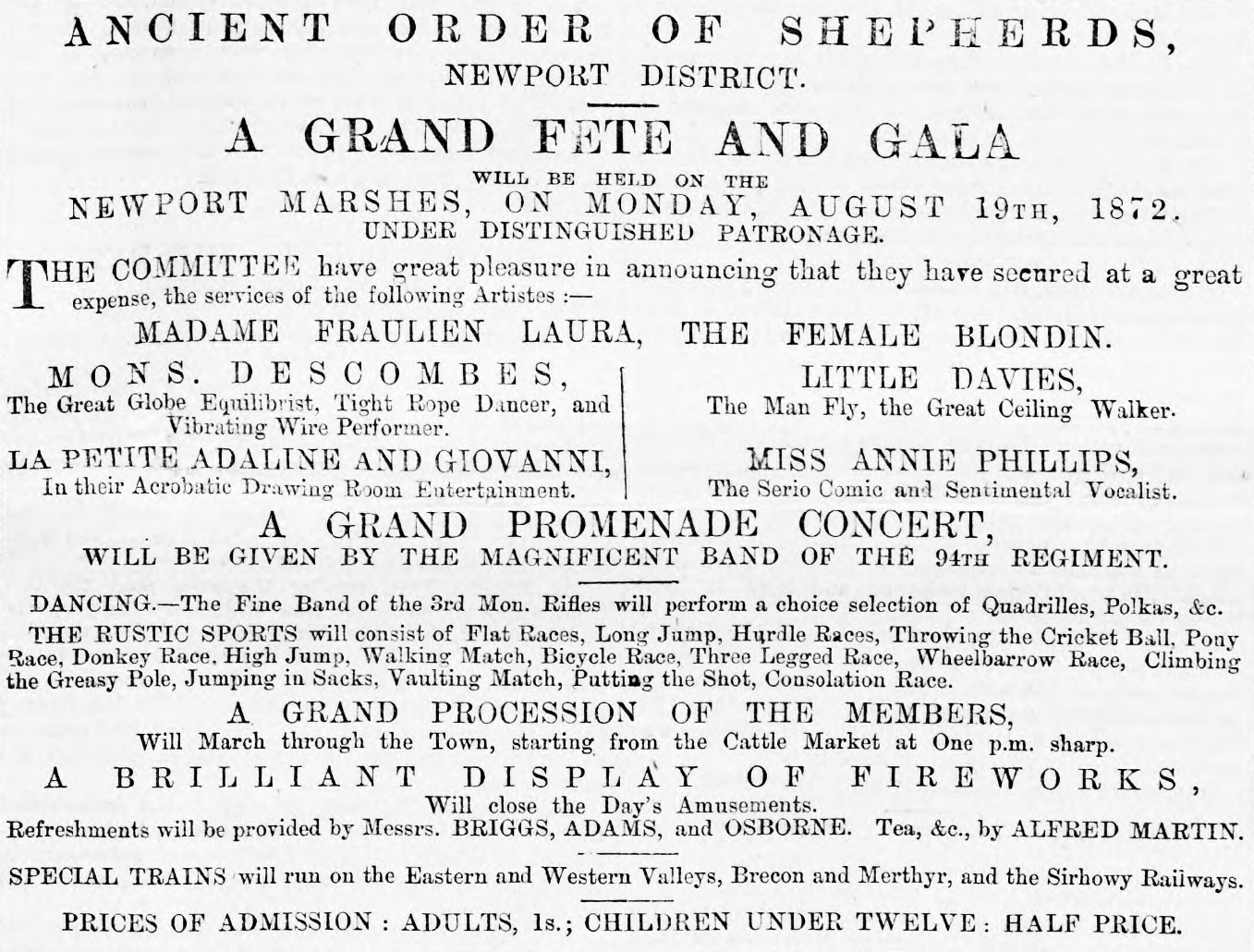
At the Marshes (Shaftesbury Park area) in August 1872, the Ancient Order of Shepherds held a 'Grand Fete and Gala'. Entertaining the crowd was Little Davies the 'Man Fly', La Petite Adaline and Giovani performing their 'acrobatic drawing room entertainment and Madame Fraulien Laura, the 'Female Blondin'.
The Blondin reference is to Charles Blondin, the great tightrope walker who crossed Niagara Falls and also performed at the Marshes in 1871.
— Monmouthshire Merlin, 16th August, 1872
New Public Hall
Our townsmen are aware that a new entrance to the greatly-increasing district of Banes-well is now in progress. The statue of the late Sir Charles Morgan is at this time in the direct course of the new street but when removed, and the Tredegar estate offices displaced, a noble opening into that quarter will be formed, exhibiting tastefully designed dwelling houses, shops, the pretty edifice of St. Mark's church, the railway works, the Gold Top villas, and the stately mansion of Farmfields; at the top of the street of houses lately erected by Mr. H. P. Bolt for his workmen, a large piece of ground lies between that street and the main roadway to the church, and upon this piece Mr. Bolt is about to erect several fine three-storied houses while on the large space of ground on the other side of the roadway, and extending from St. Mark's church to the new street crossing to the Dissenting chapel, the same enterprising and speculative builder intends to place two or three large houses and his new Public Hall—a building which he designs to create in a style of architecture, and with the fullest regard to taste, convenience, and extent, that shall ensure the praise and approbation of his fellow-townsmen.
It is indeed gratifying to know that Newport possesses a gentleman whose enterprise is thus directed towards the lasting benefit of his fellow townsmen. The ground, which is the property of Lord Tredegar, and who has shown a just regard to the requirements of the town in this matter, will be about one hundred feet long, by seventy-five feet in breadth and the Public Hall, which will fully occupy this extent, will be erected from elegant designs prepared by Mr. Habershon, of London, architect to the Tredegar estate.
The hall will in every respect be worthy of the future Newport, though perhaps it may be considered of too great magnitude for the present. On that point, however, there may be different opinions. We have had numerous instances of late which prove the fatal inadequacy of the Town-hall for great public occasions. The People's Concerts were attended by overwhelming numbers, so that perhaps more than one hundred persons were now and then obliged to bow to the reluctant refusal of the committee to admit them, and to go away disappointed and annoyed.
And surely, "the People," and their instruction and amusement, are no unworthy objects to provide for in the fullest sense. Again, the late political gathering, which will be more numerous and important at any future election, incontestably proved that the ratepayers or electors were wretchedly cared for to respect to hall accommodation, and that there existed an urgent necessity for a new hall, where two thousand persons or more might find "ample room and verge enough."
The present hall will contain no more than 800 or 900 persons closely packed. Mr. Bolt's new Public Hall will be calculated to accommodate fully two thousand persons. And although we have not yet been favoured with a view of the architect's plans, now in hand, we understand that Mr. Bolt, with his practical judgement and taste, will so provide for the convertibility of his building that almost every kind of public requirement, whether political, polemical, musical, terpsichorean, or scientific, may be provided for on the largest and most advantageous scale.
And the well-known architectural skill of Mr. Habershon leaves no room to doubt that the edifice, externally and internally, will be alike the most attractive and most elegant of any of our public structures. Of the eligibility of the situation there can be no question. It will be within a stone-throw of the great throughfare of the town—adjacent to our principal hotels-itself the very entrance, as it were, to an almost new town, where buildings are still being erected, and roads forming in every direction, towards the numerous villas on the Gold Tops, which are rapidly increasing, and constituting thoroughfares through the numerous streets of Baneswell, towards the country. We hail the speculation of Mr. Bolt's indicative of the progress of a town towards importance and eminence; and we rejoice to be able to guarantee to the public that Mr. Bolt's well-known position, determination, and perseverance will light speedily secure to us the much-desired Public Hall.
— The Cardiff and Merthyr Guardian, 21st May, 1859
'The New Street into Baneswell'
It having been deemed necessary, in order to construct the new street into Baneswell, to remove the Tredegar estate offices and the statue of the late Sir Chas. Morgan.
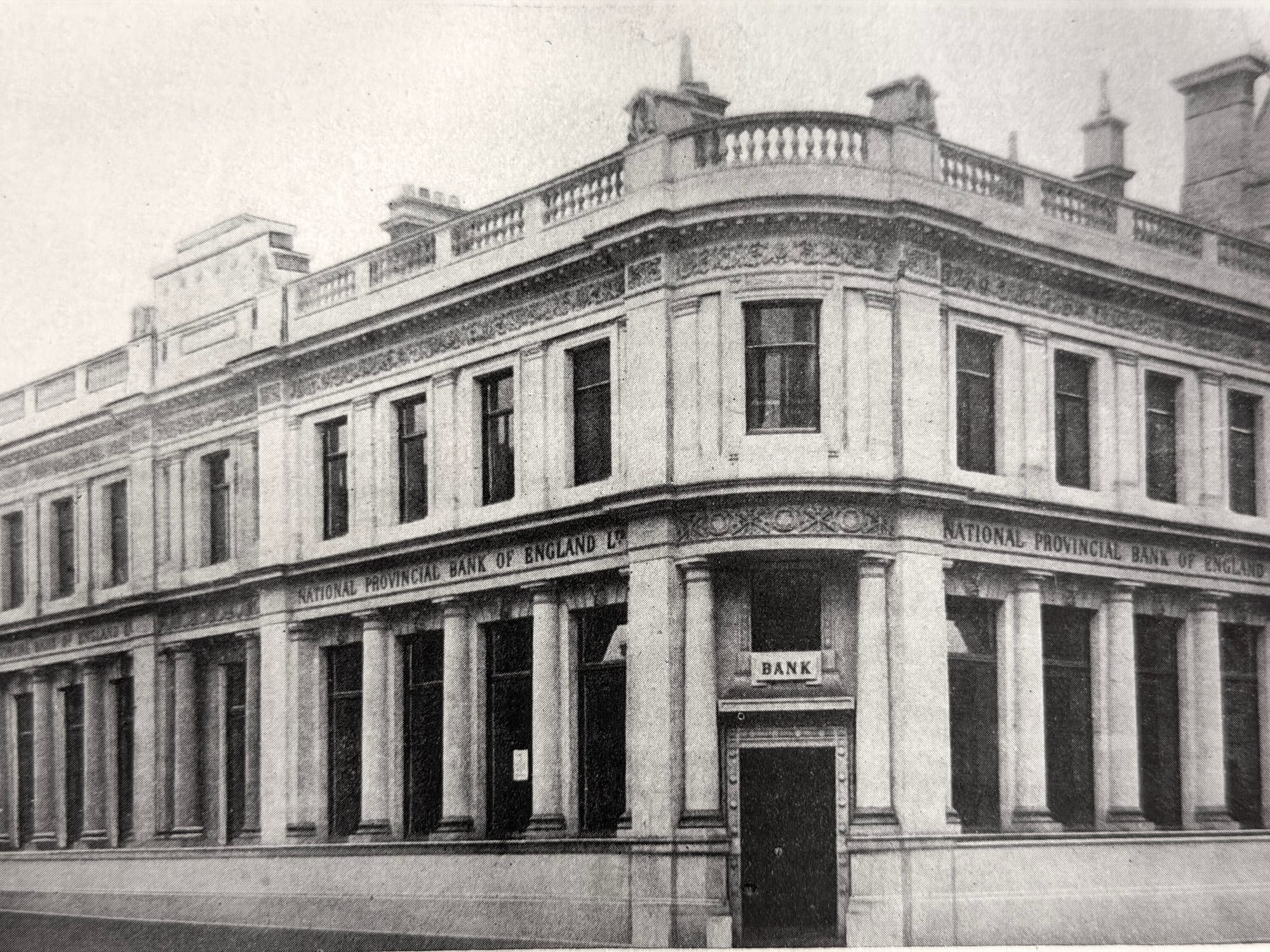
Mr. H. J Davis suggested that the best site whereon tore-erect the statue was at the upper part of Tredegar-square (Park-square) and also for the improvement of the street, that the fronts of the line of houses, including Messrs. Bailey, Gratrex & Co.'s bank, extending along High-street to Mr. Horrigan's shop, be pulled down, and the street widened.
— The Cardiff and Merthyr Guardian, 28th May, 1859
The Contemplated Improvements in High Street
It appears that by 1867 the 1859 proposals hadn't been enacted.
The Mayor said at the meeting of the Public Committee the other day, it was brought to their knowledge that the house and shop known as Mrs. Evans's, had been leased to Mr. W. R. Matthews was about to put in a new shop front. The Town Council, having previously become aware of this, had communicated with Mr. Matthews, who seemed disposed to come to terms for taking down the front and setting it level with the Tredegar Estate Offices.
They had a large meeting of the Publc Works Committee, and Mr. Matthews came in. The terms on which he held the property were these—he had a lease of 24 years and by his setting back his frontage 3 feet 6 inches the Corporation would got 15 square yards of land. The committee offered him £150, telling him that for a piece of freehold opposite, the Board had paid £160; they were somewhat surprised to find that he asked compensation for property which was only leased. But the committee, as stated in the report, recommended that £200 should be paid, if Mr. Matthews saw it in his interest to accept that amount. The committee asked for power to carry out their recommendation, if their offer should be accepted.
In answer to a question, the Mayor saidd there would be no difficulty as to the ground at the expiration of 24 years, as Lord Tredegar had been consulted.
Mr. Batchelor wished to offer a remark or the subject, which was one to which he had previous drawn attention. A civil engineer of Newport was setting out a plan with a view to remove all the block buildings from the Tredegar estate offices to Mr. Horrigan's building, which it was proposed to rail round, leaving also the Victoria Hall an isolated building which was likewise to be railed in—the ultimate object being to build shops with the back towards the South Wales Railway yard, and, in fact, throwing open whole of that part of the town, making a wide thoroughfare to the Westgate Hotel, where the streets were already wide. If that plan were regarded favourably by the Council — but he was sorry to see Mr Homfray ____.
Alderman Homfray was going to ask whether this was a scheme by the larded proprietors or by an architect?
Mr. Batchelor: I think this was the very same plan which was proposed by one ot the cleverest Newport ever knew—the late Mr. James Rennie. It does not originate with any civil engineer, but with myself.
Alderman Homfray: It would be a good thing if it could be carried out. But I think it is too large an undertaking for Newport.
Mr. Batchelor would say thus much—if he lived long enough to get this Board into the humour, he would submit a motion to get it done.
Mr. Murphy: At the ratepayers' expense?
Alderman Homfray: When you find one man ask £400 for 15 yards, you will see it must coat a good deal of money.
On the motion of Mr. L. A. Homfray, seconded Mr. Moses. the recommendation of the Committee adopted, and the members then separated.
— Monmouthshire Merlin, 21st September, 1867
Trade Picnic
The third annual pic-nic of the employes of Mr. George Fothergill, tobacconist, of this town," took place on Thursday, the 8th inst. At about eight in the morning the party, numbering 80, embarked on board the Joe Hazell, steamer, and after a splendid trip down Channel to the Holmes, they arrived at Weston at 11.30. The company then rambled over the cliffs and beach, after which they all met at the Pier Hotel, where a dinner was provided by Mr. Fothergill.
After dinner various toasts were proposed, during which several glees were sung by members of the factory choir. At 7 p.m. the company re-assembled on board the boat, arriving at Newport a little after nine o'clock: Mr. Jacob's string band was in attendance, both on the boat and at dinner. All the arrangements were well carried out.
— Monmouthshire Merlin, 16th August, 1872
According to the Weston Mercury, the Joe Hazell steamer was a tugboat owned by Joseph Hazell who provided a regular service between Cardiff and Weston. The service started in 1866 and he boasted about dropping passengers off in a gentleman's garden in Weston allowing them to cross a lawn rather than using a path to reach the gate.
George Fothergill had a tobacconist shop at 47 High Street (where Careers Wales entrance is) and then 36 High Street (next door to McDonald's). He was also the owner of Maindee House.

Highway Robbery by a Soldier
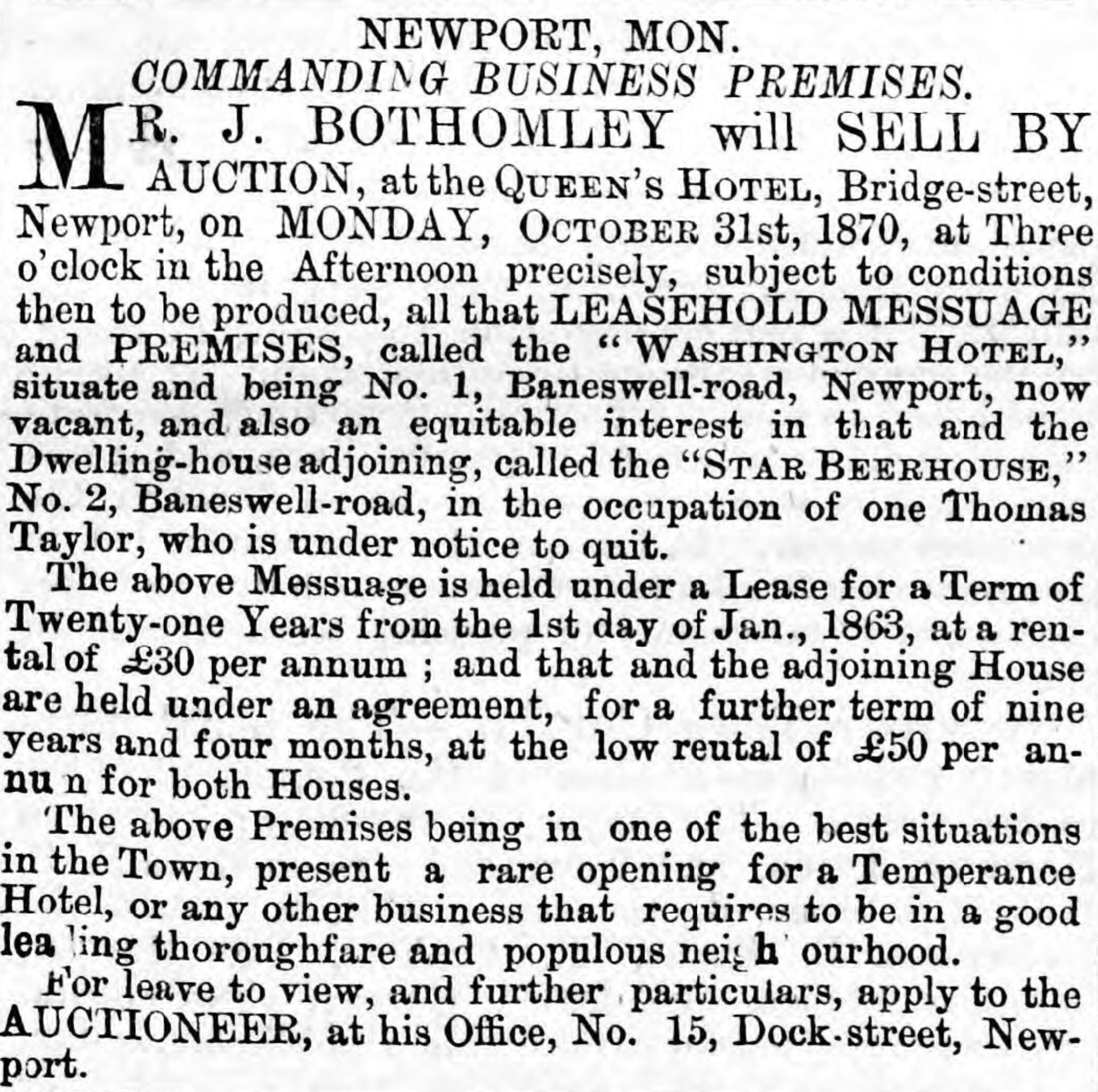
David Chinery, a private in the 94th, was charged with stealing about 18s. from the person of Frederick Smith. Complainant said he was a millwright and lived in Club-row On Sunday night three soldiers, of whom defendant was one, were drinking in a house in Club-row. When complainant left the house they followed him. Prisoner took him by the arm and dragged him to a public-house to stand a pint of beer. This complainant refused to do The next public-house he passed on his way home prisoner tried to get him in there, but without success. He had about 18s. in his pocket. Prisoner put his hand into his pocket and snatched the money.
Complainant followed him a long while, looking in vain for a policeman. At last, with the aid of some other men, he took him to the Town-hall. Among the money lost were two new shillings. These, together with other money, were found on the prisoner—George Shell, hobbler, saw Smith struggling with the soldier. Some other people were looking on, trying to induce the soldier to give the old man the money.
Prisoner turned to witness and said, "Let me do a shunt and I'll sling you half." Witness, and others, then brought him to the Town-hall. On the way he tried to hand the money to another soldier. Sergeant Franklin, on searching the prisoner, found on him 15s., including two new ones. The prisoner said "his girl" had given them him. Prisoner pleaded not guilty he knew nothing about it. Committed for trial at the next sessions.
— Monmouthshire Merlin, 16th August, 1872
'Exposing His Person'
John Finn, for being drunk and disorderly, and also for exposing his person before a lot of people in a public thoroughfare, was fined 10s. 6d., or, in default, fourteen days. The man said he came from Pontywain, and in consequence of having a letter to say his wife was confined he went off and had some beer.
— Monmouthshire Merlin, 16th August, 1872
An Unnatural Mother: Shocking Effects of Drink
At the Castle Inn, on Friday last, W. H. Brewer, Esq., held an inquest on the body of Catherine Allen, an infant, five weeks old, which died on the previous day. The child's father was a foreman carpenter, in the employ of Mr. James Murphy, and he had deserted his second wife, the child's mother, in consequence of her intemperate habits.
This degraded and besotted being had been drunk every day for a week, and whilst in a state of intoxication she overlaid the luckless infant, and it died from suffocation. About mid-day, on Thursday, the neighbours saw Mrs. Allen in a state of stupid drunkenness staggering to the public-house for more drink, and at the time she had the dead infant hanging over her shoulders. When remonstrated with she said the child was only in a fit, and would recover.
Dr. Morgan gave it as his opinion that the child died from suffocation, but said there was no trace of violence to show that it had been strangled. The jury found that deceased died from suffocation, but there was no evidence to show in what manner.
— Monmouthshire Merlin, 16th August, 1872
'Overcrowding in Kear Street'
Timothy Donovan, of Kear-street, was summoned for allowing his house to be overcrowded. Inspector Williams said fourteen persons lived in the house, which contained four rooms. In the first room upstairs Donovan, his wife, and two children slept.
In a back room, containing only 470 ft. of air, there were two men, their wives, and three children, and in another room two persons.
Defendant paid 3s. 6d. per week for the house, and let it out for 5s., making a profit of 1s. 6d and living rent free. Dr. Davies corroborated the Inspector's statement. Fined 20s., or seven days' imprisonment.
Dennis Fitzgerald, of Kear-street, was summoned for a like offence. The house contained three rooms, two upstairs and one down.
In the cupboard down, stairs there were two children, aged 15 and 18 years.
Upstairs in one room, defendant, wife, and two children. In the other room a man and wife, and two children of defendant's. The children were put in the cupboard in order to take in the lodger. Dr. Davies said the house was in a most filthy state. The Bench thought this case not so bad as the preceding one, and fined defendant 10s., or two days.
Fortune Telling
Sarah Smith, a bronze-featured old woman and Trefena Loveridge, were charged as rogues and vagabonds, going about telling fortunes.
Mr Champ was solicitor for the prosecution.
Mary Jones, an interesting looking girl, servant to Mr Edwards, in Dock-sireet, said the elder prisoner came to see her, and said, "shall I tell yer fortune?" This was last Thursday evening, I did not consent hear my fortune then, but did next night, when she told me a pretty good fortune by cards. I gave her one shilling. She told me I was to have a husband in three months. She said, "If you don't have your fortune told, I'll bewitch you". (Laughter.) The cards produced, "are those with which my fortune" was told.
Cross-examined by Sarah Smith: You saw me with a little child. You did ask me to have my fortune told.
Prisoner: No, I said I could "dissolve fortunes". She told me her friend was troubled in love about a gentleman, and she would bring her up also.
Mr Champ to witness: "She told you you were to have a food husband, and very pretty children too, didn't, she?"
Witness, blushing: Yes, she did, sir. (Laughter.)
Mr Edwards said he saw the younger prisoner near his house on the night in question, and saw her and the elder prisoner making signs to each other, and walking off in company.
P.C.Bath produced the cards and money which he had taken from the elder prisoner. He saw thr money was peculiarly marked. The two prisoners were seen by him together in High street.
Mr Champ: She cuts the cards twice only, if one kind of payment is made and three times, if the payment is better.
Smith: Well, you would prefer kissing a pretty girl three times, rather than twice, wouldn't you? (Laughter.)
Mr Champ: Oh, very likely I would. (Renewed laughter.)
The prisoner Loveridge was dismissed, and ordered to leave the town at once and the prisoner Smith was committed for twenty-one days' hard labour.
Mr Kessick: There, that's your fortune.
Smith: Thank you, sir and that's for telling a young girl she should have a sweetheart, is it. However, Mr Mayor, you are a nice gentleman. (Laughter.)
— Monmouthshire Merlin, 6th August, 1852
Escaped Prisoner
Shop Improvements
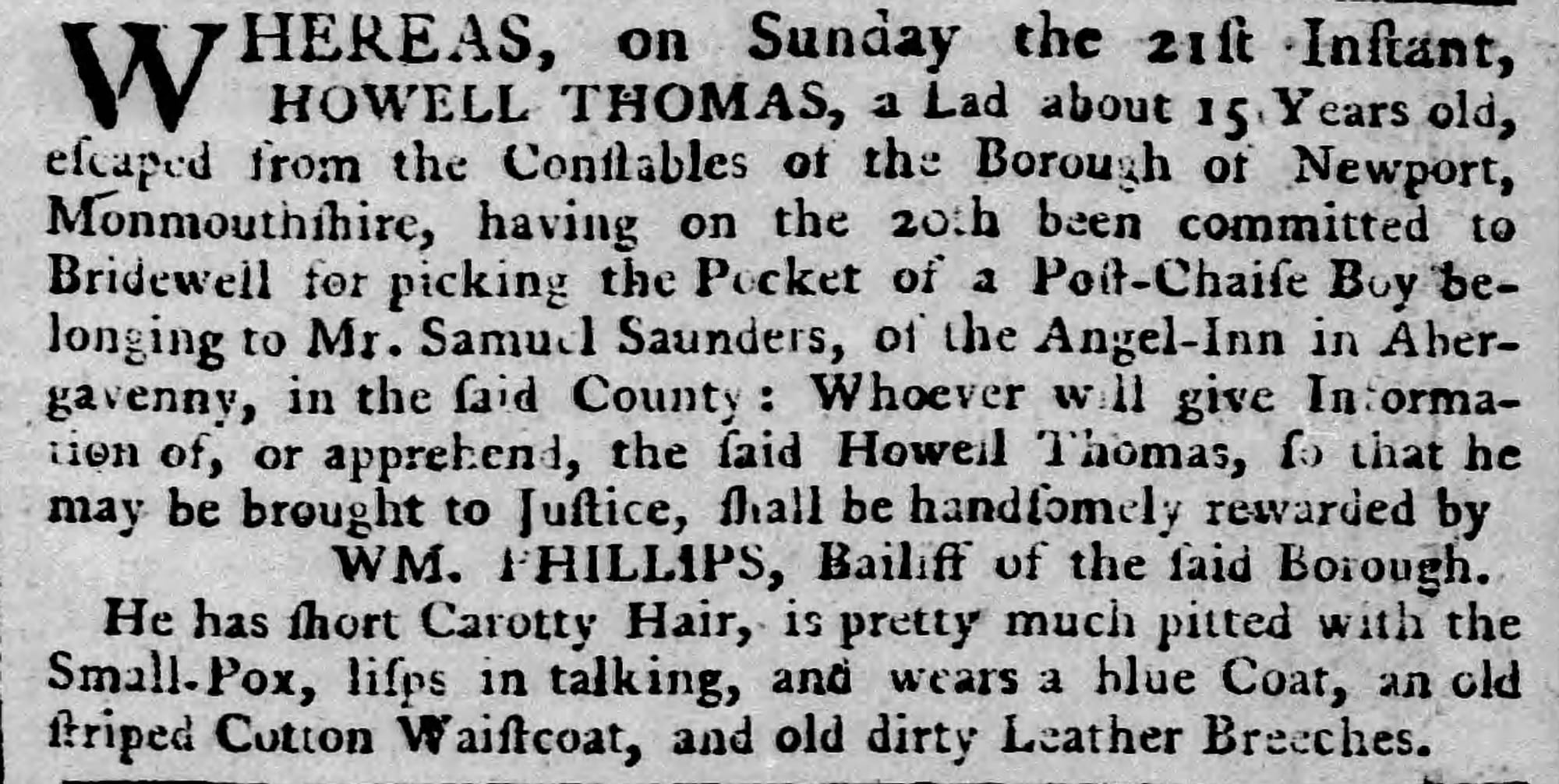
On Friday evening the public were attracted by the exceedingly tasteful and ornamental display which Mr. Habershon, the architect, and Mr. George Jones, the builder, had produced at the new grocery and provision establishment of Mr. John Mason, 173, Commercial-street.
This point of the street had previously exhibited the architecture of olden times—high shop fronts, belying into the street, and formed of miniature squares of glass.
All this has been replaced by one of the most elegant plate-glass fronts in Newport, surmounted and surrounded by architectural devices, and emblazoned, as it were, from within by a number of magnificent glass chandeliers. We congratulate Mr. Mason on his having thus accomplished, by persevering industry and good judgment, one of the proud monuments of success.
— Cardiff Times, 13th October, 1860
The Dog Nuisance
From a council meeting in May, 1866
The Mayor said he had noticed in one of the local papers, a fortnight ago, a paragraph relating to the muzzling of dogs. But he believed the muzzling of dogs had been enforced only in districts where the cattle plague prevailed. Lest some persons might be alarmed, he wished to say that as soon as the "dog days" arrived, the usual notice would be issued at Newport. There was another thing to which reference should have been made at the last meeting had he not been in London— vis., an order issued by the Privy Council with respect to the threatened approach of cholera. But there was a report to be presented from the medical officer of the Board which would deal more particularly, and doubtless very ably, with that matter.
Mr. Brown said before the subject of the dogs was dismissed, he wished to observe that when in London, last week, he had remarked that in one or two towns the police had taken charge of dogs found loose in the streets, and poisoned them. He supposed that power must be vested in them by law, before they would venture to exercise it.
Alderman Homfray said they were destroyed after being kept a certain number of days without being claimed.
Mr. Brown did not know of any legislation upon the matter.
The Town Clerk: It must be a private Act.
Mr. Brown would like to know if there was any general Act applicable to this town. It appeared to him an extraordinary proceeding.
Mr. Moses said some persons were of opinion that dogs should now be muzzled at Newport.
The Town Clerk was directed to write to Manchester and inquire under what Act they proceeded as to the destruction of dogs.
— Monmouthshire Merlin, 12th May, 1866
Member discussion