

Welcome to another issue of The Newport Cornucopia where we dig through the newspapers archives for interesting news articles and adverts. All articles are posted verbatim and most headlines are original (headlines in quotes are my own).

Town Nuisances and Fever Stills
SIR,— I read lately, in your excellent paper, particulars of a visit paid by the surveyor and superintendent, to a regular fever-still— a lodging-house, choke-full of filth, fever, and lodgers. I also read the letters of two medical men, in your last publication, stating that fever was among families in a foul and dirty street near the Cattle Market. I should be sorry to excite any improper apprehension, but cannot help saying I think this state of things at so early a period of the year, ominously foreshadows a summer epidemical scourge that may carry oft' our population again, as in 1849.
God forbid that it should be so but let us have an active and energetic human agency at work, to avert a too-probable result of neglect. We have bought our Public Health Act at a high rate of taxation—let us have its benefits, its new sewerage, its better cleansings, its improved sanatory regulations; and by a prudent and zealous performance of their important duties, by the Public Health Board and their officers, speedilv applied to existing fever-stills and town nuisances, we may look for a better state of things.
I am, sir, your obedient servant,
Newport, 24th February.
PRECAUTION.
— Monmouthshire Merlin, 1st March, 1851
'Furniture For Sale'
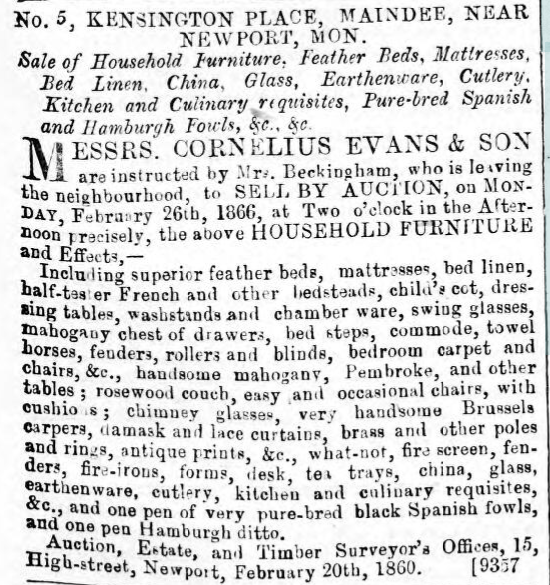
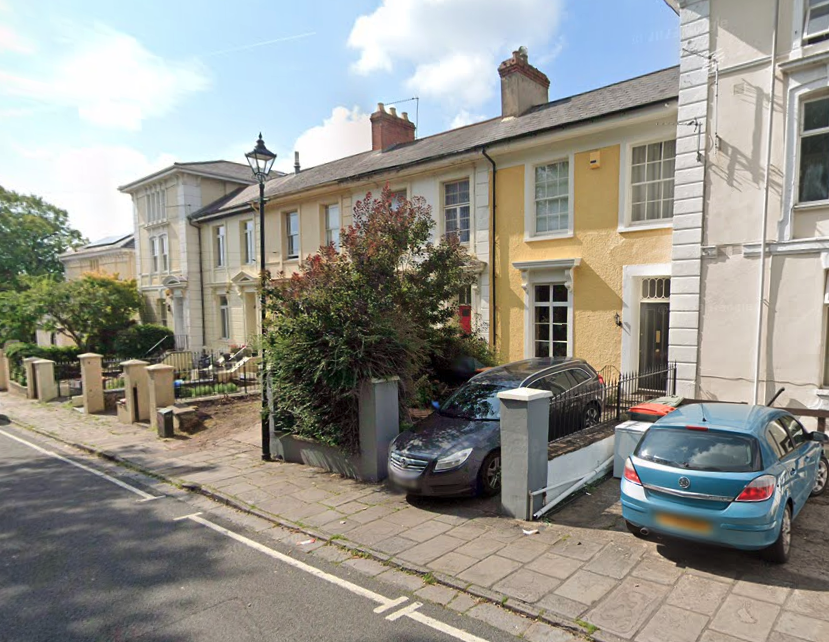
An advert in an 1866 edition of the Monmouthshire Merlin gives an insight into the furniture that was being auctioned from 5 Kensington Place which is the house in yellow in the photo below.
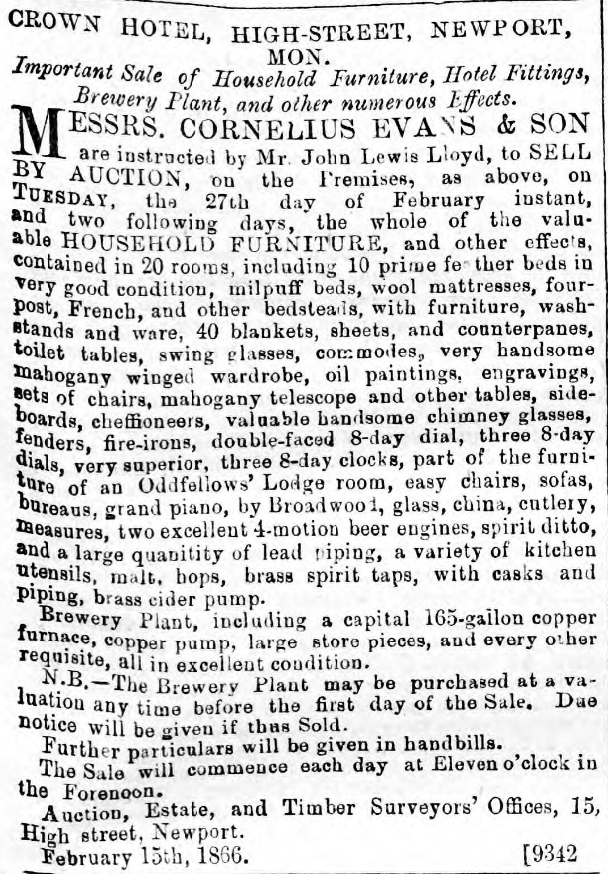
Also for sale in the same newspaper was furniture and brewery equipment from the Crown Hotel on High Street.
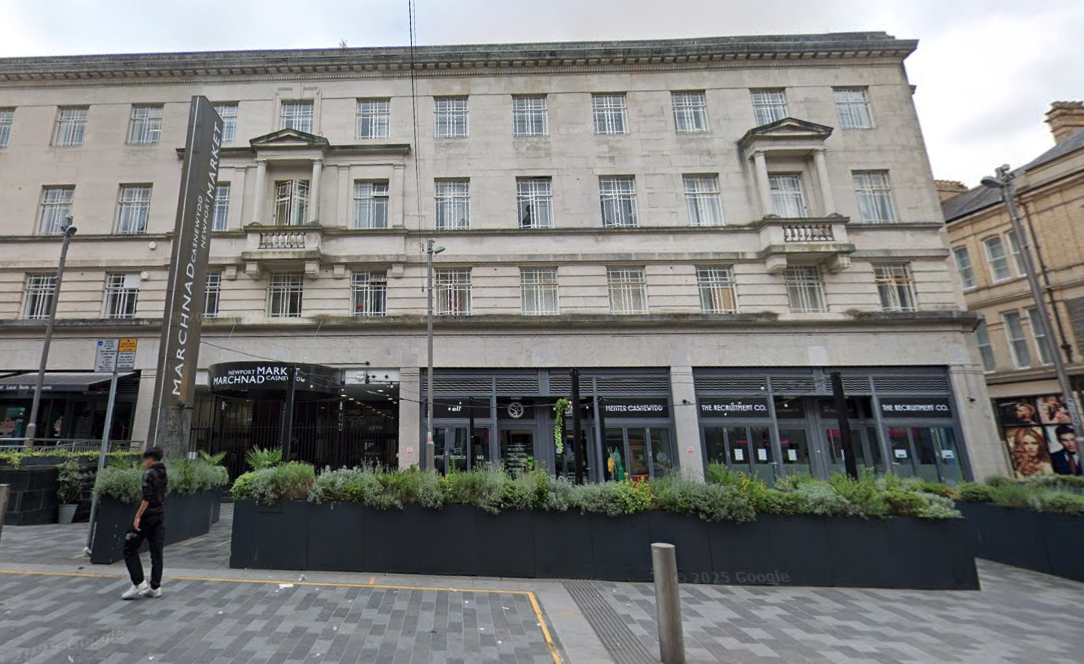
The Crown Hotel, also known as the Crown Wine Vaults in the 1886 street directory, was in between Market Street and Griffin Street.
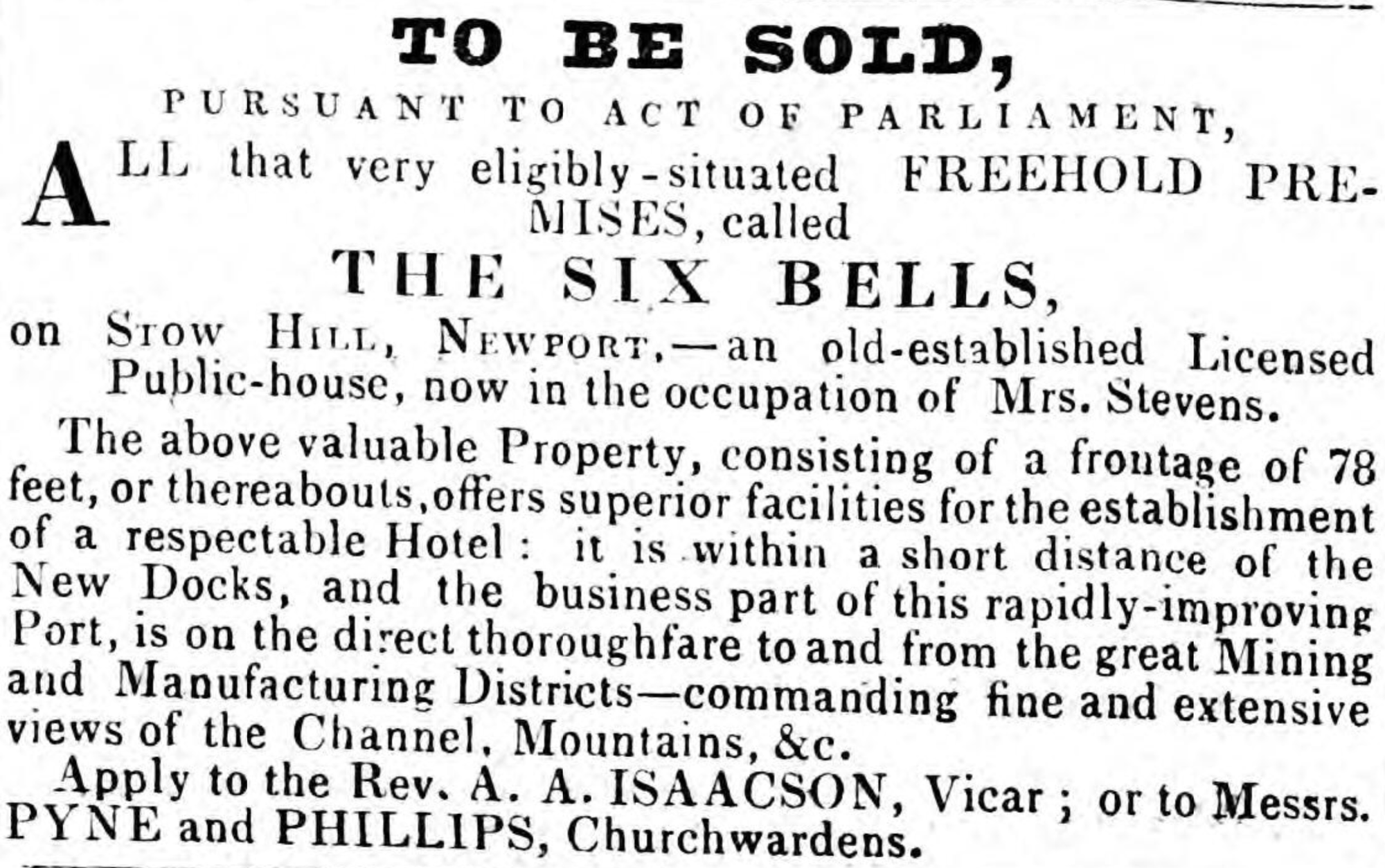
'Special Constable Summoned For Assault'
Special constable Harper, having summoned Mr. Townscnd to appear before the magistrates on the 18th of July last, for an assault alleged to have been committed on him by defendant, on the morning of the 15th, Mr. Townsend appeared, when the case was gone into, and after a full inquiry, the summons was dismissed. Mr. Townsend therefore lodged a complaint against Harper, with the Watch Committee, before whom the following proceedings took place, at a meeting held on the 24th of August:—
Present—Thomas Jones Phillips, chairman, Lewis Edwards, John Frost, Joseph Latch, George Gething, Thomas Hawkins.
Mr. John LLoyd: I saw Harper the constable, of Newport, about half-past six o'clock on Sunday morning, the 15th July; he was standing at the corner of the Westgate I was in my bed-room window he was walking steady and appearing to know what he was about; I should say he was not in a state to perform his duty as a constable. I at the same time saw Mr. Townsend; I saw Mr. Townsend go up Stow Hill and knocking at Miss Poulton's door. I saw Harper take hold of Mr. Townsend at Miss Poulton's door I did not hear any conversation that took place between them. Harper attacked Mr. Townsend. Mr. Townsend appeared very violent and much excited in consequence of Harper taking hold of him. Mr. Townsend got loose of Harper, and ran down the hill towards the Westgate. Harper followed him. They both went down Commercial-street. I saw nothing afterwards. I heard a noise down the lane which occasioned my getting up. Mr. Townsend was speaking very loud. I did not hear Mr. Townsend make a noise before I saw Harper. I did not consider that any violence was used. I should consider that Mr. Townsend was able enough to go home himself.
Mr. Daniel Tombs: On Sunday morning, the 15th July, about seven o'clock, I was going down the street from the King's Head Inn towards the Westgate; I saw Harper the constable; he was going after Mr. Townsend to the Westgate. Mr. Townsend went up Stow Hill as far as Miss Poulton's. Harper went after him. At Miss Poulton's door, I heard Harper say to Mr. Townsend, "you must go along with me". Mr. Townsend said he wanted to have nothing at all to do with him, that he did not like him. Mr. Townsend was then on the platform opposite Miss Poulton's door. Mr. Townsend ran down the street and Harper ran after him towards the Westgate. Mr. Townsend proceeded as far as Messrs. Edwards and Evans shop; he was followed by Harper. I saw nothing of them afterwards. I did not hear Mr. Townsend knock at the door. I was no nearer than Abraham Clements' door to Miss Poulton's.
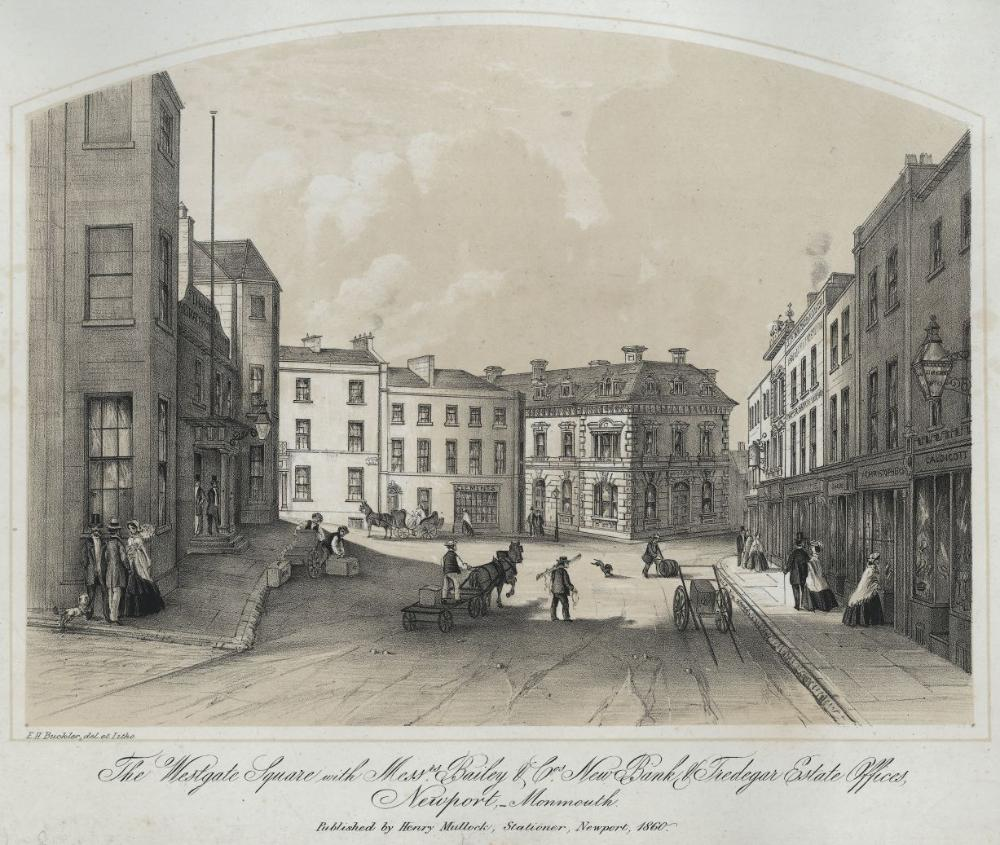
I saw no violence. Harper attempted to take hold of Mr. Townsend. I saw something in Mr. Townsend's hand, it had the appearance of something red. I think Harper was quite intoxicated—that is my opinion, and I believe it is the truth. I heard Harper say to Mr. Townsend, "you must go along with me." I did not hear Harper say he should have the pleasure of putting a Town Councillor in the Clock-house.
I heard Harper say to Mr. Townsend, "you must go along with me." I did not see Mr. Townsend by the King's Head. I did not see him by Mr. Brewer's window.
Valentine Daniel: Between six and seven o'clock on Sunday morning, the 15th July, I was standing on the steps of my door; Mr. Townsend passed me and said, "I will go up and see my old friend, though we have disagreed many times." He knocked at Miss Poulton's door. Mr. Harper went up to him. I did not hear what took place between them. Mr. Townsend returned, followed by Harper; both of them walked very well—they walked as if they were sober and quite solid—no conversation took place between them as they returned. I heard Mr. Townsend speaking loud before I saw Harper; it was a short time before I saw Harper follow Mr. Townsend up the hill.
David Davies: Between six and seven o'clock in the morning of Sunday, the 15th July, I was near Mr. Evans the grocer's door, in Commercial-street; I saw Harper there and spoke to him. I saw Mr. Townsend and Mr. Turner near Edward James' house. I said to Harper not to take any advantage of any other person because he was drunk himself. Harper was drunk, and said he would watch my house. He could not speak very plain. His features told me he was drunk. I could tell he was drunk by looking into his eyes. Harper said it was fitter for the constables to have irons to put on the people than for the police; he said, that Mr. Townsend was one of those that ordered swords and pistols for the police to carry about with them. Pretty sort of peace makers. If I don't have £5 out of him to-morrow I'll summon him up. I called David Jones to witness, and David Jones told Harper he would appear against him. David Jones was standing by, heard what Harper said. I was quite sober when I first got out of bed. I did not see anything indecent or improper in Mr. Townsend's conduct; hc was walking under Mr. Turner's arm.
David Jones: About seven o'clock on Sunday morning, the 15th July, I was coming up Commercial-street; I saw Harper opposite Mr. Evans the grocer's he was in conversation with many persons I think he was a little in liquor. I saw Mr. Townsend; I did not see them near each other; I discovered from his conversation that he had taken more than did him good he was not sober. I heard Harper tell David Davies that he would have a warrant against Mr. Townsend for opening his knife—a fine councilman going to insult a peace-officer ; I'll have a warrant against him to-morrow morning, and make him pay £5 for it. I did not see Mr. Townsend do anything to Mr. Harper. I saw many going in custody in the same situation as Mr. Harper was in. I saw Mr. Townsend with his purse in his hand, and said this is what Mr. Harper wants to have. I did not hear any one say that Mr. Townsend had drawn his knife—I did not see any knife.
Mr. Turner: I walked home with Mr. Townsend; he had no knife in his hand; he had a purse in his hand; he insulted no one. I saw Harper—he was drunk. Mr. Townsend was not sober. Harper was not in that state that was proper for a peace-officer. Mr. Townsend and myself joined at Mr. Evans the grocer's, and we went together to Mr. Townsend's house. I saw Mr. Townsend with his back against Mr. Lewis's door. I did not see him with Harper.
William Jenkins: I was at my house in Commercial-street, about seven o'clock, the 15th July: I saw Harper the constable that morning, near the Westgate Inn he was walking backwards and forwards. Judging from the appearance of his walking, I should say that he could not be very tipsy, he seemed to walk very well. I saw him walking after Mr. Townsend up Stow. I did not hear anything that took place between them. In a few moments afterwards, I saw Mr. Townsend return, and Harper was then walking after him. I heard a noise in the street before I got up. I heard Mr. Townsend's voice. I thought he was in a rage about something. Mr. Townsend walked very well, and did not appear to me to be tipsy. I did not see anything hostile in the conduct of Harper towards Mr. Townsend. I did not see anything in Mr. Townsend's hand. I heard Mr. Townsend's voice before and after I got up.
The constable Harper was reprimanded by the chairman.
— Monmouthshire Merlin, 15th September, 1838
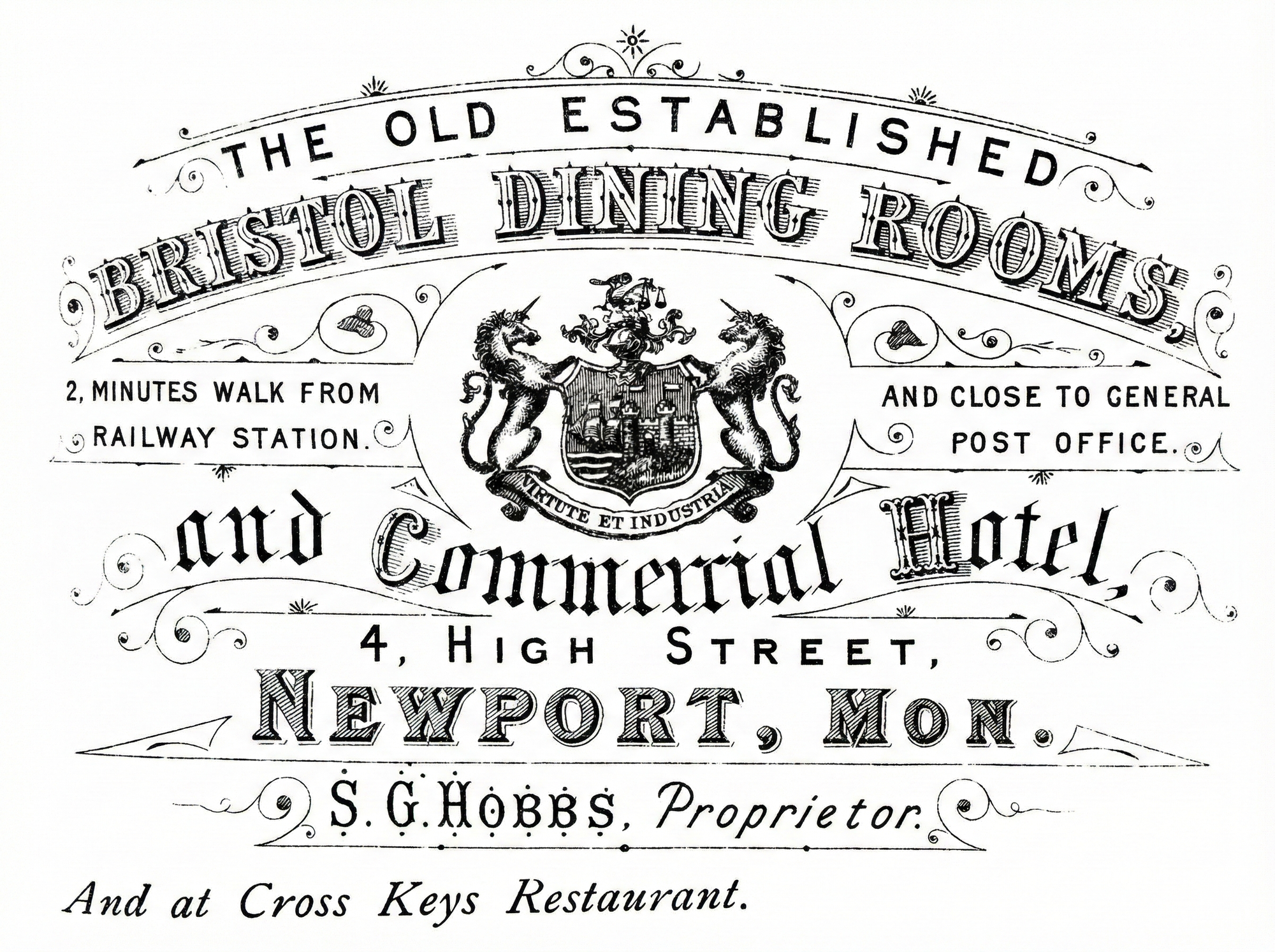
Fire at Newport
Marvellous Escape of Large Business Premises
A police officer, whist passing the foundry of Messrs W.A. Baker and Co., in New Dock-street, just after three o'clock this (Saturday) morning, was startled to observe a huge sheet of flame suddenly shoot up into the air on the foundry premises. H eat once gave an alarm, the fire bell was rang, and members of the brigade called by means of their electric bells. In the course of a very short time 18 men were upon the scene of the conflagration, with hose and reel.
Captain H. S. Lyne and Lieutenant J. A. Lyne were in command. The foundry doors were forced open, and it was then found that a large quantity of old timber, stacked near the cupola, had been ignited. The flames reached the flooring of the warehouse, which is immediately above, and for some moments it was feared, the fire would extend to this part of the building. Had such been the case, a conflagration unprecedented in the town for years past must have resulted.
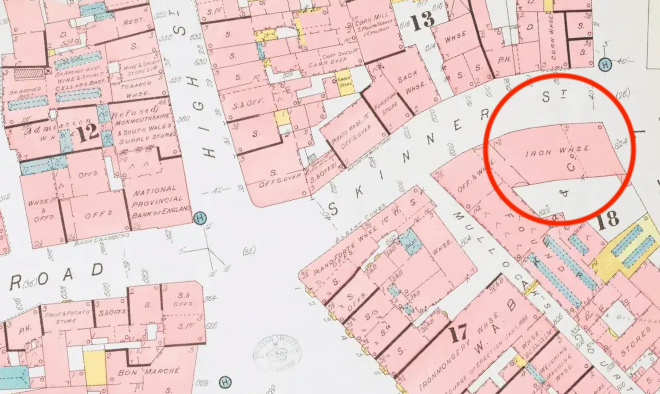
The firemen, however, assisted by police, worked with a will, and by mighty efforts succeeded in levelling the burning timber, thus saving the warehouse. At half-past four the fire was finally extinguished. Mr Baker, who had been called to the spot immediately the outbreak was discovered, is unable to account for the timber catching fire, and the only theory is that some sparks from the cupola had reached it, and smouldered for some hours until the wood caught fire.
— South Wales Daily Times and Star of Gwent, 7th September, 1889 (Subscription Required)
Mr Baker, wrote to the newspaper and the letter was published after the article.
To the Editor of the Star of Gwent
A fire was discovered at our works at 3.30 this (Saturday) morning, which had taken a strong hold upon a quantity of wood work which we are removing from the old building now being pulled down to make room for considerable extension to the works, and although I was on the spot as quickly as possible, yet the police and Fire Brigade were already there, hard at work with the hose, and had got the flames under control. I desire publicly to express my thanks to the captain of the Fire Brigade (Horace Lyne, Esq), the Superintendent of Police, Sergeant Evans, who discovered the fire, and the other officers and men present for the able way in which everything was managed. It is owing to the promptness and energy displayed by the police and Volunteer Fire Brigade that a most serious conflagration has been averted.
I remain, sir, yours truly,
W.A. Baker
Street Preaching
SIR, Observing a report of magisterial proceedings preferred on Monday the 22nd of June instant, bv Superintendent Huxtable, before G. Wr. Jones, Esq., Mayor James Brown, Esq., ex-Mayor and W. Evans, Esq, charging me, with a woman named Hopkins, with holding forth at the Pump, Cardiff-road, Newport — street preaching, singing, &c., from 10 and 11 to half-past 11 at night, to the great annoyance of the inhabitants of the neighbourhood — it now becomes my duty to inform Superintendent Huxtable, through your columns, that I challenge him to the proof that I did at any place at Newport, highway, byway, or otherwise, preach or ever was connected with street preachers; and for thus libelling my character, it is my intention to take immediate legal proceeding against him.
Your insertion of this in your next MONMOUTHSHIRE MERLIN will oblige, your obedient servant,
HENRY MATHIAS, Master Mariner.
Victoria Crescent, Newport, Mon., July 1, 1863.
— Monmouthshire Merlin, 4th July, 1863
Very "Heavy Wet"
A foolish fellow, last Tuesday afternoon, imbibed such large quantities of "moistening," that he was induced to strip off his clothes at the Rodney Parade packet-slip, and take a plunge into the tide, which was running out rapidly at the time. He had miscalculated his strength, and the amount of his sobriety for the tide carried him down so fast, and rendered him so powerless, that had not a friend put off a boat to his assistance, he might have been drowned, as the reward of his drunkcn temerity.
— Monmouthshire Merlin, 7th May, 1852
'Salmon Caught in Canal'
A few days since, Mr. Edmund Oscroft, of this town, caught at the Gwastoed lock, with a trout tackle, a salmon, weighing four pounds and three ounces, rather a fine fellow to be captured in the canal.
— Monmouthshire Merlin, 7th May, 1852
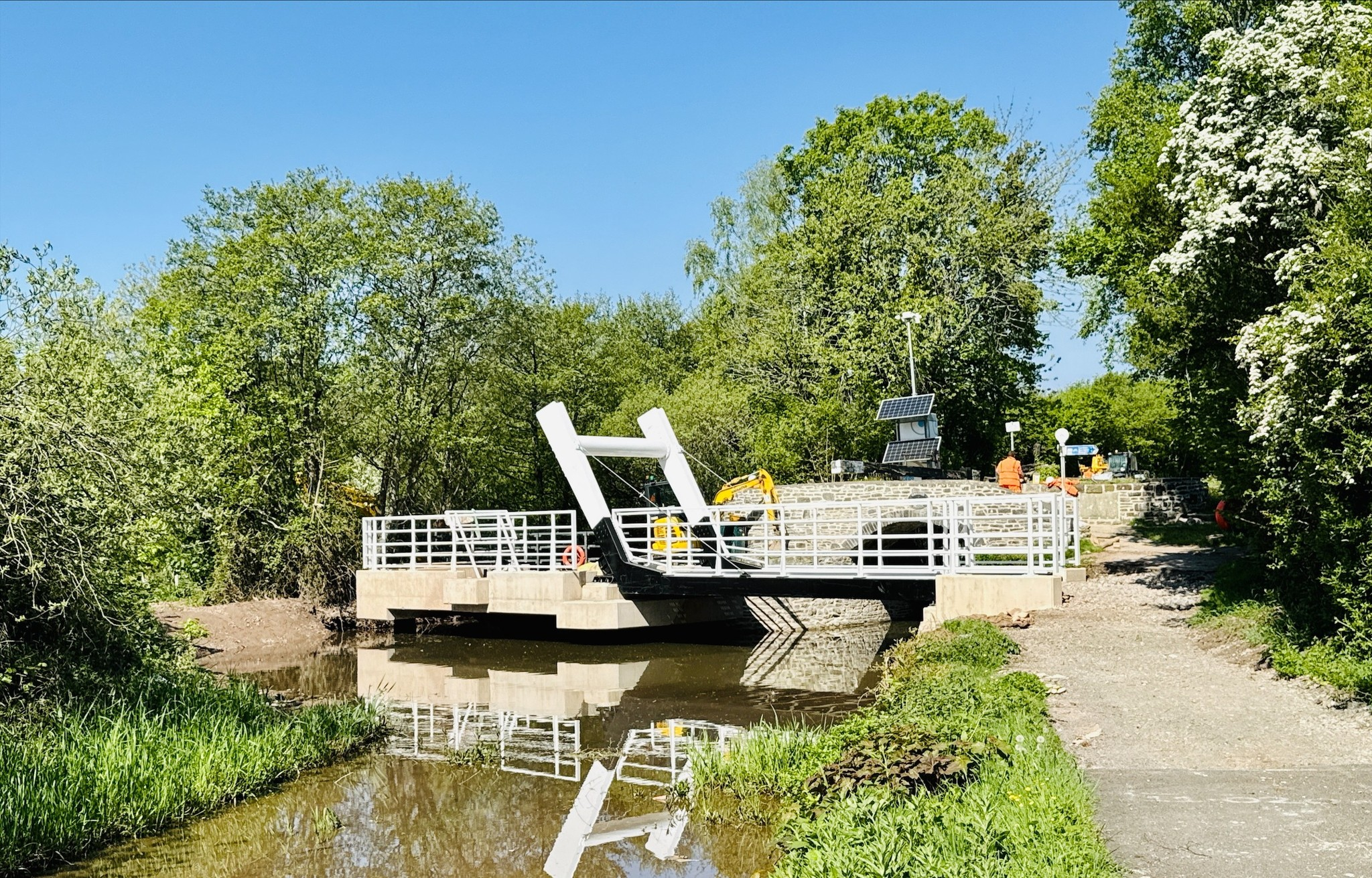
Nuisances
Wherever foul smells arise, from whatever nuisances, means should be at once applied for the abatement of all that may be infectious or poisonous in them; and now that so many remedies of this nature are in existence, that father of a family or master of an establishment, is really criminal, who neglects to disinfect such nuisances of their dangerous properties. There is not a druggist's shop in Newport or elsewhere, perhaps, where valuable disinfecting agents are not sold, and at a rate, too, quite within the reach of the poorest householder. It would not be quite right for us to commend any particular article but the very great value and remarkably cheap cost of certain fluids and powders that we have heard praised, entitle them to immediate use in and about every house in Newport.
— Monmouthshire Merlin, 1st September, 1849
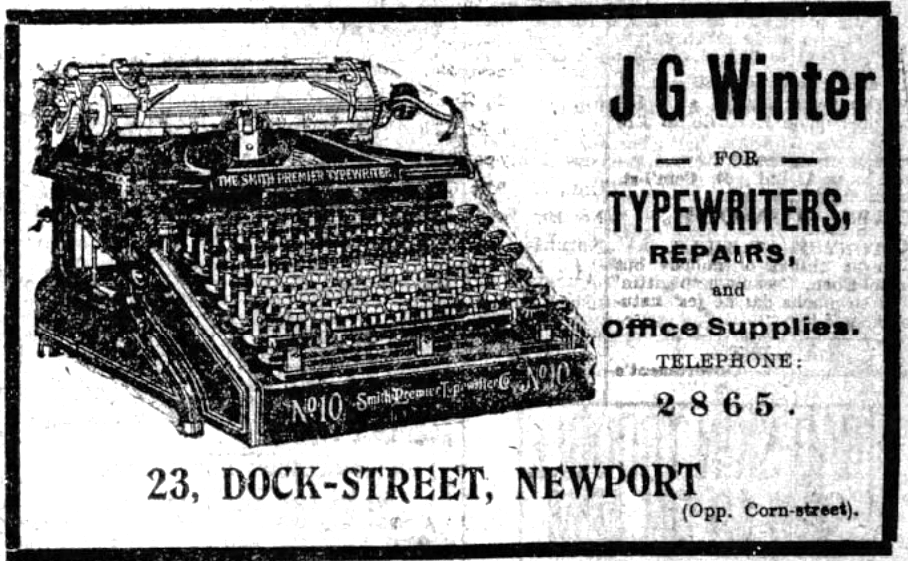
New Class of Irish Immigrants
On Sunday morning last, a large cargo of Irish immigrants were landed at Penarth, and with the usual love of Newport, all were here in a very short time. We understand, however, that these were of a very different class to their predecessors, being only women and children, pursuing their way, in decent apparel, and with some little money, to husbands and fathers who had settled in many parts of England as industrious workmen. It was also stated that a cargo of potatoes was brought by these immigrants, in the same vessel, which one or more have been left behind to dispose of for the lot. The crop of potatoes is described by the passengers as most abundant in Ireland this season. This is cheering.
— Monmouthshire Merlin, 1st September, 1849
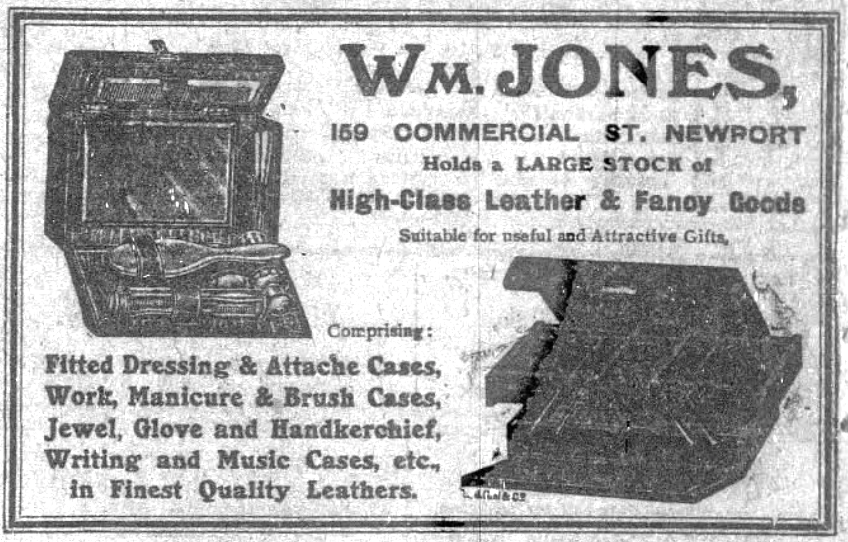
The Sisters Sophia and Annie
The Sisters Sophia and Annie gave their popular entertainment "Fun," at the Town Hall, on Friday and Monday evenings last, and the manner in which they acquitted themselves fully sustained their well-earned reputation. The attendance on Friday was probably owing to the number of entertainments that have been given in the town of late—rather limited, but that on Monday was very large, the room being well-filled with a highly-respectable audience, who repeatedly testified their appreciation of the entertainment by warm applause.
— Monmouthshire Merlin, 24th February, 1866

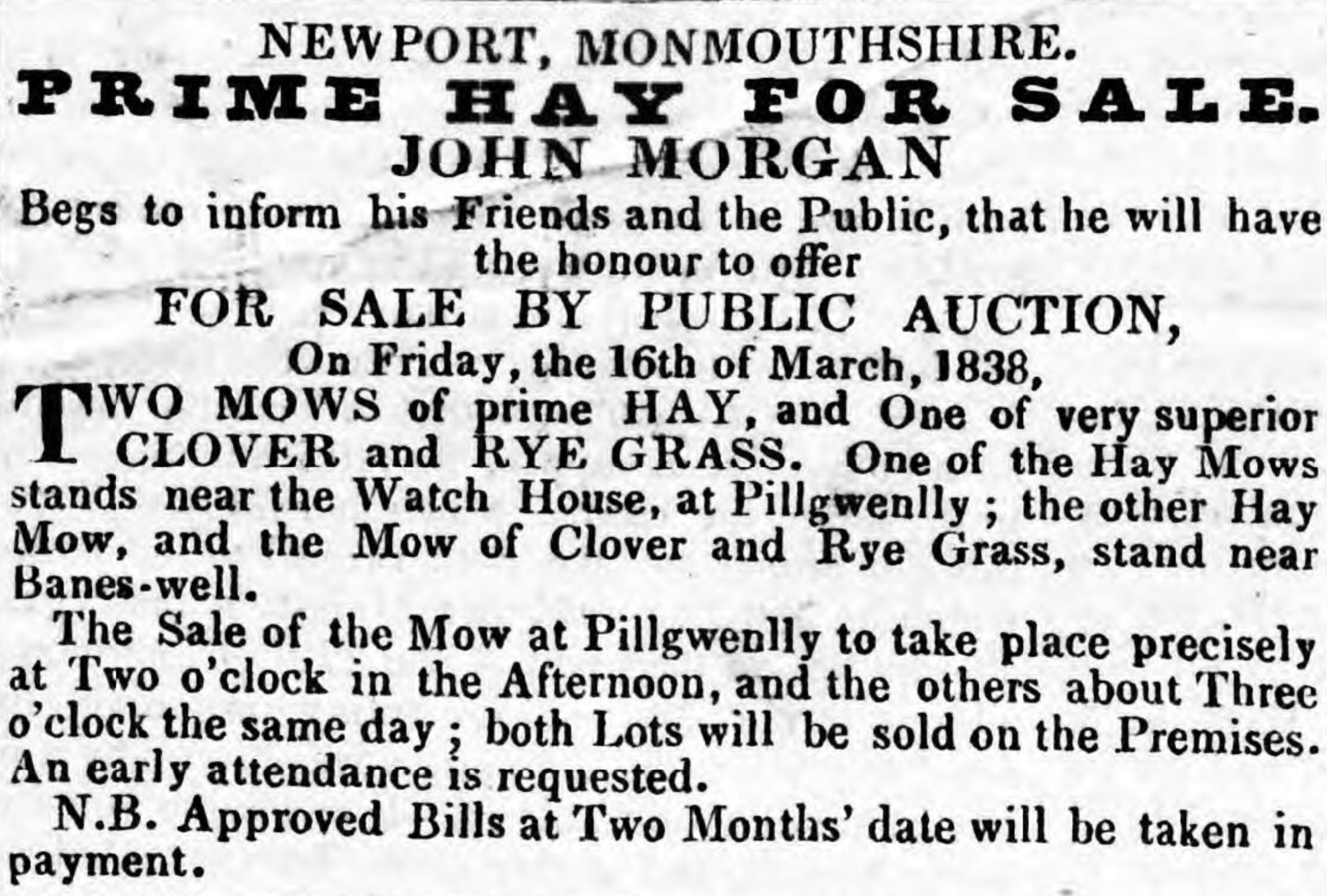
Ham Stealing at Pillgwenlly
Mary Hayes was charged with stealing a ham, the property of Mr.Jabez Haime, grocer, Pillgwenlly.— Mr. Woollett was solicitor for the prosecution. On the 6th of this month, prisoner entered the shop of prosecutor, and bought sugar. She came again in a few minutes, and, as on the former occasion, excited suspicion, by her loitering about, and especially near the door, on which eight hams were hanging. After she had gone out, prosecutor discovered that one of the hams was missing.
The officers, on receiving information, set to work, and on Friday last, brought him two bones and a piece of smoked hams, the latter corresponding with the quality of the ham stolen he believed it was his. The value of the stolen ham was 8s. Prosecutor had seen the prisoner, in leaving the shop, so placed her cloak at the door, that she could cover the ham and carry it off.
P. C. Price produced the ham, which he had found in the privy, from which he had seen prisoner coming a minute before. He also found a piece of cooked smoked ham in the house. The Bench said there could be but little doubt about the case but the identification of the ham was not quite clear. The prisoner was, however, committed to take her trial at the Sessions.
— Monmouthshire Merlin, 14th May, 1852
Charity
William Phillips, Esq., of Wilson, has transmitted £25 to be distributed amongst the poor of the parishes of Witson, Goldcliff, Magor, Redwick, and Nash, and the kind-hearted squire's gift has been, we understand, carefully and judiciously disbursed by Mr. Wilcox, according to the several necessities of the indigent people. This benevolence is "in humble testimony of mercies granted in the birth of a son and heir. and the safety of the mother." It is well that the hearts of the poor should be made glad on such interesting occasions.
— Monmouthshire Merlin, 1st September, 1849
Public Nuisance
"A Lady" writes to urge the removal of a disagreeable public nuisance, which has long been suffered to remain just at the entrance to the otherwise been suffered to remain just at the entrance to the otherwise delightful field-walk from the Cardiff-road to the road leading to St. Woollos Church; and she expresses a hope-in which we cordially concur—that the unsightly and un-healthy subject of complaint may be removed at once.
— Monmouthshire Merlin, 14th May, 1852
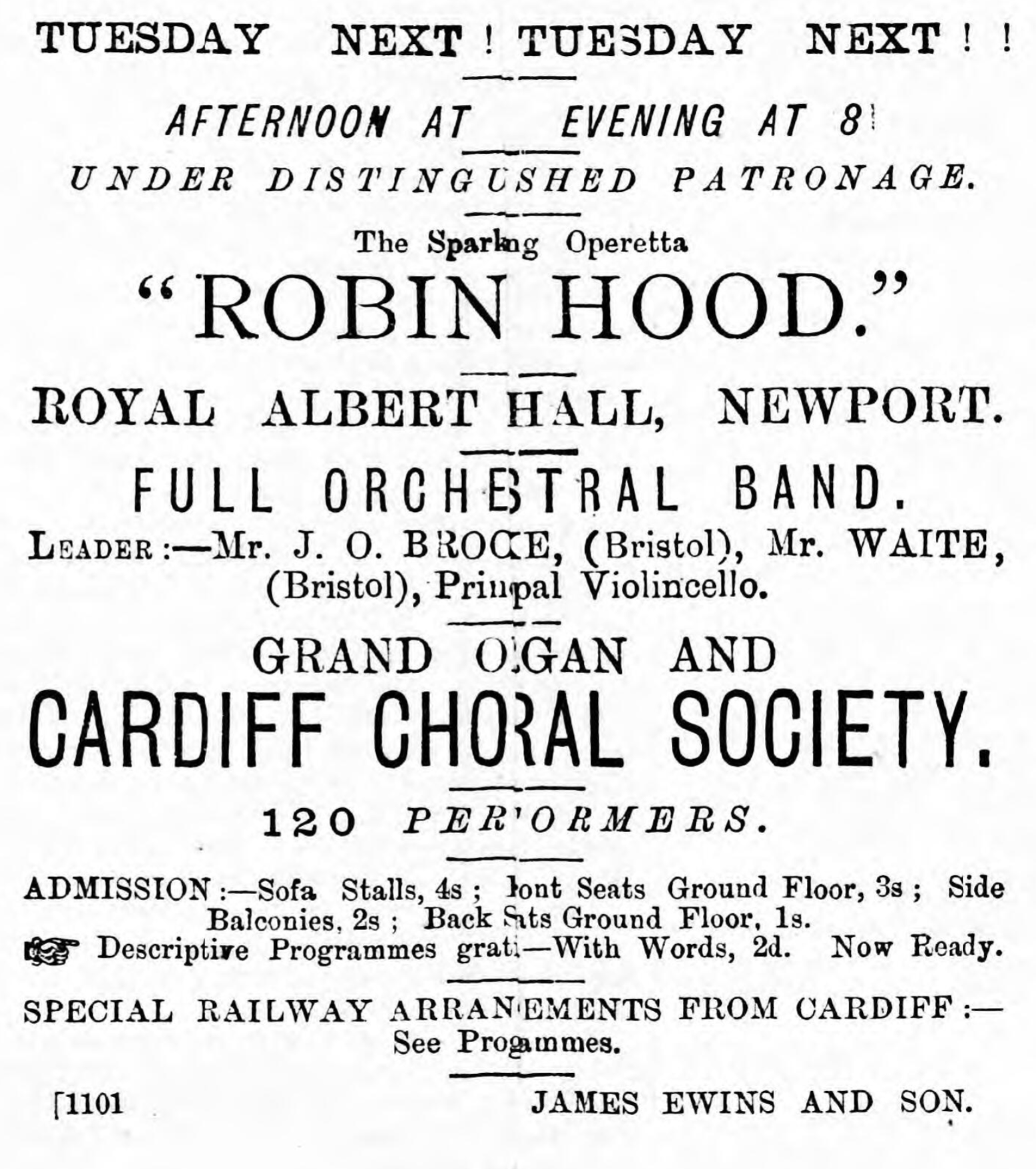
Mrs Cummins' House
We understand that the vacant old house on Stow Hill, belonging to Mrs. Cummins, which has been represented as extremely dangerous to the passing public, will shortly be converted into premises for the new Water Works.
— Monmouthshire Merlin, 3rd October, 1846
Electro-Biology and Mesmerism
A rich treat for the lovers of fun has been afforded this week, by the clever experiments of Miss Montagne. This lady, who possesses a superior skill in the Mesmeric has performed some most astonishing experiments; amongst which we notice her power to attract persons from among the audience to the platform. For instance, on Monday night a young gentleman, well known as a native of the town, left his seat, with eyes riveted on the animal magnet — the lady operator. In another instance, a sailor was so impressed when led by imagination, to suppose he was at his avocation, that he made many attempts to go aloft, actually mistaking the wall for shrouds and ratlins.
To enumerate the successful experiments of this really clever Mesmerist would be a task too voluminous, and, therefore, we merely say that the risibility of the crowded audiences could not be kept down, and that roars of laughter and applause were deservedly awarded.
— Cardiff Times, 8th January, 1859
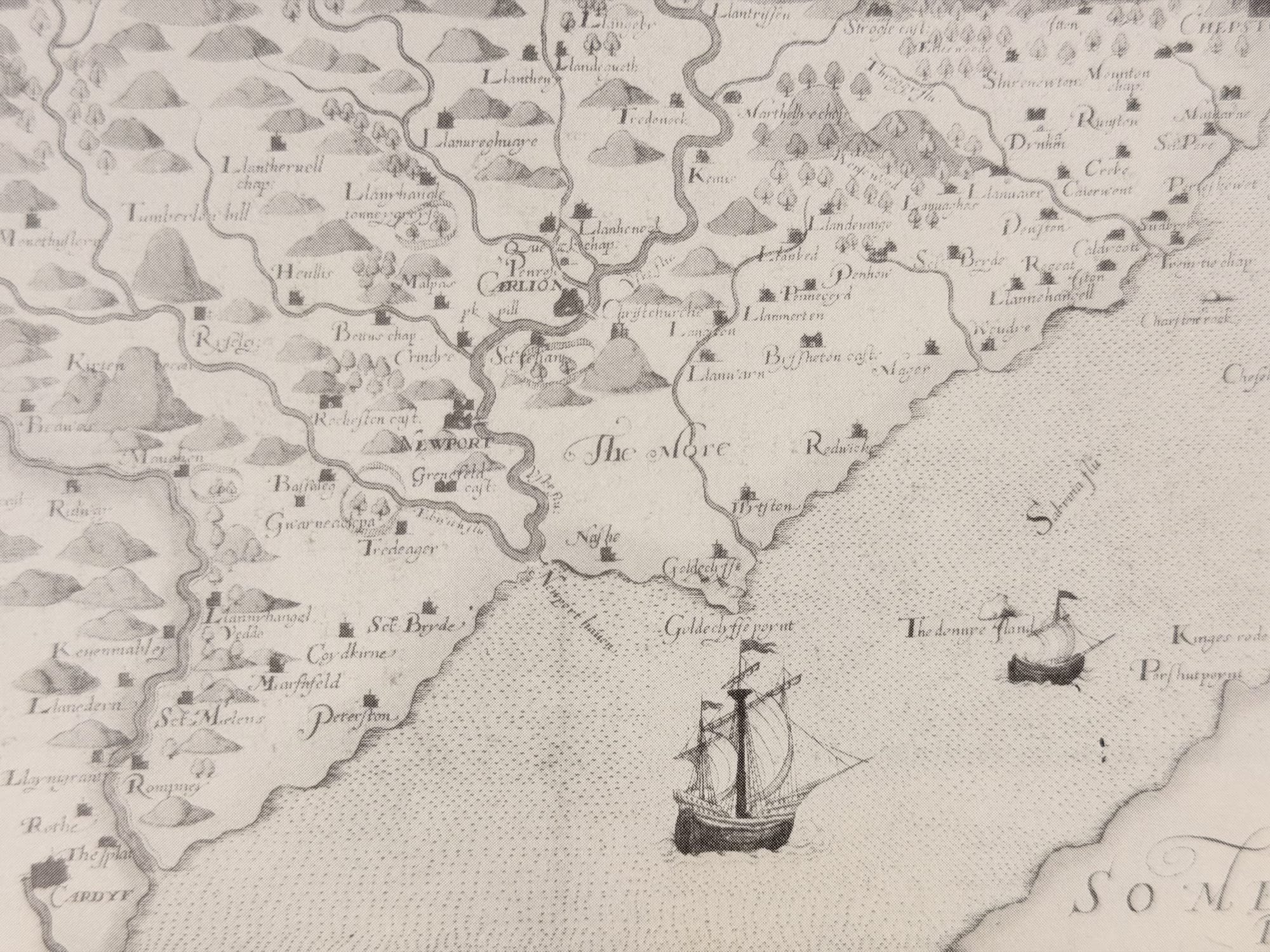
Monmouthshire Map, 1577


Member discussion