

The Forgotten Boom of Lighthouse Beach
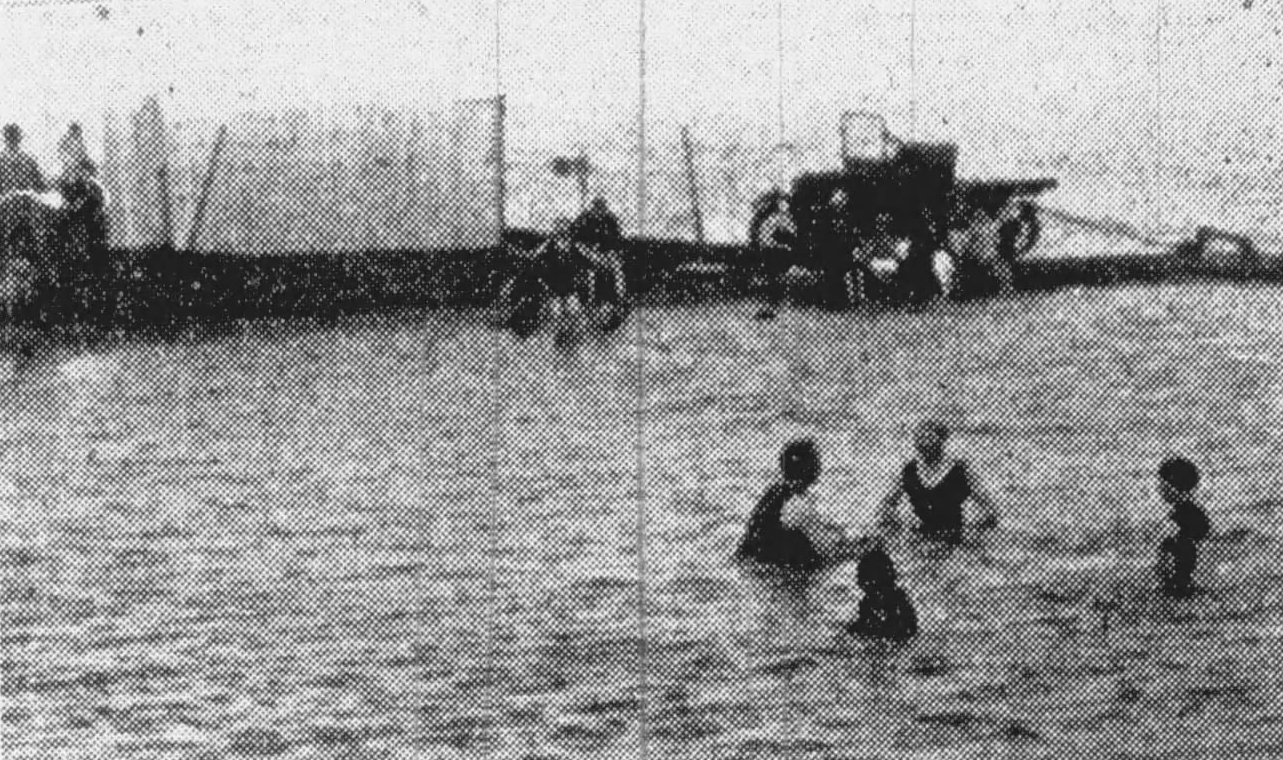
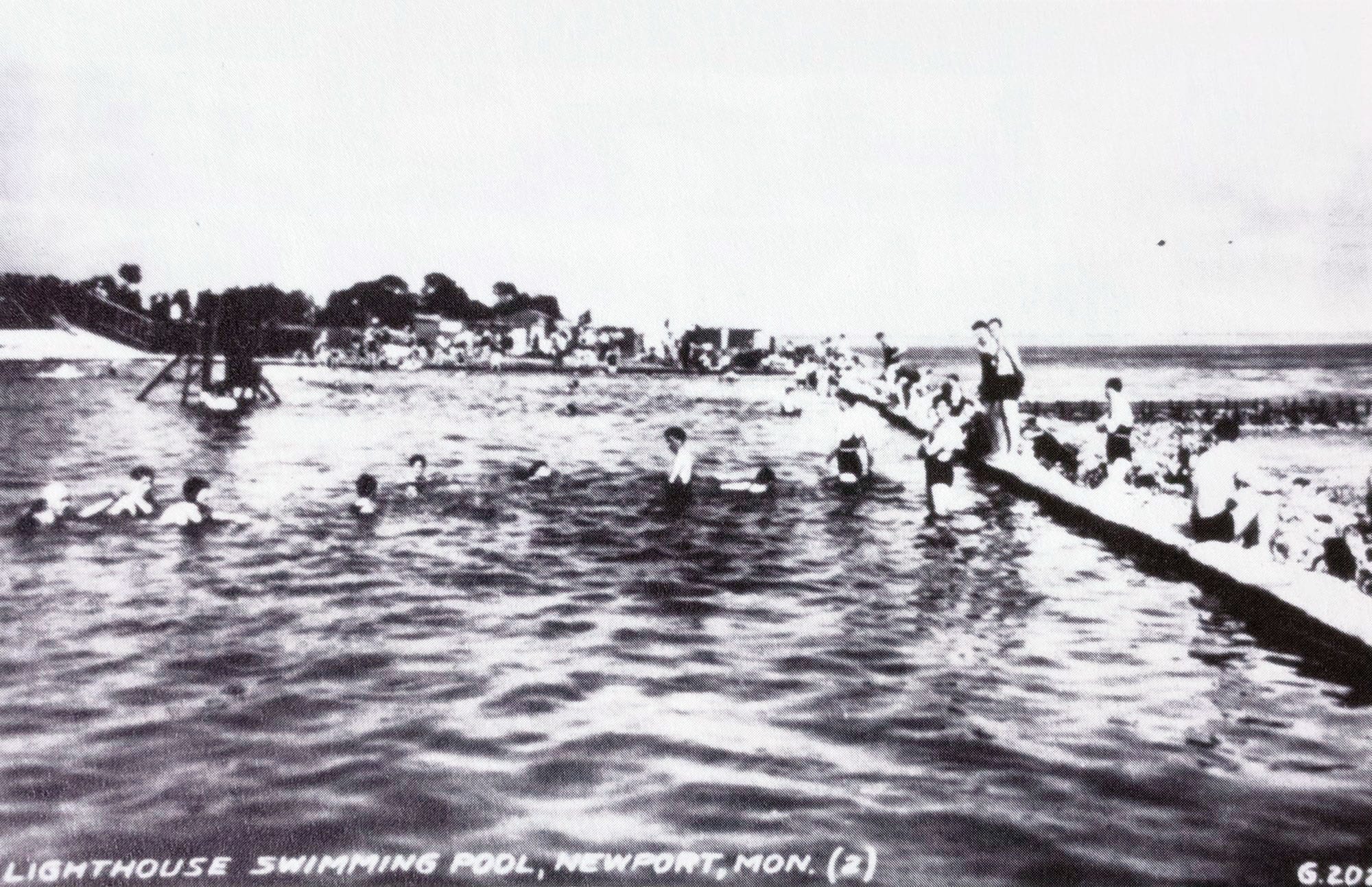
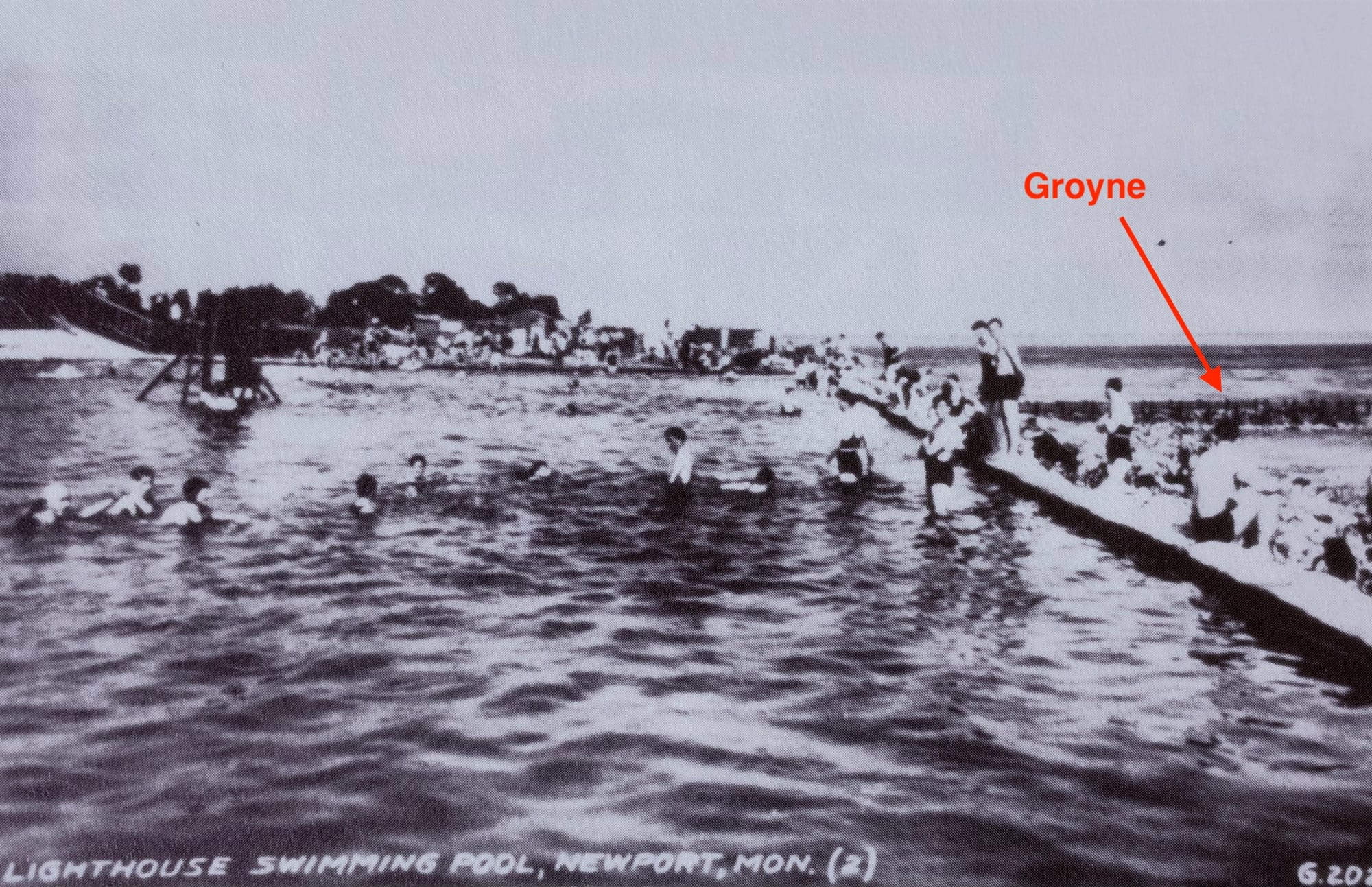
Recently, Newport Library shared a mystery image printed in a local history book: a vintage postcard captioned simply "LIGHTHOUSE SWIMMING POOL, NEWPORT, MON"—showing swimmers in a vast, concrete-walled coastal bath, with dozens of bathers perched along its sea wall and a wooden diving platform rising from the water. Alongside it in the library's archives were two original Western Mail copyright photographs capturing a dramatic full-immersion baptism taking place inside the very same pool. Nobody was quite sure where the pool had stood.
Ask most people in Newport today where the town's seaside resort was, and you will likely get a blank look. Yet for decades—from the late nineteenth century right through to the 1950s and beyond—the stretch of coast at St Brides Lighthouse was one of the area's busiest leisure destinations, anchored at its peak by a vast saltwater bathing pool promoted as the largest in Wales.
While the coastline there still draws visitors today, including walkers on the Wales Coast Path, few remember its extraordinary late-1920s boom, when the South Wales Argus championed the spot as "Newport-on-Sea" and "Newport-by-the-Sea," and crowds of up to 30,000 people descended on it in a single day.
A Seaside Escape Since the 1890s
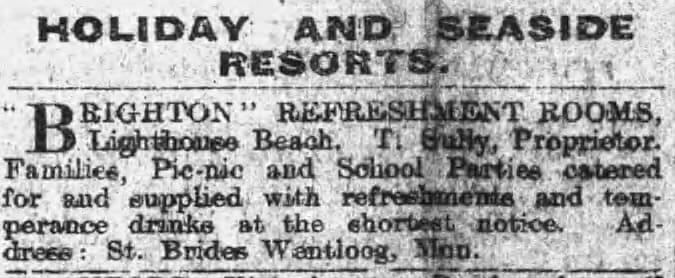
Long before the interwar boom, Lighthouse Beach was already a regular day out for Newport residents. By the 1890s and early 1900s, visitors were heading down to the coast for fetes, sports, and teas—most notably at T. Sully’s "Brighton" Refreshment Rooms, which catered for families, picnics, and school parties. Disaster struck during the violent gale of 10 September 1903, when all four refreshment rooms on the beach—owned by Messrs. Davies, Sully and Sully, and Mrs. Lock—were swept away by the sea, representing a £300 loss.
Despite the harsh Severn Estuary weather, the appeal persisted. The Newport Fresh Air Fund, led by the Revs. E. Waldron Skinner and Harry Abraham, regularly brought underprivileged Newport children down to the beach in horse brakes for organised games, community singing, and supervised bathing. By 1910, locals were already campaigning for "a drinking fountain, swings, mechanical amusements and a light railway to replace the horse brakes".
In October 1925, Newport Corporation's Parliamentary and Improvement Committee even discussed approaching Viscount Tredegar to acquire the beach—with Councillor W. J. Wall suggesting Lord Tredegar might gift it to the town—while the Borough Engineer was tasked with estimating the cost of fencing a footpath and erecting a footbridge.
Building "Sea Baths for Newport": The Boughton Brothers' Pool
The real transformation—and the setting of Newport Library's mystery postcard—began in the summer of 1927. Made possible through the generosity of Viscount Tredegar, C.B.E., D.L. (who held the foreshore rights) and the cooperation of the Sewerage Commissioners, three brothers—Messrs. Boughton, led by former Army officer H. E. Boughton (nephews of Sir William Rouse-Boughton, Bart.)—acted entirely on their own initiative to build a permanent open-air saltwater bathing bath on the edge of the rocks.
Because the Severn Estuary's mudflats and extreme tides made ordinary sea bathing treacherous, the brothers engineered the pool so visitors could swim or frolic in safety at any hour of the day, regardless of the state of the tide. They constructed a reinforced concrete dam along the rocky foreshore to enclose a basin measuring 75 yards long by 35 yards wide—three-quarters the length of a football pitch.
Inside, the pool was carefully graded for both serious swimmers and families. Its cemented sides sloped down to give a depth of 5 feet to 5 feet 6 inches across the greater area of the bath, providing ample room for proper swimming, while leaving shallow water around the edges where children could paddle in safety from ledges along the bank. Crucially, cementing the sides and approaches from the green eliminated any trace of the notorious Severn mud inside the bath itself.
To keep the water clean and buoyant, the brothers installed a motor-driven pump capable of 100 gallons per minute, which pumped 6,000 gallons of seawater into the pool at the change of every tide. As the water passed from the river mouth into the bath, it ran through a filtration system, while a sluice set into the centre of the concrete wall drained the bottom of the pool so the water was constantly refreshed.
Around the water's edge, the Boughton brothers built a dedicated ladies' dressing room alongside covered changing accommodation for men, hiring out bathing costumes and towels for a small charge. Out on the water, bathers played on a wooden raft, three or four lifebuoys, and a "large inflated sea-horse," while plans were already drawn up for a dedicated children's paddling pool and sand-pit. As the South Wales Argus noted in August 1927, the brothers had given Newport "for nothing what the ratepayers of Barry had to pay thousands of pounds to provide".
Disaster and Rebirth: 1927–1928
Nature, however, immediately tested their engineering. Just hours after the South Wales Argus published its feature praising the new pool on 16 August 1927, a fierce storm battered the coast. Between ten and eleven o'clock on Tuesday night, rough seas drove spray 30 feet high over the concrete wall. After two days of high-tide backwash, a 50-foot section of the ferro-concrete front wall gave way and collapsed, twisting the iron reinforcing rods, reducing the water depth to two or three feet, and sweeping away all the bathing huts and marquee furniture. Hundreds of disappointed visitors arrived on Wednesday to find the brand-new pool wrecked, though many still splashed in the shallow water anyway.
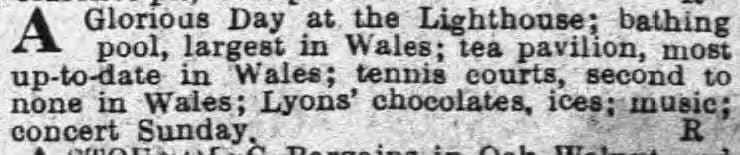
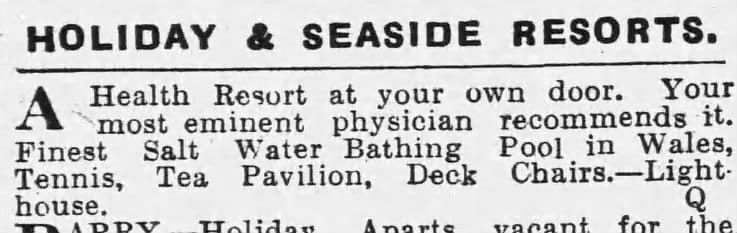
Rather than abandoning the venture, the Boughton brothers repaired the breach, reinforced the structure, and expanded the site. By late April 1928, bathing had resumed with a diving board, and by June, the brothers' newspaper adverts were hailing it as the "largest open-air bathing pool in Wales"—complete with a tea pavilion, tennis courts, deck chairs, Lyons' chocolates and ices, Sunday concerts, and furnished bungalow huts offered at 10s. per person for a Saturday–Monday weekend including meals. One advert summed up the pitch: "A Capital Day with little outlay.—The full cost of a day at the Lighthouse, Newport's own seaside: Bathing Pool 3d., Tennis 6d., Deck Chairs 3d., Plain Teas 1s.; cheapest seaside holiday in Wales".
30,000 Visitors, Baptisms, and Putting Records
Between 1928 and 1930, Lighthouse Beach hit its golden era. At its height in the summer of 1928, promotional notices boasted that 30,000 people visited and took full advantage of the bathing pool, tennis, tea pavilion, and amusements in a single day.

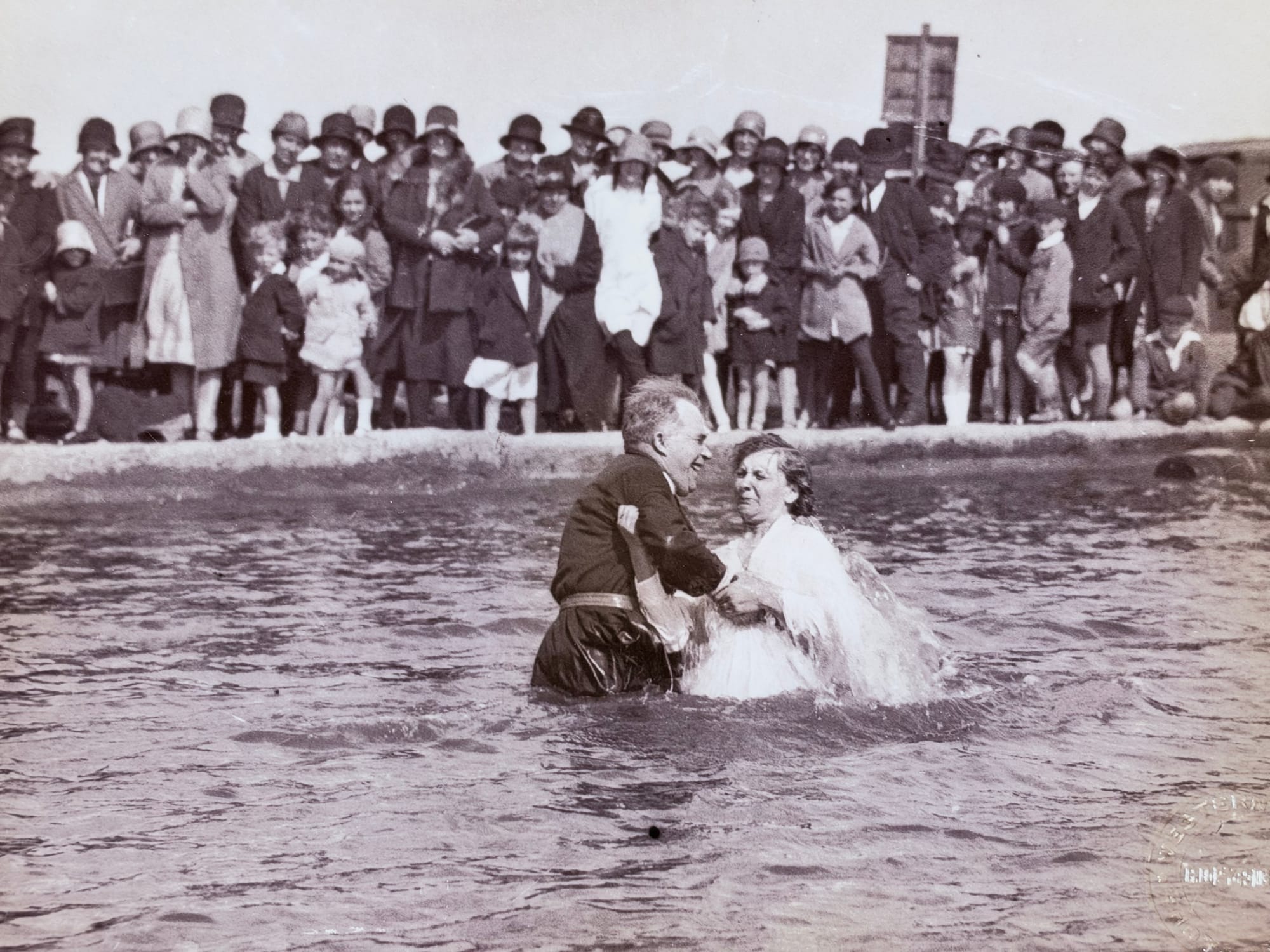
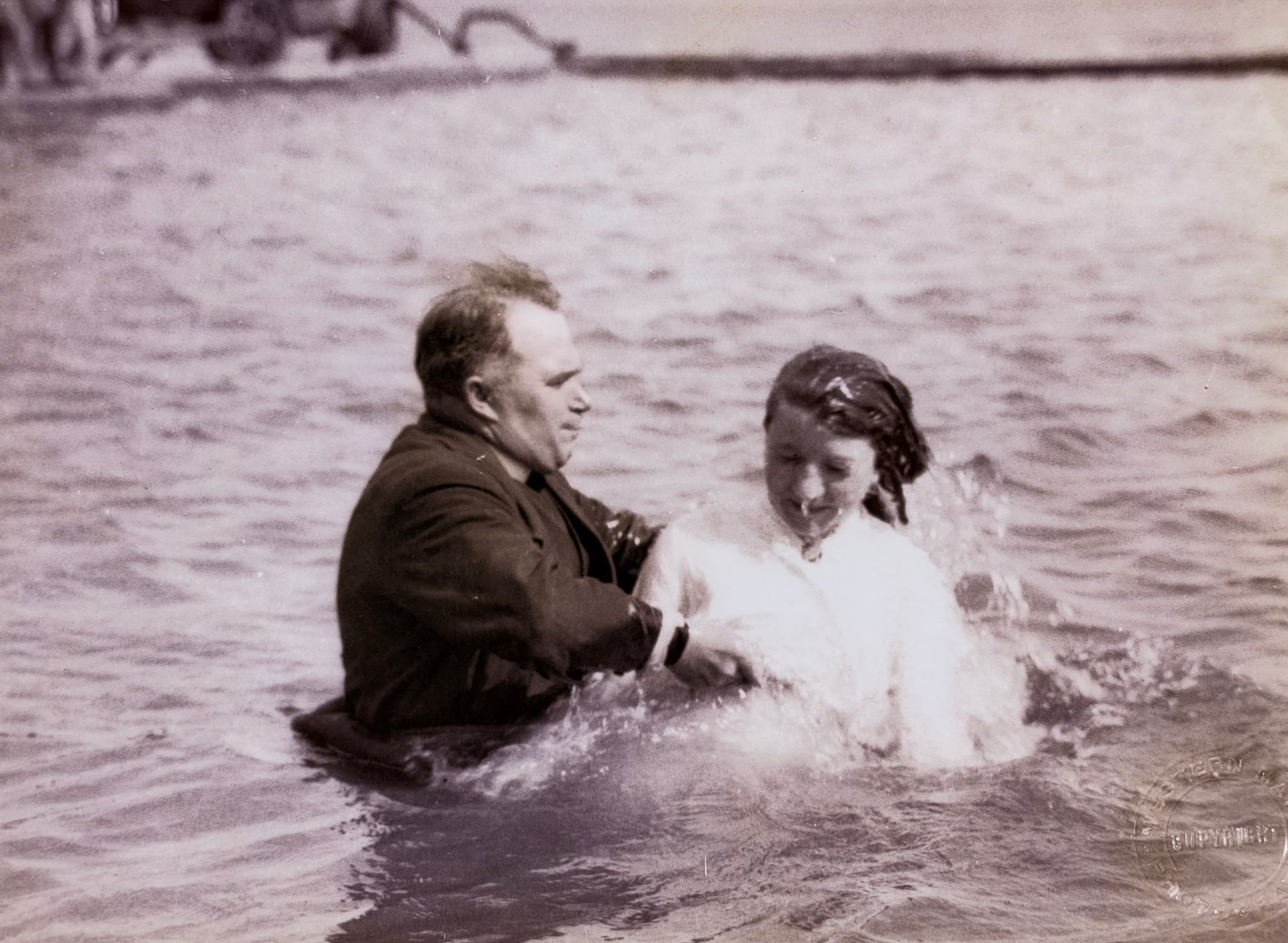
The pool remained the centrepiece of life on the foreshore—even doubling as an open-air baptistery. In August 1931, with the sea tide well out, hundreds of brightly garbed bathers paused in reverence around the concrete rim while Pastor Rhys Edwards of Bethel Evangelistic Society (Bethel Temple, Newport) walked down into the pool in a black gown to immerse six white-robed candidates—starting with a 13-year-old boy—before bathers jumped straight back in once the ceremony concluded.
Right beside the pool, the 100-by-20-yard coastal putting course—charged at 3d. a round, or 2d. with a ticket bought from Coast Line bus conductors—became fiercely competitive. During one Bank Holiday tournament, the old course record of 32 was broken three times, with R. Moore of Risca shooting an astonishing 28, including eight holes-in-one.
The coast even developed a reputation for unorthodox health cures. In April 1929, H. E. Boughton wrote to the Argus claiming that five hot baths of St Brides coastal mud—boiled in his domestic copper and kept warm over two primus stoves—had completely cured his crippling sciatica after Droitwich salt baths and Turkish baths failed. The Argus Special Commissioner noted that local doctors had long praised the "ozone-laden air" and mud of St Brides as a rival to Weston-super-Mare across the Channel. Meanwhile, crowds packed into the adjacent Tyn-y-Pwll Hotel (and later a neighbouring amusement park featuring galloping horses, dodgems, and a Noah's Ark), alongside annual Sunday school, chapel, and club outings—such as the Crindau Ward Young Britons, who brought 350 members and 100 mothers down for tea and sports.
The Chaos of Popularity
Getting tens of thousands of people down narrow, un-tarred country lanes to St Brides proved to be the resort's biggest headache.
The sheer demand overwhelmed local transport and sparked years of municipal wrangling. Because the Lighthouse lay outside Newport's two-mile borough bus limit, Newport Corporation's attempts to run buses there were blocked by St. Mellons District Council. At one point, peak summer congestion in central Newport became so severe that the Corporation ran buses down to the seashore illegally for a fortnight before St. Mellons refused permission—a refusal later overturned on appeal by the Ministry of Transport. By 1930–1931, Councillor Thomas Crowther claimed demand was "20 times greater than was catered for," with stragglers waiting until 1:00 a.m. for a ride home, until Traffic Commissioners eventually brokered a rota between Red and White Services and 17 local charabanc proprietors at a 1s. return fare from Ebenezer Terrace.

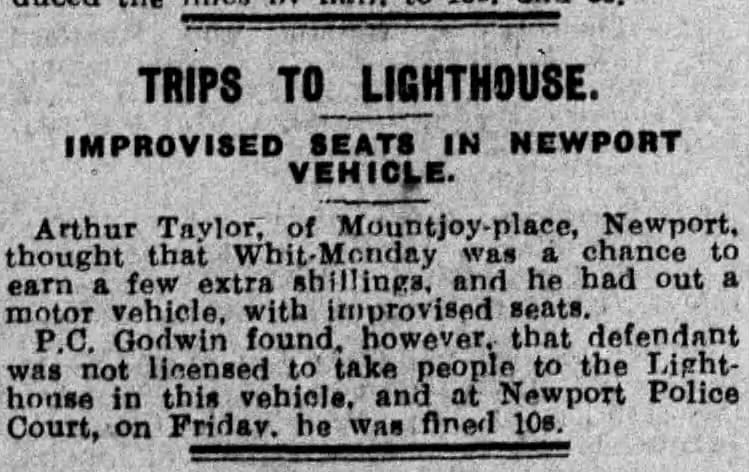
In the meantime, opportunistic drivers stepped into the gap and landed themselves in Newport Police Court for plying for hire without hackney carriage licences. Thomas J. Evans and Griffin Barnett were fined and ordered to pay costs after using Barnett's greengrocery motor-van to ferry passengers on August Bank Holiday; Evans told the bench: "There was such a crowd to go to the Lighthouse at St. Brides on August Bank Holiday that they would have gone down in wheelbarrows if there had been any available". Similarly, Arthur Taylor of Mountjoy Place was fined 10s. on Whit-Monday after fitting a motor vehicle with improvised seats to run trips to the coast.
Popularity brought other growing pains, too. Police complained of rowdy trippers—with Supt. L. Spendlove remarking at court that St. Brides received "two kinds of visitors—nice people, and people of Lloyd's sort"—while R. Boughton offered a £1 reward in August 1928 after vandals wilfully destroyed the direct road signpost to the bathing pool. In June 1930, a dramatic Whitsuntide caravan fire at Glanymor melted window glass and sent flames 30 feet above the treetops, visible from the main Newport–Cardiff road.
A Quiet Fade
While the late 1920s represented its peak, Lighthouse Beach did not vanish overnight. Group outings, bungalow holidays, and summer crowds continued well into the 1930s and 1940s, with newspaper reports showing the area was still pulling in visitors in August 1950.
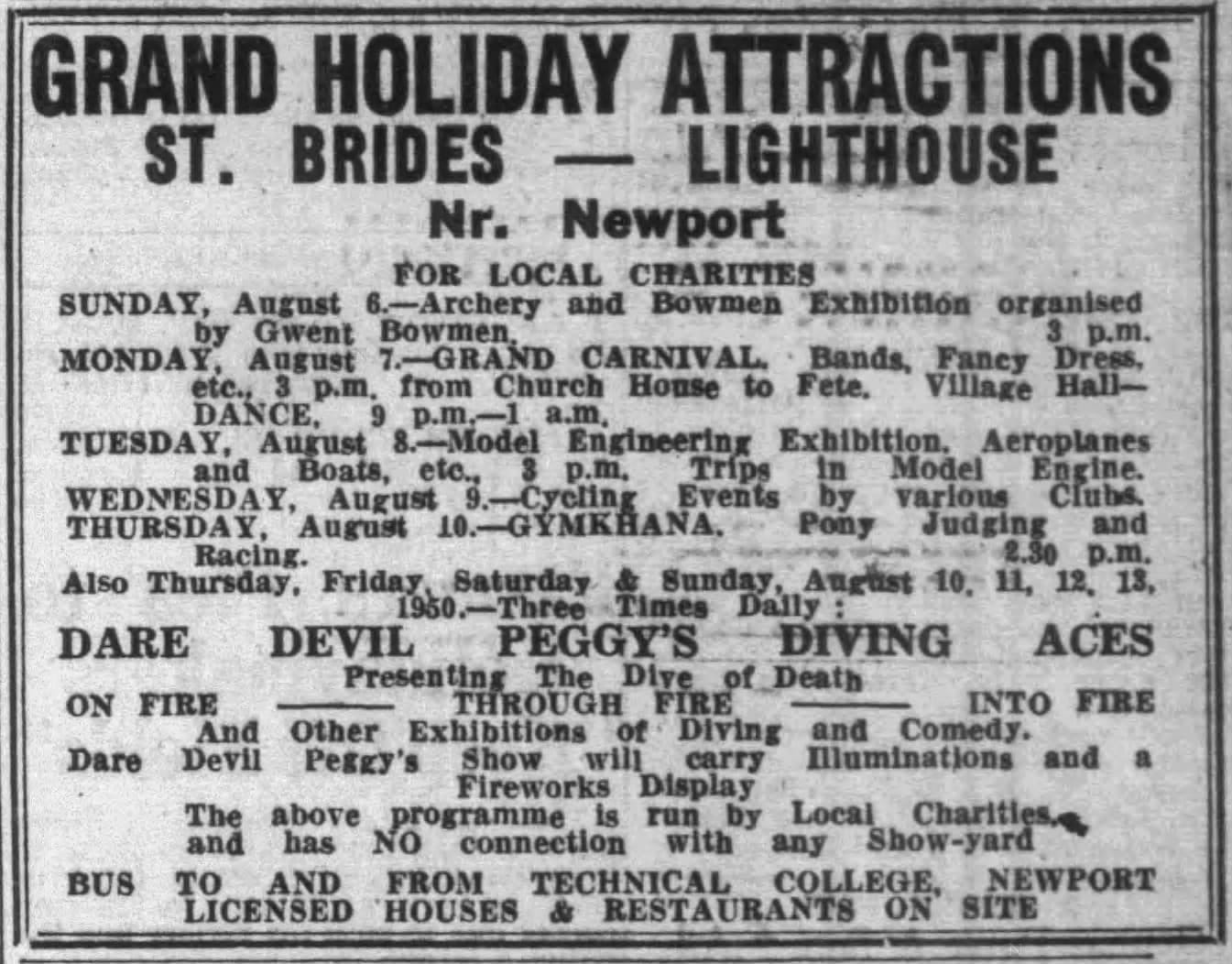
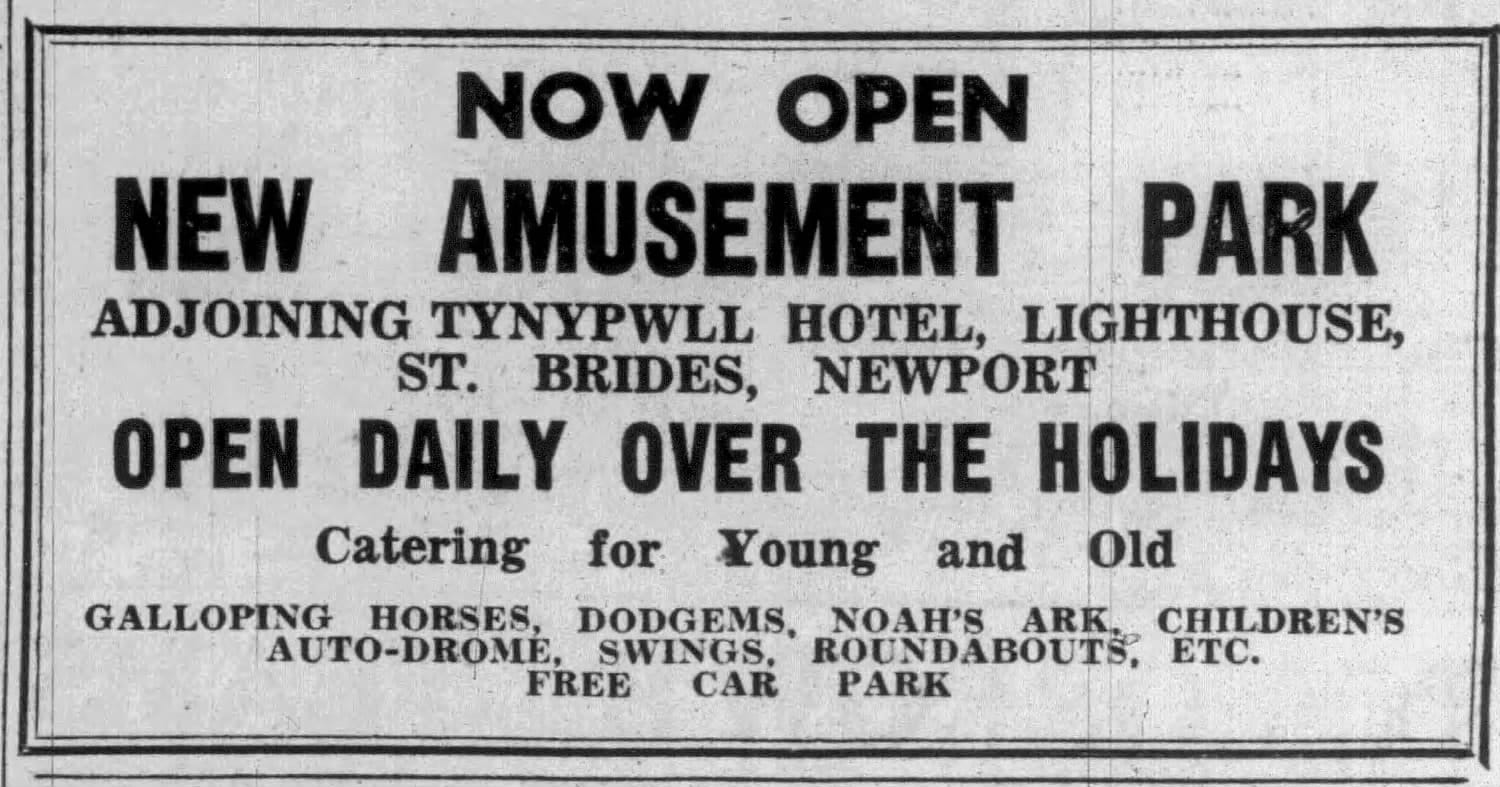
Adverts from the South Wales Argus, August 4th and 5th, 1950
Today, the massive concrete tidal pool is long gone—replaced by high grassy sea defences, boulder embankments, and the tidal mudflats of the estuary—and its 30,000-strong crowds have faded into a distant memory. Yet when a faded postcard of bathers in an unknown coastal pool surfaces in Newport Library's archives, it offers a vivid glimpse of the summer when Newport briefly had a seaside resort of its own.
Where Was It?
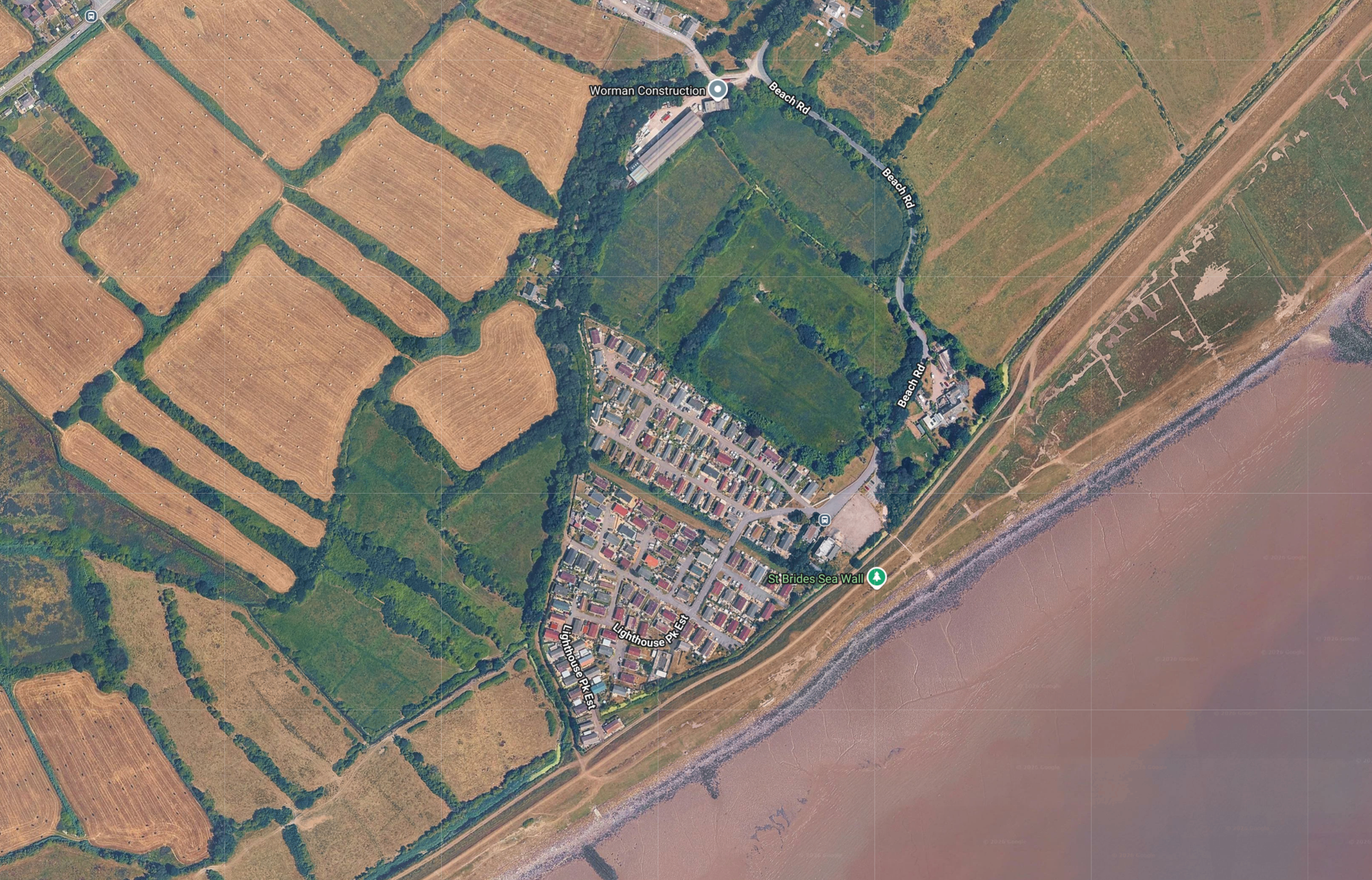
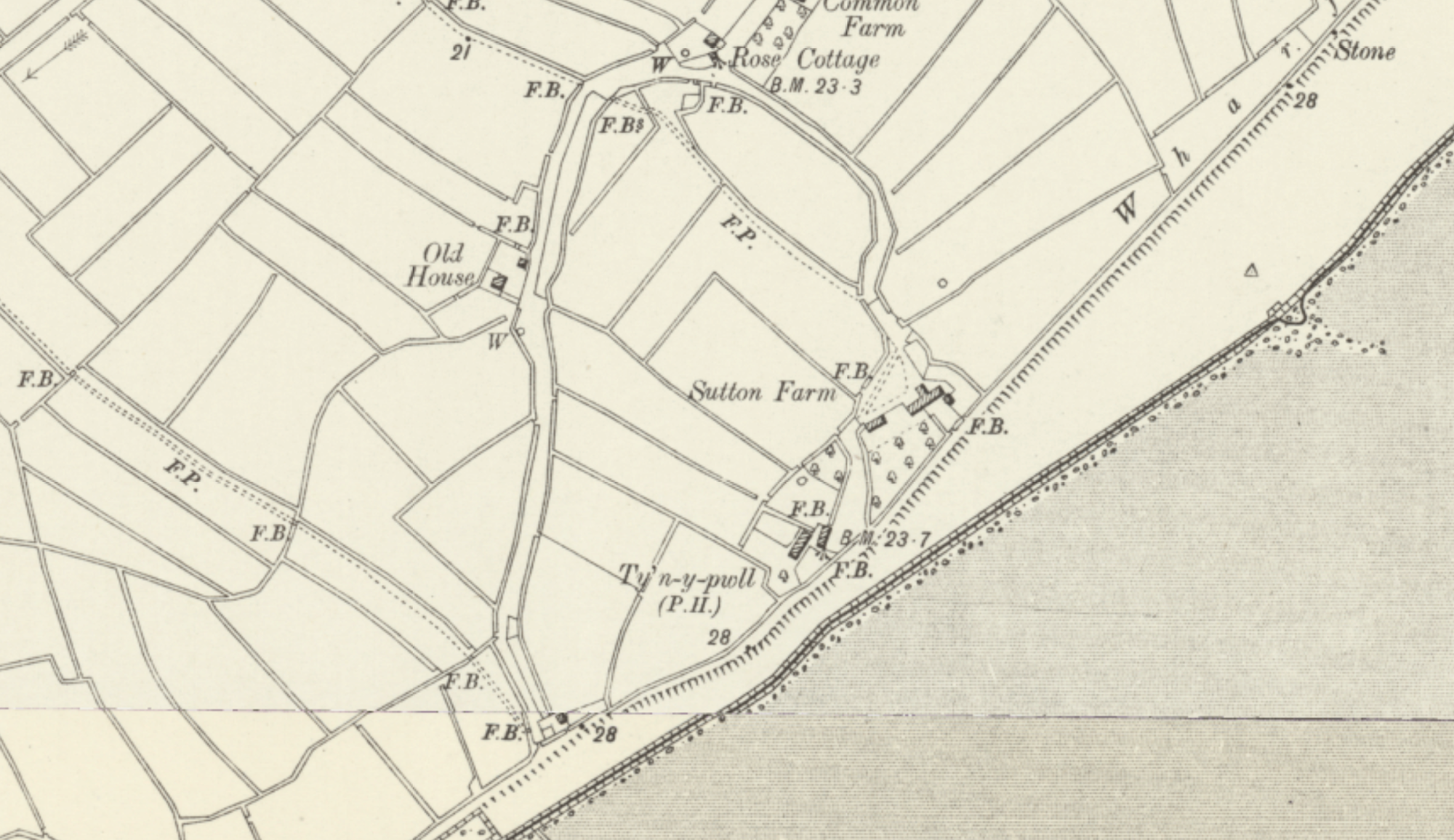
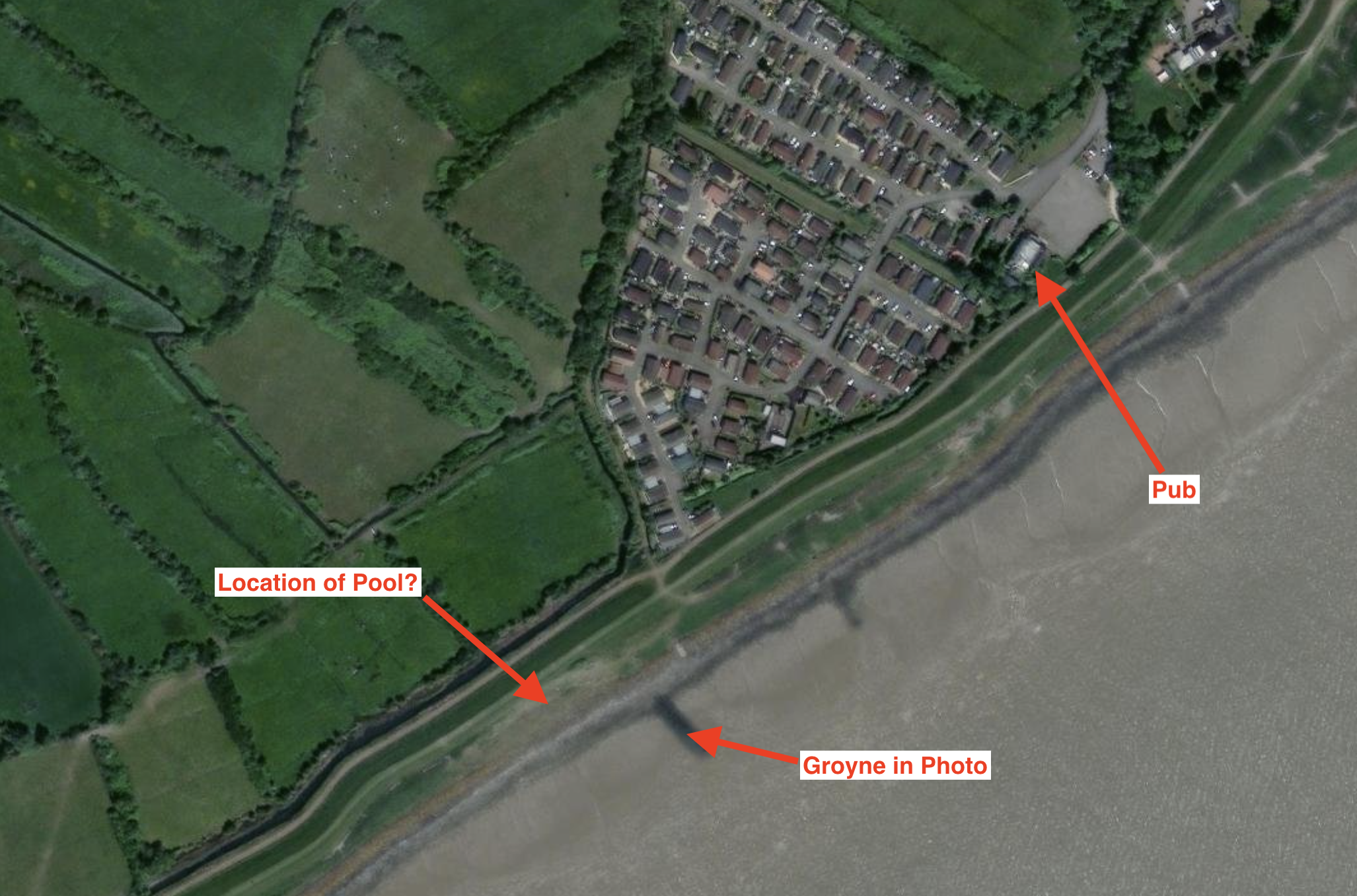
This is how the location looks today with the large Lighthouse Caravan Park and the pub which is currently closed. I haven't been able to find any maps that specifically show an outline of a pool but I have found some buildings on a map that was published sometime between 1937-1961.
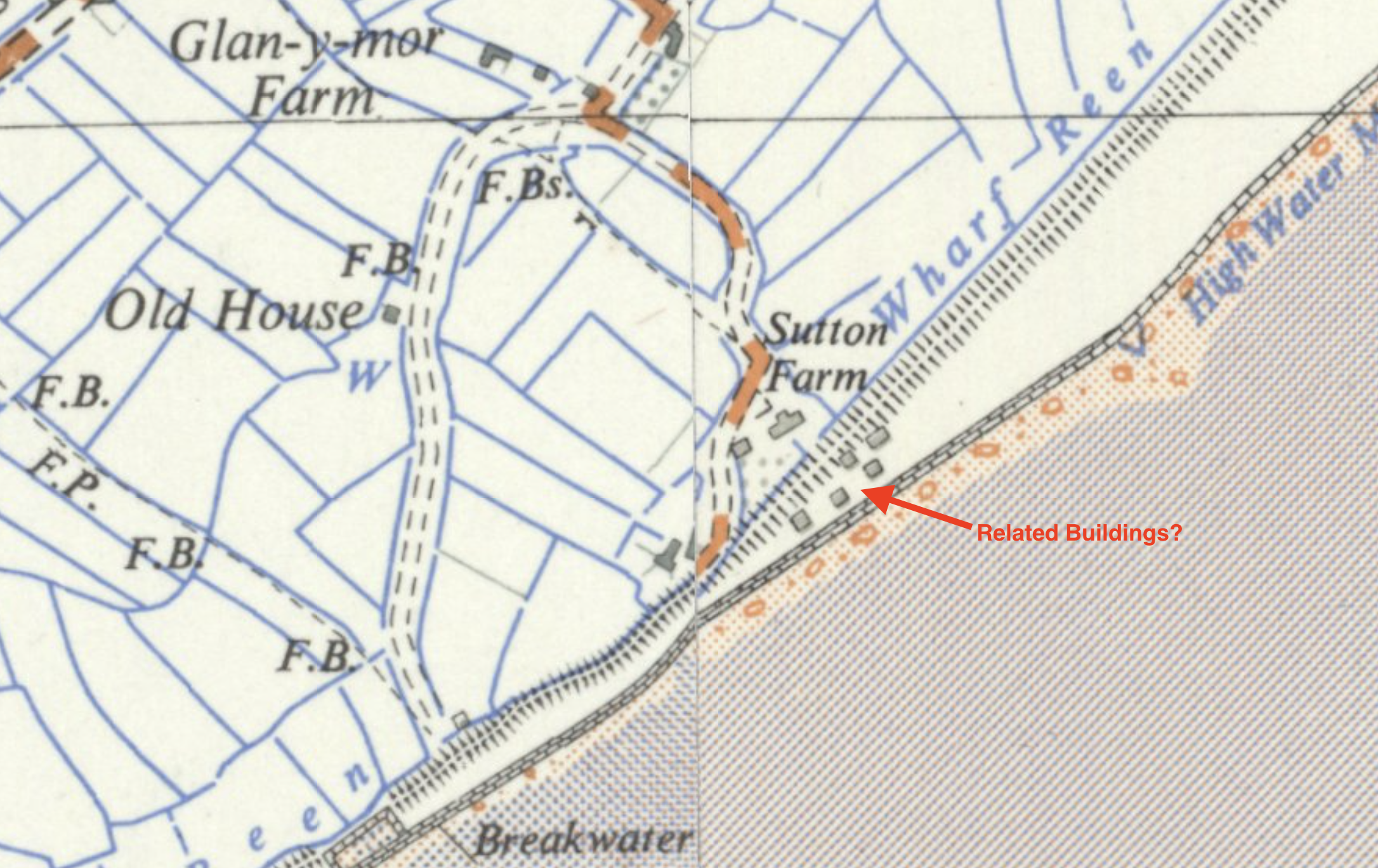
In the original postcard in the background are a row of wooden stakes which is a groyne/breakwater and is marked on at the bottom of the map above. There are two breakwaters south of where the sea wall is today.
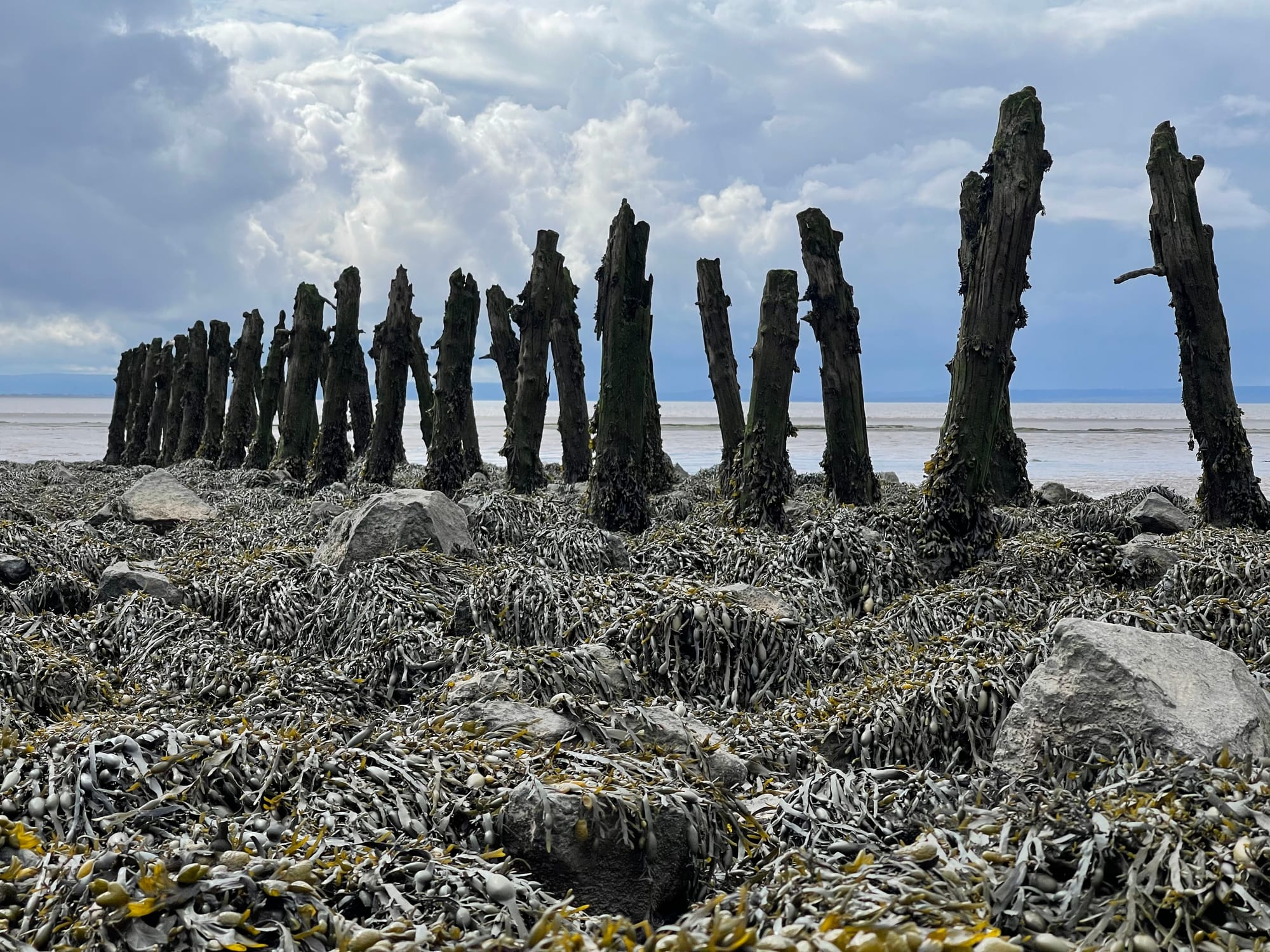
I happen to have taken a photo of the groyne in the map above back in 2011 and it looks very similar to the one in the photo.
If it is the same groyne it would suggest that the pool was located south of the pub in an area near the groyne. I'm unsure if there's any remains of the pool left but certainly worth an explore sometime.

Sources & Contemporary Press
Unless otherwise noted, all contemporary newspaper reports, letters, and classified advertisements are from the South Wales Argus:
- 1 October 1903 — "Lighthouse Refreshment Rooms" (Letter from W. J. Tucker appealing for aid after the gale of 10 September 1903 destroyed four refreshment rooms)
- 11 May 1907 — Classified advertisement for T. Sully's "Brighton" Refreshment Rooms, Lighthouse Beach, St. Brides Wentloog
- 29 May 1922 — Notice of grand fete, sports, and dancing at Lighthouse Beach, St. Brides (Sports secretary T. Sully)
- 10 October 1925 — "The Lighthouse Beach: Suggested Gift to Newport by Lord Tredegar" (Newport Corporation Parliamentary and Improvement Committee report)
- 15 June 1927 — "Golf at the Lighthouse" (Feature and photograph of the new coastal putting green)
- 16 August 1927 — "Sea Baths for Newport: Interesting Development" (Feature and photograph of the Boughton brothers' new saltwater pool)
- 18 August 1927 — "The Power of the Sea: Ferro-Concrete Bathing Pool Collapses — Havoc at the Lighthouse"
- 28 April 1928 — Classified notice announcing bathing started at the Open Air Swimming Pool, St. Brides, Lighthouse
- 12 May 1928 — Classified advertisement: "Visit the Golf Course at the Lighthouse" (3d. per round; 2d. via Coast Line 'Buses)
- 24 May 1928 — Classified advertisement: "Wake Up, Newport! Come to your own Seaside Resort" (Boughton, Lighthouse, Newport)
- 31 May 1928 — "Letters to the Editor: Lighthouse Attractions and Transport Facilities" (Signed "Art.")
- 1 June 1928 — Classified advertisement for furnished bungalow huts at "Newport's new Seaside Resort" (10s. weekend inclusive per person, Boughton)
- 1 June 1928 — Classified notice reporting "Thousands visited the bathing pools, tennis courts and amusements at the Lighthouse"
- 13 June 1928 — Classified notice postponing the Flannel Dance at the Bathing Pool Pavilion, Lighthouse
- 20 June 1928 — Classified advertisement: "A Glorious Day at the Lighthouse; bathing pool, largest in Wales"
- 4 July 1928 — "Vision of the Future Newport by the Sea: St. Brides as a Residential District and Holiday Resort" (By the South Wales Argus Special Commissioner)
- 21 July 1928 — Editorial commentary on improving the Lighthouse as "a lung for Newport citizens"
- 26 July 1928 — Classified notice for motorists: "Use direct road to Bathing Pool, Beach, Lighthouse; convenience, safety; free parking"
- 1 August 1928 — Classified notice offering a £1 reward by R. Boughton for information on the destroyed direct road sign
- 7 August 1928 — "Putting at St. Brides: New Records for the Lighthouse Course" (Bank Holiday tournament results and R. Moore's record 28)
- 11 August 1928 — Classified notice stating "30,000 people visited and took full advantage of the Lighthouse Bathing Pool, Tennis, Tea Pavilion and Amusements in one day"
- 18 August 1928 — Classified advertisement: "Holiday & Seaside Resorts — A Health Resort at your own door"
- 25 August 1928 — Report on the Crindau Ward Young Britons excursion to the Lighthouse (350 members and 100 mothers)
- 31 August 1928 — "Lighthouse Crowds: Newport Men and Greengrocer's Van" (Newport Police Court prosecution of Thomas J. Evans and Griffin Barnett)
- 28 March 1929 — "A Word in Season" (Commentary on Newport Corporation bus services to St. Brides and the Lighthouse)
- 28 March 1929 — Classified notice: "Golf at the Lighthouse" (Announcing improvements and holiday opening of the putting course)
- 5 April 1929 — "Virtuous Characteristics of Lighthouse Mud? Some Remarkable Cures Attributed to Its Use" (By the South Wales Argus Special Commissioner, featuring H. E. Boughton)
- 24 May 1929 — "Fight for Wider 'Bus Range: Problems of Newport Ozone Seekers — Commons Committee Hear of 'An Illegal Act'"
- 31 May 1929 — "Trips to Lighthouse: Improvised Seats in Newport Vehicle" (Newport Police Court prosecution of Arthur Taylor)
- 6 June 1929 — "Lighthouse Visitors: 'Nice People and Other Sort' at St. Brides" (Newport County Police Court remarks by Supt. L. Spendlove)
- 10 September 1929 — "Lighthouse Road Snags: Another Postponement by Local Council" (St. Mellons Council road-widening debate)
- 12 September 1929 — Classified notice: "Danygraig Omnibus Service — Sunday Excursions to Lighthouse" (1s. return fare)
- 19 September 1929 — "Cadets' Outing: An Afternoon Spent at St. Brides" (80 Monmouthshire Cadets swimming and taking tea at Tyn-y-Pwll Hotel)
- 22 October 1929 — Classified advertisement for a two-roomed bungalow to let on the bus route via Tyn-y-Pwll Hotel, St. Brides Wentlooge
- 7 December 1929 — "Those Buses Again: The Lighthouse Service Opposed" (Newport Town Council debate)
- 21 January 1930 — Letter to the Editor: "Newport and the Coast Line Service" (Signed Charles A. Smith, 146 Commercial Street)
- 8 April 1930 — Report on bus licensing and services to the Lighthouse
- 29 May 1930 — Report on the resumption of Lighthouse bus services following public demand
- 6 June 1930 — "Fierce Blaze at Newport: Lighthouse Caravan Burned to the Ground" (Whitsuntide fire at Glanymor)
- 20 June 1930 — Classified advertisement: "Don't queue for Lighthouse. Go by Saloon Car from your door, 1s. return fare" (14 Liverpool Street)
- 9 January 1931 — "Lighthouse 'Buses: Application by the Red and White" (Transfer of E. J. Davies's Coast Line Omnibus Service licences)
- 14 August 1931 — "Baptism in Pool at Lighthouse: Brightly Garbed Bathers Watch Ceremony" (Pastor Rhys Edwards and Bethel Evangelistic Society)
- 18 December 1931 — "To Lighthouse: Extra Facilities to be Granted" (Traffic Commissioners rota for Red and White Services and 17 charabanc proprietors)
- 13 June [1934 / 1940] — Classified notice for Tabernacle Congregational Church annual tea at Lighthouse Beach (Note: year digit partially cropped in cutting)
- 4 August 1950 — Report on summer outings and crowds at Lighthouse Beach
- 11 October 1972 — "Notes by the Way" by Carfax (Reproducing "A scene at the Lighthouse Beach, 1906" and recalling the Newport Fresh Air Fund)
- Undated Cutting — Display advertisement: "Now Open: New Amusement Park Adjoining Tynypwll Hotel, Lighthouse, St. Brides, Newport"


Member discussion