

Welcome to another issue of The Newport Cornucopia where we dig through the newspapers archives for interesting news articles and adverts. All articles are posted verbatim and most headlines are original (headlines in quotes are my own).

'Greedy Builders Disregard Town Bye-Laws'
George Davies is to be congratulated upon the courage he displayed at Tuesday's meeting of the Newport Corporation in calling attention to what is undoubtedly great evil, and yet one which has attracted but very little notice.
A builder or some other person leases a piece of land and immediately commences to utilise every inch of it for building purposes. His one object is to crowd every possible brick or stone upon it, and in numerous instances where there is only proper accommodation for four or five houses, six or seven are erected, thus allowing the lessee of the land to secure large rentals. No attention whatever is paid to breathing spaces, and outbreaks of infectious diseases are actually invited in consequence thereof. Neither do these builders pay the slightest regard to the surroundings of the locality in which they erect such buildings.
They proceed to overcrowding in such districts as Gold Tops or Stow Park with as much indifference as they would do were they erecting houses in one of the lowest slums of the town. The bye-laws have been wilfully disregarded, and there is too much reason to fear that the Corporation officials have been far too lax in demanding that their regulations shall be strictly carried out. Now that Dr Davies has directed attention to the matter it is to be hoped change will be effected, and that not even the Corporation shall be permitted to break bye-laws which have been framed for the preservation of health and life.
— Star of Gwent, 12th June, 1889
'An Hour's Heavy Slogging'
We hear that a fight which lasted an hour, and was of most determined nature, came off on the Marshes on Monday. Eye witness declares that a primitive ring was formed, and the combatants furiously pummelled each other for an hour, the breathing intervals being of very short duration. Both men stripped to the waist, and what they lacked in science was made up for in brute strength.
At the end of the hour the combatants were so exhausted that it was agreed to postpone the finish until a future day. Such is the information of the eyewitness. The police, reticent as usual, profess to only know of a fight between brothers, and that summonses will be, or are already, served upon the principals.
— Star of Gwent, 12th June, 1889
'A Decrease in Trade'
There are now somewhat brighter hopes that the decrease in the trade of Newport has reached its lowest level. Our comments in connection therewith might have laid us open to the charge of being pessimists, but we could not shut our eyes to the facts, neither could we refrain from pointing out what we deemed to be legitimate remedies for so serious a state of things.
The proceedings at Wednesday's meeting of the Chamber of Commerce induces us to hope and believe that the dawn of a far greater amount of prosperity has set in. It is to be sincerely hoped that the increased charge for night loading, which for years past has given rise to so much irritation, is about to be swept away, and that the short distance charges are to undergo complete revision.
With these imposts removed, the construction of a now railway, and a lock, which shall admit with ease the largest vessel afloat, there is every reason to believe that the trade of the port will not only return, but will exhibit a greater volume than ever.
With unity on the part of those concerned, together with the active co-operation of Sir George Elliot, such a happy condition of things is practically certain.
— Star of Gwent, June 13th, 1889

'Assaults'
Catharine Sullivan was charged with assaulting and beating Jane Olatworthy. The complainant, a little girl, said she was going through the court where she lived, on Thursday last, with a pennyworth of lavender-water, when the defendant ran up, took away the lavender-water, and cut her in the hand and bosom with a knife; only because she took a lozenge from Mrs. Sullivan's child. A witness said there was bad language used by both persons, and one was as bad as the other. Bound over to keep the peace towards the girl.
John Andrews was-charged with assaulting Catherine Sullivan [presumably the same Catherine Sullivan as above] with a poker and a spade. John said he had been similarly assaulted by Catherine. Each party was bound over to keep the peace.
— Monmouthshire Merlin, 8th July, 1853
'A Quay Ranger'
Patrick Murphy, a juvenile "quay ranger," was charged with stealing rope, the property of Mesers. Darby and others. Mr. Woollett was attorney for the prosecution. Richard Killa said the rope had been cut off the end of the buffers of the trams of the Ebbw Yale Company, at the Victoria Wharf. It was about two 2lbs. weight.
Mr. Rennie said he wished the Bench had power to send the father and mother to prison, instead of the boy.
A fortnight's imprisonment.
— Monmouthshire Merlin, 8th July, 1853
'A Gaudily Attired Woman'
Julia Brown, a gaudily-attired woman, was charged with assaulting and beating Sarah Morgan, Railway Tavern beer-house, Marshes-road. A slight cas; and dismissed by the Bench; upon which Mrs. Brown made the most graceful bow to the Bench, and departed.
— Monmouthshire Merlin, 8th July, 1853
'Drunk on Stow Hill'
Charles Gamblin was charged with being drunk and disorderly on Stow-hill. Defendant said he had only been in a little dispute With his landlord, as to an overcharge of rent; He said he was not drunk. P.C.. Garrett, however, proved him to be both drunk and disorderly. Fined 5s., including costs.
— Monmouthshire Merlin, 8th July, 1853
'Incapably Drunk'
Ann Watts was charged with being drunk and incapable. P.C. Jenkins proved the case.
She was so incapably drunk that she was obliged to be conveyed to the station-house on a pair of trucks.
Fined 5s., including costs.
— Monmouthshire Merlin, 8th July, 1853
'Drunk on Stow Hill'
Rees Davies was charged with being drunk and incapable. He was so drunk, said the Superintendent, that on going up Stow-hill to go to Bassalleg, on Sunday morning at two o'clock, he fell over the bank, and, miraculously escaped being killed. Cautioned, ordered to pay station fees, and dismissed.
— Monmouthshire Merlin, 8th July, 1853

Fire in Commercial Street
On Monday- evening a fire broke out on the premises of Mr. John Cousins Sims, toy and fancy basket maker, 57, Commercial-street, just after the shutters of the shop had been put up. Some persons passing were frightened by the exploding of fireworks, and seeing flames issuing through the fanlight over the door. An alarm was raised, and information sent to the police-station. The whole of the shop was very soon in a blaze, the shop window was smashed by the fire, and the flames burst out to the street.
The engine and hose arrived in a short time, and a continuous stream of water was poured upon the fire. Fears were at one time, entertained as to the shops adjoining, but only a small portion of the woodwork in front of Mr. Mogford's shop ignited. The fire was got under, before nine o'clock, the whole of the stock-in-trade, fixtures, and furniture of the shop having then been destroyed. The rooms above were only slightly damaged.
— Monmouthshire Merlin, 25th October, 1878
Police Matters
One of the police constables called to the fire was in front of the council shortly after in regards to be absent from duty:-
The Superintendent read his fortnightly report of crime committed in the borough. With regard to the Police Force, the report said that P.C. Gould had been fined 2s for being off his beat, and unseen by the Sergeant for 20 minutes, on the 29th of September; P.C. Mends had assisted to extinguish the tire at Mr Sims's shop, on last Monday week, and had absented himself from duty for five hours; P.C.'s Pullinger and Spencer Jones had served faithlully for 12 months, and were entitled to an advance in their wages of 1s weekly. The Superiutendent also presented his annual report of the cost of the force, which was, after being signed by the Chairman of the Watch Committee, to be sent to the Home Secretary. He also stated that he had in his hand a memorial from the men in the force, asking for a reduction in the hours of duty, by the adoption of the eight hours system.
The Deputy Mayor: The first matter arising out of the Superintendent's report, is the conduct of P.C. Mends, who absented himself from his beat on the night of the fire in Commercial-street.
Mr Jacob: How long, Mr Superintendent, do you think this man, Mends, had been absent from his post?
The Superintendent: From nine o'clock at night until two in the morning. He should have been on duty at Barnard-town at the time, but he did not report himself at all until he went to the Pill Station at about two o'clock.
Mr Jacob: How is that? Did he not go to the station at all during that time?
The Superintendent: No. He lodges at Pill station. He went out to the fire in Commercial-street; went back and changed his clothes, it seems, and went out again in plain clothes.
Mr. S. Goss: Had he another uniform?
The Superintendent: Oh, yes there are always two suits.
Mr. Jacob: Was he wet?
The Superintendent: Yes, sir; he was wet then he changed his clothes, and went out again.
A Member: Does he say he was ill?
The Superintendent: Yes he says so.
Mr. Jacob: And yet he stayed out in his wet clothes.
The Deputy-mayor to the Superintendent: Has Mends ever been guilty of a fault of this kind before?
The Superintendent: He was fined one day's pay for being under the influence of drink, about two years ago.
At the suggestion of the Deputy-mayor, the constable in question was called in, aud interrogated as to his conduct. He replied that he was preparing to go out on duty when information was brought to the Pill station that a fire had broken out in Commercial-street. He hastened out, and, after getting to the place, aid his best to extinguish the fire, as the Superintendent and also Mr. Hoskins, could testify. About 10 o'clock, he left the fire, and as he was very wet, he went as far as Temple-street, but feeling ill, he went back to seek the Superintendant or an Inspector. He did not see aither, and feeling worse, he went into a house then he got better, and about two o'clock he went home. He thought he was not fit for duty.
Mr. Huzzey: I take it that you went to the station earlier to change your clothes?
The Constable: No, I did not; I was in tunic clothes, going to put my uniform on, when the information came about the fire. If Mr. Hoskins were here he could bear me out.
Mr. Jacob: Whose house were you at?
Constable: The people don't wish to have their names mentioned, sir or I could say.
Mr. H. R. Evans: Was it a public-bouse?
Constable: No it was a private house.
The Deputy-Mayor: You may retire now, Mends.
Constable: I hope, gentlemen, you will be lenient with me. This is the first time I have been brought before you. I came to Newport with 12 testimonials of good character, and the Superinnendent knows I have always done my best, in the station and out of the station, to promote discipline.
The Deputy-Mayor: This is not the way to promote discipline—to stay away from your beat for five hours.
Constable: No, sir.
The man then retired, and Mr. S. Goss said he had watched this officer for some time, and he always saw him at his duty.
Alderman Murphy said the man was only fined one day's pay for being under the influence of drink, and this was not so bad an offence as that.
The Superintendent replied that he could not deal with his men if they were allowed to absent themselves from duty whenever they chose.
Mr. Jacob thought it would be quite enough to reprimand the policeman severely. Mr. O. Goss thought something more than that should be done.
Alderman Harrhy asked the Superintendent what was the condition of the constable when he did arrive at the Pill station.
The Superintendent said the sergeant who went there could not awake him—he was sleeping soundly.
Mr. H. R. Evans: But being so wet would make him sleep heavily.
The Superintendent said Mends had been on duty on Saturday night, and on Suoday; and on Monday, instead of going to sleep, he stopped in the police-court.
The Deputy-Mayor pointed out that P.C. Gould had been lined 2s. for being off his beat for 20 minutes, and he would certainly have reason to complain if this man were let off without a fine.
After some further discussion it was resolved that Mends should be fined one day's pay and reprimanded by the Deputy-Mayor.
The constable was called in again, and the Deputy-Mayor said: You are fouud to have been absent from duty without leave for five hours, and we see no reasonable excuse for your conduct. You made no effort to see the Superintendent at all to report yourself. We have taken a very lenient view of the case, and you will be let off with a time of one day's pay.
Constable: Much obliged to you, gentlemen much obliged to you.
Mr. H. R. Evans: He seems to think he has got off well. (Laughter.)
— Monmouthshire Merlin, 1st November, 1878
'The Birth of Newport RFC'
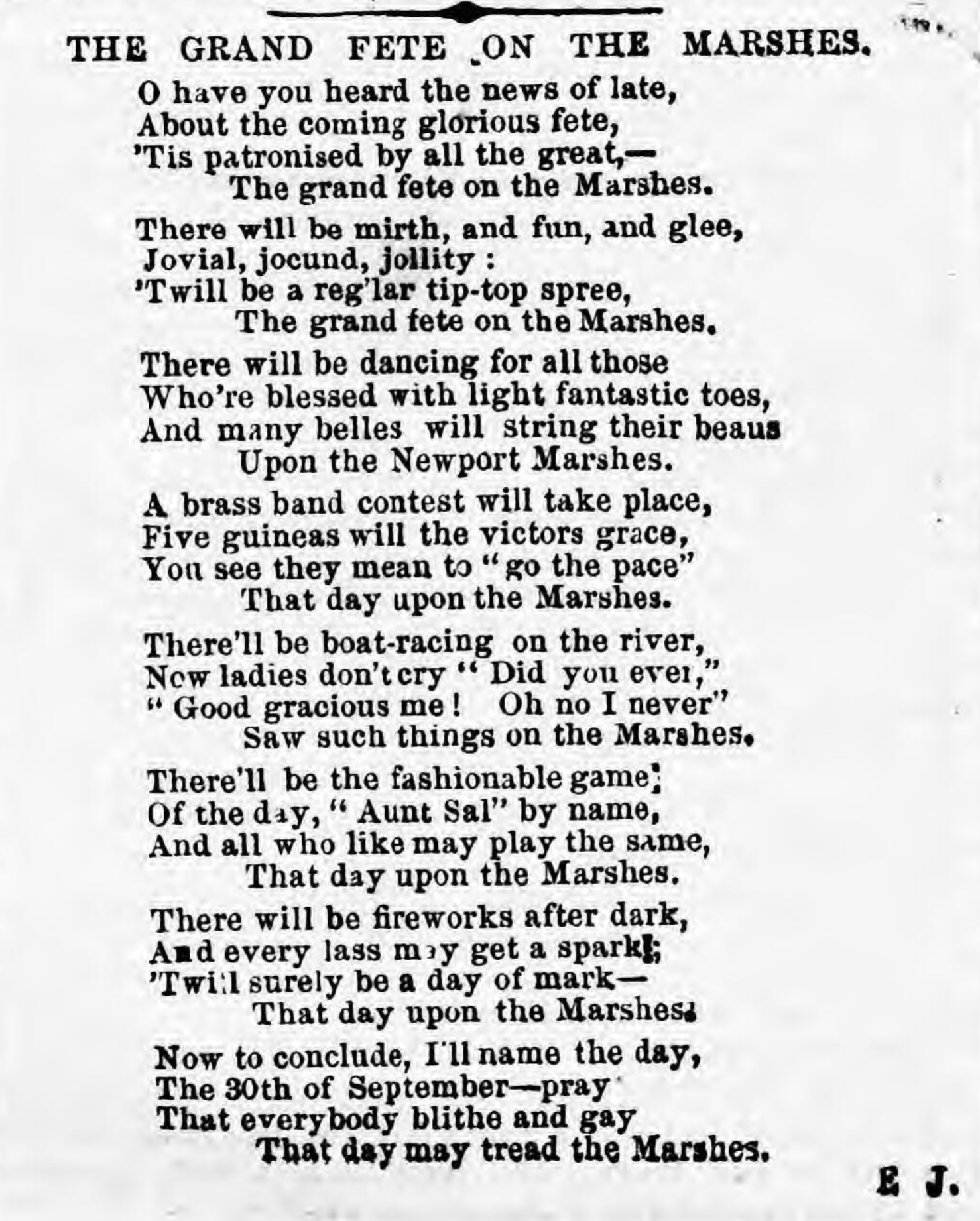
'A Grand Fete on the Marshes'
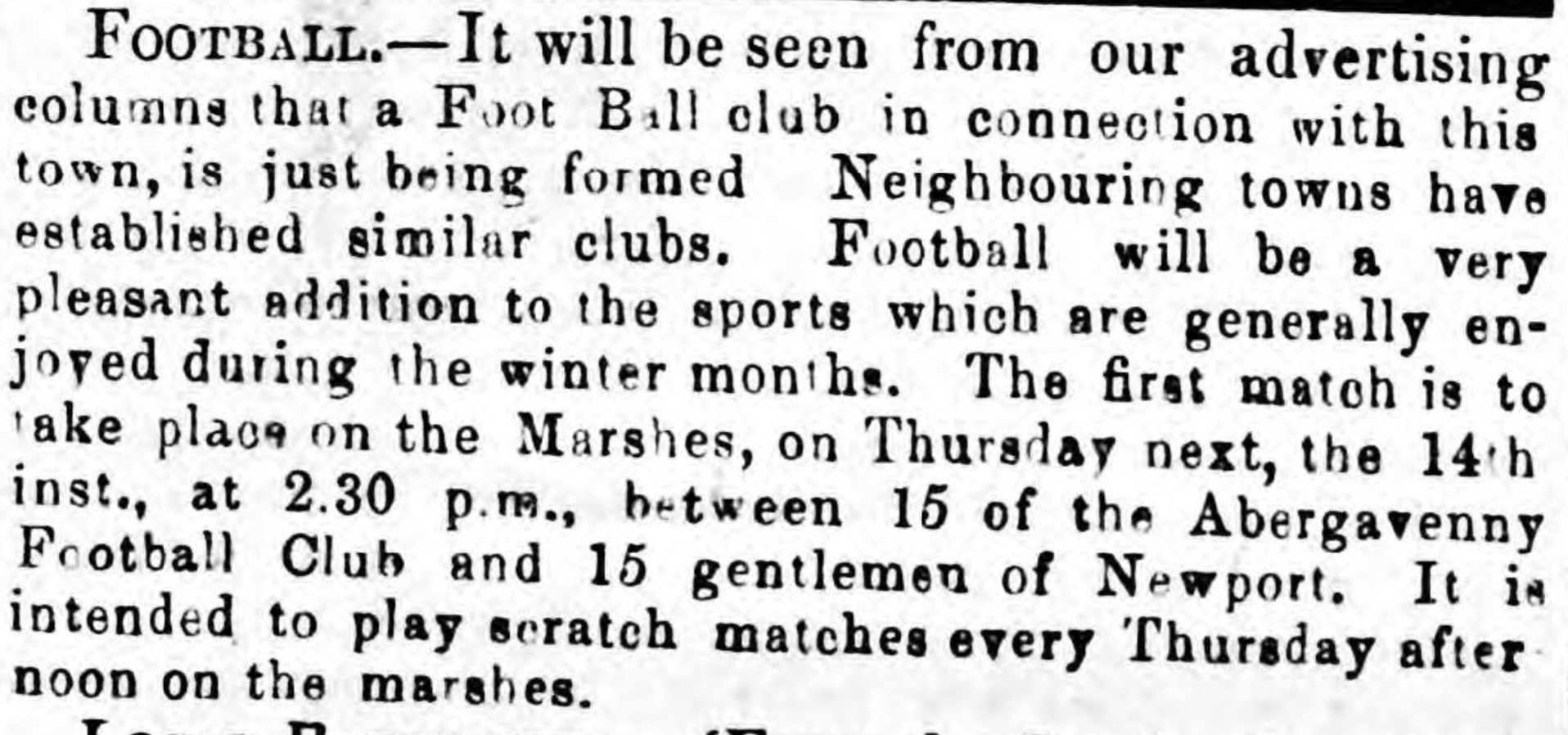
A poem printed in the Monmouthshire Merlin in 1861 about an upcoming fete on the Marshes.
Bands in Park Square
To the Editor of the Star of Gwent
Sir,—I desire to call attention to the nuisance and inconvenience occasioned to adult visitors at the People's Park on Thursday evenings, when the band plays, by the numbers of unruly children, who rush from place to place and occupy many of the best seats. I would not wish to debar children from being present, but it would be well if some greater efforts were made to restrain, for an hour ot two, the great a display of childish folics. If this were done, I feel sure a larger number of adult persons would attend, and for such, especially, I take it, the bands inted to cater.
VISITOR
June 13, 1889
— Star of Gwent, 15th June, 1889


Member discussion