

Welcome to another issue of The Newport Cornucopia where we dig through the newspapers archives for interesting news articles and adverts. All articles are posted verbatim and most headlines are original (headlines in quotes are my own).

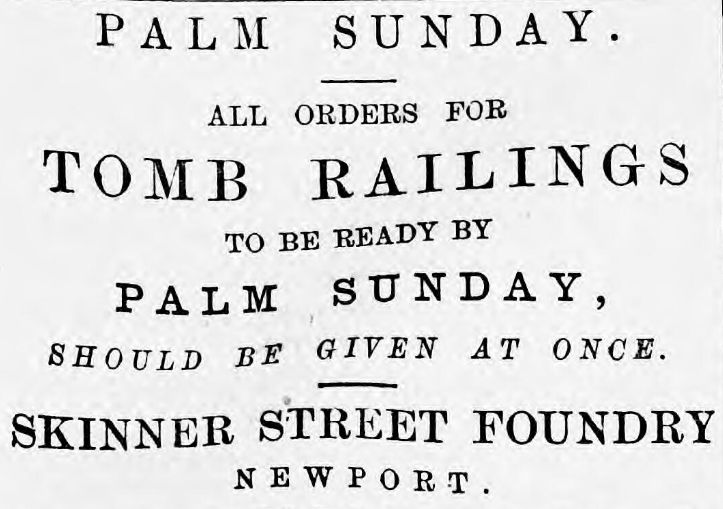
The Fire in Skinner Street
On Thursday evening last, at a late hour, the premises of Mr. Lazarus Roberts, coach-builder, in Skinner-street, were found to be in a blaze caused, it is supposed, from some one throwing the snuff of a candle among some loose shavings which smouldered for some time previously to bursting forth.
The officer on duty at the station house, on receipt of in the information, immediately wheeled down the light carriage, with the apparatus, &c., to the fire, and the hose being, attached to the plug, at a distance of two hundred yards — the hose being long enough to cover that distance. Superintendent Huxtable took command of the delivery pipe, and a large volume of water was poured upon the blazing building. The fire was got under in about three quarters of an hour.
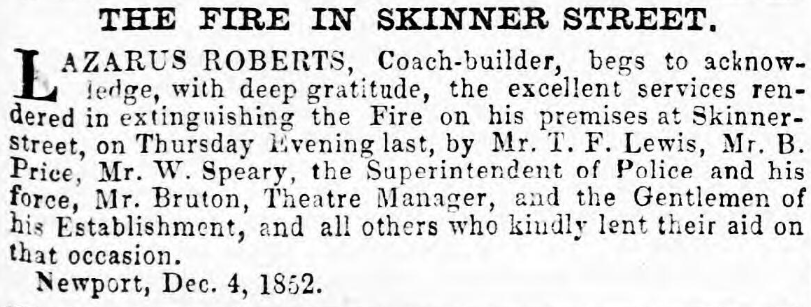
Damage to the amount of £100 was occasioned but it was fortunate for Mr. Roberts that the property was insured. Valuable assistance was rendered by Mr. Bruton and his corps dramatique, who forsook their Thespian occupations in their booth hard by, to quench the fire that was consuming their neighbour's premises.
Mr. T. F. Lewis, one of the town council, also rendered great aid, and by his tact and exertions, inspirited the crowd present to do good service. Had the wind been blowing freshly from the east that night, the houses and premises in front of the Westgate would have been endangered.
— Monmouthshire Merlin, 10th December, 1852
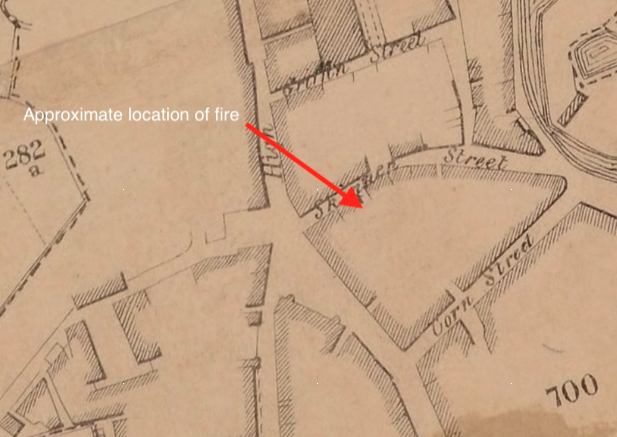
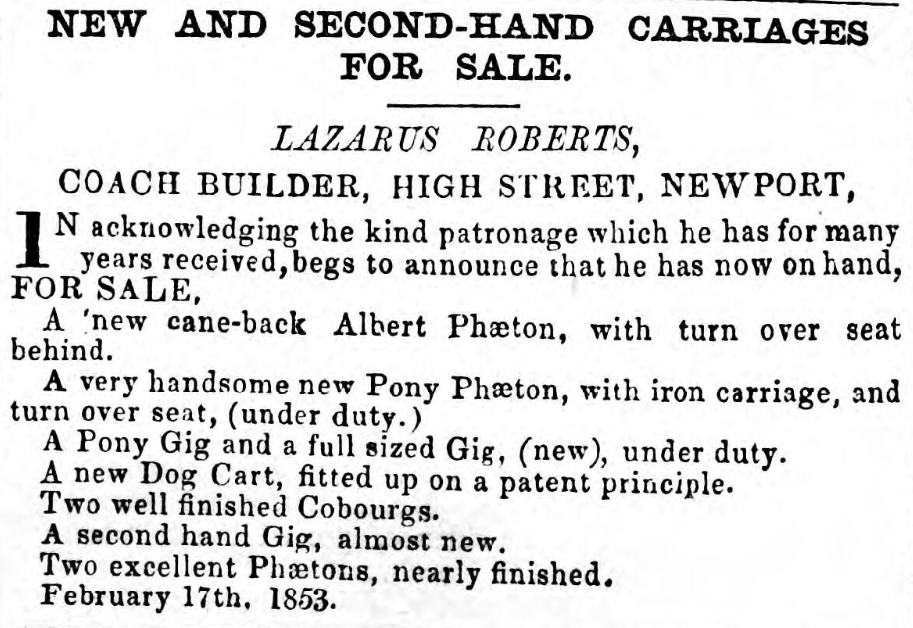
This wasn't the only time Lazarus Roberts experienced a fire at one of his premises. He also had a premises at 52 High Street and had a fire there in 1856.
Fire
On Tuesday evening, between nine and ten o'clock, the painter's shop in the rear of the premises occupied by Mr. Lazarus Roberts, coach-builder, High-street, took fire. Superintendent Huxtable at once ran to the premises, followed by men with the reel and hose, and having fixed the hose, a supply of water was poured on, and did such good service that the flames were quickly extinguished.
The fire was supposed to have arisen among varnish, shavings, &c., allowed carelessly to lie in a heap in the paint shop, just above the forge fire of the smithy below. Mr. Roberts was fortunately insured in the Lancashire Insurance Office—his loss is supposed to be £17 the building was insured in the Royal Exchange.
— Monmouthshire Merlin, 29th March, 1856
Interestingly, Lazarus Roberts built Newport's first omnibus built in Newport in 1855.
New Omnibus
A very elegant and ingeniously constructed omnibus as been built by Mr. Lazarus Roberts, at his establishment in this town, which has attracted much attention as much on account of its being the first ever built in Newport, as for the complete and stylish manner in which it has keen turned out of hand.
— Monmouthshire Merlin, 9th March, 1855

Stealing Fowl in Malpas
Henry Webber alias Baker, was charged with stealing three fowls, the property of Joseph Prust, farmer, of Malpas. P.C. Burrows deposed that, on the evening of toe 14th ult., about six o clock, he met the prisoner on the Canal-bank, in the parish of Malpas. He was carrying a bag over his shoulders, and he (witness) stopped him and asked what he had, when he answered "Nothing". He then took hold of the bag, and a fowl "cried out," upon which he asked the prisoner where he had the fowls frpm, and receiving no reply, he took him into custody on suspicion of stealing them.
In answer to the officer he said, he had three fowls, and then be stated he had them from Mr. Prust's. The constable then took him to Mr. Prust's farm, and there he found in the bag the three live fowls now produced. Mrs. Prust identified them as her husband's property.
Prisoner was then taken to the station, and on the way he said, "he was going to Newport to sell them to get beer and tobacco." The prosecutor was then sworn and identified the fowls and the bag as his property. The prisoner was in his employ, having come to him on the night of the 31st of December, on his return from the sessions, where the grand jury had ignored two bills of which had been preferred against him.
He asked for a job, saying he had been falsely imprisoned, and making up a very pitiful tale. Prosecutor gave him some bread and cheese and beer, and the next morning he returned, and prosecutor employed him to work. He lived out of the house three days, and on the next Monday he went to live in the house. On the Thursday following he (prosecutor) missed a drake.
Prisoner had previously worked for him, and there was about 1s. 6d. due to him. He had continued in the house up to the time of his apprehension. Prisoner said another chap helped him to catch the fowls, and he was going to give him half the proceeds.
He was committed for trial. He was also remanded on the two charges in respect of which the bills had been ignored, Inspector Sheppard Stating that they had been thrown out in consequence of the property not being found, but it bad since been discovered.
— Monmouthshire Merlin, 25th January, 1868
'Stealing a Shovel'
Charles Wood, a man of colour, described as a laoourer without abode, was charged with stealing a shovel, the property of Thomas Mapson Williams, of Maesglas Farm, St. Woolos. P.C. Jamm said he was on duty in Maesglas on the 14th December, when he saw a black man in a stooping position milking a cow. He then made a turn to meet the man as he was leaving, and on coming up with him, he found he was carrying the shovel produced.
The officer asked him where he got it, and he said it was his own, and he had brought it from Castletown. He then dropped the shovel and ran away, and witness did net see him again until yesterday morning. He was apprehended at Blaina. Believed prisoner was the man, but could not positively swear to him.
Silas Miles, who was in the service of the Prosecutor, identified the shovel as belonging to his master. He also produced a tin can which he had picked up in the field where the constable had seen "the black man." It was then full of milk. Witness, who had been with the constable, when the man milked the cow, could not identify the prisoner.
Prisoner, who denied the charge said he was a puddler, and got his living honestly. The Bench considered there was a doubt in the case, and discharged the prisoner.
— Monmouthshire Merlin, 25th January, 1868
Life in Club Row
Catherine Sullivan was charged under a warrant with assaulting Elizabeth Howell, who appeared with a sticking plaster constellation on her forehead. The parties were neighbours, and live in Club-row. Howell alleged that Sullivan struck her with a stick, and threw a jagged piece of tin at her, which struck her on the forehead. causing her to bleed profusely. Fined 10s 6d; in default 14 days imprisonment and to be bound over to keep the peace.
— Monmouthshire Merlin, 17th September, 1875
A Loafer
William Lavington was charged with being drunk and tresspassing on the Great Western Railway. It appeared that prisoner is in the habit of loafing about the booking office door, much to the annoyance of passengers. On Tuesday afternoon he was drunk and refused to leave, and as he had been cautioned innumerable times, he was taken to the station.
Inspector Hickey stated that a great nuisance was occasioned by loafers, and he pressed for a conviction.
Mr. Gething: You never keep any order there, and it is almost impossible to approach the door of the station.
Inspector Hickey: We do all we can, but without your assistance, it is impossible for us to preserve order.
Mr. Gething: There are a lot of boys there why do you not bring some of them before us instead of an old man like this?
The Deputy Clerk said that there were two convictions last month. The prisoners defence-was that he was waiting for "Mrs. Jones" but when questioned what Mrs. Jones it was, he hesitated a moment, and then gave the safe locality of George- street. He was fined 10s. 6d., in default 14 days, the Mayor remarking that the Bench were determined to put a stop to "this sort of thing." Defendant said he bad no money, and was detained.
— Monmouthshire Merlin, 17th September, 1875
'Sent to the Treadmill'
Thomas Rees was charged with a trespass on the premises of Mrs. Rebecca Harrhy.
It appears that Mrs. Harrhy has suffered to a considerable extent by the depredations of a set of plundering scoundrels, who infest this town, and who, at this season of the year, are prowling about all night, ready to rob any garden where they think they may be able to carry off their booty without discovery.
Mrs. Harrhy's garden was cleared of a large quantity of apples by some of these marauders on Thursday night, and Mr. James Harrhy, on the following night, hearing some noise in the back premises, went out and found the prisoner in the potatoe garden. The fellow had nothing upon him, but there is little doubt he is connected with the gang, which is likely to he broken up by the vigilance of the police, who are now keeping a sharp look-out after certain fellows who are suspected to be the perpetrators of these depredations, and who, if they should happen to be found in the neighbourhood of gardens, under suspicious circumstances, will find that they will be sharply dealt with. The prisoner was convicted under the Town Act, and sent to the treadmill for one month.
— Monmouthshire Merlin, 30th July, 1842
Thomas Turk's Beer License Gone
When Pillgwenlly beershop keeper Thomas Turk was hauled before the magistrates in 1848 for running a house whilst being a convicted felon, the town’s Superintendent of Police expected an open-and-shut case.
Instead, Turk acted as his own lawyer and turned the tables entirely. Through a razor-sharp cross-examination, he dragged the Superintendent’s own questionable conduct into the open—revealing secret parlour visits, waived change, and backroom attempts to recruit him as a police informant against local burglars.
Here is the courtroom drama as reported in the press at the time:
Thomas Turk, whose case stood adjourned from Monday, today appeared in answer to an information charging him with, selling beer without a license. These proceedings were taken under the 3rd and 4th Victoria, cap. xi., sec. 7, which enacts that every person who should be lawfully convicted of felony, or of selling spirits without license, should for ever thereafter be disqualified from selling beer and cider by retail; and if such convicted person should take out such license, it,s hould be void to all intents and purposes. And the license held by Turk was alleged to be void, by reason of the certificate of a conviction, under seal, put in by Mr. Superintendent English, which proved that Thos. Turk had been tried for horse-stealing at Liverpool on the 30th of July, 1842, and convicted, and was imprisoned twelve months, with hard labour, for the offence.
Mr. English proved that beer had been sold in Turk's house at Pillgwenlly, on the 28th of March and the 4th of April.
He said: I am the superintendent of police. Previously to the 4th of April, I went into Turk's house at Pillgwenlly, and had a glass of beer, for which I paid. There is a sign over the door, with T. Turk upon it This was on the 28th of March, and I then cautioned Thomas Turk not to sell any more beer, as he had been convicted of felony.
He asked: When?
I said, At Liverpool, in 1842.
He said, Then a person convicted of felony cannot sell beer?
I replied, He cannot.
He then said, The house shall be let. and I'll be tap boy.
PC Bath was then with me. On the 4th of April I went to Turk's house with Sergt. Harlow, and saw Mrs. Turk, and three men were seated there at a table, drinking beer from two jugs, one of which, Harlow and I tasted. The door was open, and the same sign still over the door.
On the same day, I saw Turk upon the Newport bridge, and said to him, well, you are still selling beer, although I cautioned you not to do so.
He replied, Yes, and I mean to do so, and the magistrates cannot prevent me.
I said, They can, you being a convicted thief.
He replied, I have not been transported.
I answered, No, but you were once convicted of horse-stealing.
He said, I know that. [Defendant, who had frequently interrupted witness by denials, here vehemently cried out, You are a liar'—at the same time threatening to give his wife a kick for remonstrating with him on his violence.]
Witness continued: He turned round, and said to Mrs. English, who was with me on the bridge, I'll tell you how that was, madam I bought two horses of a party; and the agreement was, that I was not to take the horses away, until I had paid for them. They were put into one stable, and I broke the contract by taking them away, and putting them into another and then they made out that I stole them, and I got twelve months' imprisonment for it, which was very hard.
I asked, At Kirkdale?
And he said, Yes, at Kirkdale. I told him. You had better not sell—you had better see your solicitor, and take his advice.
He said, I have had the best advice, and though the magistrates might take away a spirit license, they can't stop my beershop. I know an instance of it in Bristol.
Mr. English then put in the certificate of conviction, referred to above, which was read by the clerk of the magistrates. Defendant replied thereto I deny it. And I object to the information; as I keep no such house as that mentioned in it. The Mayor said there was nothing material in Mr. Turk's objection. The name of the sign was of no consequence. Defendant was charged with selling beer without a license, and to that charge he had appeared.
Defendant: Very well, sir-we will go on, then. And now, Mr. English, What were the names of the parties you saw drinking in my house on the 4th of April?
I don't know.
Do you know if they paid for their beer, or my wife gave it to them?
I don't know.
Then if you don't know, sir, how did you swear that I had sold beer on that day?
No answer.
The Mayor: Mr. English has given evidence that he drank and paid for beer in your house previous to the 4th, which is sufficient in law to support the information. Were it a day subsequent to the 4th, it would be invalid.
Defendant: Very well, sir.
Now, again Mr. English: Have you not sat half an hour at at time in my parlour, and refused to take the change out of sixpences for glasses of ale?
I have. And, sir, didn't you tell me that you wouldn't mind my keeping late hours in the house?
I did not.
Didn't you tell me you would be my friend?
I did; but it was on condition that you should give me information of the burglars who broke into the houses of Mr. Gething, Mr. Justice, and others. (Sensation.)
Did you not say that be who didn't play at a game of cards, couldn't lose the game?
I might; but don't recollect.
The Mayor: You can explain, Mr. English, I suppose, the reason why you promised to be his friend?
Mr. English: Readily, sir. Before I knew Turk had been convicted of horse-stealing, I understood from him that he knew something of the burglars I have referred to, and I was, of course, desirous of obtaining as much evidence respecting them as I possibly could.
Defendant: I have nothing further to say, except that I have not been convicted. My license was up on the 9th, and it has cost me some pounds to get the new one, &c. which expense the supervisor should not have put me to, if I was doing wrong; and I know he was told of it.
The Mayor said, if the excise officer was aware of it, it was wrong to have acted as he had. His Worship then read over that section of the 3rd and 4th Victoria, on which this information had been laid against the defendant, and said the case clearly came within the meaning of that section, and was proved.
The Bench was also satisfied that the previous conviction was established. The defendant was therefore adjudged to have sold beer without a license, the penalty for which was £5.; but that penalty would be mitigated to 10s., and 13s. 6d. costs.
In the absence of Mr. Dawson from town, defendant was is own lawyer, and exhibited such skill and ingenuity as left an impression that he was au fait at bar practice.
— Monmouthshire Merlin, 15th April, 1848
This wasn't Thomas Turks' first run-in with the police. He had quite a chequered history before and after this article:
- Whilst running a seaman's lodging house in the docks in 1846 was charged with assault.
- In 1846 he was charged with harbouring deserters from a vessel in the docks;
- In 1850 he was charged with assaulting a woman.
'Where Was Queen's Parade?'
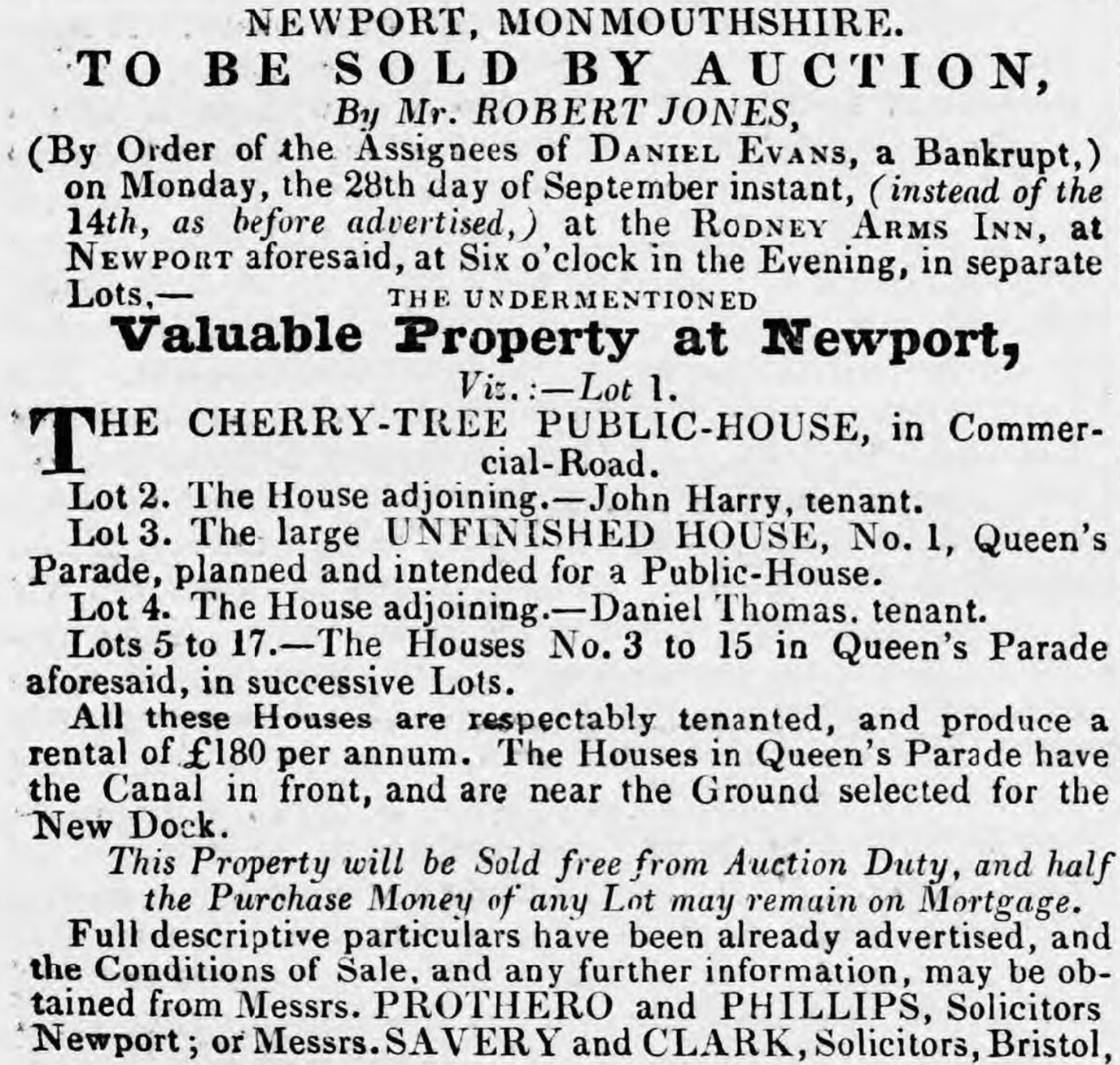
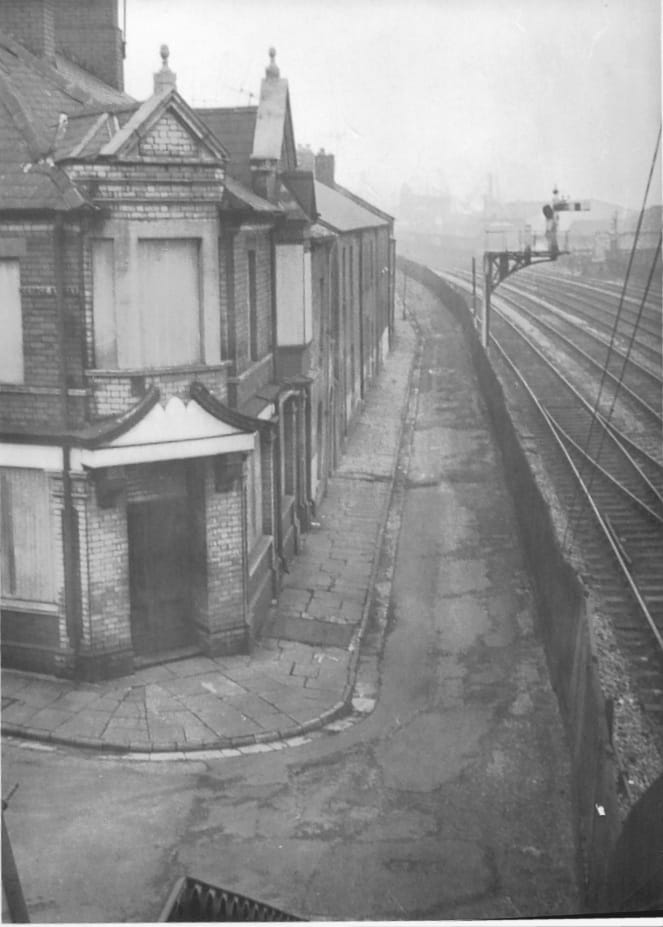
In 1835, a new stretch of 15 properties were under construction under the name of Queen's Parade. One of the properties, No. 1, was intended to be a public house, No. 2 was occupied and No.3 to No. 15 appeared to be empty or unfinished. But where was this row of houses?
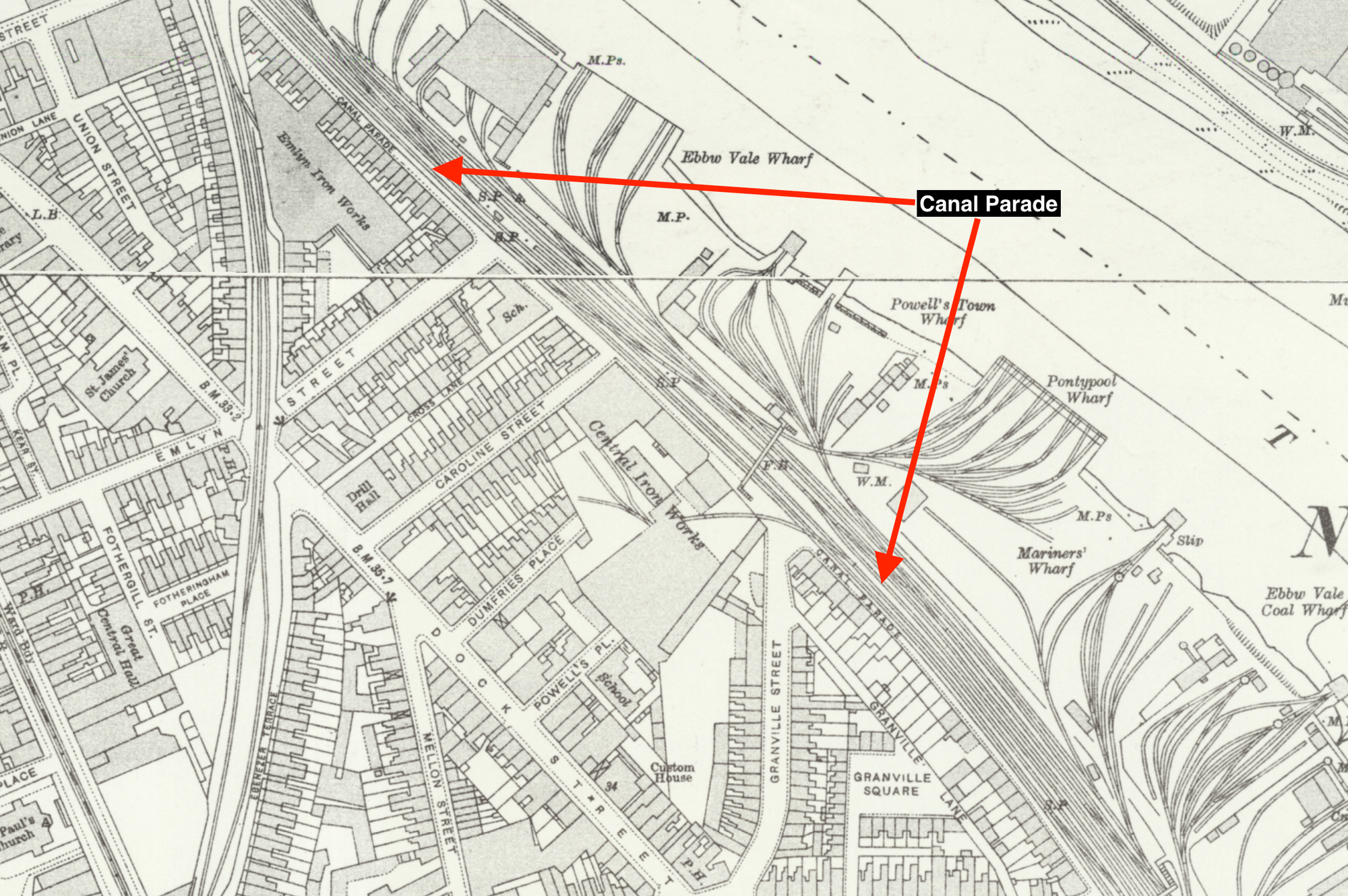
Today there are two separate sections on Usk Way called Canal Parade — one is near Emlyn Street, the other just before George Street behind Masala Bazaar. I've been curious as to why these are separated by such a big gap but following a similar alignment of the canal, which would have been there at construction, you could see why it shared the same name.
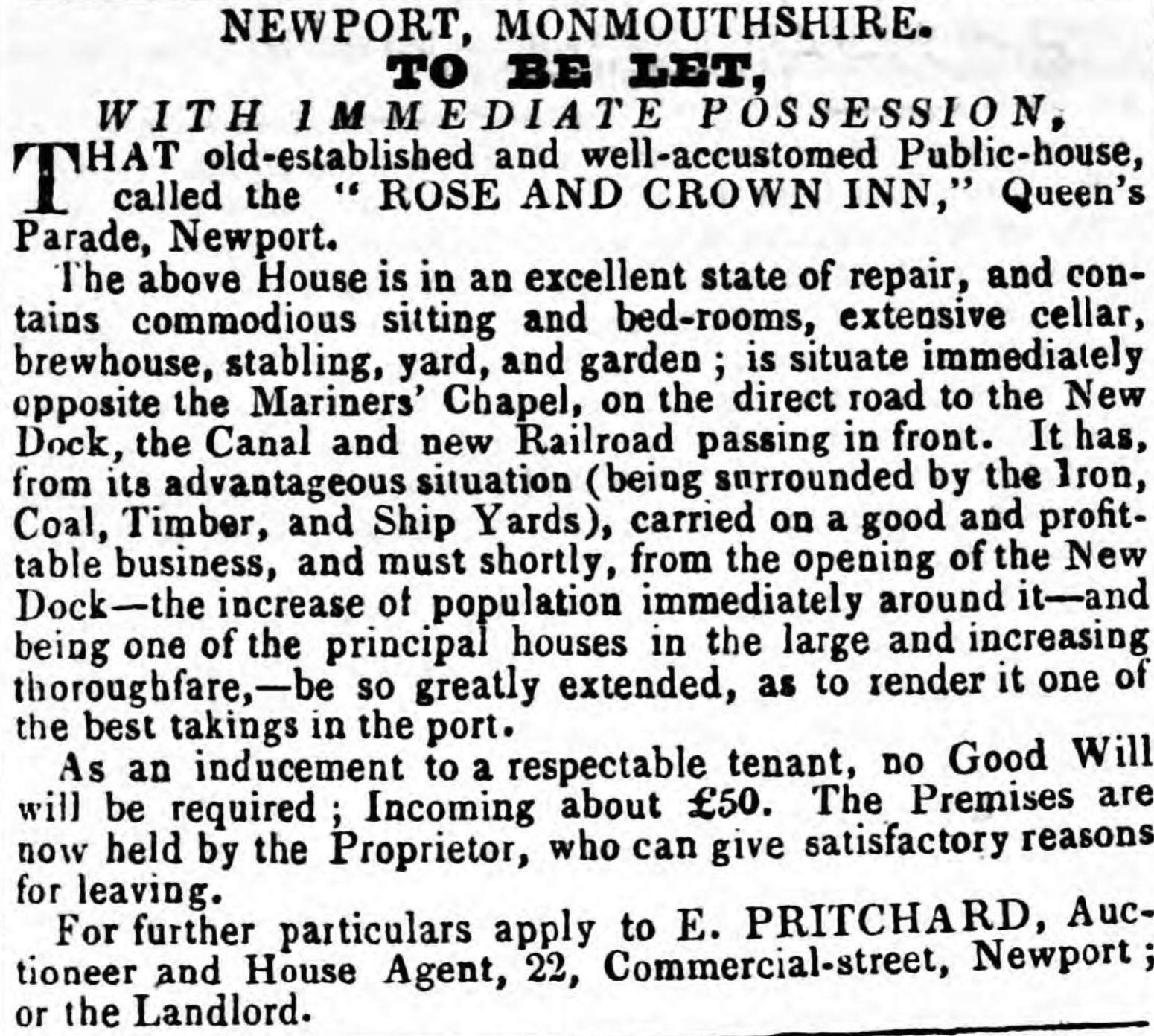
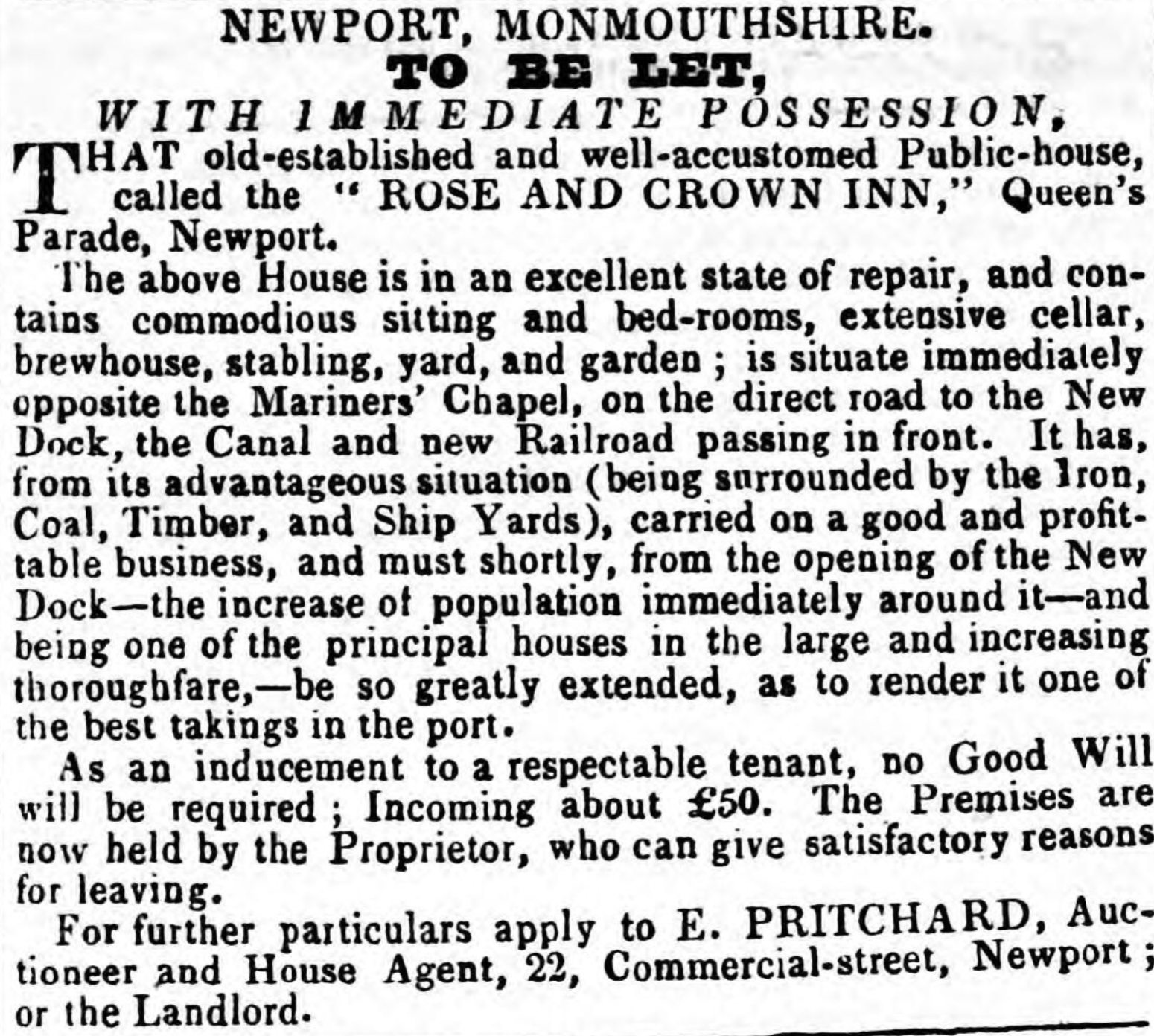
In 1842 an advert was published which mentions the Rose and Crown Inn on Queen's Parade and being opposite the Mariner's Chapel which was located near Mariner's Wharf.
On the 1883 OS Map there is a public house opposite what looks like a chapel and on the stretch of road today called Canal Parade.
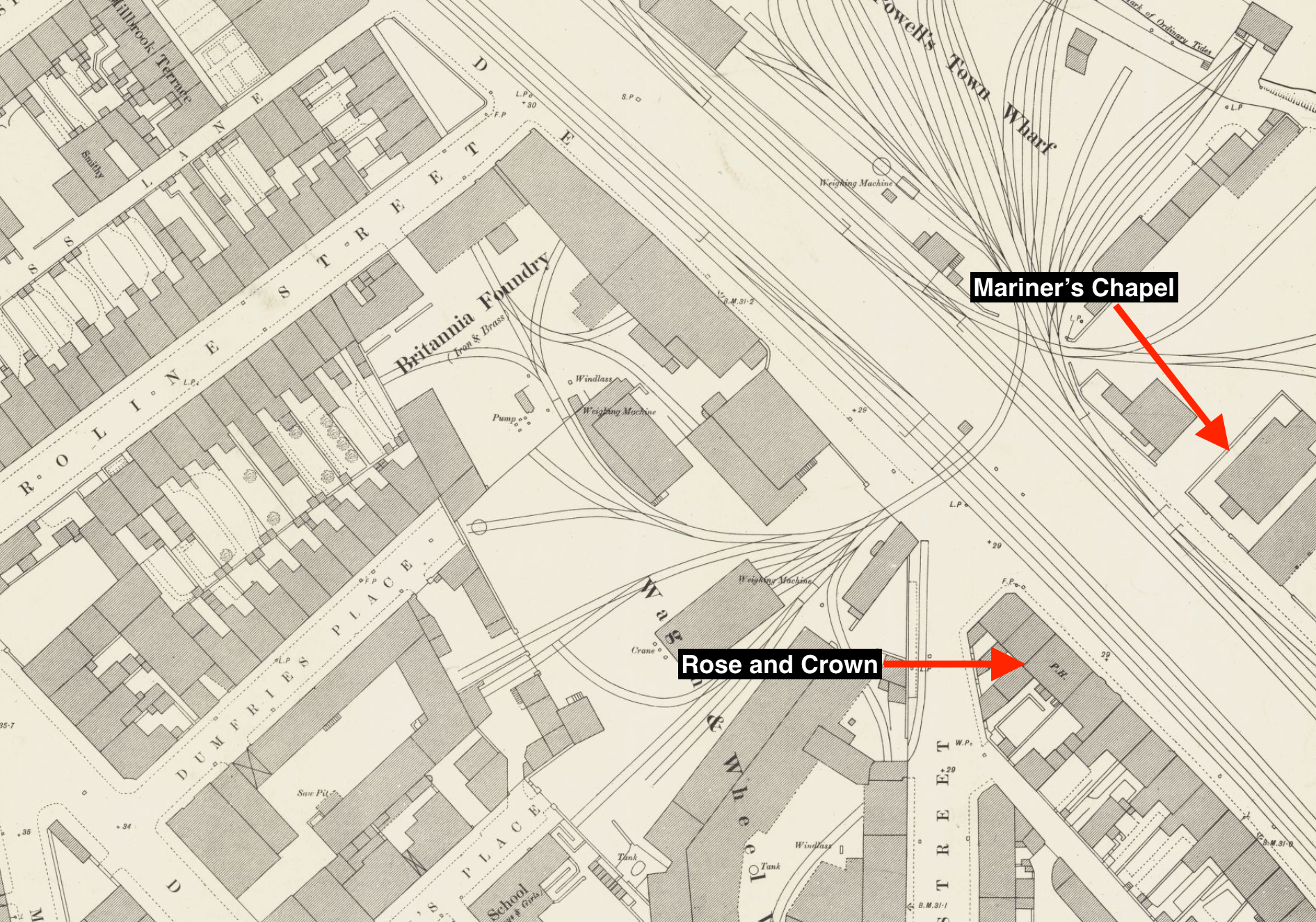
An advert in 1853 which mentions the parade being close to the Dock and Railway Terminus and Dock Street Station had opened recently and another in 1849 mentions No. 1 being adjacent to the railway terminus so this gives us the southern end of the parade. Today that section of Canal Parade is no longer there.
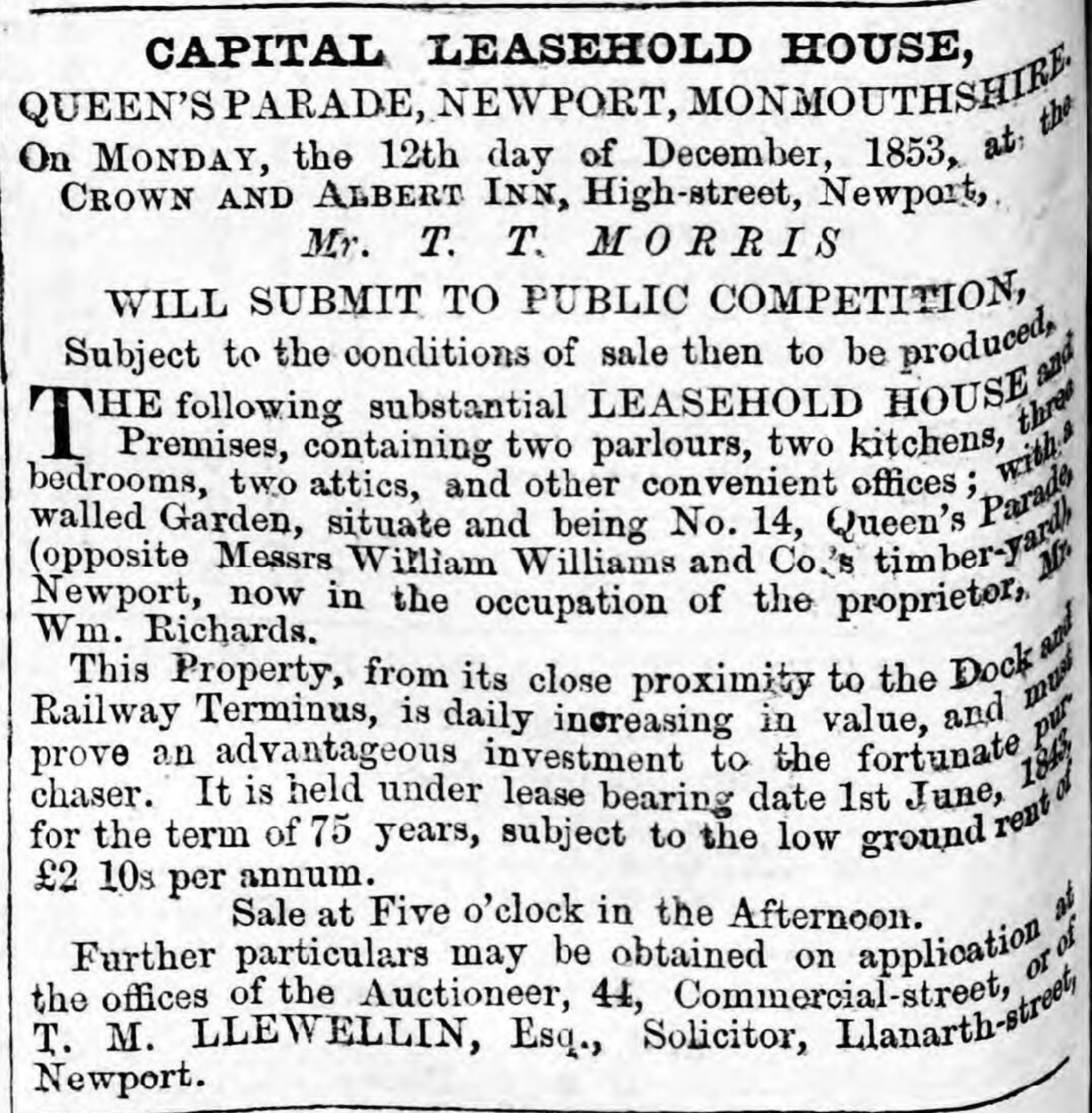
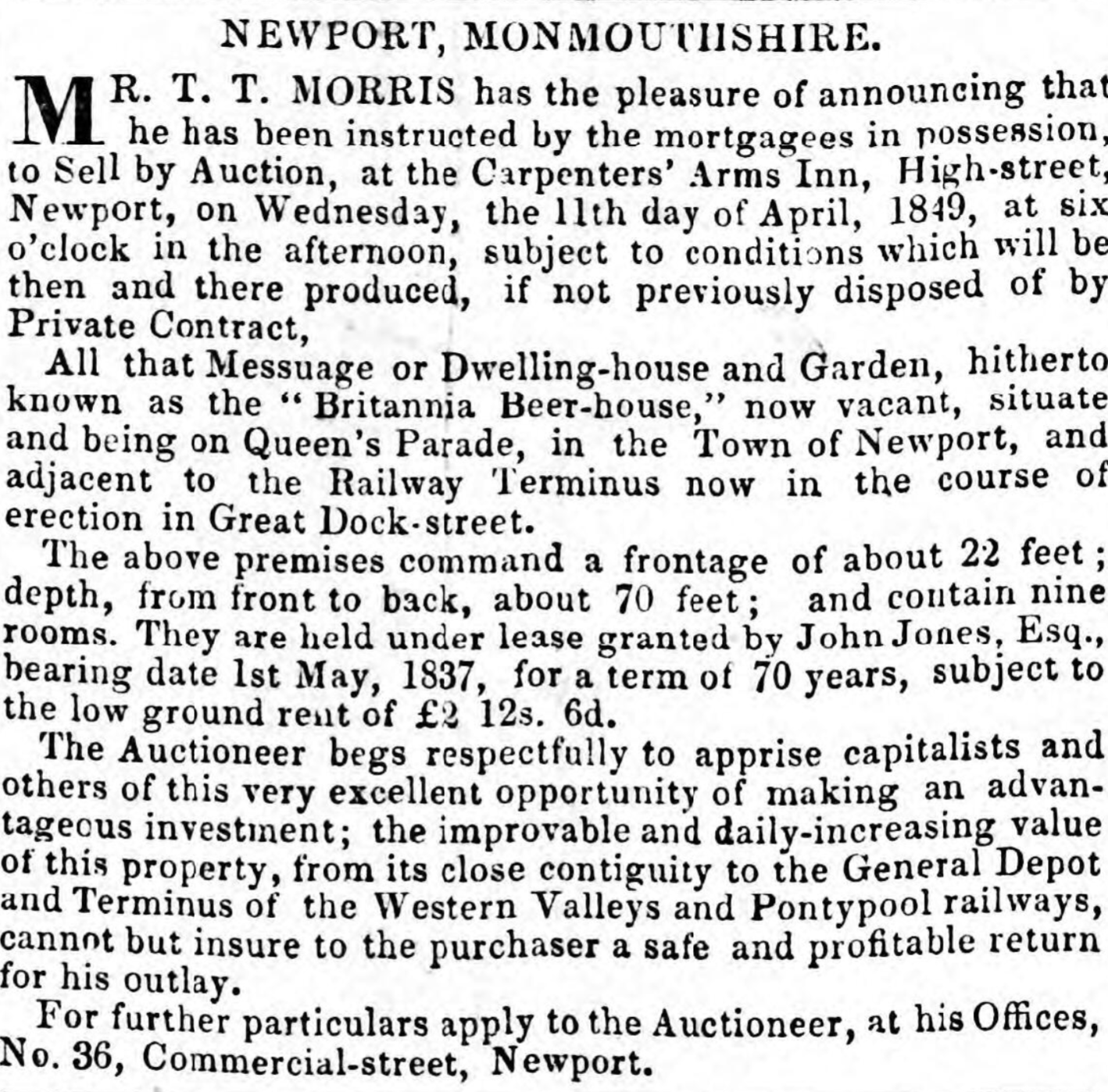
Monmouthshire Merlin, 2nd December, 1853 / Monmouthshire Merlin, 31st March, 1849
Up until 1847 the pub at No. 1 was known as the Dock Tavern and then was briefly the Britannia. It was mentioned in the 1848 street directory but in 1849 was mentioned as being vacant and it may have been named after the nearby Britannia Foundry which was located where Lidl is today. After that it was named the George Street Tavern.
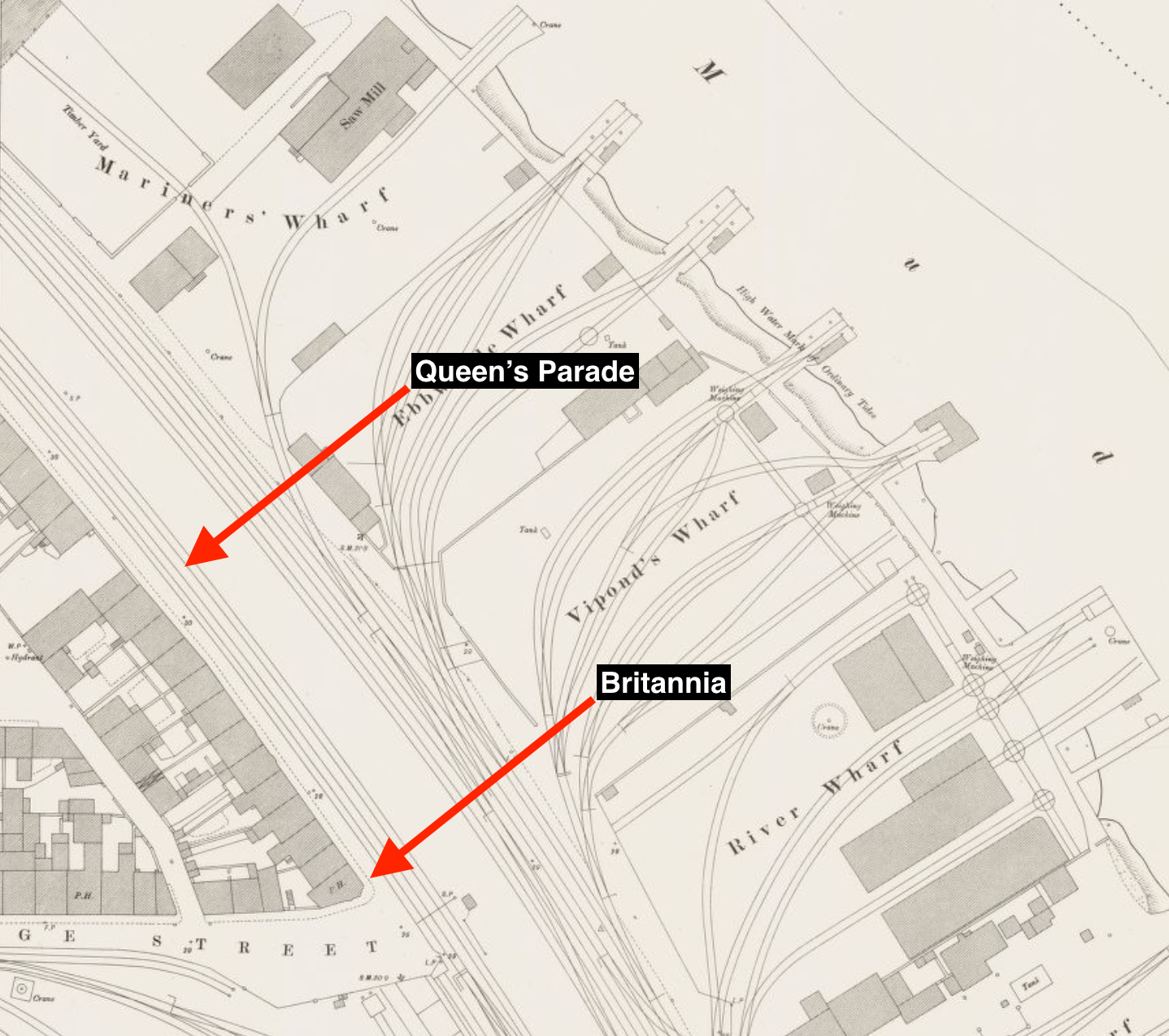
So when did Queen's Parade cease to exist?
A letter published in the Monmouthshire Merlin in 1867 gives an indication for when the parade changed names and it appeared to have caused some confusion.
Street Numbering
The want of proper regularity in numbering the houses in Newport streets has long been a subject of great inconvenience, as was exemplified before the Judge of our County Court on Tuesday last.
It appears that a row of houses formerly called Queen's Parade, and which, although at some considerable distance from the old Canal Parade, are in a straight line with it, has been christened also "Canal Parade:" so that there are two rows of houses both called by the same name.
Now this would be of little consequence it the houses had been re-numbered consecutively but some few houses in each row retaining their original numbers there are, in several instances, two houses bearing like figures.
Very few bear any, and you are left to count, as best you can, for the house required.
In the case above alluded to the bailiff had served a man at a house in one of these rows, whereas the real defendant, of the same name, resided at the corresponding number in the other row. Ulterior proceedings had been taken thereon, and the plaintiff put to considerable expense, when it was discovered that the real defendant knew nothing of the summons.
I think the attention of our Local Board should be called to this matter.
A remedy would save a vast deal of time and trouble, particularly to letter carriers.
I am, Sir, yours, &c., THE PLAINTIFF.
— Monmouthshire Merlin, 30th March, 1867
It's not known why the name was changed but by 1876, a street directory shows that the number confusion had been corrected and the both sections were number sequentially from George Street to Emlyn Street.


Member discussion