

Welcome to another issue of The Newport Cornucopia where we dig through the newspapers archives for interesting news articles and adverts. All articles are posted verbatim and most headlines are original (headlines in quotes are my own).

Names of Streets and Numbers of Houses
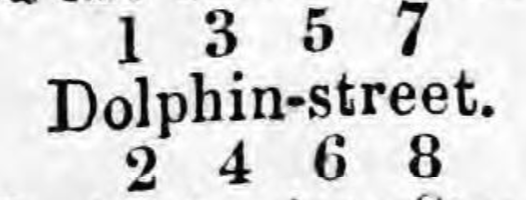
The names of streets and numbers of houses are in many parts of the town deficient, and unnecessary trouble and confusion are thus caused. I propose that the names of streets be put up by the Local Board, and that all owners be compelled to have their houses legibly numbered. I would suggest that, where practicable, the improved system of numbering adopted in Regent-street, and some of the West End streets—all the even numbers on one side the street, and the odd ones on the other be carried out, thus:—
— Monmouthshire Merlin, 9th May, 1851
Curious Occurrence
An interesting incident took place on Tuesday on board the screw steamer Avon, Captain Howe, on her passage down to Newport. A gentleman on board—when the vessel was about the Denny—let go a carrier pigeon, which, when nearly out of sight, was observed to be returning with all speed, closely pursued by a hawk. The pigeon pitched on the mast-head, but master hawk did not venture within reach of a gun that was pre- pared for him, and the poor pigeon remained till his carnivorous enemy thought proper to make off, when he again winged his way homewards. Much sympathy was manifested on board for the interesting little carrier.
— The Cardiff Times, 9th November, 1860
Newport Shopkeepers Exposing Their Goods
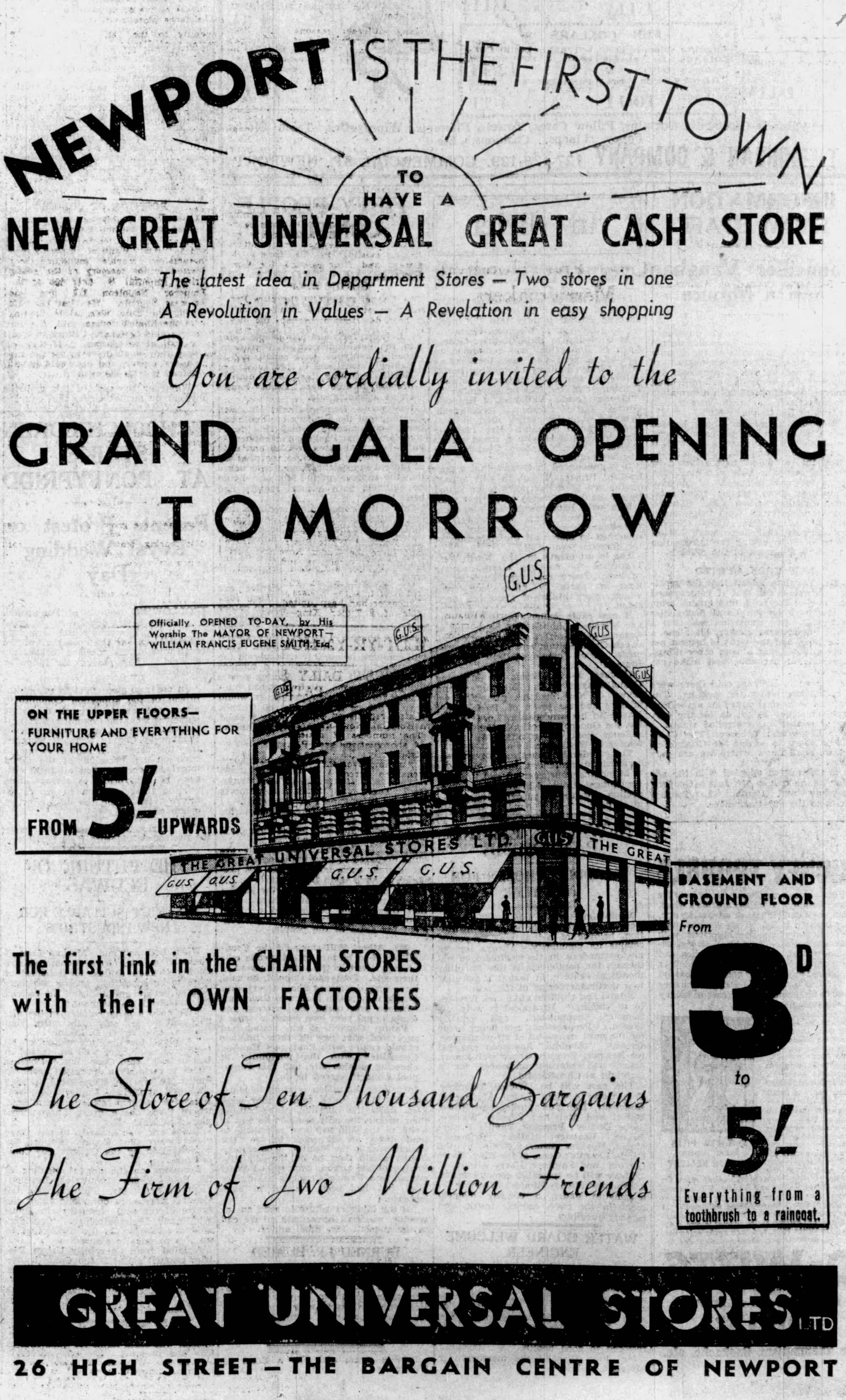
Yesterday morning the borough police court was crowded, in consequence of a number of tradesmen having been summoned for causing obstructions by exposing their goods for sale.
Messrs. L. A. Homfray, C. Lyne, H. Phillips, and T. P. Wansbrough were on the bench.
The defence was conducted by Mr. Gibbs in all but one case, a learned counsel who had been retained not being able to attend.
Hugh Morgan was summoned for obstructing Commercial street by hanging meat outside his shop. Sergeant Winmill said on the 11th inst. he saw three quarters of beef hanging outside the shop. They projected on the footway. Any ladies passing by would brush their dresses against them. Defendant was represented by his son.
Alfred Taylor, outfitter, High-street, was summoned for an obstruction. Sergeant Winmill said on the 11th inst. he saw a number of coats, and other articles of apparel, hanging outside the defendant's shop. They were hung a good way up, except some scarves. Cross examined: The coats were higher than a man's head. Dismissed.
Richard Hugh Richards, saddler, was summoned for hanging harness outside his windows. Sergeant Winmill gave evidence. He laid some part of the harness was quite an obstruction. Called the attention of the foreman to the fact, and he only laughed. Cross-examined: The harness hung within five feet of the ground.
Harry William., shoe salesman, Commercial-street, wu summoned for the like offence. Sergeant Winwill proved that the boot, and shoes were hung outside, but they were not beyond the frame of the window. He believed they were not an obstruction. They were about six feet above the ground. Defendant: They were 7ft. 6in. above.
Edward Chapman, High street, was summoned for hanging his boots and shoes outside. In this case, the sergeant said the articles were hung on a bar outside. They were above a tall man's head.
William Williams, High-street, in the same trade his goods were said to be above the head, of passers-by. James Little, outfitter, High-street, had coats, &c hanging outside, but they did not obstruct. The nails were in the facial board.
Joseph Bryan, outfitter, High-street, was in the same condition.
Thomas Jenkins, draper, Commercial-street had on one side of his shop a blanket, and on other a counterpane. Both were blowing about and any one on the footway was liable to be incommoded by them. They were outside the building altogether.
The same officer gave evidence in these cases, and they all referred to what he saw on the 13th instant. Mr. Gibbs, at the close of the evidence, said his clients were anxious to comply with the bye law under which they had been summoned. He contended that no obstruction had been proved, except in the cases of Mr. Richards and Mr. Jenkins: and so far as they were concerned they might possibly have broken the law, but this was the first time they had been summoned. The tradesmen intended to adhere as far as they could to the bye laws. They were at liberty to hang goods, up, so long as no one was incommoded.
The Town-clerk pointed out the provisions of 7 Geo. IV., c. sec. 59, which stipulated that no carcases of animals, wares, merchandise, or fruit should be exhibited in or upon any premises so as to obstruct the footway.
Mr. Lyne said the bye-law ought to have been as explicit as the section of the Act. The board of health had better amend the bye-law.
The Chairman, after consulting with his brother magistrates, said these cases were brought before the bench as much in the interests and for the protection of tradesmen as in the interests of the public. There was no doubt that a large and increasing population was living in Newport, and it was most desirable that the roads should be kept as clear as possible. It was advisable not to hang goods within shop doors, as a great temptation to steal was offered. He did not say it was against the law to put gods in the doorways, but it would be much better that they should refrain from so exhibiting them. The bench did not say whether Mr. Gibbs's law was right or not. Defendants were summoned under the bye-laws, and not under the Act of Parliament. There were only three cases in which the bench would convict. The others were dismissed.
With regard to Mr. Richards and Mr. Jenkins they would have to pay the costs, and the bench hoped they would not offend again. The board of health desired that the traffic should not be interrupted. With regard to Mr. Morgan, his case was a little different. He had been summoned before. There could be no greater obstruction than bloody meat overhanging the pavement, so that dresses might be spoiled. He would be fined 5s. and costs, and they hoped be would not commit the like offence again.
Mr. Gibbs asked for costs in the cues dismissed. The bench refused the application.
— Western Mail, 23rd February, 1875

A Squabble Over a Glass of Beer
Daniel Keefe and Edward Dowling, were charged with assaulting Edward Long, who s'lid that the defendant Keefe took up his (prosecutor's) glass of beer at the Albion Inn, last Saturday week some hot conversation ensued between them, and when they went outside, both defendants began to kick the prosecutor. The case was adjourned until Wednesday, both defendants being admitted to bail.
— Monmouthshire Merlin, 1st March, 1878
An Adjourned Case
Daniel Keefe and Edwin Dowling [mentioned above] were charged with assaulting Arthur Long. Prosecutor said they were in the Albion, on Saturday, the 16th inst., when Keefe took up his (witness's) glass of beer asked him to put it down, and they (defendants) kicked him outside the door. Thomas Fit gerald saw the two defendants and another man kicking the prosecutor.
Sergeant Brooks said that on Saturday night the 16th inst., he saw the complainant in Commercial-road covered with blood he told witness that he had been kicked by the two defendants and another man named Sweeney, who had "slipped it," there was now a mark as large as half-a-crown on the man's leg. It was a regular practice with those Pill chaps to tight on a Saturday night. Defendants said that the prosecutor was drunk and that he wanted to tight them both.
Dowling I have something to show you here, gentlemen you say that I have a bad character, but I have a testimonial here. Mr Kessick You have not got a good character in this book—you have been convicted here several times. Dowling That is through bad company, sir. Mr Evans There are good characters up to June, 1877; You have made a breach since then. Committed to a month's hard labour.
— Monmouthshire Merlin, 1st March, 1878
Stealing Oranges
Benjamin Pritchard and John Lynch, two boys, were charged with stealing a quantity of oranges from Paul Clifford's stall, in the Newport Market. James Rogers deposed to seeing the lads take the oranges, and giving the two boys into custody. Clifford said he knew nothing about the theft. Ordered to be locked up for a day, and to receive 12 strokes with the birch rod.
— Monmouthshire Merlin, 1st March, 1878
Throwing a Stone
Ann Shea was summoned for assaulting John Manship. Complainant said the defendant threw a stone at him. Bound over to keep the peace for six months.
— Monmouthshire Merlin, 1st March, 1878
Mr Bolt's New Hotel
Mr. Bolt had proprosed erecting a large hotel in Baneswell, opposite his new public hall, now in course of erection, and to be known as the Victoria-rooms, and plans of the proposed hotel had been prepared, which plans he (the chairman) then laid on the table. After much discussion, the plans were allowed, and the following resolution carried, on the motion of Mr. Lyne, seconded by Mr. H. J. Davis:—
"That the plans be approved and passed; but that it is the unanimous opinion of this Board, that so soon as the lease of the Black Horse inn, at the corner of the square, falls in, the same, or so much of it as prevents the street from being 40 feet wide, should be removed and that a copy of this resolution be sent to the agent of Lord Tredegar."
— The Cardiff and Merthyr Guardian, 19th July, 1862
Drapers' Assistants
To the Editor of the Monmouthshire Merlin
SIR, Seeing in your last a letter reflecting on the conduct of the drapers allow me to say that I know ten or a dozen who are members of the Institute at this moment, and that many of those who were members the last quarter, have left the town—that several of them attend my classes regularly for French, writing, arithmetic, &c., and three certainly attend my dancing lessons. I have ever found them steady and attentive to a degree, and extremely punctual to their limited hours.
This is but an act of justice, and as such I claim for it your polite attention.
I am, sir, yours obediently,
DANIEL CARTER. March 1, 1843, Commercial-road, Newport.
— Monmouthshire Merlin, 4th March, 1843
Electric Lighting at Newport
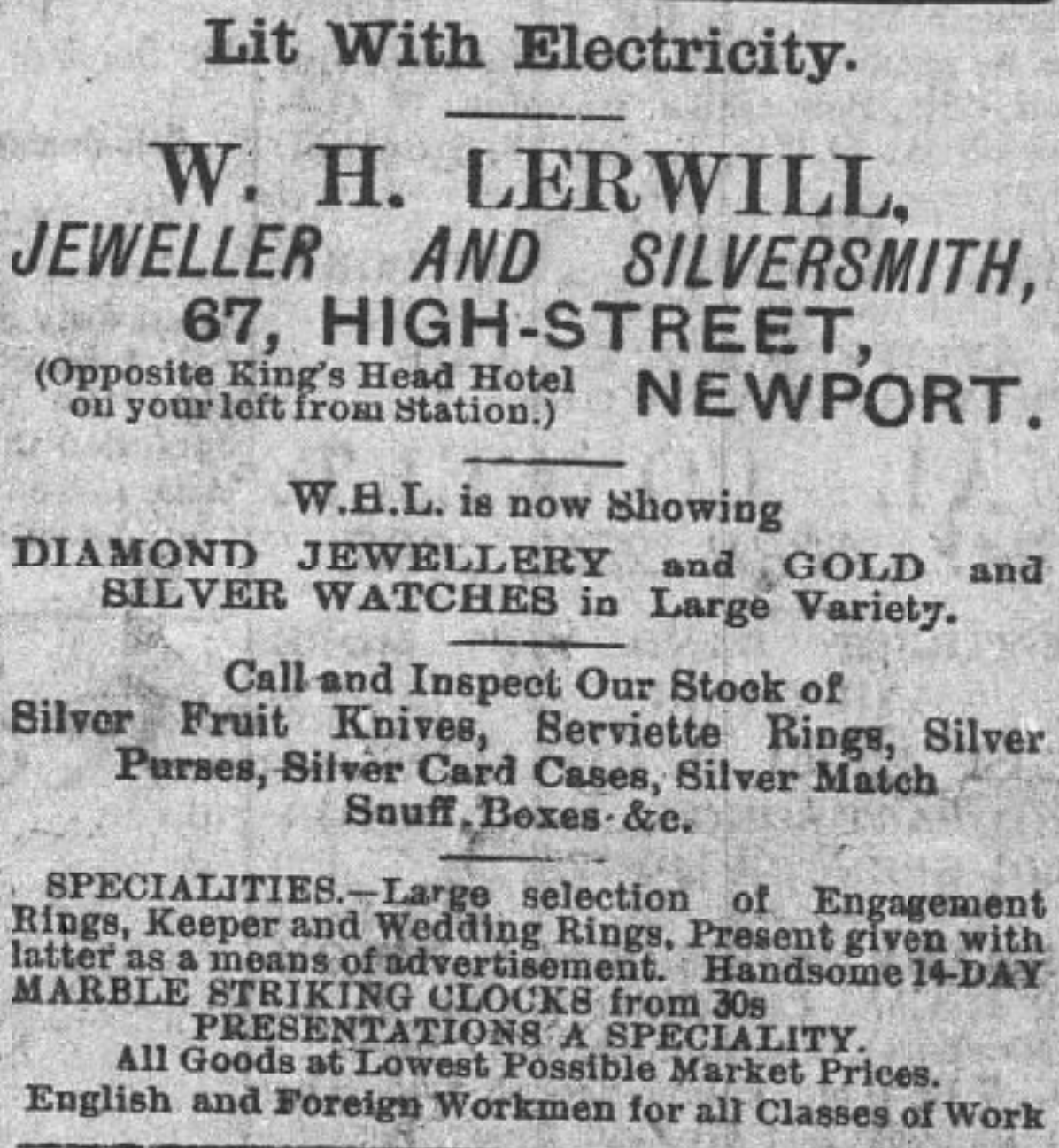
The electric light was turned on on Saturday night at Newport for private use for the first time. It had been announced that the shops of the following would be illuminated: Messrs Christophers and Son, Messrs Wadley and Son, Mr P. Birkley, Mr C.H. Burcham, Messrs Greenhouse and Scrivener, Mr W. Evans, Mr H. Smith, Mr W.H. Lerwill and Mr C. Keene. The night was a stormy and wet one, otherwise many people will have made a round and inspected the lights at the various shops.
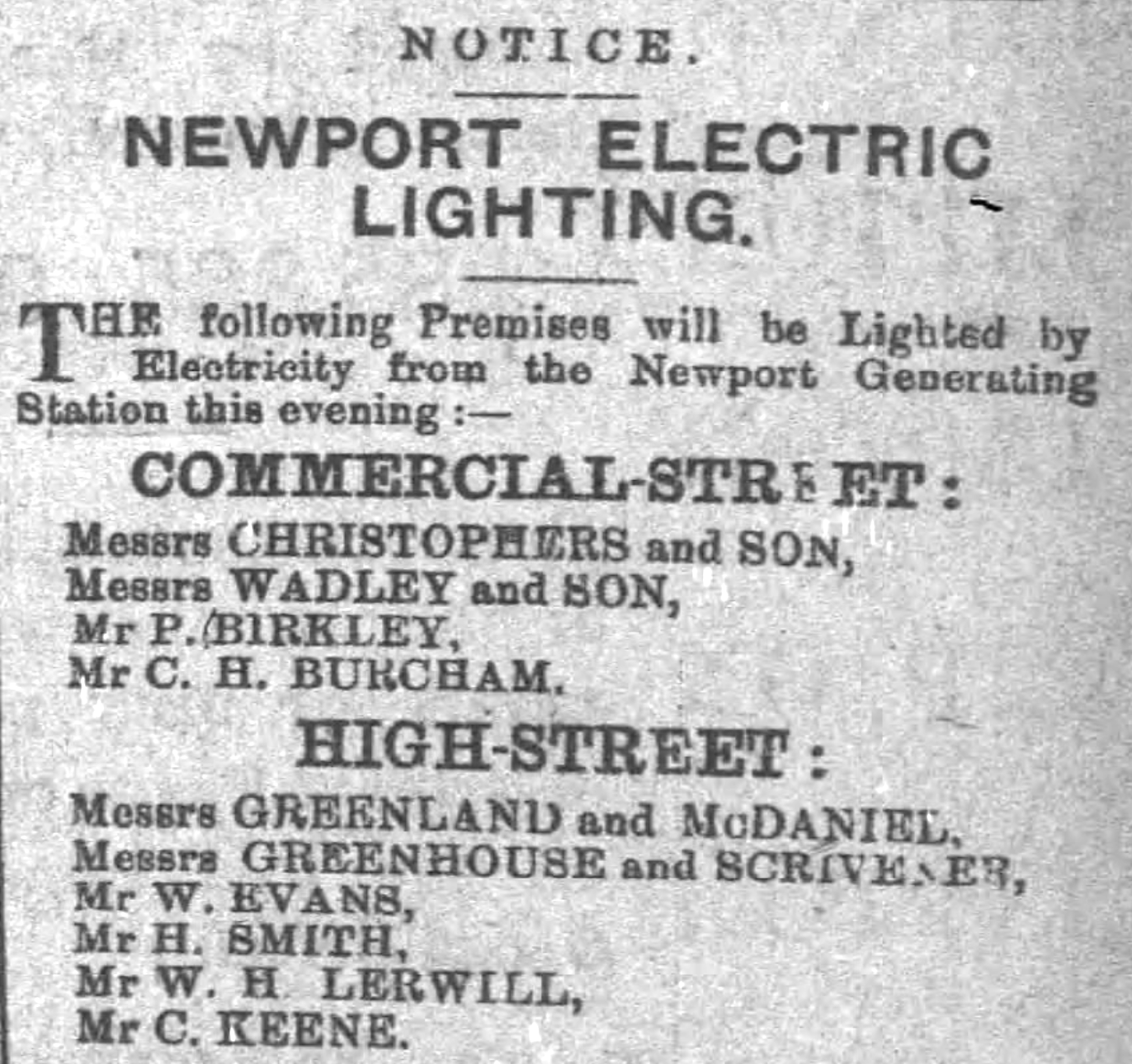
Some of the shops looked quite brilliant, principally those in which the lights were closed in lamps of plain glass. The red shades considerably softened the light, and those with a blue rim made the effect a beautiful one. The light burned well, and in those cases where the glass was plain furnished a marked contrast to the shops illuminated by ordinary gas burners.
— South Wales Argus, 25th March, 1895 (Subscription Required)
Mr Turner's Parrot
Mr. Turner, of Pill-road, in this town, has had a grey parrot from the coast of Africa, in his possession twelve years, which, two years ago, laid two eggs, last week laid two more and this week has added another to the number.
— Monmouthshire Merlin, 25th May, 1844
Dangerous Practice
Last Tuesday evening an aged domestic, in the employ of Mr. Poole, of the Stow Hill Academy, was engaged in the dangerous practice of cleaning one of the front bed-room windows, by standing on the outside ledge, and holding the sashes in one hand, while she cleaned the glass with the other.
By some mischance, she unfortunately slipped from her position, and fell into the garden below. We are happy to add that, although serious results might have been anticipated, the woman was not much hurt. Female servants should not be employed in such unsuitable and perilous work.
— Monmouthshire Merlin, 25th May, 1844


Member discussion