

Welcome to another issue of The Newport Cornucopia where we dig through the newspapers archives for interesting news articles and adverts. All articles are posted verbatim and most headlines are original (headlines in quotes are my own).


'The Poor of Pillgwenlly'
The poor of Pillgwenlly were most seasonably recieved on Saturday and Monday last, with bread, potatoes, and herrings. by the direction of Sir Charles Morgan, who kindly handed over, for that purpose £2, the amount of a fine levied for trespass, to which was added the subscription of Samuel Homfray, J. F. Hanson, and — Vaughan, Esq., together with small contributions, amounting altogether to about £8. for which relief the grateful recipients beg to return their thanks.
— Monmouthshire Merlin, 17th February, 1838
Highway Robbery
The police are in quest of three privates of the 2nd Warwick Militia, stationed at our barracks, who, a night or two since, followed a workman at the Dos Works, named Ricketts, who was proceeding to his home at Malpas. At some distance beyond the houses, the soldiers knocked Ricketts down, and while one held him by the throat, the others plundered him of a German-silver watch (maker's name, Daniel Manley), and a broad steel chain, with black stone seal. The highwaymen then decamped towards the barracks. Several offences, we regret to state, have been committed by some men of this regiment, and the difficulty of identifying a soldier may prevent the detection of the scoundrels who committed the highway robbery now recorded.
— Cardiff Times, 28th January, 1860
'Stow Hill Accident'
About three o'clock on Monday morning a man named Jeremiah Welsh, from Bassalleg, fell from the high and dangerous paving on Stow-hill into the roadway, and broke his ribs. Really some protection ought to be afforded the public from tumbling over this high, steep footway, over which so many persons have slipped, to the imminent peril of their lives.
— Cardiff Times, 4th February, 1860

Whitby Place
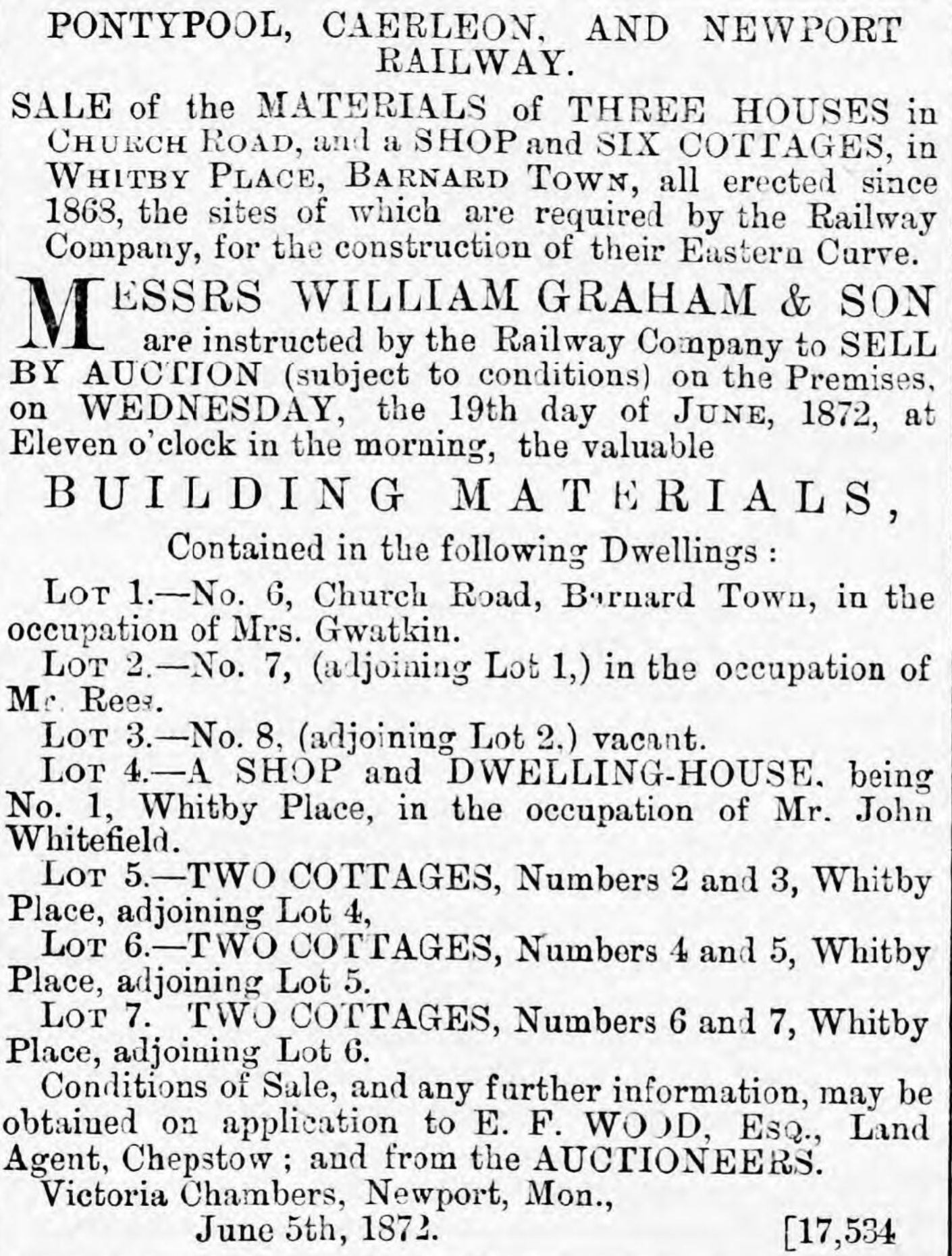
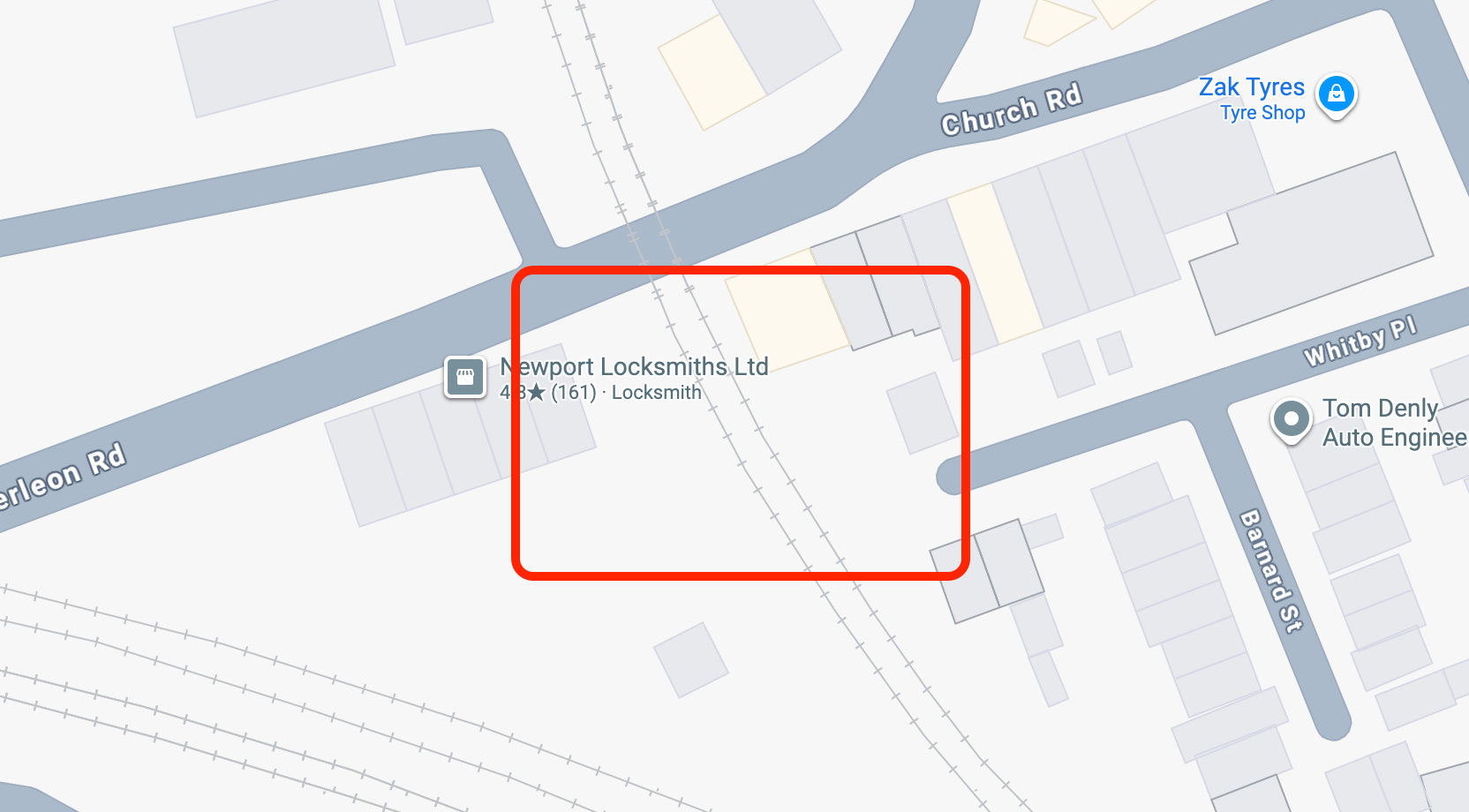
Whitby Place is a bit of an odd street in Barnardtown with a few houses at each end, a couple of car garages and the rear entrances to houses on Church Road but back in 1868 there were at least 6 more houses and a shop.
The area was in its infancy and these properties had only been in existence for 4 years when they demolished to make room for the Eastern Curve of the Pontypool, Caerleon and Newport Railway.
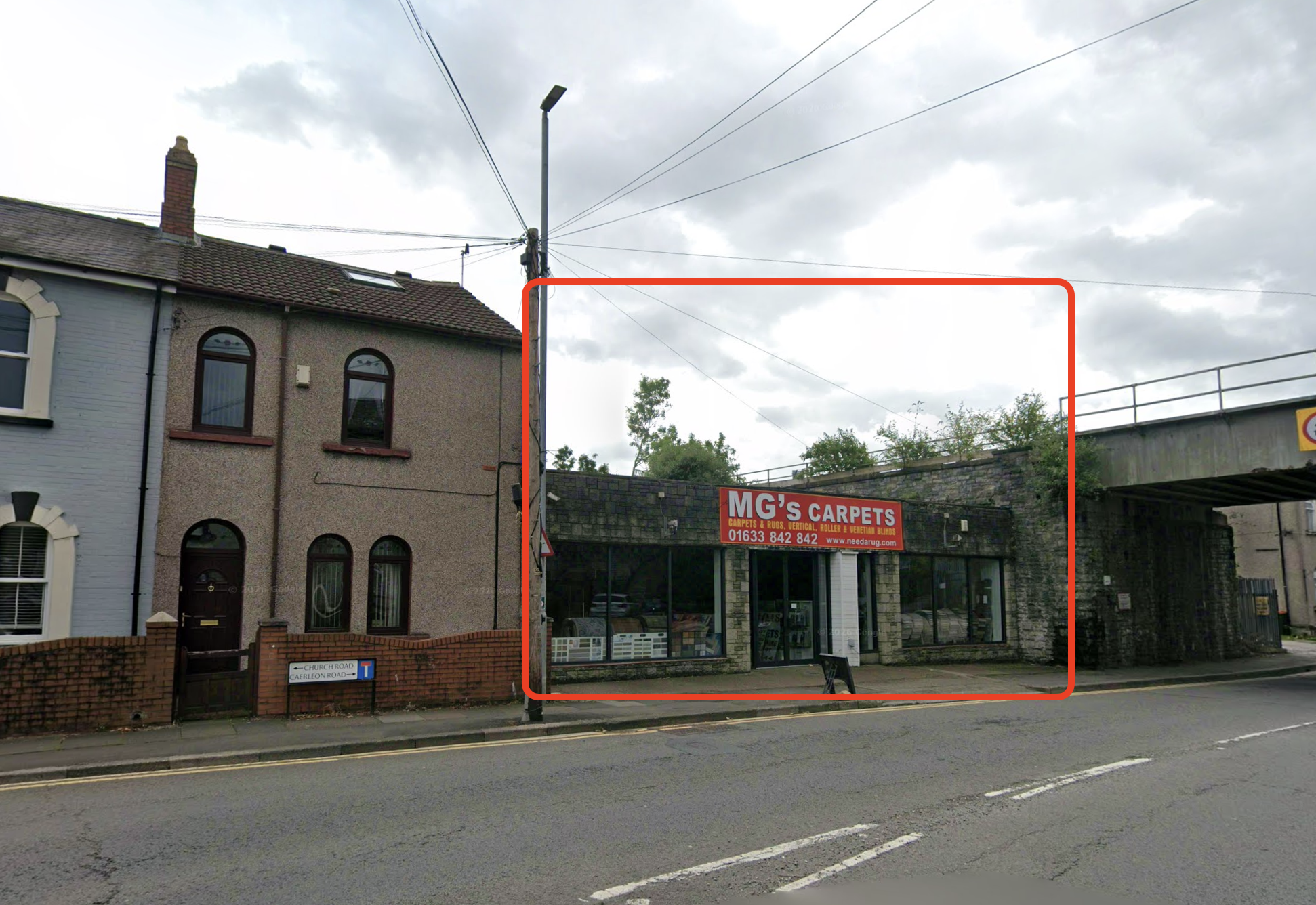
In addition to the properties on Whitby Place, three houses on Church Road were demolished which may have been where MG's Carpets is located.


Impudent Theft at Maindee
John White was charged with stealing a jacket and silk dress, belonging to David Marsden, of Maindee. Mrs. Marsden said prisoner came to her saying he was commissioned to purchase left-off clothes for the colonies. She produced a lot of old clothes, and then went up stairs for more, having previously placed a silk dress and jacket on a chair by themselves.
On her return he bought clothes to the amount of £4 18s. He took the dress and jacket, which were not included in the bargain, and putting 4s. down on the table, he left the house. Sergeant McEvoy apprehended the prisoner at Podesta's lodging-house, at Newport, and found the dress and jacket there. On the prisoner's person was found a pedlar's certificate. Defendant pleaded not guilty, and was committed for trial at the Quarter Sessions.
— Monmouthshire Merlin, 22nd March, 1872
In 1849, a 12-year-old John was assaulted by a man who hired John from his parents for a year (see below). One of the tasks he was hired for was playing the accordion on the streets.
In 1873, whilst running the Three Horse Shoes on High Street had a shawl and petticoat stolen. The previous year he was fined for allowing disorderly conduct in the pub (drunken soldiers and prostitutes).
In 1882, he was charged with assaulting two women and was referred to as being an 'itinerant accordion player'.
An English Slave Driver
Conrad Rompf, a man who drives unholy bargains with parents brutal enough to lend out their children to him on hire, was charged with having assaulted a poor sickly little lad, twelve years of age, named John Podesta. The juvenile musician stated that he was hired by the defendant to play the accordion about the street.
The poor little fellow said that on Sunday morning, at seven o'clock, his master ordered him to get up. Being tired and overwearied (sic) by his previous day's tramping, he cried because he was called to get up, and his master beat him upon the bed, very badly. His little sister was also hired by him, and he beat her very much. She played the tambourine to her master.
He was hired to the prisoner upon the following stamped agreement:
Conrad Rompf, October 7, 1848, of Ann Podesta, engages Mary Podesta and John Podesta for one year, at £2 10s. per year, washing and lodging and clothes dog and carrig (sic) concluded—not to go out of England in advance £1.
ANN PODESTA x. Witness, CONRAD ROMPF. STEPHEN PODESTA.
The boy proceeded to say, that just before Christmas, the prisoner beat him with the leather dog straps, because he had not brought home more than one shilling and a halfpenny. The greatest amount he had got in a day, was 3s. 10d., and sometimes as low as 2s, 6d., was beaten if he didn't bring home 2s. every night. Did not get his supper always.
By Mr. Phillpotts: I did not call him an Italian thief—I called the master of the lodging house so, after he had beaten me. The prisoner had beaten me with the bellows on the side, very badly. He had to clothe and feed me.
To the Mayor: Those clothes (rags) I have on, are all I have. I have another shirt, but don't know when this was washed last. I have the itch all over my body—have a bad toothache, and sores on my neck, where my master beat me.
The mother of the poor child said, she had heard the master's wife tell him if he got 2s. a day, she would give him a halfpenny and this was enough, she said, to make her child thieve. She had followed the master, because he was always cruelly beating her children, and she was determined to act as a mother to her children.
Mr. Phillpotts said she could not be acting much like a mother, when she signed a contract for the hire of her children. She replied, that she had only the workhouse or beggary before her and her children; and this it was that had compelled her to do what she had.
The Mayor, in the strongest terms of censure, commented on the prisoner's conduct, and the system pursued both by him and the poor children's mother, and fined the prisoner 5s and costs for his assault on the boy; at the same time advising the unnatural mother, if worthy of the trust, to take her children home to Herefordshire, from whence they had been taken.
Mr. English said, the practice of hiring out children for begging and musical performance was very common in Newport.
Mr. Hughes said, the fault lay with the inhabitants, who so foolishly and wrongly encouraged every system of mendicancy, by indiscriminate charity.
— Monmouthshire Merlin, 10th February, 1849
'1838 Crimes'
A selection of crimes in front of the magistrates (one was John Frost) in 1838.
Henry Williams, beer house keeper, for drawing beer to one Lewis, he (Lewis), being drunk at the same time, and shortly afterwards was killed upon the tram-road. Fined 40s and costs.
Daniel Lewis, and William. Lloyd, charged with secretly burying a new born male child in St. Woollos churchyard, in the middle of the nght of the 1oth inst. Discharged with a caution.
John Loyn, charged with assaulting Richard Williams, a blind man. Fined 40s and costs, or 21 day's imprisonment.
The Old Cemetery
Some scandal has been created in the town by the neglect of the lodge-keeper and gravedigger, who, for a long time, had neglected to fill up graves, and had been in the habit of keeping them open for the interment of a number of corpses for a considerable period. The man has been discharged from his situation.
— Cardiff Times, 4th February, 1860
Barnard Town
This rapidly increasing district on the outskirts of Newport appears likely to become notorious for the quarrels and scenes of drunkenness which are constantly arising amongst a certain section of its inhabitants. Scarcely a police-court passes, but some denizens of this neighbourhood are summoned for drunkenness or assaults. It is beyond the boundary of the borough, and hence the Borough police-force have no jurisdiction in the place.
Yesterday, before the Mayor and Mr J. Cullum, two more case from Barnard Town were disposed of, and some of the parties implicated have figured prominently in the police annals when they were occupants of tenements in the old Friars' fields. Although Barnard Town has only recently sprung into existence, yet, unless extreme care be exercised by the owners of houses in selecting tenants, their property will deteriorate in value.
— South Wales Daily News, 3rd June, 1875


Member discussion