

Welcome to another issue of The Newport Cornucopia where we dig through the newspapers archives for interesting news articles and adverts. All articles are posted verbatim and most headlines are original (headlines in quotes are my own).

Opening of the British School Stow Hill
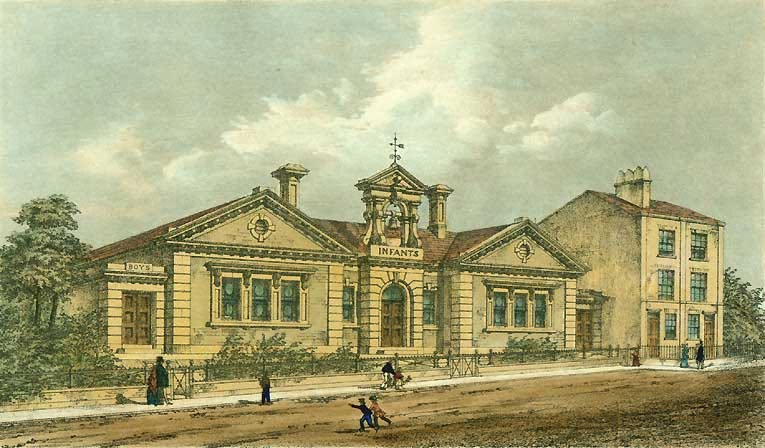
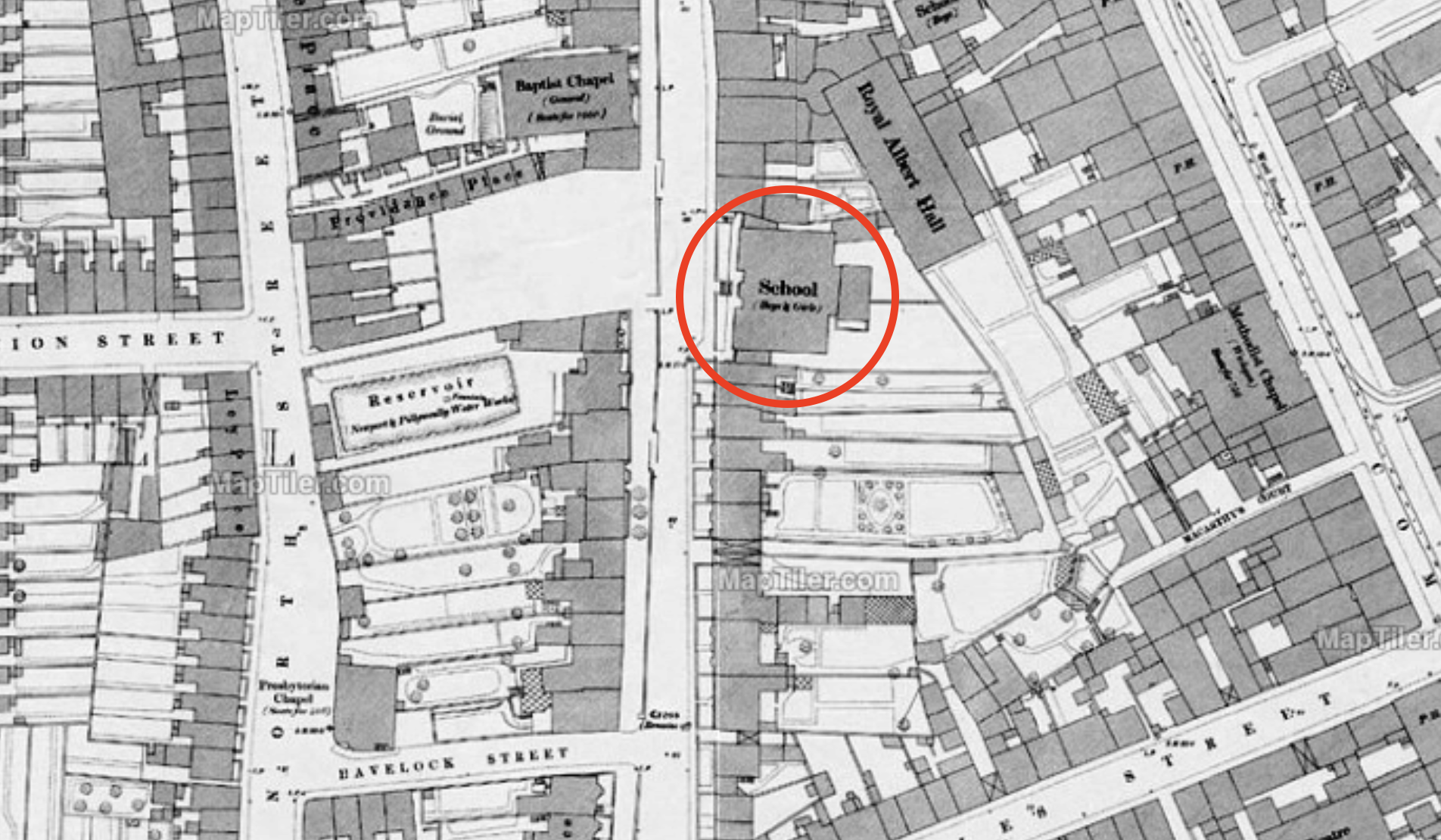
The handsome building which has been erected or Stow-hill, for the purpose of the British Schools, having been at length completed, its formal opening took place on Tuesday morning last, by a public breakfast, at which Sir Charles Morgan, Bart., presided, and at which the members of the principal families of Newport and the neighbourhood, and especially the friends of the school were present.
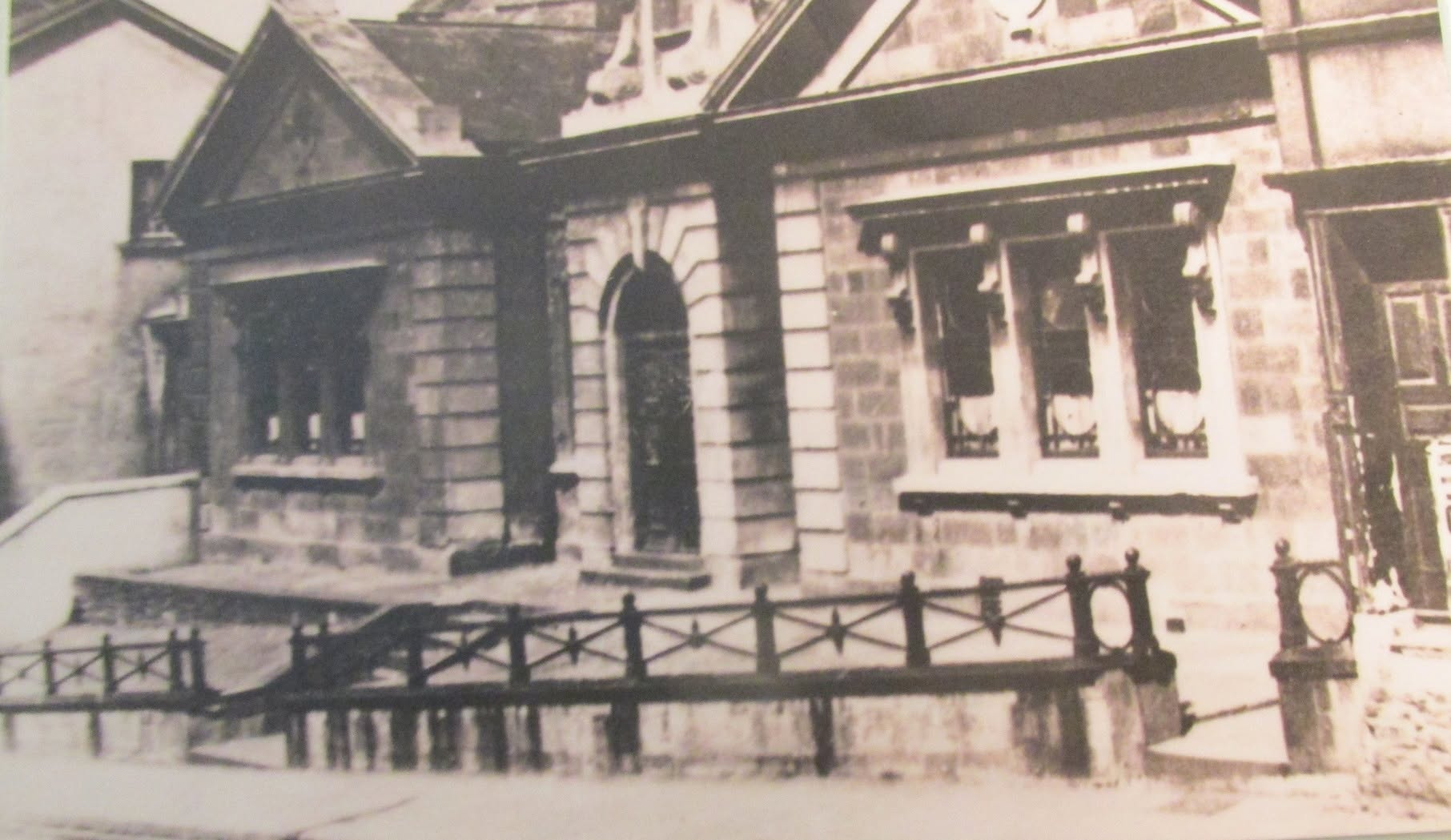
The building is in the Italian style of architecture, the front facade being executed in Newbridge stone, with Bath stone windows, rustications, entablatures, and bell turret, presenting a handsome appearance. There art two schoolrooms — for boys and girls, each 54 feet long by 24 feet wide, and an infant school-room 40 feet long by 24 feet wide; besides which there are convenient ant commodious class-rooms, suitable offices, and a large sized play-ground.
Each school-room is furnished with two large fire-places, and the ventilation has been care fully attended to, by the insertion in the windows of Moore's patent ventilators, used in conjunction with other appliances. The rooms are lofty, and being ceiling (?) on the face of the rafters, allow a height of more than 22 feet to the ridge, and the whole of the interior is of light and pleasing character. Messrs. Habershon are the architects; and Mr. Norman, of Newport, the builder The whole cost of the building is £1,800.
The breakfast, which was of the most recherche description, was supplied by Mr. Lloyd, of the Kings Head Hotel, and placed upon the table in the most tasteful manner, by Mr. Halliday, of Birmingham. The wines supplied, principally sherry and champagne, were of excellent quality, and the repast generally gave grest satisfaction. The room in which the breakfast too: place was tastefully decorated with banners and festoons of flowers and evergreens, the word "Education," formed of wreaths of flowers, being conspicuous among other devices. Miss Clowes, Mr. Willey, and Mr. Toogood sang a choice selection of pieces in the course of the day at intervals between the speeches, Mr. H. J. Groves presiding at the pianoforte.
The Rev. J. T. Wrenford asked a blessing before breakfast, and returned thanks afterwards. The chair then sang "Apollo strikes the Lyre," after which—
The President said he was not aware, when he acceded to the request of Mr. Evans and others, to preside over them that day, that he should have had to address so respectable, numerous, and brilliant an assembly. He thought it must be gratifying to the committee to see that their exertions had been successful, and he hoped these schools would be well supported by the people of Newport, and be succeeded by others of a similar kind;
for no person could walk through the streets of Newport without seeing a large number of poor children, almost naked, and entirely neglected as regarded their education.
This was a matter for great regret, but it was a matter of congratulation, and very much to the credit of the inhabitants of Newport, that they appeared anxious to give a moral and religious education to the poorer classes, who were not able to obtain that education themselves.
It was hoped the promoters of the school would train up the children to a moral sense of religion, the fear of God, and to show a proper respect and reverance for the law and their country and if any exertions on his part could forward the views of the committee, he would be most happy and ready to assist them. (Applause.)
Although the committee might not meet with that support they calculated upon, they would, at all events, have the gratification of knowing that in the establishment of those schools they had done their duty to God and to their neighbours. (Applause.)
— Monmouthshire Merlin, 1st November, 1856
'Signor Quaglieni's Sardinian Cirque'
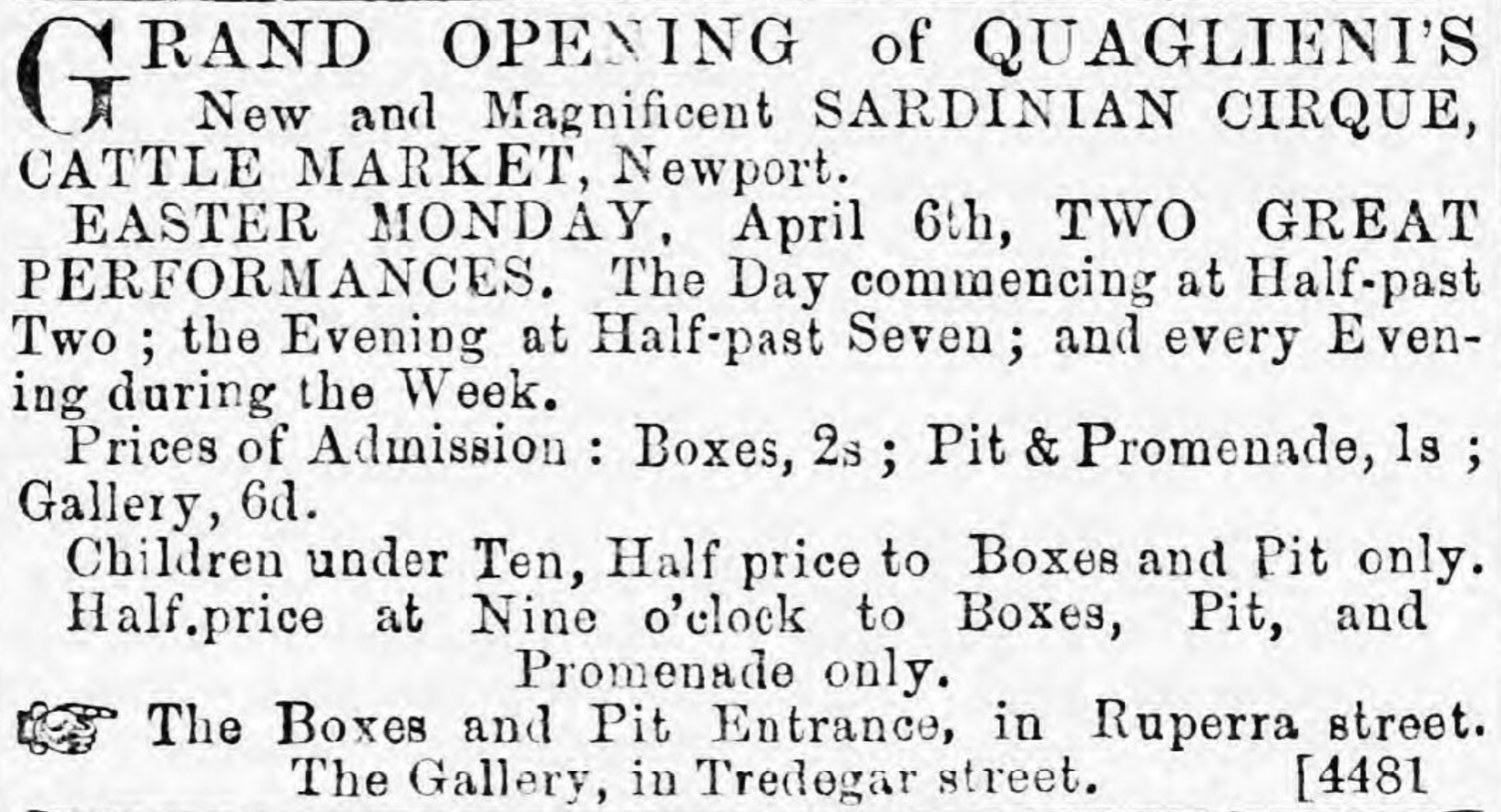
This place of amusement becomes an increasingly popular resort, from the talent of the performers and the efforts of the proprietor to ensure the comfort and satisfaction of his patrons. On Wednesday night the performances were for the benefit of Mr. Henry Brown, one of the clowns, and he was favoured with a bumper house. The programme was of a miscellaneous kind, and was, it is hardly necessary to say, admirably carried out.
Mr. Brown's election speech was a pointed satire on the hustings oratory; and no less clear and witty were his puns on the names of streets in Newport. The entertainment terminated with the ever-popular "spectacle" of Turpin's Ride to York, and which afforded an opportunity of displaying the marvellous extent to which it is possible to train a horse.
The performance of Quaglieni's animal surpassed anything of the kind we ever witnessed, and was greeted with rounds of acclamation. We understand the circus will, for this season, close next week.
— Monmouthshire Merlin, 16th May, 1863

Easter Monday 'Sports'
James Bevan and Elijah Gainey, were charged with fighting in a field belonging to Mr. Latch, on Monday, the 8th instant.
P.C. Bath stated, that being on his beat near the Salutation, with P.C. Hayward, last Monday, he perceived a crowd 0n the tram-road, going towards the fields. They, went thither, and saw the prisoners fighting. Witness captured Bevan, who made a run for it but he had not seen the figbt.
P.C. Hayward said he saw the men peeled for milling, but had not seen them fight. The prisoners said that it was only a set-to for practice.
The Mayor: I suppose it is usual to have a fight on Easter Monday?
Bevan: Why, I don't know but it is, your worship; one must have a bit of pleasure, sometimes (Laughter.)
Mayor: Well, you are discharged now, but don't get fighting in the fields again.
— Monmouthshire Merlin, 20th April, 1844
'Cruelty to a Dog'
William Davis was charged by Mr. T. J. Phillips, with cruelty to a dog. Mr. Phillips said that on Thursday morning he was going over Newport bridge, when his attention was called by Captain Parfitt to the prisoner, who was treating a dog with great inhumanity he flung him over several times, and as often as the poor animal would creep through the mud in order to make his escape, the prisoner would catch him and throw him over again.
The prisoner pleaded guilty. Judgment was deferred for the present, and his worship gave directions to the Police to bring up the prisoner 10 receive sentence if they should after that day see him in Newport.
— Monmouthshire Merlin, 14th May, 1842
'Stealing Iron'
Before the Mayor. Elias Jones, a ragged and barefooted boy, was charged with stealing iron, the property of the Rhymney Iron Company. The Superintendent of Police informed his worship that the prisoner was before him some time ago, and was dismissed on a promise to leave the town. P.C. Pennimore being sworn, stated that on Thursday evening, between six and seven o clock, he and P. C. Huxtable met prisoner and another boy with a bag on the shoulder of each, on the Canal Bank, near Botany. Prisoner on being questioned, said that he had some old iron in the bag, which he found in a ballast heap. The other boy escaped, but left his bag behind.
In bringing prisoner to the station-house he tilted the bag off his shoulders into the canal. Huxtable brought prisoner to the station-house, and witness remained by the canal where the bag was thrown in till nearly ten o'clock, when he went away.
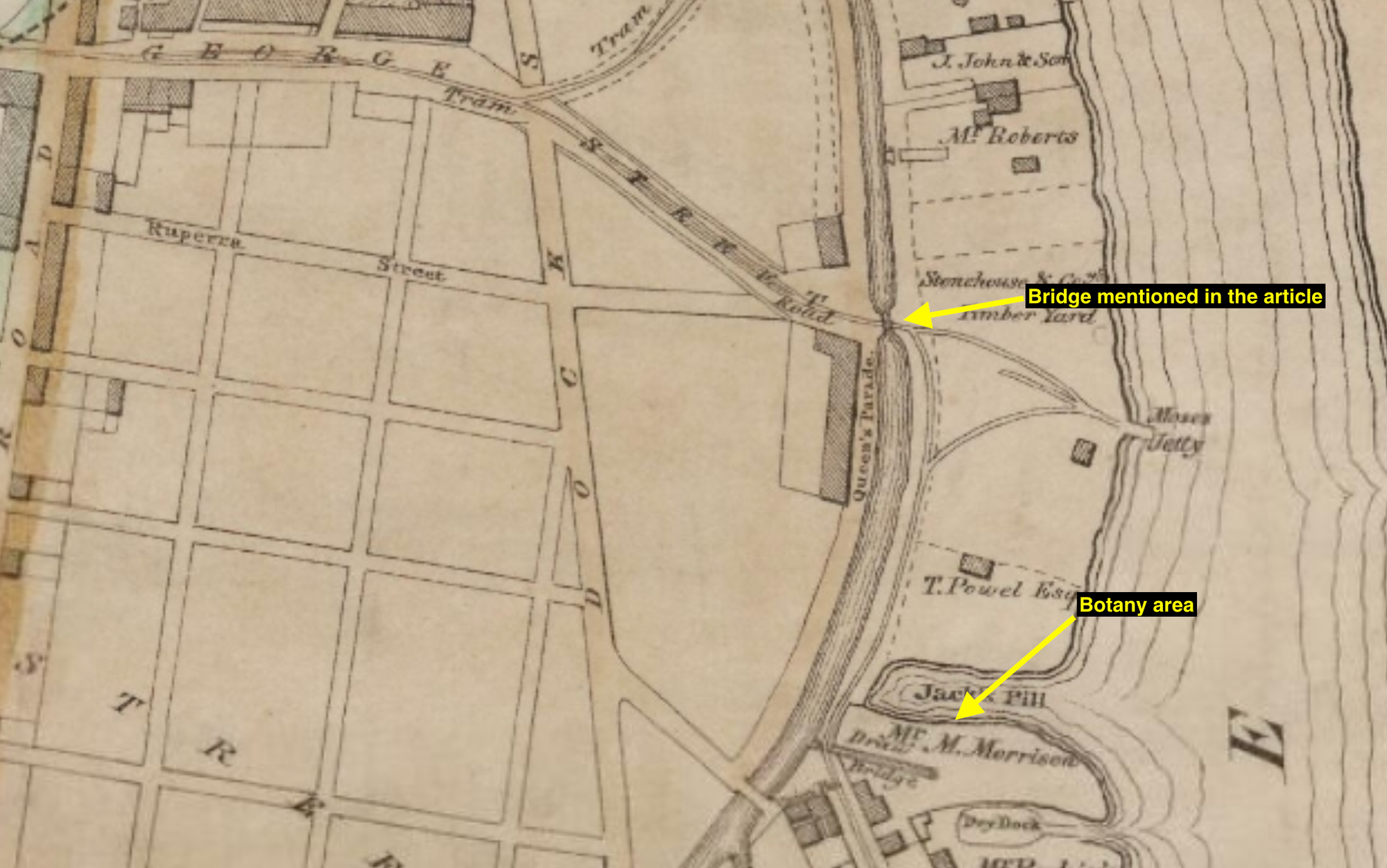
P.C. Bath then came and searched the canal witness did not see Bath search the canal, nor was he there when Bath arrived. Witness here produced a bag containing several small pieces of iron he would swear that the bag was the one prisoner had on his shoulder when stopped, and which he threw into the canal. There was one piece of iron also which witness would swear to as having been in the bag when witness searched it on taking prisoner into custody.
P. C. Bath stated that on Thursday night, between nine and ten o'clock, he was ordered to go to the bridge over the canal, at the bottom of George-street, and relieve Pennimore he went there, and between two and three o'clock on the following morning he got a boat hook and fished up the bag produced he identified the same piece of iron as was identified by Pennimore as having been in the bag when he took it out of the water.
Mr. Duncan, agent to the Rhymney Company identified the piece of iron as belonging to the Company. Mr. T. J. Phillips reprimanded the constables for the slovenly way in which the case was managed. Committed.
— Monmouthshire Merlin, 14th May, 1842
'Accident at Botany'
On Monday last some labourers were employed discharging ballast from a vessel, which lay alongside the wharf of Mr. M. Morrison, at Botany. It is usual on these occasions to rig a temporary platform, one end of which rests the jetty head, the other being attached to the rigging of the vessel. This was done in the present instance when the ship was afloat but when she took the ground, she listed off and broke the lashings of the stage, at the moment when there tram of ballast upon it and an unfortunate man, named Michael Ryan, who was employed upon the work.
Ryan, who stood at the extremity of the platform, was first precipitated and he fell with his back across the combings the tram followed him instantaneously, and dropping on his body crushed and mutilated him in so dreadful a manner, that he died almost before he could breathe a prayer for mercy on his soul.
Seldom has it been our painful duly to record a more melanncholy case than this; and we sincerely trust it may prove a warning to those poor and industrious men, who earn an honest livelihood by toiling at this laborious occupation, and them to be more cautious in looking to the security of appliances and means they use to facilitate their operations.
Wednssday an inquest was held on the body, before Wm. Brewer, Esq., coroner, when the foregoing facts were stated in evidence, and a verdict of "Accidental death" returned. However, one more fact connected with this sad case which adds, if anything can add, to its melancholy interest: the poor labourer thus snatched from life,
has left behind him a destitute widow and nine helpless orphans, who will no longer receive their daily bread from the toil of the husband and the father, cut off in the act of earning their subsisence; they have now no other stay in life—no other source to they may look for help in their affliction, than the sympathy and the charitable and humane who may become acquainted with their sad story.
We know, by experience, that the appeal widow or the orphan, is never made in vain to our fellow townsmen. Here is a group—a widow and nine orphans! with every additional circumstance which can strengthen their claim on our pity; and we repeat our conviction, that the appeal they now make through us, will not be made in vain
We shall gladly receive subscriptions for this destitute family; and we hop to be enabled to state, that the benevolence of our fellow townsmen will have effectually ministered to the necessities of this portion of those, whom we will have always with us — the poor and the afflicted.
— Monmouthshire Merlin, 19th September, 1840
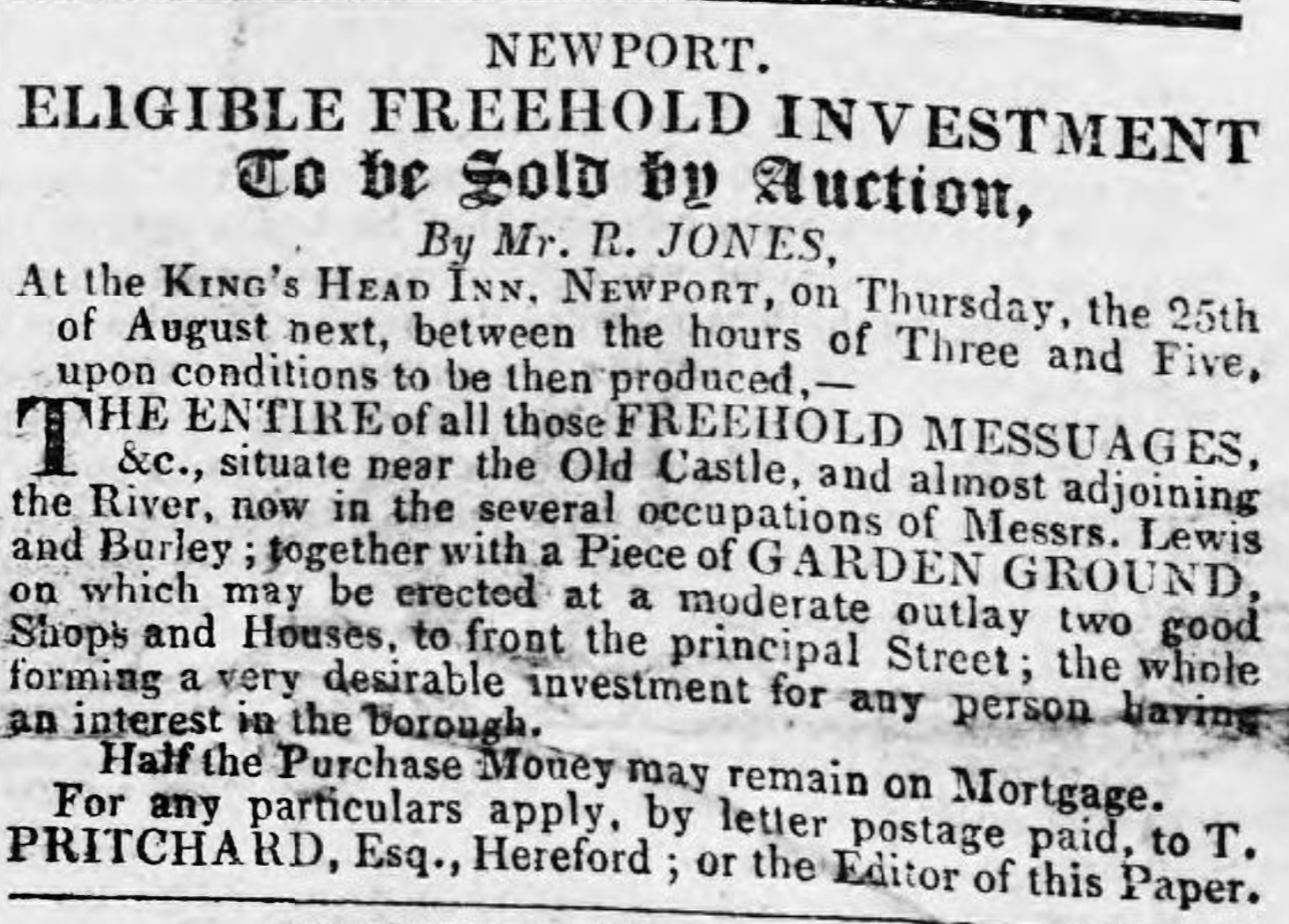
'Brewery For Sale in 1816'
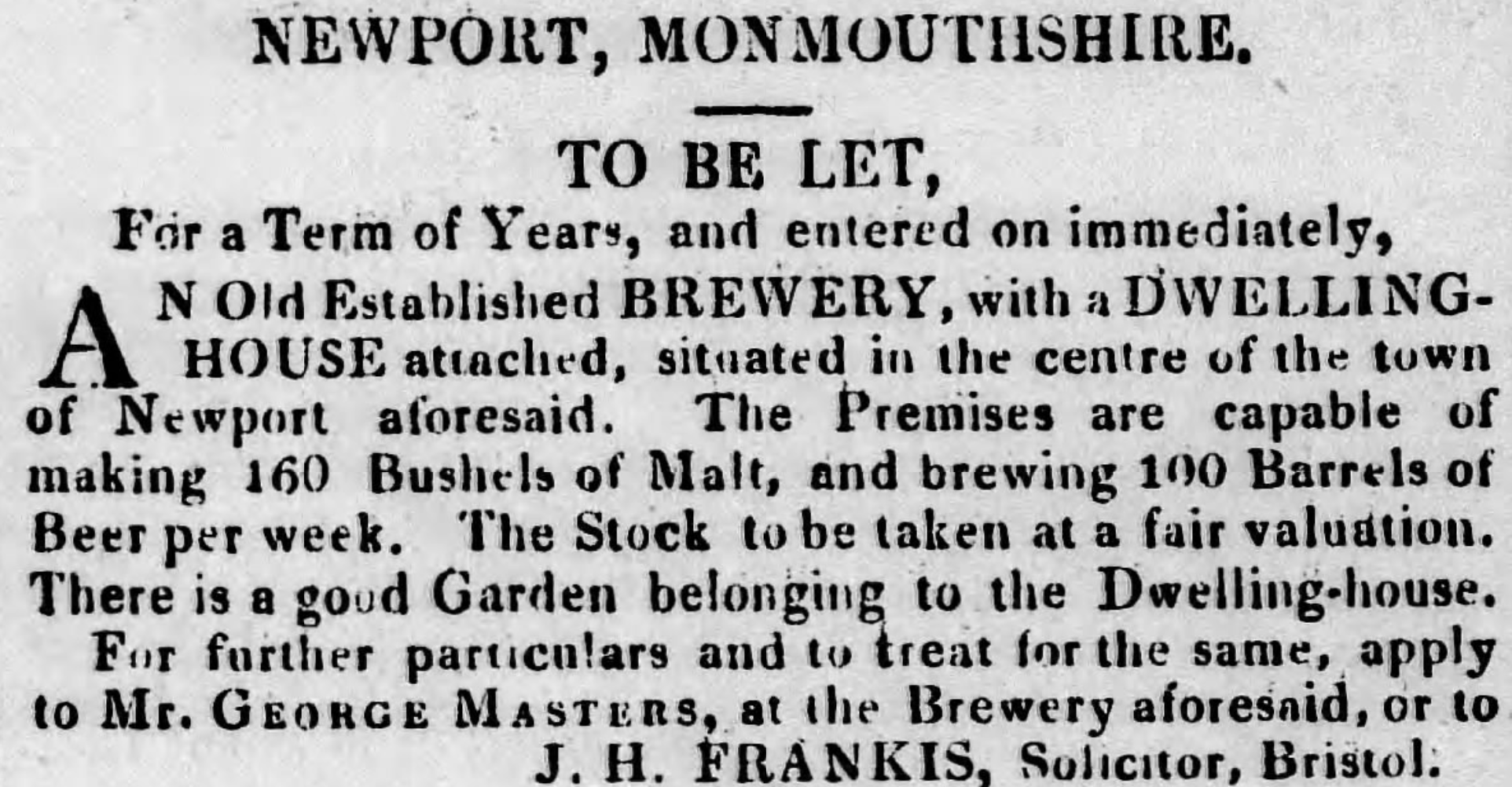
In 1816, an advertisement offered to let an "old established" brewery with an attached dwelling-house and garden in the centre of Newport, with enquiries directed to George Masters at the brewery. Capable of producing 160 bushels of malt and brewing 100 barrels (3,600 gallons) of beer per week, this was a substantial commercial "common brewery" rather than a small tavern brewhouse. At full capacity, it could turn out roughly 5,200 barrels—or around 1.5 million pints—a year, making it a major local supplier for a town whose population stood at only around 3,000 to 3,500 people at the time.
Having its own on-site malthouse producing 20 quarters of malt weekly meant the business was largely self-sufficient in its raw ingredients. George Masters later appears in Newport trade directories from at least 1835 to 1859 trading at No. 2 High Street—next to the Heathcock Inn/Bridge Hotel near the town bridge—as a wine and spirit merchant.
King's Vale Hall
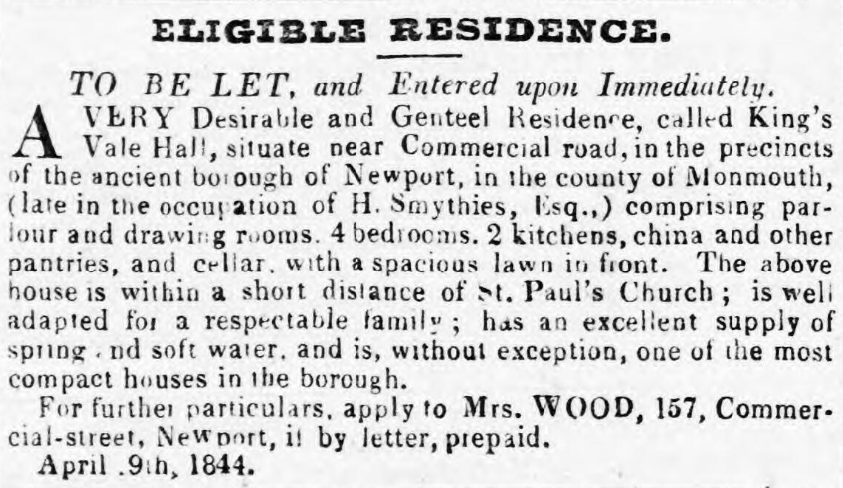
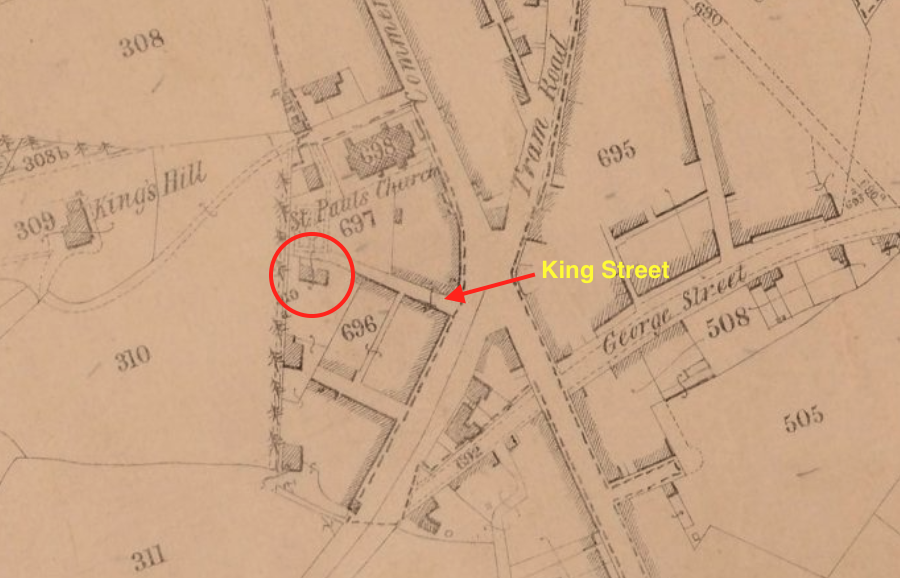
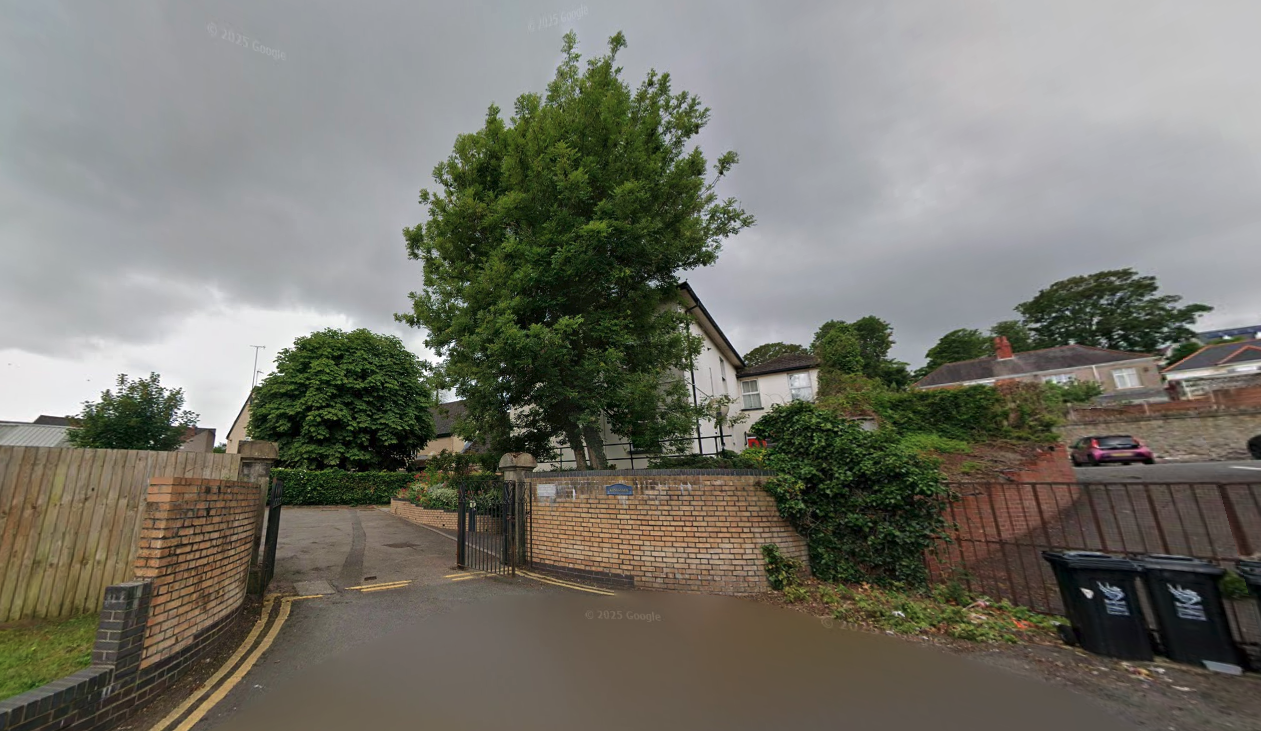
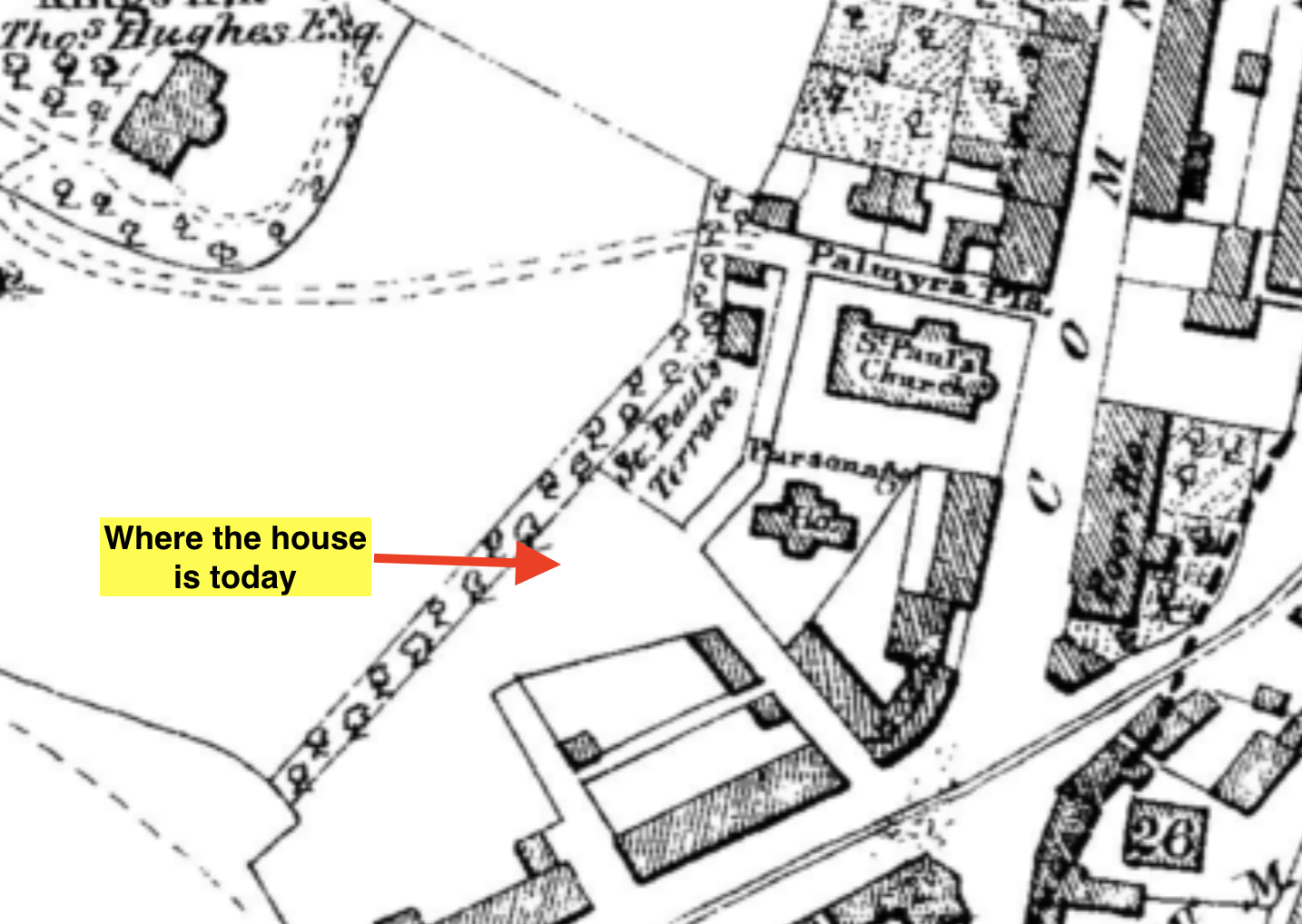
King's Vale Hall was located at the top of King Street and the building is still there today. It's been mentioned on the Newport Cornucopia previously when it was advertised for sale in 1852 but didn't have the name of King's Vale Hall.
The house dates back to at least the early 1840s as it's on the tithe map and was also listed for sale with a house adjoining it.
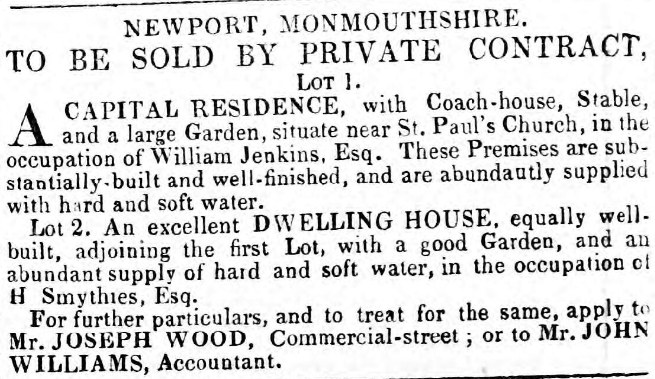
The house doesn't appear to have been there on the Wood map of 1836 so likely to have been built shortly afterwards.


Member discussion