

Welcome to another issue of The Newport Cornucopia where we dig through the newspapers archives for interesting news articles and adverts. All articles are posted verbatim and most headlines are original (headlines in quotes are my own).

'Early Closing'
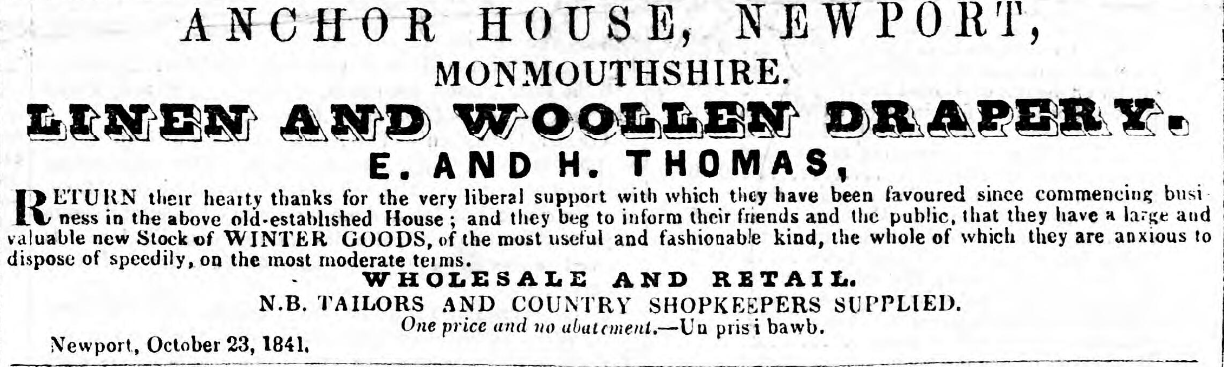
We are happy to hear that the drapers of Newport have come to an arrangement to close their shops during the winter season, at eight o'clock in the evening, beginning on Monday evening next.
We trust that this liberality on the part of the employers, will be duly appreciated by their assistants; and that the latter will devote the hours thereby afforded them, to the improvement of their minds, rather than to frivolous amusement or loose pursuits.
They would find the advantage of devoting an hour or two to study in the Mechanics' Institute.
— Monmouthshire Merlin, 30th September, 1843
The Pleasures and Perils of a Day at the Holms
Seldom as the good folk of Newport participate in ma- rine excursions, there are occasions when some few determine to enjoy a run dowh our noble river, and across to the Flat or Steep Holms, or the picturesque watering place, Weston-super-Mare.
An excursion of this kind, previously announced in the MERLIN, and by handbills, took place on Monday last, when the Fearless tug steam-boat was engaged by Mrs. Cripps, to convey a party of pleasure-seekers from Newport to the flat island keeping solitary watch off Cardiff. The morning was hazy, with scudding winds, rather portentous of a "wet sheet and a flowing sea;" but, nothing daunted, and as "fearless" as the tug, the excursionists started from the Rodney Wharf at about half-past-past nine, harp and violin-players entertaining the party with enlivening airs. At the Dock gates, a considerable accession of numbers took place, and the Fearless steamed away for her destination.
The island was reached in due time, and a landing by small boats easily effected. A variety of sports soon occupied the party. Some few sportsmen, armed with deadly weapons, started in search of rabbits—others wended their way to the inn (where capital accommodation was afforded throughout the event—others to the lighthouse; and, although many showers fell during the day, there was scarcely any cessation of dancing and other healthful pastimes. The party was increased during the afternoon, by a number of ladies and gentlemen who arrived from Newport in No. 10 pilot-boat—the yacht-like "Bloomer," belonging to Mr. Ray, jun.
Towards evening, the startling intelligence was spread that the pilot-boat and steam-tug could not be approached in the small boats, owing to the heavy sea running, and a night on the island seemed inevitable. At length, however, amidst rain and fierce winds, the party struggled down to the beach, and there witnessed quite sufficient to shake the nerves of timid ladies and delicate gentlemen—worse still, there was no prospect of the sea becoming less boisterous; so, after long and impatiently sitting about upon the crags, a boat-load of gentlemen ventured off.
Their passage to the steamer was a succession of tumbles and leaps—the boat being knocked about mercilessly by the waves. A second boat-load was about to start, when a billow dashed the frail craft broadside on the beach and threw her freight overboard—fortunately in very shallow water. After many similar adventures, however, amid the screams of the ladies, and expressions of great alarm from some of the gentlemen, the party at length boarded the tug and pilot-boat; when the home-ward trip was commenced—the Bloomer dashing ahead of the Fearless in gallant style, and keeping the lead for several miles.
Ultimately, however, tho Bloomer thankfully accepted a warp from the Fearless and thus a pleasant companionship was enjoyed to the Newport Dock, where, and at the Rodney Wharf, the excursionists—having had "enough of a water trip for some time to come,"—touched terra firma with much pleasure, and hied to their family circles, to narrate the pleasures and perils of their excursion to the Holms.
— Monmouthshire Merlin, 21st July 1855

Elizabeth Harry, an old woman dressed in the primitive style, who appeared to feel the loss of her self-respect, was charged with being drunk and incapable of taking care of herself, in a shed near the Steam Packet Inn, about a quarter past twelve on Sunday night.
The information was proved by P.C. Hayward, after which his Worship said he was afraid this was an offence of which the prisoner had often been guilty. It was a disgrace to her family and herself, and if continued, would lead to ruin. Hoping that she had been sufficiently punished to prevent a repetition of such infatuated conduct, she was discharged.
— Monmouthshire Merlin, 23rd September, 1843
'A Young Fellow of the Cyclops Genus'
Thomas Uncle, a young fellow of the Cyclops genus, having but one large peeper, and being, moreover, minus a leg, was charged with being drunk and disorderly.
P.C. Walters stated that, hearing a noise in George-street last night, he went towards the spot, where, to his astonishment, he found Uncle," who was cursing, swearing, and bellowing quite shocking. He was advised to be quiet, and as he was the more violent, he was taken into custody.
"Uncle" said he was an Irishman, and in the station-house he said he didn't care a certain malediction for the magistrates, for he knew the law "more betterer than any mother soul of 'em." It was hard that an honest boy couldn't take his divarsions widout being bate by the blue devils. (Laughter.)
The Mayor ordered him to pay the fees of the court, and he would be discharged.
"Fees of the court! Oh, by the powers, that's funny: Why, the Divil a rap have I got, yer wenchip," said Pat, upon which he was again ordered into custody, to be kept till the expenses were paid.
— Monmouthshire Merlin, 23rd September, 1843
Elderly Matrimony and Friar's Fields
A respectable-looking man, named William Kyte who resides near the Rock and Fountain Ian, on the Cheptow road, and was attended in court by several females, charged two Harpy-looking Cyprians named Peggy Palmer and Mary Jenkins, of Friars' Fields, with being accessaries to robbing him of the sum of £19.
Mr. Pyke: Mr. Kyle, how old are you?
Mr. Kyte: I am 68 years of age, sir.
Mr. Pyke: A nice young gentleman you are, surely, to go to Friars'Fields. (Roars of laughter.)
From enquiries made by Mr. Edwards of the complainant, it appeared that he was a married man—the father of several children—had been a farmer, and was now a dealer, but not in such "cattle" as were usually exhibited in the the "fields" of Newport.
The erratic old gentleman then stated that he went through Friars' Fields last Saturday night about 10 o'clock, for the purpose of going to Commercial-street from the market and that in going through the Fields one of the prisoners got him into her house, fastened the door, and then with the other, looked on and prevented his escape, while one, whom he could not discover afterwards robbed him of £19.
Mary Jenkins cross-examined complainant to show that he was the first to make advances to her, in the way of mercenary love, that he had been at a dancing party of free and easy persons, &c.
Peggy Palmer said she had never seen the prosecutor, and therefore she "hadn't a-got a question to ax the good old un."
Elizabeth Williams was then called for the defence, and with her arms stuck akimbo, confronting the old Lothario very boldly, underwent a curious face-scrutiny by the prosecutor, who, after prying, Lavater-like, into every organ perceivable, stated that he did not know the girl.
(It was suspected she was the girl who committed the robbery.)
She was then examined for the defence, and stated that she lived in the Friars' Fields with another female called Ann Richards.
Mr. Edwards: But what is her other came? You have all crack names, you know.
Witness: Why she harn't a got another name that I knows on. I pays for my lodgings 3d a night, when I gets it; and when I doesn't get it, I doesn't pay it. She then denied acquaintance with the prosecutor, and denied a knowledge of the money, also giving herself a very good character.
A long examination and cross-examination ensued between the prisoners and this witness, in the course of which there must have been the grossest lying and prevarication ever heard in a police court—proceedings which the audience, among which seemed all the denizens of Friars' Fields of both sexes, appeared to relish amazingly. The prisoners were remanded to Thursday, in order to obtain further evidence.
— Monmouthshire Merlin, 23rd September, 1843
'Gambolling Porpoise'
On Tuesday morning last, at an early hour, the inhabitants of this town were roused from then peaceful pillows by the rumour of a porpoise having been see gambolling in the river Usk, immediately above the bridge. Proceeding to the spot, we found the report correct, but the amusement which this fish generally affords, when found in our rivers, had induced but one shotsman to be on the spot.
On the first, the fish prudently took advantage of the flood tide, and bolted up the river, leaving his pursuers far behind. On the reflux of the tide, with which it was anticipated the fish would return, some dozen or more sportsmen, armed with fowling pieces of various calibre and lengths, from two to six feet, sallied forth to welcome him.
About a mile above the town he was seen making down with the tide, and after affording about an hour's amusement to a number of spectators, who lined the hanks of the river on either side, he was killed by Mr. E. Pollard, the fatal bullet entering the middle of the back, and was found lodged in the thick part of the neck. Of the numerous shots fired at him, both here and at Newport, on the previous day, two only had struck him. It was a small fish, weighing tittle more than forty pounds.
— Monmouthshire Merlin, 30th September, 1843
'Caerleon Amphitheatre'
Several workmen are now being employed by Lieutenant Colonel Sir Digby Mackworth. Bart., in digging in the Amphitheatre, called King Arthur's Round Table, at Caerleon, and the fields contiguous, for the purpose of discovering some remains of the ancient and once glorious city—Isca Silurum. Various portions of buildings have been discovered, and we trust the worthy Baronet will soon be fully compensated for his trouble by meeting with some distinct vestige of the former greatness of the place to commemorate his zeal in antiquarian researches.
— Monmouthshire Merlin, 30th September, 1843
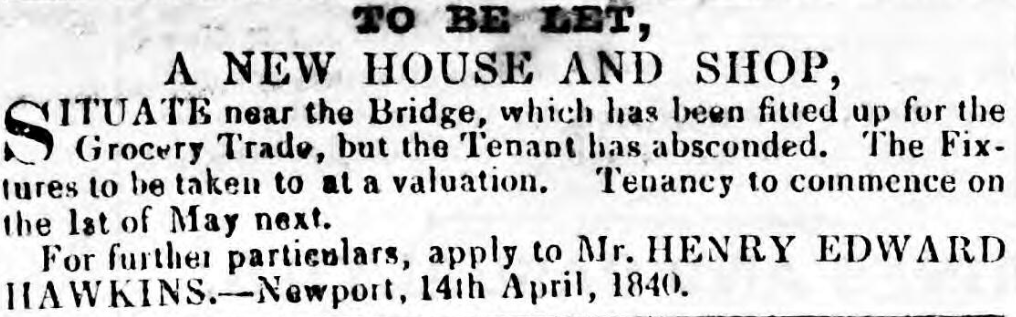
'The Saloon at the Parrot Inn'
Mr. Prothero, county magistrate, enquired of the Bench, if an advertisement, which he handed them of the Albert Saloon entertainments, held nightly at the Parrot Inn, had been noticed by them, and whether such entertainments had obtained their sanction.
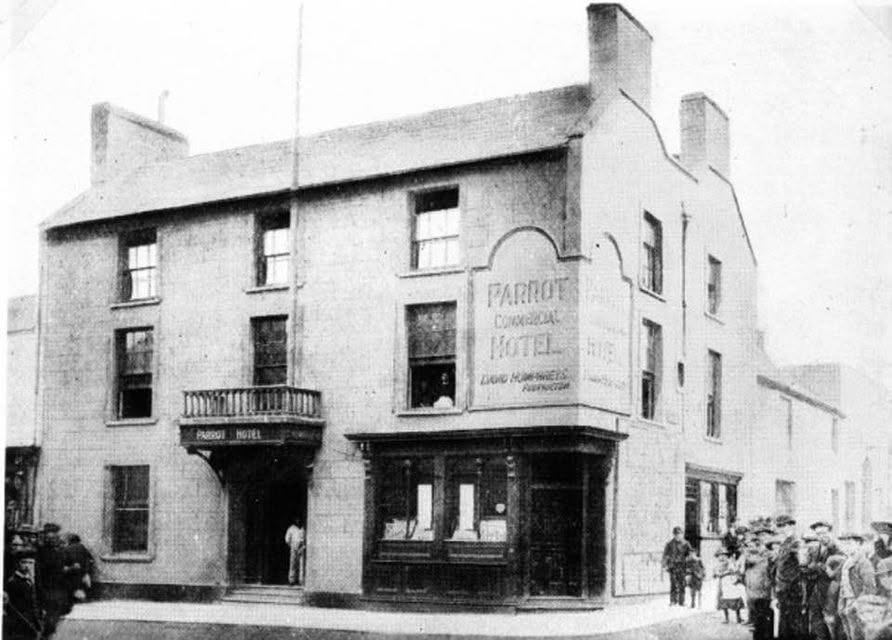
The Mayor, and the other magistrates, having read the advertisement, replied that their sanction had not been sought not given to such an entertainment, not had they, in fact, heard of the Saloon amusements before.
Mr. Prothero: Then I beg to call your attention to the matter, I think the police officers should have looked after such a nuisance. It is held at the Parrot Hotel. I deem it impossible that the magistrates could sanction such a nightly exhibition as the advertisement announces. There is no doubt but this is a means by which the landlord of the Parrot draws company, to indulge in singing, drunkenness, and profligacy. This landlord sells in two houses, but he cannot occupy the Parrot and other premises, selling liquors in both, and be supposed to o preserve proper order in each. It is well known that he permitted a notorious gambling booth on the Marshes the other day and really, it seems to me he is trying how far he can provoke your forbearance.
A conversation ensued on the bench, but no order was made in the matter.
— Monmouthshire Merlin, 30th September, 1843
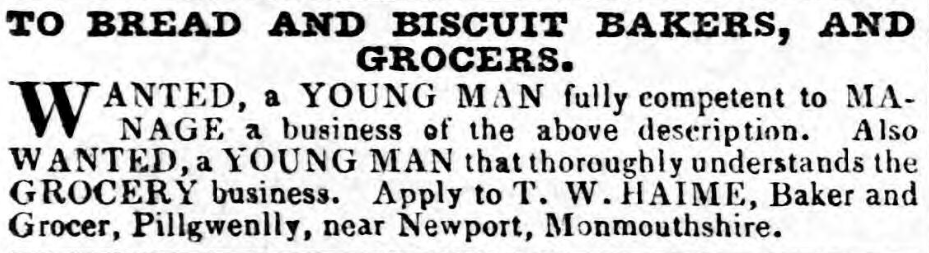
Filial Love in the Nineteenth Century
A correspondent informs us that on going towards Bassaleg from Newport, by the higher road, on Tuesday evening last, his attention was drawn towards a wretched-looking object, crouching in the ditch near some houses situated by the hand post; and on drawing near to the hedge he discovered a poor old woman, about seventy years of age, lamenting in tones of the deepest distress, the cruelty of her children, which had driven her forth from the home in which she had resided for the list twenty years, in comparative happiness, to die by the road-side.
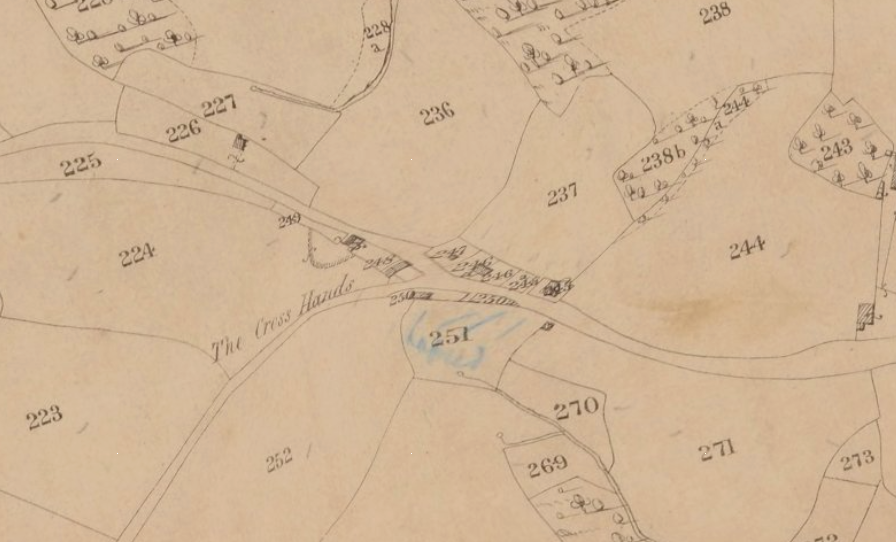
In broken English she related to our informant a long series of wretchedness and misery, which she had endured from those she long had nurtured and treated kindly, till she herself, being unable longer to support them, claimed that filial devotion and aid which natural affection would dictate. That support had been grudgingly afforded, attended by unnatural severities and unjust cruelties, until at length, unable longer to endure such treatment from those who should have sheltered her from want in her declining years, she found a road-side ditch her last place of refuge. This conduct, so disgraceful to humanity, should be examined into by the proper authorities. Her name, the stated, was Mary Waters, or Taylor, and the home from which she was so unnaturally thrust forth upon a cold world, is adjacent to the hand post.
— Monmouthshire Merlin, 10th September, 1842
Domestic Ties
The love of home is, beyond all contradiction, inherent in the pig creation, as instinctively as in the creation to which we ourselves belong. This instinct was peculiarly exemplified in the case of an old sow, in an "interesting" condition, belonging to Mr. J. Young, of this town, which had long past, even from her infantile hours, her "local habitation" upon the Little Farm, adjoining Pen Lan, in St. Woollos parish.
Desirous of affording her superior accommodations in her "family" state, Mr. Young removed the old sow to his farm in Christchurch, called Fair Oak, distant about one mile from the farm in St. Woollos, the road to which, of course, lies direct through Newport; but not locking her up, and leaving her to roam among the fresh green herbage of Christchurch, she grew dissatisfied as her hour of trial approached, and looking fondly across the town to her first home, she turned herself indignantly from her new residence, plodded her weary way through the bustling town, and, missing her path, strayed towards the new cemetery on Stow, and arrived, much exhausted, by the stable-door of Mr. Pain, on Monday evening last, where she lay down to rest.
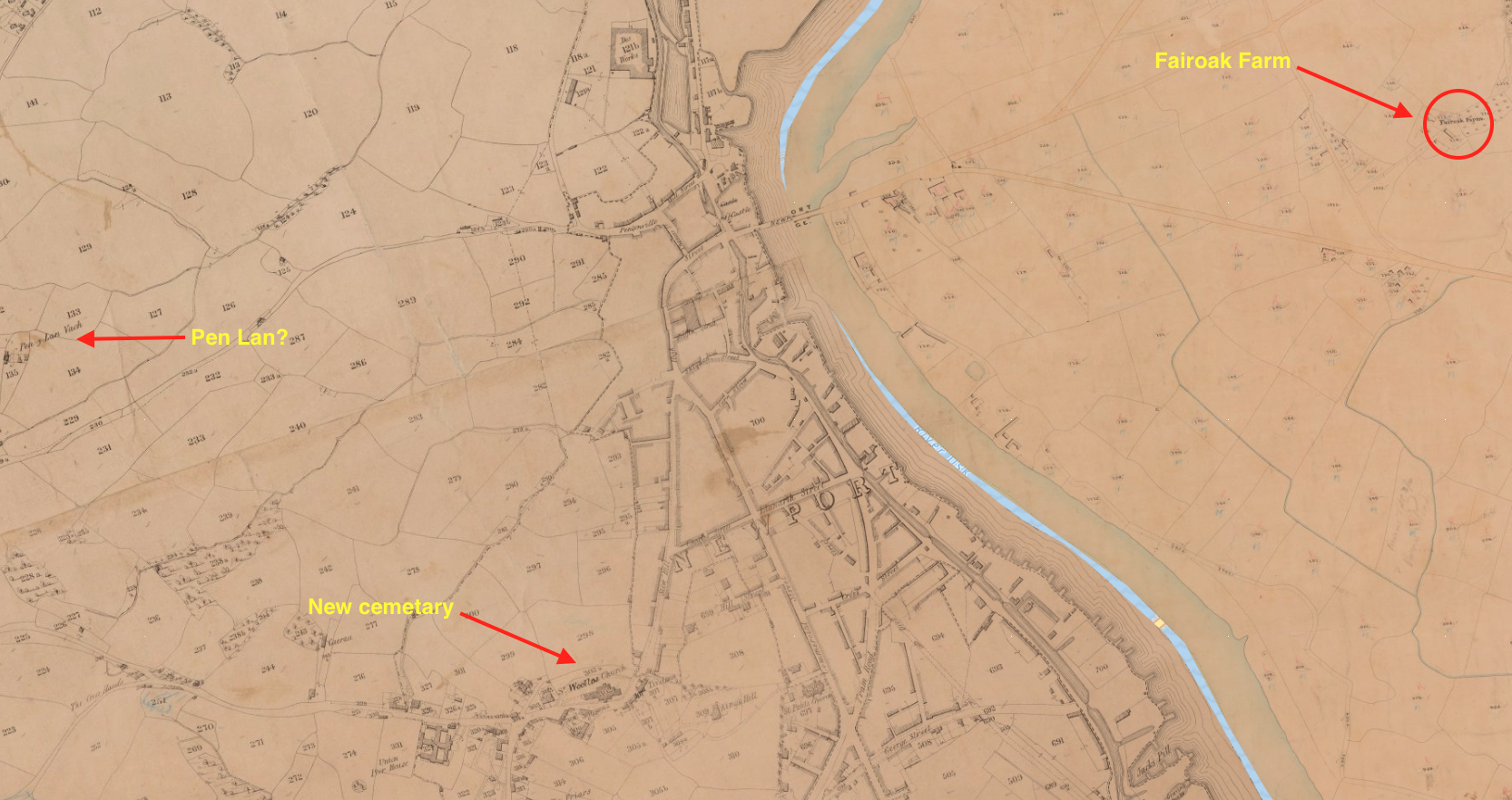
On Tuesday morning, behold a family of affectionate young grunters were surrounding the old dame, and squeaking in most noisy and discordant tones, their terror of the new world into which they were ushered. The parent pig boasted a progeny of thirteen white and finely-shaped youngsters, and testified much eager desire to retrace her steps, and lead them to the Little Farm.
The intelligence was quickly conveyed to Mr. Young, who immediately sent a proper conductor, and the grunting dame and her family were forthwith taken to her favourite hovel, where they are going on as well as can be expected.
— Monmouthshire Merlin, 10th September, 1842



Member discussion