

Welcome to another issue of The Newport Cornucopia where we dig through the newspapers archives for interesting news articles and adverts. All articles are posted verbatim and most headlines are original (headlines in quotes are my own).

'Footways and House Numbers'
SIR,—I observe by your reports that the Newport Town Council contemplate expending a large sum of the ratepayer's money, to improve the footway in High-street, and as it would appear the Corporate right extends no further than Stow-hill and High-street, I think I can point to where several improvements, sadly required for the convenience of the heavily-taxed inhabitants of the western end of the town, would be a far more judicious outlay of the money.
First. I would refer to the disgracefully-filthy and shattered pavement on the east side of Commercial-road, from Frederick-street to the bottom, which, in wet weather, contains holes and hollows of mud and slush, and at all times stumbling traps, by which people are constantly falling. To this I will add the equally or more filthy railway crossings and their grease-begrimed gate posts, with which the dresses of females may constantly come in contact.
I would further direct the Corporate attention to the sad want of street numbering, the irregularities of which I should suppose cannot be equalled by any town in the kingdom, taking Portland-street and Clarence-street as specimens.
The former would run something like this, 7, 9, 11, 21, a few doors further you come to 16, and still further on you come to 12, &c. In Clarence-street, you find No. 1 in the middle of the street, with 46 or 56 next door, and so on higgledy-piggledy throughout, but the majority of houses have no numbers.
Now, I think these matters require attention far more than High-street, with all due deference to a few gentlemen who so strongly advocate that improvement, but who cannot, in common honesty, take the money from the pockets of the Pillgwenlly people to expend upon the east end of the town, whilst the west is in the disreputable condition I have pointed out.
Another matter I would advert to is, that whilst houses are undergoing alterations or repairs, foot passengers should be protected from danger, both the person and dress. A short time ago, I met a poor little girl, with blood streaming from head to foot, and upon inquiries found that a mason's boy, hurling bricks and rubbish across the pavement, from a house undergoing repairs, had struck the child, cutting its head severely. The parents were poor, and of course had no remedy, and the authorities heard nothing of it.
We see now and then houses stripped of their old plaster and restuccoed, whilst persons are passing to and fro underneath-even babies in perambulators, one of which might be killed by a small lump of mortar or chip, such as are constantly falling around them.
I trust these few remarks may have the desired effect,
And am, Sir, your obedient servant,
Newport, 10th Dec., 1867.
A WEST-ENDER.
— Monmouthshire Merlin, 14th December, 1867
Alleged Jewel Robbery
On Wednesday evening, a woman styling herself "Lady Russell," went to the police-office, at the Town-hall, Newport, and stated that she had been robbed of a large amount of jewellery, at a house on the Caerleon-road, where she had been staying for a week or two. The police took the matter in hand, and on Thursday they apprehended a man named Summerhayes, on suspicion.
At the Borough police-court to-day (Friday) this man, Edward Summerhayes, was brought up charged, on suspicion, with stealing a pair of gold earrings, a diamond stud, a gold watch, a gold ring, and other jewellery the property of (as the charge sheet described it) "Kate Russell." On the application at Chief Superintendent Sinclair, the case was adjourned until Monday.
— Monmouthshire Merlin, 18th October, 1878
Market Accommodation for Newport
SIR,—Extravagant outlay in the erection of public buildings appears to be all the rage in the present day, and some of the members of our Town Council, desirous, I suppose, of following the prevailing fashion, but utterly regardless of the real interests of the town, advocate the expenditure of at least £15,000 for the building of a market for Newport.
I am really astonished that any man professing to be possessed of common sense could foster such an Utopian scheme, which, if carried out, would certainly entail upon the already over-burdened ratepayers an annual loss of £300 or £400.
Fortunately for us, we have such representatives as Mr. H. J. Davis, Mr. Homfray, and a few others, in the Council, who check such wild extravagance.
The object I have in writing this letter is, respectfully to lay before the public my views upon the subject, that more practical men may judge of their feasibility. My proposal, if adopted, at all events will have the merit of saving the ratepayers from any outlay whatever.
I believe the present market might be altered to meet the requirements of the town for many years to comp, by raising it another storey, to be covered with a roof of iron and glass, the ground floor to be used as a vegetable market, the upper storey for meat, poultry, and butter, the latter to be approached from Upper Market-street by one or two easy flights of steps: the ground floor could of course be entirely remodelled, and thus would afford much more space than at present.
The Duke of Beaufort has long ago decided to have taken down, the two old houses in High-street, occupied by Mr. Bryant and Mr. Ewins, and to erect on the site an arcade, which would form an agreeable approach to the market from High-street.
I venture to say that if the matter was properly laid before the Duke he would have the market altered in some such way as suggested, and other improvements effected at his own cost; and if at any future time the financial affairs of the town should be in a more flourishing condition, and it should be deemed advisable that the market should become the property of the ratepayers, I have no doubt but it might then be purchased at a fair price, according to the amount of income derived from it.
I am, Sir, yours obediently,
A RATEPAYER.
Jany. 1st, 1862.
— Monmouthshire Merlin, 4th January 1862

A Careless Gipsy
William Dixon, a gipsy hawker, was summoned for allowing his horse to stray. On Tuesday evening P,C. Furkeswell saw a horse wandering about Caerleon village, and he impounded the animal. Next morning the horse was claimed by defendant. It was stated by defendant that the horse got out of the field where it was grazing owing to a defect in the gate. The Bench fined defendant half- a-crown.
— Monmouthshire Merlin, 28th November, 1884
Stealing and Embezzlement
Edward Bush, sweep, was charged with stealing a pair of shoes from the house of John Jones, who lives in Lewis-street. The prisoner was apprehended wearing the shoes, and Mary Ann Simpson, the prosecutor's servant, stated that they were missed after prisoner had been to the house to sweep a chimney. The prisoner was further charged with embezzling 16s., the property of Thomas Williams, his late employer. He pleaded guilty to stealing the shoes and to embezzling 6s.—Sentenced to six weeks' hard labour on each charge.
— Monmouthshire Merlin, 28th November, 1884
Stealing and Receiving
Emily Griffiths and Annie Ellen Gould, domestic servants, were charged, the former with stealing £5, the money of John Davies, butcher, Commercial-road, and the latter with receiving it, well knowing it to have been stolen.
P.C. Dukelow proved apprehending prisoners, who handed him several articles which had been bought with the money. Prisoners pleaded guilty.
Prosecutor said he did not wish to press the charge, and only wanted the girls cautioned. Prisoners were ordered to be detained at the police-station for two days, the Bench hoping this would prove a warning to them.
— Monmouthshire Merlin, 28th November, 1884
'Stealing Glasses from the Windsor Castle'
Alice Wynne was charged with stealing three glasses from the bar of the Windsor Castle public-house. P.C. Nursey deposed to apprehending the prisoner on suspicion of stealing the glasses. She was then very drunk.
The landlady of the Eastern Valley public-house, stated that on Monday evening prisoner came into her bar and offered the glasses for sale. She refused to buy them. Prosecutrix stated that on Monday the prisoner came into her house, but she did not see ber take anything. On the following morning she missed the four glasses produced, which she now identified as her property. Prisoner, who said she had bought the glasses, was sentenced to 14 days.
— Monmouthshire Merlin, 28th November, 1884
'Summer Fashions at the Great Shoe Manufactory (c. 1860)'
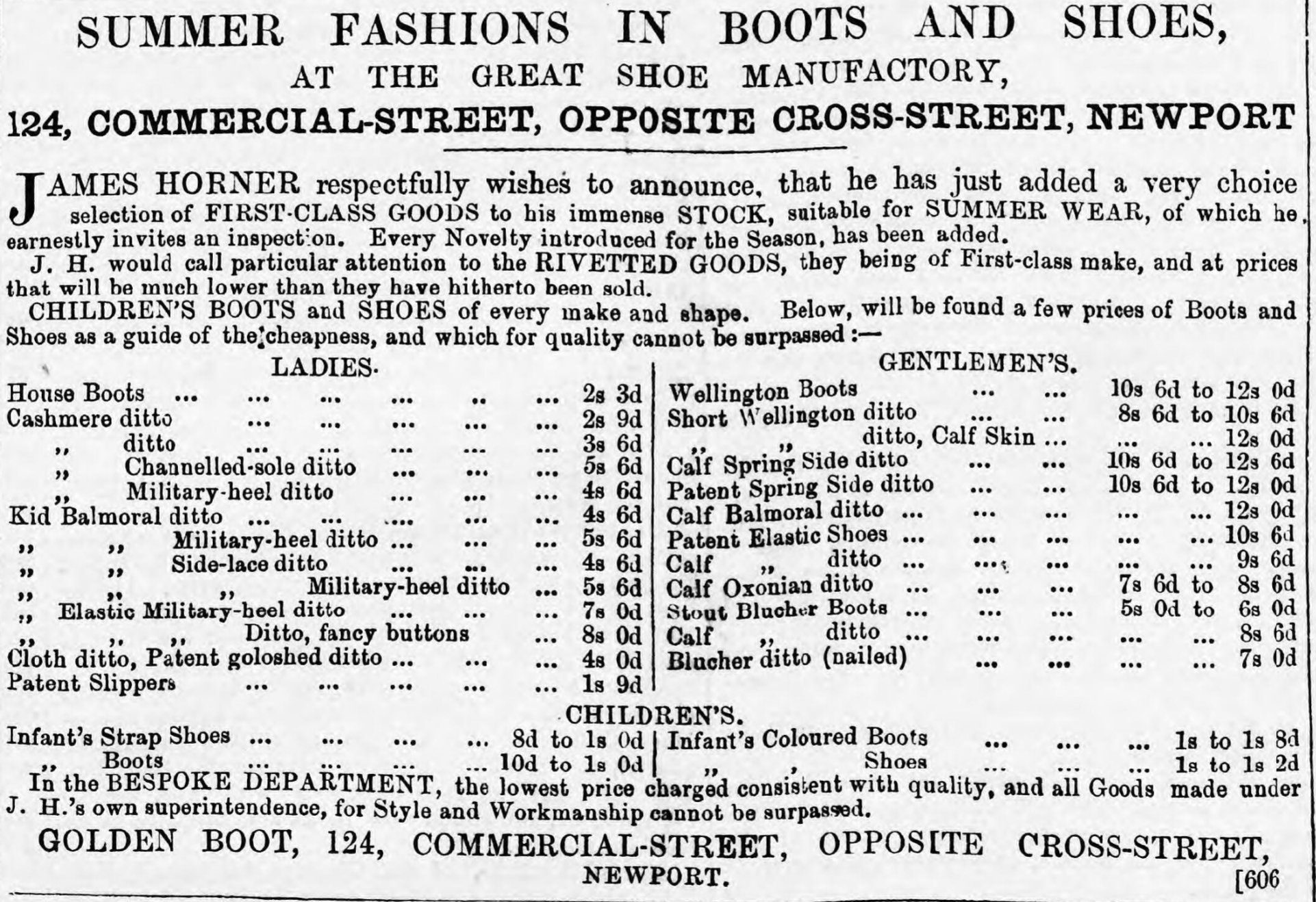
An advertisement for The Great Shoe Manufactory—also trading as the Golden Boot—provides a window into mid-Victorian retail and footwear trends in Newport. Located at 124 Commercial Street, opposite Cross Street, the business was run by James Horner, who announced a new selection of "first-class goods" added to his stock specifically for summer wear.
Horner gave particular prominence to his stock of "rivetted goods," noting they were offered at lower prices than previously available. The advertisement covers footwear options suited to every member of the household, alongside a dedicated Bespoke Department for custom-made orders produced under Horner's direct supervision.
The Inventory
Ladies' Footwear
For women, the shop stocked a mix of indoor, formal, and lightweight outdoor footwear:
- House Boots and soft Cashmere Boots (available with channelled soles or military heels).
- Kid Balmoral Boots, featuring either military heels or side-lacing.
- Elastic Military-Heel Boots, including versions styled with fancy buttons.
- Cloth Boots with patent goloshed finishes.
- Lightweight Patent Slippers.
Gentlemen's Footwear
The men's department covered formal dress, casual wear, and heavy-duty workwear:
- Wellington Boots (in standard lengths, short cuts, and calfskin).
- Spring-Side Boots (available in calfskin or patent finishes).
- Calf Balmorals, Patent Elastic Shoes, and Calf Oxonians for lighter town wear.
- Stout Blucher Boots, including heavy-duty nailed versions for working conditions.
Children's Footwear
For younger family members, the shop stocked Infant Strap Shoes and Boots, as well as Infant Coloured Boots and Shoes in simpler cuts.
Understanding Mid-Victorian Footwear Styles
To put James Horner’s stock list into historical context, many of these shoe names refer to distinct 19th-century designs and construction methods:
- Balmoral Boots: Popularised by Prince Albert following his visits to the Balmoral estate in Scotland. They featured a closed-lacing system (similar to a modern Oxford shoe) with a horizontal seam running parallel to the sole, separating the upper and lower sections.
- Blucher Boots: Named after the Prussian Field Marshal Gebhard Leberecht von Blücher, who commissioned them for his army during the Napoleonic Wars. Featuring an open-lacing system formed by two leather side flaps, the "stout" and "nailed" Bluchers in Horner's advert represented durable workwear built for rough ground.
- Spring-Side Boots: An early version of the modern Chelsea boot. Patented in the mid-19th century, they incorporated vulcanised elastic rubber side gussets, allowing the wearer to slip them on and off without lacing or buttoning.
- Oxonian Shoes: Originating as a popular low-cut half-boot among Oxford University students in the 1820s, the Oxonian was a direct predecessor to the modern lace-up shoe.
- Wellington Boots: Mid-Victorian Wellingtons were leather dress boots fitted close to the leg and worn under trousers, derived from the style made famous by the 1st Duke of Wellington. They predate the modern rubber rain boots that later inherited the name.
Key Materials & Construction Terms
- Kid: Soft leather made from young goat skin, used for finer dress footwear.
- Golosh (Galosh): A protective strip of heavy or patent leather stitched around the lower perimeter of a fabric boot to resist mud and water.
- Nailed Soles: Soles fitted with hobnails or iron studs to reduce wear and improve traction on unpaved streets.
SIR — Although not now a resident of Newport allow me through the medium of your paper to call the attention of the public to a nuisance at present existing in the town. The nuisance I complain of is this—In High street passers by, particularly ladies, are liable to insult, and to be "...logged" [flogged?] as they walk through the street.
Were such occurrence to take place in the metropolis the offenders would soon be brought to their senses by "the force." but they manage these things worse in Newport. It is not every lady who would like to enter a police court as complainant; or these fellows would soon get their deserts (sic).
I would advise every gentleman of the town to carry a whip or stick, and on seeing a lady (under his protection or not) annoyed to use it with effect. I think the magistrates would deal very leniently with any charge of assault preferred by the thrashed, and the thrasher would certainly gain the thanks (no slight reward) of the ladies generally.
Hoping this may lead to an abatement of the nuisance,
I am, yours, &c.,
E.S.
— Monmouthshire Merlin, 10th June, 1865
'Fire on Skinner Street'
About seven o'clock on Tuesday evening, one of the hauliers in the employ of Messrs. J. J. Nicholas and Co., on entering his employers' stables found the building filled with smoke. On examination he discovered a quantity of straw smouldering, and an alarm being raised, the active Chief Superintendent of Police, with several of the force, having got out the reel, proceeded to the spot, and having obtained a plentiful supply of water speedily quenched the fire.
The stables are beneath a long room belonging to the Royal Oak beer-house, Skinner-street, kept by Mrs. Morgan, and the flooring being very old, it is supposed a quantity of hot ashes escaped between the boards, and fell upon the straw, of which about two tons were in the stable.
Had the fire been unobserved a few minutes longer, probably the results would have been disastrous. We understand Mrs. Morgan has been previously cautioned against keeping a fire in her room.
— Monmouthshire Merlin, 21st December, 1861



Member discussion