

Welcome to another issue of The Newport Cornucopia where we dig through the newspapers archives for interesting news articles and adverts. All articles are posted verbatim and most headlines are original (headlines in quotes are my own).

An Exhibition
SIR, Any one passing along Commercial-street this morning, between eight and nine o'clock, might have witnessed an exhibition which certainly did rank as an amusement in a past age, but which, it might have been hoped, had, in these days of vaunted progress and enlightenment, become, as nn amusement, "a thing not so much as known amongst us."
A crowd of some fifty or sixty persons were formed into a circle in the midst of which were a couple of brutes worrying each other with brutal ferocity—to the delectation, as it seemed, of some of the bystanders. But, if "dogs" may "delight to bark and bite," it does not follow that men should gaze at and encourage them in their cruel sport.
This is not the first time, by many, I have witnessed a spectacle of the kind in the public thoroughfares. Does not the assembly of such a crowd come fairly within the meaning of the local by-law as to "obstructions;" and would it not be within the province of the "custodians of the peace" to put a stop to so disgraceful a scene, and bid the onlookers to "move off."
It appears to me that greater obstruction is caused on these occasions than by a poor person seeking to eke out a subsistence by hawking vegetables in the street, or by a tradesman leaving a bale of goods on the pavement for an hour and yet the instances have been not unfrequent in which for these infringements of local regulations, the strong arm of the law has been brought into operation. But on the score of humanity to the brute creation, such scenes as I have named should, by all possible means, be checked and discouraged, rather than aided and abetted.
Yours, &c.,
Z. Newport, September 18th, 1863.
— Monmouthshire Merlin, 19th September, 1863
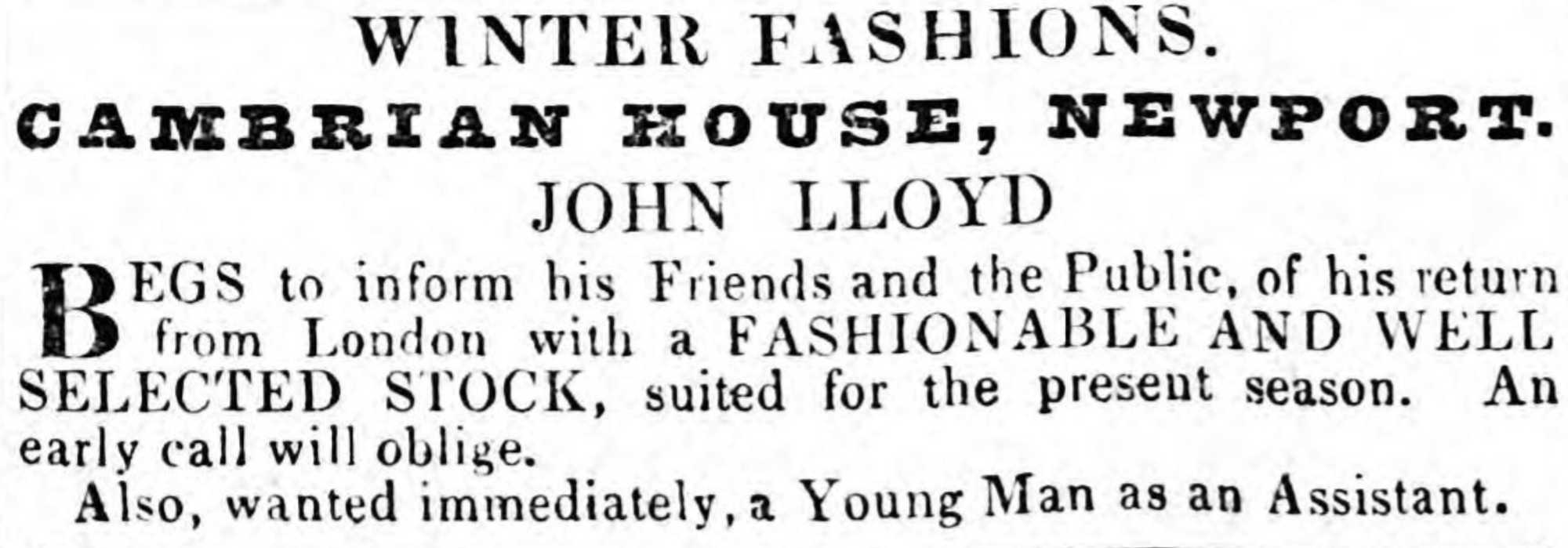
'House for Sale on Stow Hill, 1793'
An early advert for the Friars house above the Royal Gwent Hospital. Interesting that it calls St Woolos, Newport church. As the advert was published by The Gloucester Journal perhaps it didn't need to be accurate.
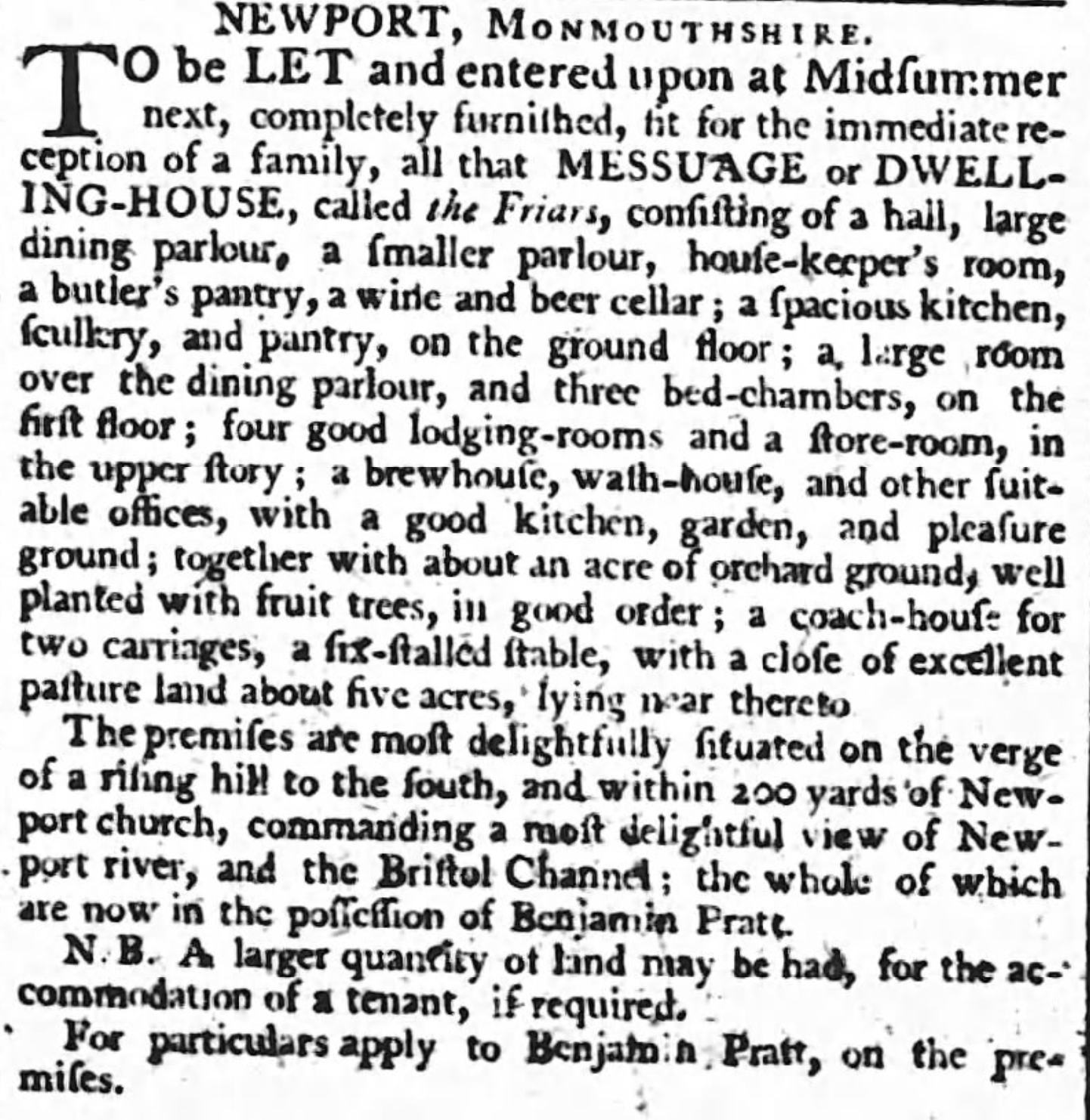
Dangerous
To the Editor of the Monmouthshire Merlin.
SIR,—Allow me to call the attention of the Surveyor under the Newport "Improvement" (!) Act, to a matter which is of too frequent occurrence in our streets, although provided against by the act.
The alteration and re-modelling of premises in the principal street [Commercial Street] have been carried on extensively of late; and in a few instances, with a flagrant disregard to the safety of the street-passengers. I am desirous of exhibiting a case in point.
A respectable householder, who is also an active commissioner under the aforesaid Improvement Act, began on Monday afternoon last the dangerous work of unroofing his house and while passing by in the evening, I observed that there were no fences at the ends of the house across the pavement, t0 warn and prevent persons from passing under the dangerous work progressing above.
At the time I was passing, a female with a child in her arms was also going by, and while upon the unfenced pavement, a stone fell from the roof, and cut the poor child's head. I am sorry to add, that...
the gentleman to whom the house belonged, came out, and instead of commiserating with the poor woman, harshly told her neither she nor any body else had any right to walk over that pavement, for it was his own.
Believing the absence of fences to have been the cause of the injury I have mentioned, and understanding that there is one clause in the act under which the gentleman has become nominally a town guardian, which expressly forbids such omissions, I have publicly addressed you, in the hope that occurrences of this nature—so dangerous to the public—will be more "few and far between."
I am, sir, yours, &c.,
A RATEPAYER.
Hill-street, June 20th, 1843
— Monmouthshire Merlin, 24th June, 1843
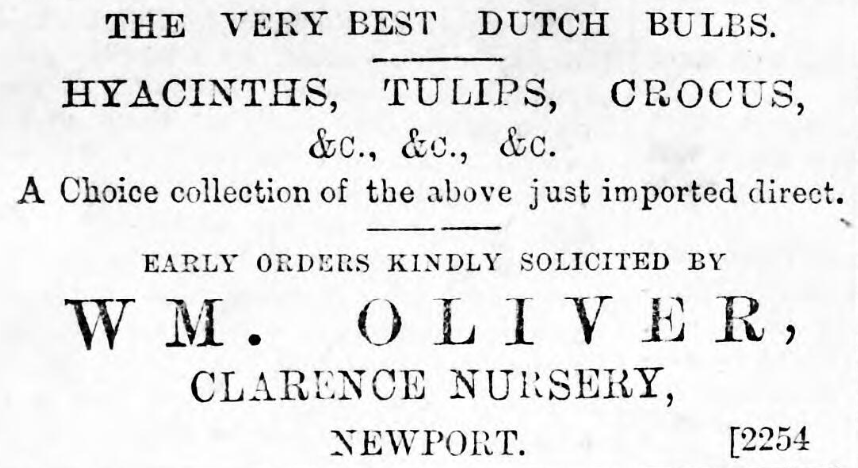
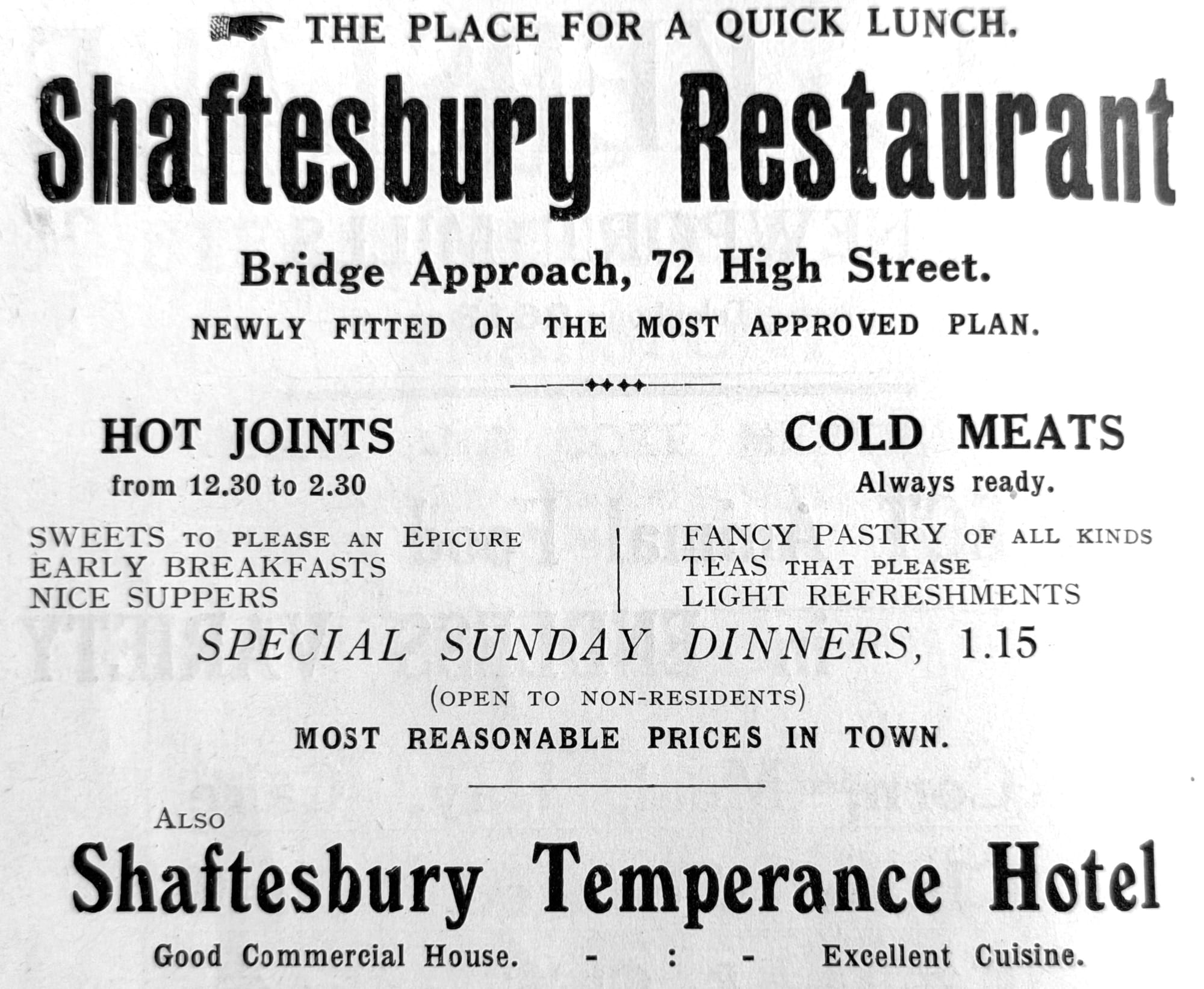

'Stealing a Pig's Cheek'
Margaret Grace was charged with stealing a pig's cheek, the property of Lydia Flook. P.S. Brooks said that on Sunday morning, at seven o'clock, he apprehended the prisoner at 6, Granville-street, and charged her with stealing a pig's cheek from the shop of Lydia Hook, Commercial-road, on Saturdav night.
She said, "Yes, I took it there it is (pointing to the table). I wanted something for my money." She said she had paid Mrs. Flook for a cheek, but she turned her out of the house. John Simmonds said he was in Flook's shop at about 8.10 on Saturday night; he saw Mrs. Grace come in, with her dress over her head she went right to the counter, took up a pig's cheek, and ran away with it, and said " There you b—— I know'd I'd have it."
Lydia Flook, a widow, keeping a shop at No. 4, Commercial-road, said that somewhere about eight o'clock on Saturday night prisoner came to her shop, but as she made some bother about the weight of a pig's cheek witness asked her to go out; prisoner's husband came and took hold of witness's daughter by the hair of the head, and abused both witness and her. They were got away, but they came back, and while the prisoner was in the shop her husband was over by the Salutation.
Prisoner said when she got in the second time and took the pig's cheek, "Now I'll get something for my money." She had not paid any money.
Prisoner: Don't you tell stories I paid you. If I wanted to steal I would have tried to do so without being seen.
Eliza Flook corroborated the evidence of the last witness.
Prisoner elected to be tried by the magistrates rather than by a jury at the Sessions, but she pleaded not guilty.
The Bench: We consider that you did not feloniously steal the pig's cheek, but that you acted under a false impression; you thought you had paid the money, and being in a drunken state no doubt you made a mistake. We will acquit you.
— Monmouthshire Merlin, 11th October, 1878
'Knowingly Suffering Persons of Notoriously Bad Character'
James Keneer Waters. a licensed victualler on the Canal side, was fined 10s. and costs, for allowing and knowingly suffering persons of notoriously bad character to assemble and meet in his house, (to wit), common prostitutes. Hopkins, the wit- ness, stated, that he. & P.C. Hayward, found a number of men, and from ten to fifteen prostitutes in the house, on the evening of the 29th September last and a harp playing for their amusement. Sergeant Huxtable said he had cleared the house in the night-time fifty times over of common girls.
...
John Elliott, of the Britannia beerhouse, for a like offence, was fined 10s. and costs. Here was music, and one Hannah Plaster, a notorious character of a certain sort, dancing with a sailor and other prostitutes. Sergeant Huxtable had visited the house frequently, and knew well that common girls were living in the house for hire also certain characters known by the cognomens of "Great Western, "Brown Bess," &c.
— Monmouthshire Merlin, 4th October, 1845
'Assault at a Female Club Dinner'
Ann Roberts was charged with assaulting Mary Davies, on Wednesday last. The case appeared to arise out of a circumstance related by one of the cloud of witnesses to a Lady, at the Female Club Dinner, last week, respecting the complainant and the defendant and as gossip frequently produces evil results at some periods, and in certain quarters, so a quarrel arose out of this.
Of the parties it might be said that "both were right, and both were wrong," but Mary Davies having first obtained a summons, stood in the place of complainant this morning, and attempted to show a case. She failed, and her own witnesses proving her to have been the first and principal aggressor, the Mayor ordered the case to be dismissed, and the complainant to pay costs.
— Monmouthshire Merlin, 24th June, 1843
'The Market Gate'
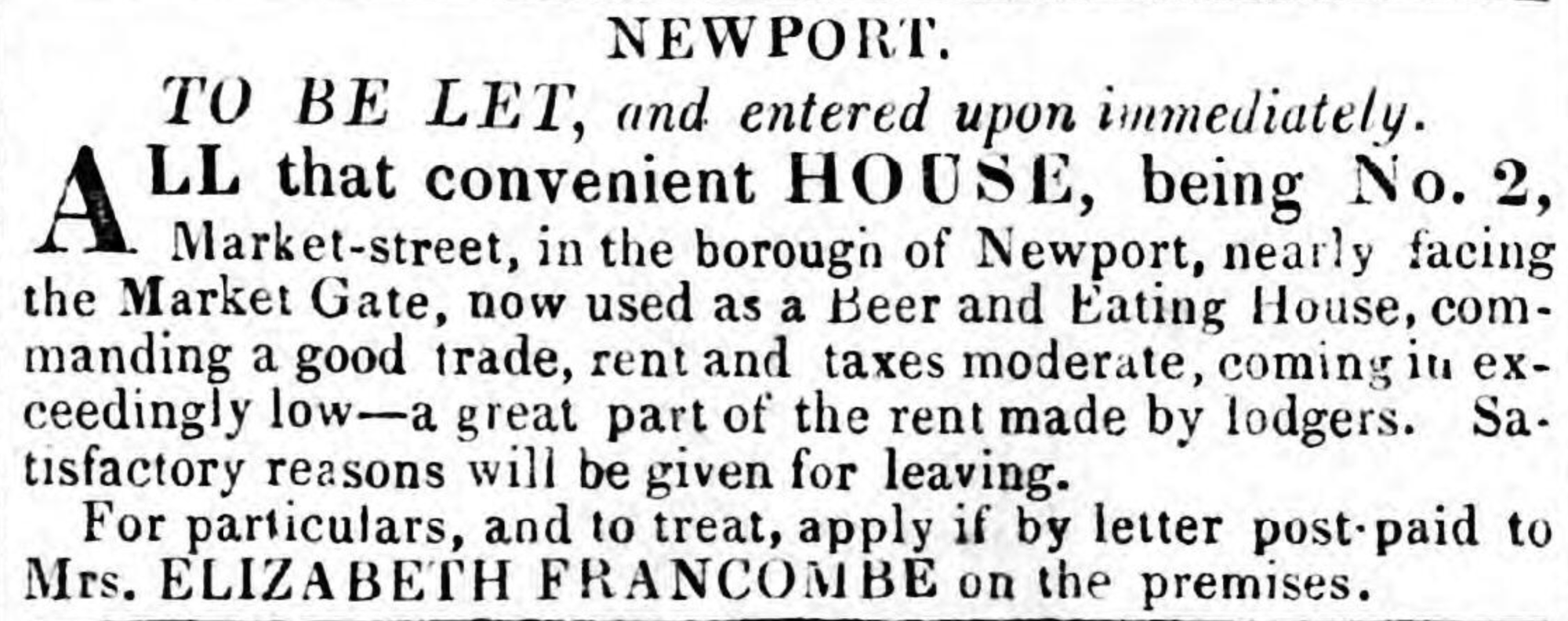
This advert from 1842 mentions number 2 Market Street (which was on the left side near High Street) and states it is opposite the Market Gate. Wonder if the gate is where the Tickled Trout pub is today?
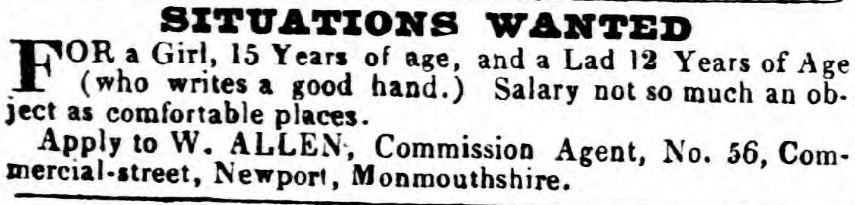
Disgraceful State of the Streets
To the Editor of the Monmouthshire Merlin.
SIR, — I beg, through the channel of your public-spirited and valuable paper, to call the attention of the proper authorities"—who they are I know not, or would not trouble you—to the disgraceful state of the footpaths (pavements they cannot be called) in, and leading to and from, George-street and the town.
The approach from the William the Fourth through Commercial street is a continuation of pools of water and of broken stones, alias pavements which in wet weather is scarcely passable, particularly for children and females, except at the risk of wet feet and spoiled dresses.
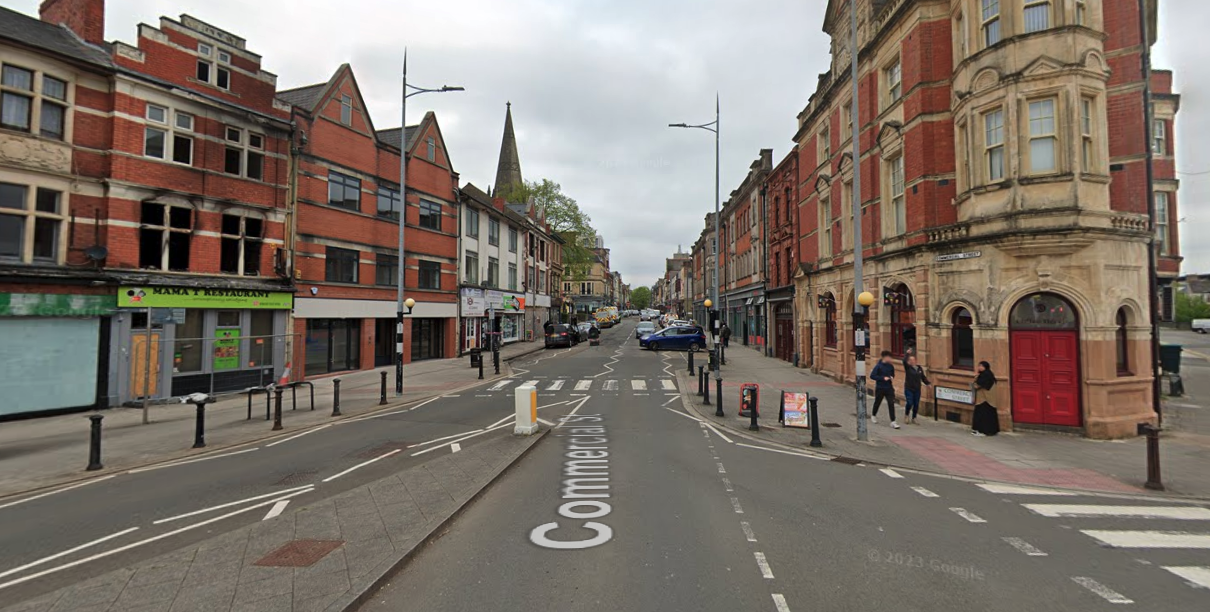
Several of both have lately occurred. Through George-street to Mellon-street and the Dock road in similar weather, it has more resemblance to a "quagmire," than a road passing through a respectable street—for to walk through it is impossible, without being "over shoes" in mud. Surely, such a dirty state of things ought not to be continued in this "improving town."
Trusting this hint may meet the eyes of those who have the care of this neighbourhood, and that they may feel a sense of the duty which they owe to those residing therein, and apologising for thus trespassing on your columns,
I remain, sir, your obedient servant,
AN INHABITANT OF GEORGE-STREET.
20th June. 1843.
— Monmouthshire Merlin, 24th June, 1843
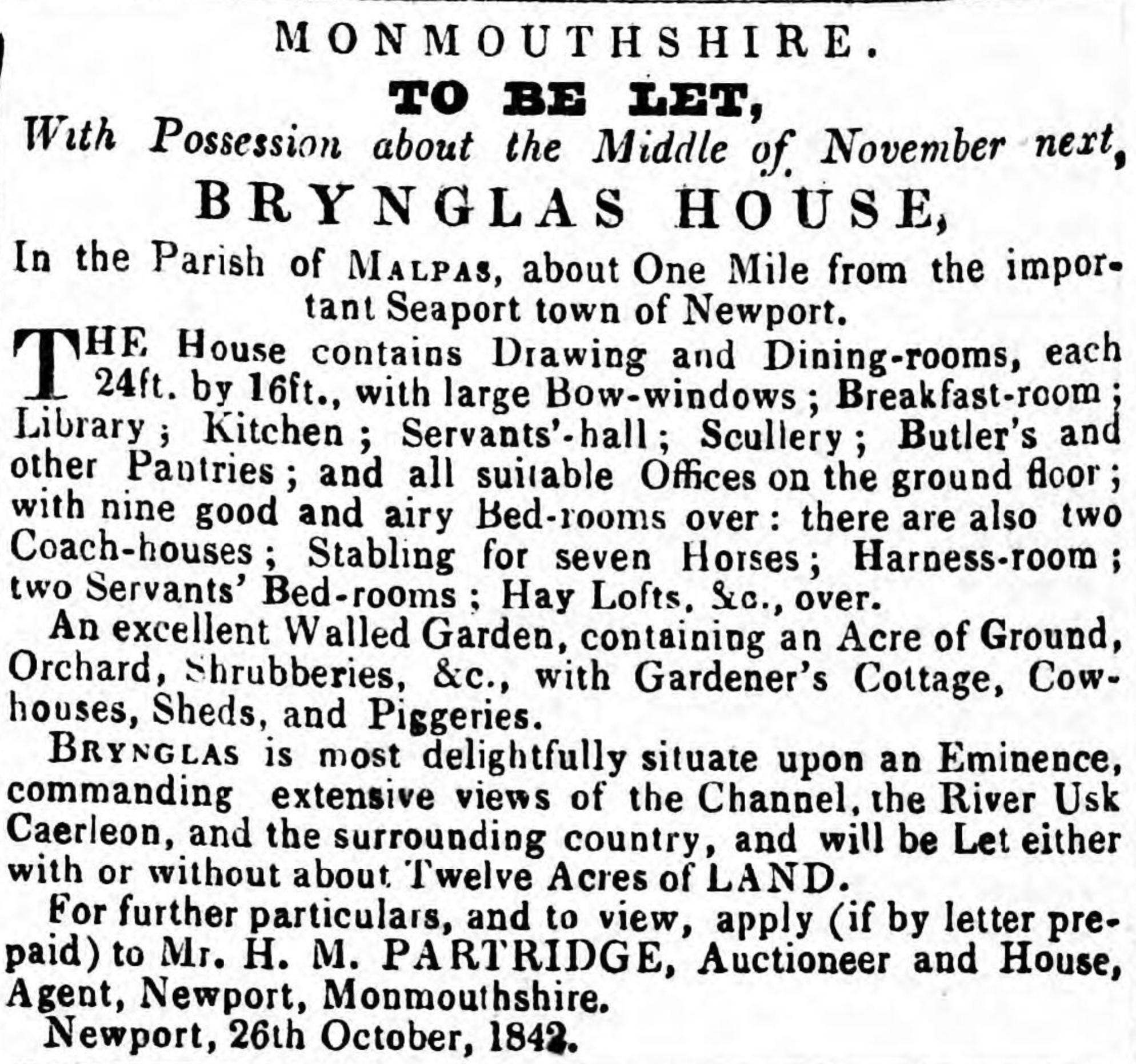
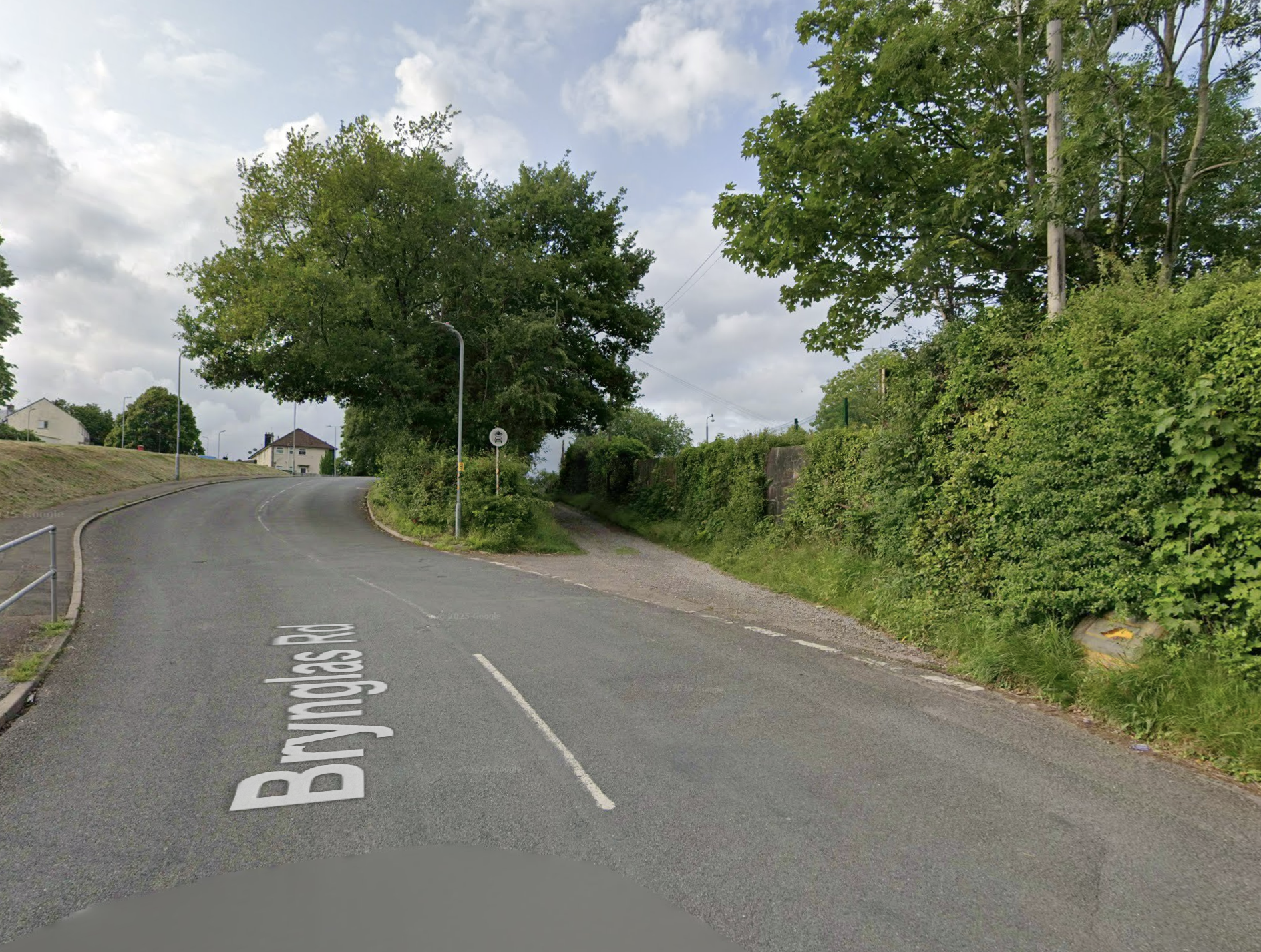
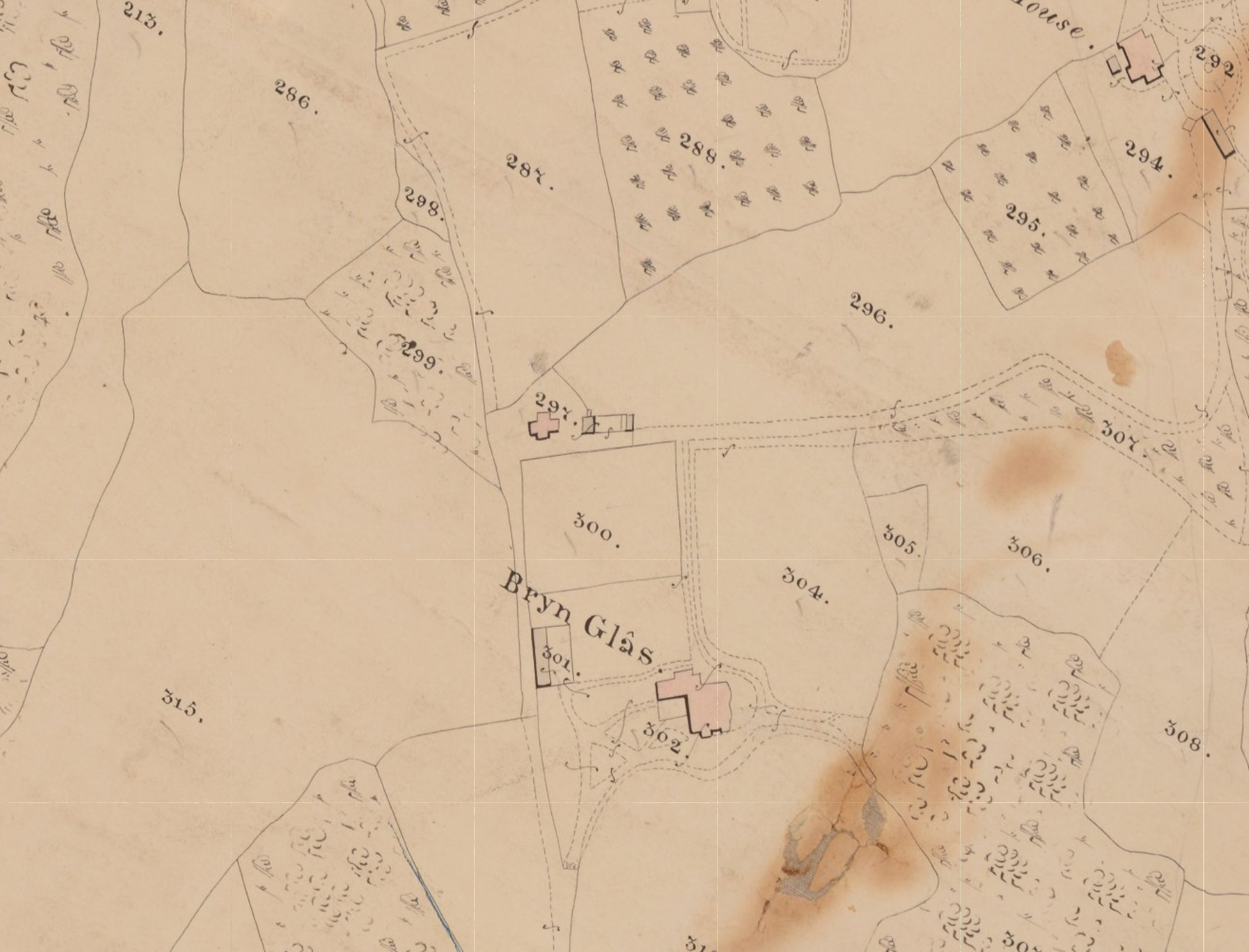
At the time of the advert there would have been very little around there apart from Pill House which is where Grove Park is and another house in Malpas. The lane that's there today was the original track that ran alongside the house.
The road would have been an 'occupation road' which provided private access to the property and would have ran from the present-day junction of Brynglas Road and Aston Crescent where the entrance to Crindau House was located.
'The Dangerous Docks'
To the Editor of the Monmouthshire Merlin
SIR,—Allow me, through the medium of your paper to call the attention of the Dock directors to the necessity of immediately adopting some means to prevent, as much as possible, any accident from occurring at the dock after night-fall I think, after having so successfully, and with so little accident, carried out their views in the erection of the splendid dock, and from the great encouragement likely to be given to the undertaking, it only requires the suggestion to cause the adoption of all necessary means to prevent the chance of loss of life.
For this purpose, I would propose that immediately before night closes in, oil lamps be lighted (until gas can be got), and chains run round the dock. At present the place is so very dangerous from want of light, especially at the entrance to the bridges, where the iron so much resembles the colour of the water in the lock, that a man, familiar with the locality and in his sober senses, is very likely to be deceived and walk over. How much more likely, then, are sailors and other strangers to lose their lives under similar circumstances?
At London and Liverpool chains and other securities are run around the docks to prevent accident. These precautions at Liverpool, I have been told, were only adopted after a number of lives were sacrificed, and I hope the directors of the Newport dock will not wait for the same melancholy proofs to shew them the necessity of something being done.
Already one life has been lost here, and I should hope now no delay will take place in doing something to prevent such another occurrence.
Asking your excuse f0r thus trespassing on your useful columns,
I remain, sir, yours, &c.,
A TRADER.
— Monmouthshire Merlin, 29th October, 1842
'Association for the Prevention of Robberies, Thefts, &c.'
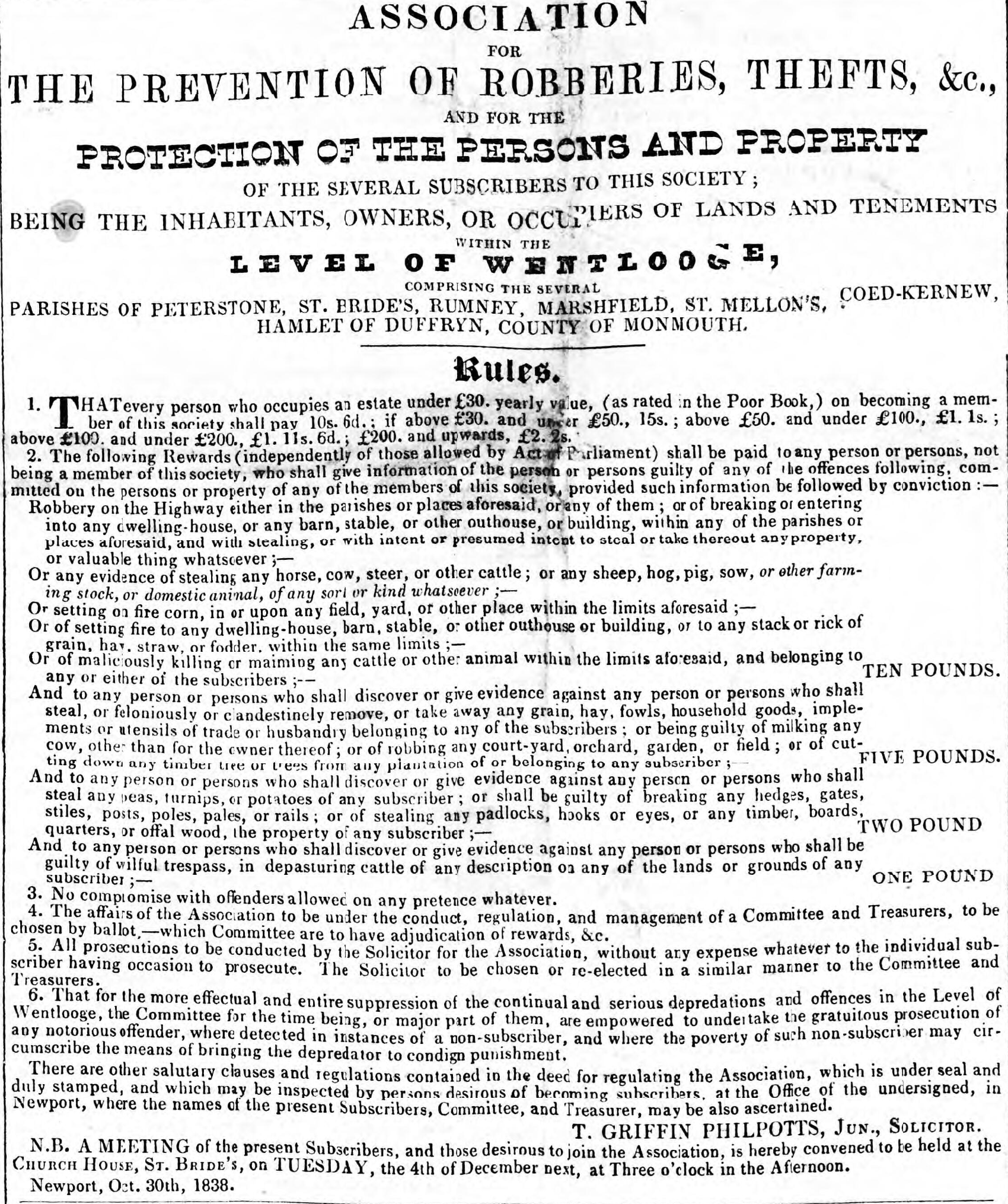
Associations for the prevention of robberies and thefts were local mutual-protection and prosecution societies formed by property owners in 18th- and 19th-century Britain, including parts of what is today's Newport boundary. Before the rise of modern professional police forces, members pooled funds to offer cash rewards for information leading to the arrest and conviction of local criminals.
It's interesting to see a mention of Duffryn being called a hamlet.


Member discussion