

Welcome to another issue of The Newport Cornucopia where we dig through the newspapers archives for interesting news articles and adverts. All articles are posted verbatim and most headlines are original (headlines in quotes are my own).

'The State of the Footpath Between Caerleon and Newport'
To the Editor of the Monmouthshire Merlin.
SIR,—If, through the medium of the Merlin, I succeed in producing any practical result, by directing the attention of the trustees to the bad state of repair in which the footpath is kept between this place and Newport, it will be the means of conferring a great benefit upon very many of her Majesty's poor but most loyal subjects.
Accustomed, as many of us are, to tramp it at all hours, and at all seasons, by daylight and in the dark, in sunshine and in storm, we cannot help desiring some more comfortable mode of transit than that experienced in stumbling over the hills, and down in the vales filled with water, and which abound, more particularly, between the upper part of St. Julian's Wood and the Farm, and again by Beaufort Cottage.
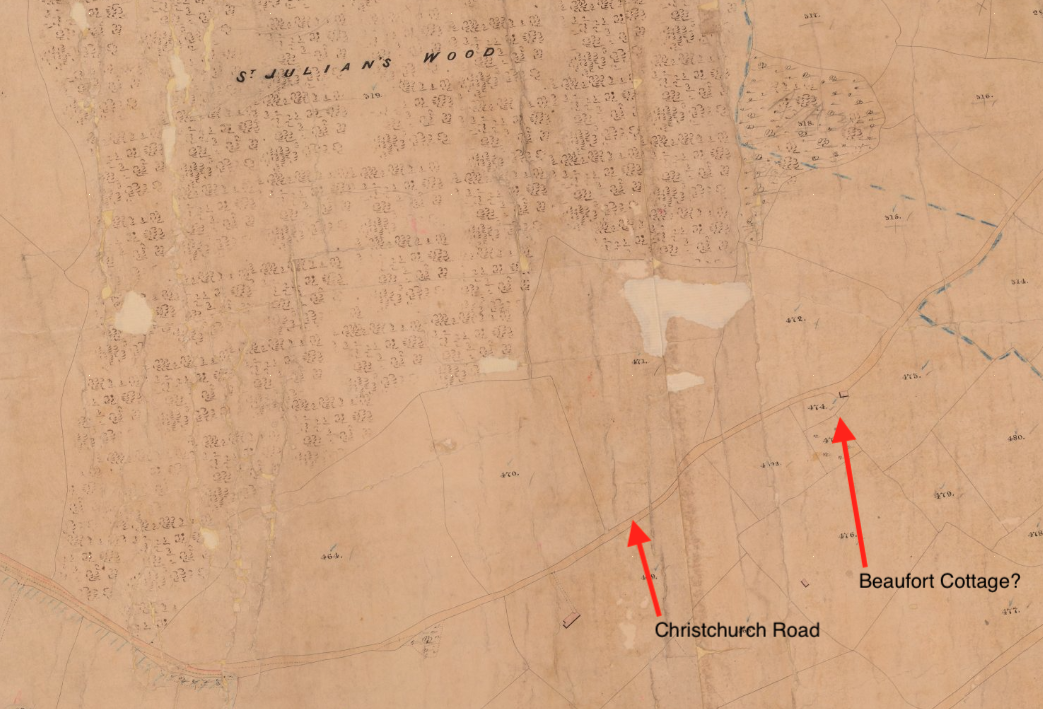
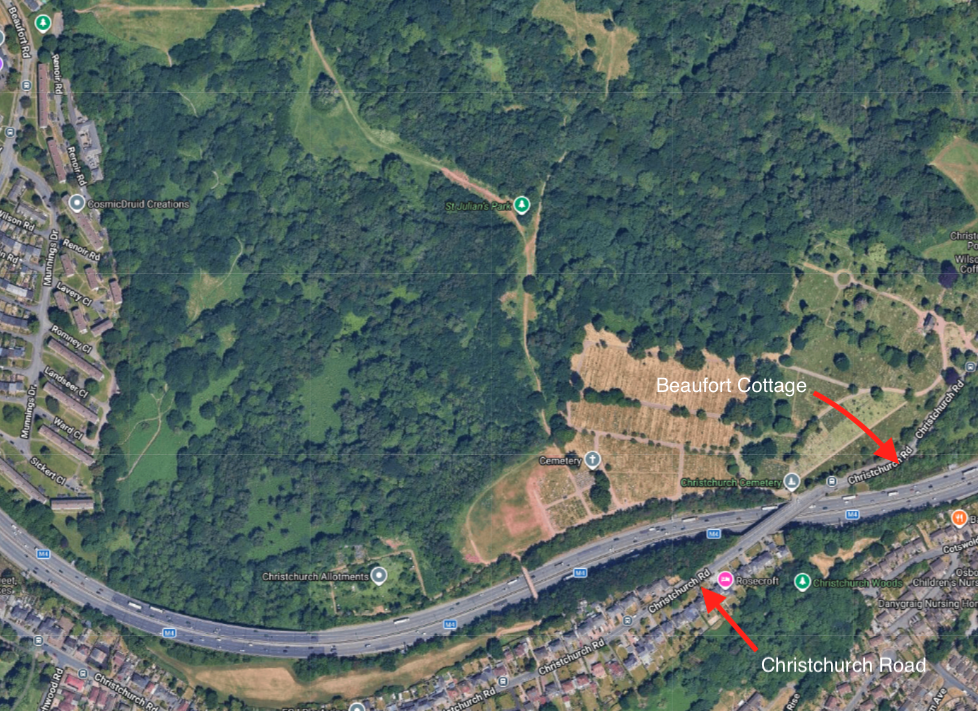
The author of the letter may be on about Christchurch Road or paths through the actual wood like the ones that exist today (unsure if the land was still private). There was a cottage near where Christchurch Road which could have been the Beaufort Cottage mentioned in the letter.
To many of those gentlemen, to whose paternal care our ways are entrusted, this footpath must be, I imagine, an article of luxury, in which they indulge at intervals, very few and very far between. I really hope that when they again pass this way they will, if only for novelty's sake, make it a pedestrian excursion, choosing for that purpose a nice wet day for walking in, and dark night for returning.
To speak of the benefit that would be conferred by maintaining such a footpath as would, at all times and seasons, give to every one the means of preserving health, is superfluous; no less superfluous would it be to expatiate upon the many natural beauties to which the walk introduces us, and the great boon it would be to all who, like myself, derive health and pleasure from being...
...A CONSTANT PEDESTRIAN.
Caerleon, October 26, 1848.
— Monmouthshire Merlin, 4th November, 1848
Alarm of Fire
About twelve o'clock on Tuesday night, information was given at the police-station that a fire bad broken out on the premises of Mr. Augustus Webber, at No. 6, Park-street.
The superintendent of police, together with a number of men, immediately proceeded to the spot with the hose-reel and fire-engine, which, however, were not required, the fire being effectually extinguished by the application of a few buckets of water. The fire occurred under the floor of the passage and back drawing-room, but it is not known by what cause.
The damage done was very trifling, the fire having been fortunately discovered in time to prevent its doing much mischief.
— Monmouthshire Merlin, 21st June, 1856
Police for Pillgwenlly
Mr. Webb, of Pillgwenlly, rose to call the attention of the council to a matter which had previously been discussed, but which lie would particularly wish to press on the attention of the meeting. He alluded to the station-house, and allocation of policemen to Pill.
True, a station-house had been opened there but it put one in mind of a fine shop, possessed of all the necessary articles for sale, but having the door locked.
Although they had the station at Pill, and three policemen to live in it, the inhabitants were never favoured by the services of the men, either by night or day, in consequence of their being required at Newport.
It should be recollected that ho asked no undue share of protection from the police force; for while Pillgwenlly was paying nearly the same amount of rates as Newport, the latter place had the services of the force, and the former place only the sleeping and boarding of three of the whole number. It was hoped, when three policemen were stationed at the Pillgwenlly station, that the inhabitants there would be benefitted with some portion of their services also; but it had resulted otherwise.
There was one man appointed to Pill duty before but now three men lived there, but the duty all transferred to Newport! Mr. Townsend said, the fact was, there was too much attention paid to clothing and feeding the police, and not to the duties they ought to perform. They did not do their duty and he did not care who heard him say so.
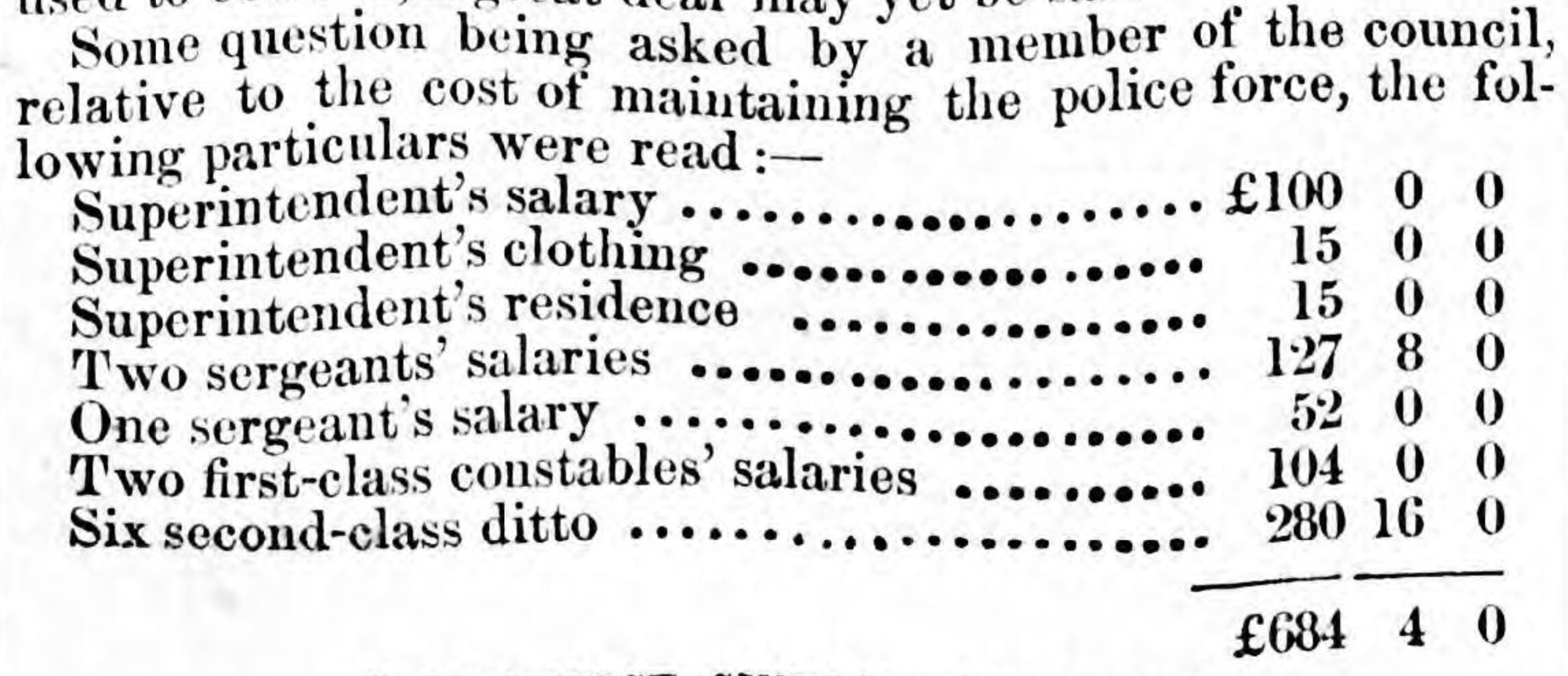
Mr. Henry John Davis remarked, that at the previous meeting of the council, he had moved that the watch committee should increase the force; for that was the necessary point. Mr. Hughes said the present force was inadequate to the duty they had to perform. Mr. Webb considered that it was nevertheless but fair Pillgwenlly should have a proportion of the services of the force.
Mr. Dowling said the intention of the watch committee was, that Pill should have every protection which the numerical strength of our police enabled the board to afford. There was now a station-house in that greatly-increasing district; and as a matter of course, arrangements must be forthwith made, in order that our fellow ratepayers and neighbours shall participate in the services of the force.
Mr. Townsend said he would not think of increasing the expenses of the police, a single penny.
Mr. Dowling thought that perhaps the prevention of crime, and the lessening of criminal proceedings at sessions and assizes from this part, might be found a far more economical course, than limiting the number of policemen to an inadequate standard.
Mr. Townsend observed, that removing the malt tax, which would prevent the necessity of constables being employed in quelling rows in the streets and public houses, would be the sound policy.
Mr. Dowling: That is not likely to occur just yet.
Mr. H. J. Davis moved—That the attention of the watch committee be again directed to the subject of the Pill station and policemen.
Mr. Townsend would beg Mr. Davis to append to his resolution that a due regard to economy be observed in the matter.
Mr. T. concluded by quoting from PUNCH—"Better attention to your arithmetic this half" (A laugh.)
The Mayor: Aye there it is. If one gentleman show good cause for increasing the expenditure, he is met by the cry of Another—"lavish expenditure!" &c.
Mr. Iggulden: If it be dearly seen that an increase of the force is indispensable, surely no gentleman can with any degree of reason taunt the watch committee with a light regard for the moneys of the ratepayers.
Some explanations followed, in conversation between Mr. Batchelor, Mr. Dowling, Mr. Iggulden, Mr. Townsend, Mr. Webb, and Mr. English, the police superintendent, which showed that duty was performed at Pillgwenlly by one man, in the evenings but that, with the present number of men, sufficient attention could not possibly be paid to both Newport and Pillgwenlly. The subject will engage the attention of the watch committee forthwith.
— Monmouthshire Merlin, 10th February, 1849
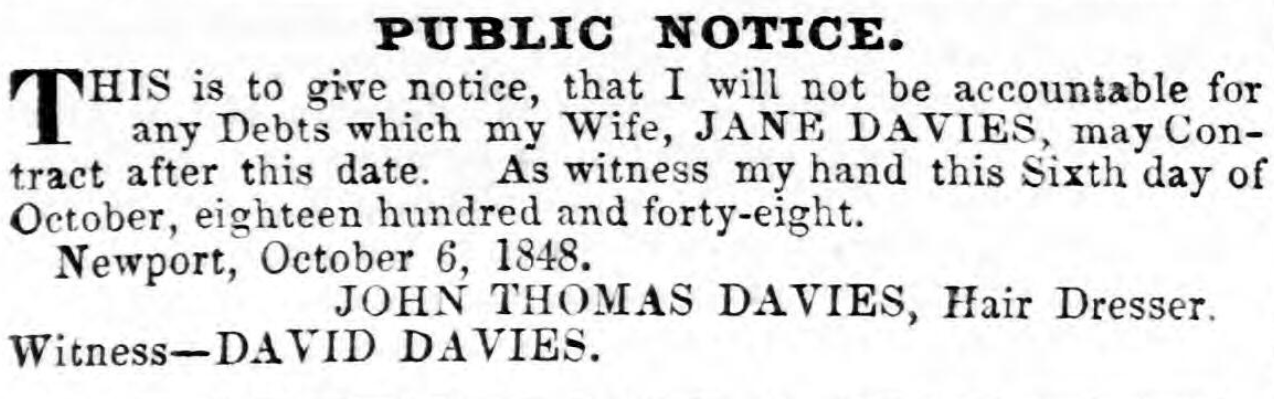
'The Newport Journal Of Gems'
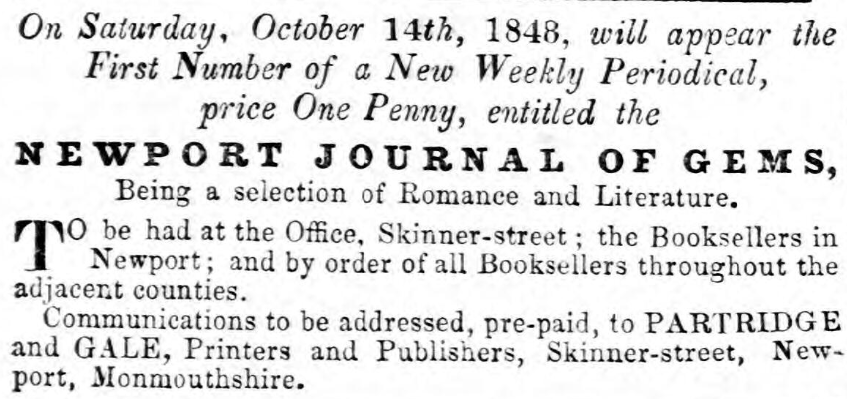
Other than an advert in the Monmouthshire Merlin and another in The Principality, I can't find any other reference of this apparently short lived journal of romance and literature.
'Photography in 1856'
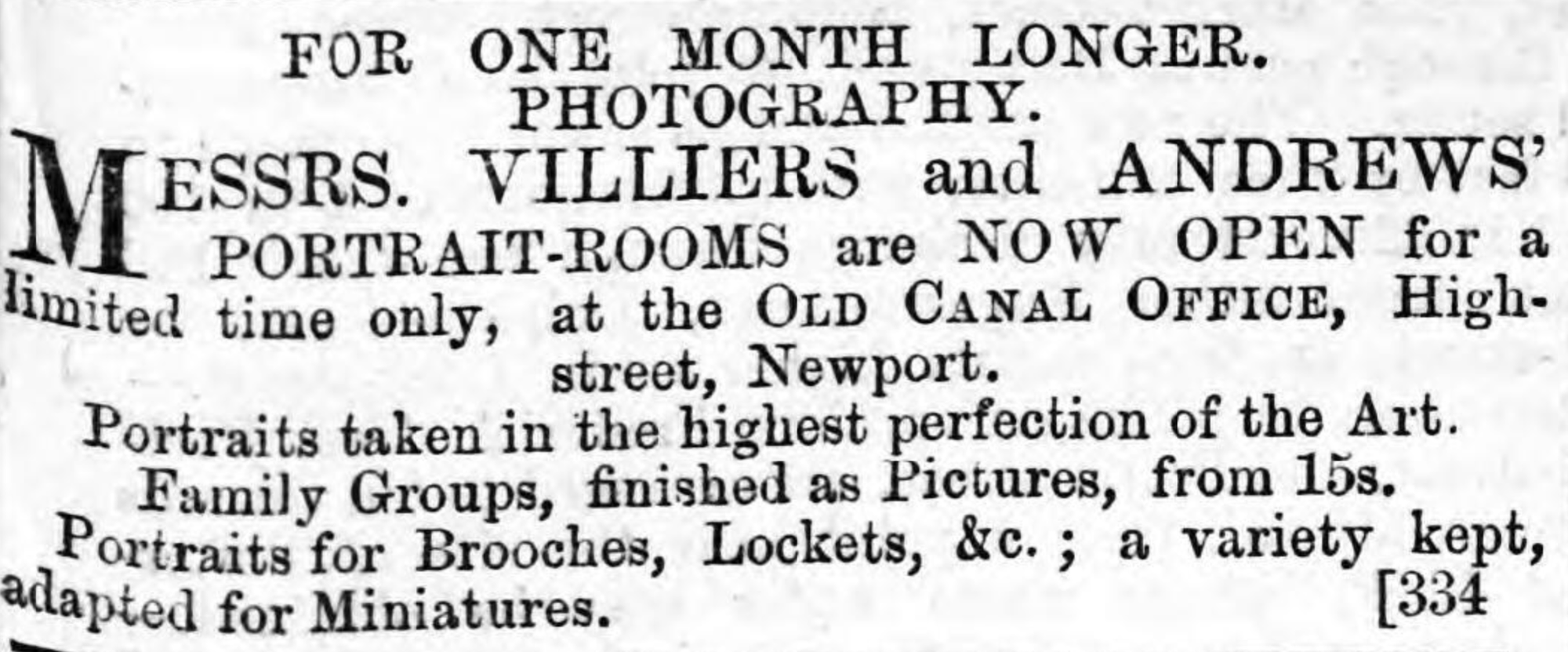
The Old Canal Office was located at the top of High Street in the area that was demolished in the 1970s for the Old Green roundabout. Using the Bank of England inflation calculator, the starting price for photos was around £72.

Fighting at the House of Refuge
Edward Coleman was charged with fighting at the House of Refuge on last Saturday evening. The matron, Mrs. Huxtable*, stated that there was a disagreement between the prisoner and others as to getting near the fire, when an awful row ensued, in which the prisoner struck about him in every direction, but at length he was secured, and locked up. Mr. Hughes said that the conduct of prisoner was deserving of punishment, and he must therefore go to prison for a month.
— Monmouthshire Merlin, 28th October, 1848
A Gaudy Nymph
Ann Watts, a gaudily-dressed nymph, with her eye edged by a sable hue, was ordered to pay 5s. for being drunk. She paid at once.
— Monmouthshire Merlin, 28th October, 1848
'A Desire to be Sent to Prison'
John Thornhill was charged with breaking a pane of glass in the shop window of Mr. Ingram, in Griffin-street. Prisoner said he had committed the offence to get into prison. Sent for a month.
— Monmouthshire Merlin, 28th October, 1848
James Fox, a vagrant, was committed for trial for stealing a shirt, the property of Edward Evans, off a line where it was hanging to dry, in a garden at Penhow. Prisoner said, he admitted stealing the shirt, and that he did it on purogse to go to prison. If he saw a loaf of bread, he would steal it "for the sake of going there, as he was tired of being on the road."
There have been six or seven prisoners committed from New- port, and the neighbourhood, within the last month, for offences committed on purpose to get into gaol!
— Monmouthshire Merlin, 11th November, 1848
A Friars Field Cannibal
Catherine Ryan, whose mouth indicated a strong propensity for devouring little children and grown-up people, was charged with assaulting Mary Walford, by biting her in the arm. The marks of this cannibal's teeth were glaringly visible on the arm of the victim; and a second intended victim came forward to show her mutilated finger, off which the prisoner bad taken a piece of considerable extent.
It appeared that this cannibal had beaten her little child most unmercifully, and on some of her neighbours interfering, she flew at them with distended jaws, and bit them in the manner described. The prisoner said she was quite unconscious of what she was about, and now regretted her conduct extremely. On paying expenses, she was severely reproved, and discharged.
— Monmouthshire Merlin, 28th October, 1848
Assault at Liswerry
Maria Bradford was charged with assaulting Martha Long, at Liswerry, on the 14th inst. The parties met on the road on the above day, and defendant asked complainant what she had been saying to Stacey (the man Bradford lives with) about her. Defendant used very foul language and shook her severely, gripping her on the arm and breast.
The Bench reprimanded defendant for her loose conduct in living with a man to whom she was not married, and fined her 10s., and l1s. 6d. costs, or twenty-one days.
— Monmouthshire Merlin, 28th June, 1856
Wife Beating
Matthew Welch was brought up charged with assaulting his wife. Defendant had but just returned from prison. He drank seven shillings worth of drink on Saturday week, and on Monday he went to his wife to look for food.
Because she remonstrated with him he struck her, and on Friday last he beat her again. The wife said she had ten children to support. Defendant had been frequently sent to prison for beating his wife, and was again committed for another month.
— Monmouthshire Merlin, 28th June, 1856
The Golden Goose
Who has not read of the goose that laid golden eggs, and wished, also, to possess such a domestic bird? Rumour says that the worthy landlord of a chief inn at Pillgwenlly, was last Saturday dreaming of such a prize, in his pleasant afternoon nap and lo on Sunday, when carving a fine goose on the dinner table, he actually discovered a gold ring, in which a diamond sparkled, deeply embedded in the flesh upon the back. It had been grown over, and only revealed itself when laid open by the carving knife.
— Monmouthshire Merlin, 4th November, 1848
'Maindee — Salubrious and Desirable'
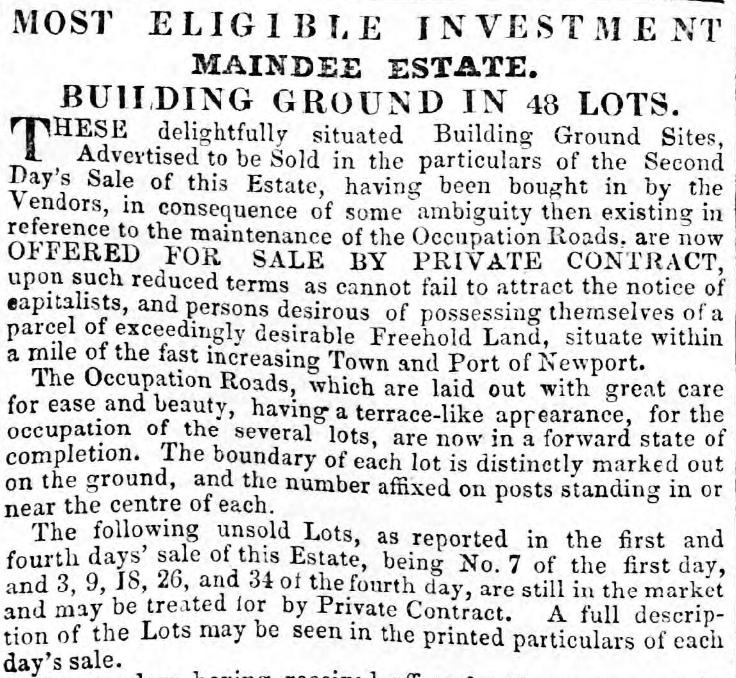
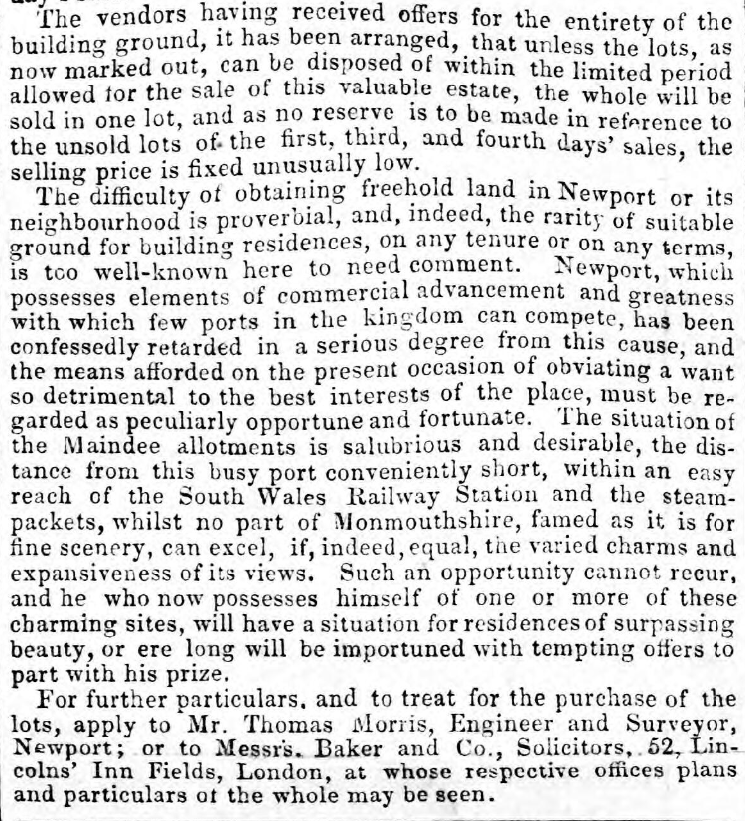
An advert was posted in the Merlin in October 1848 for freehold land in Maindee. The land was part of the Maindee Estate and mentions that the Occupation Roads (the private roads that were on of the estate) being laid out in a 'terrace-like appearance' and it would interesting to find out where these roads were located.
The advert mentions that it's difficult to get freehold land in Newport so was a prime opportunity to own land for development in a salubrious and desirable location and described the area as being...
...famed as it is for fine scenery, can excel, if, indeed, equal, the varied charms and expansiveness of its views.
— Monmouthshire Merlin, 28th October, 1848
'Shows at the Newport Theatre in 1857'
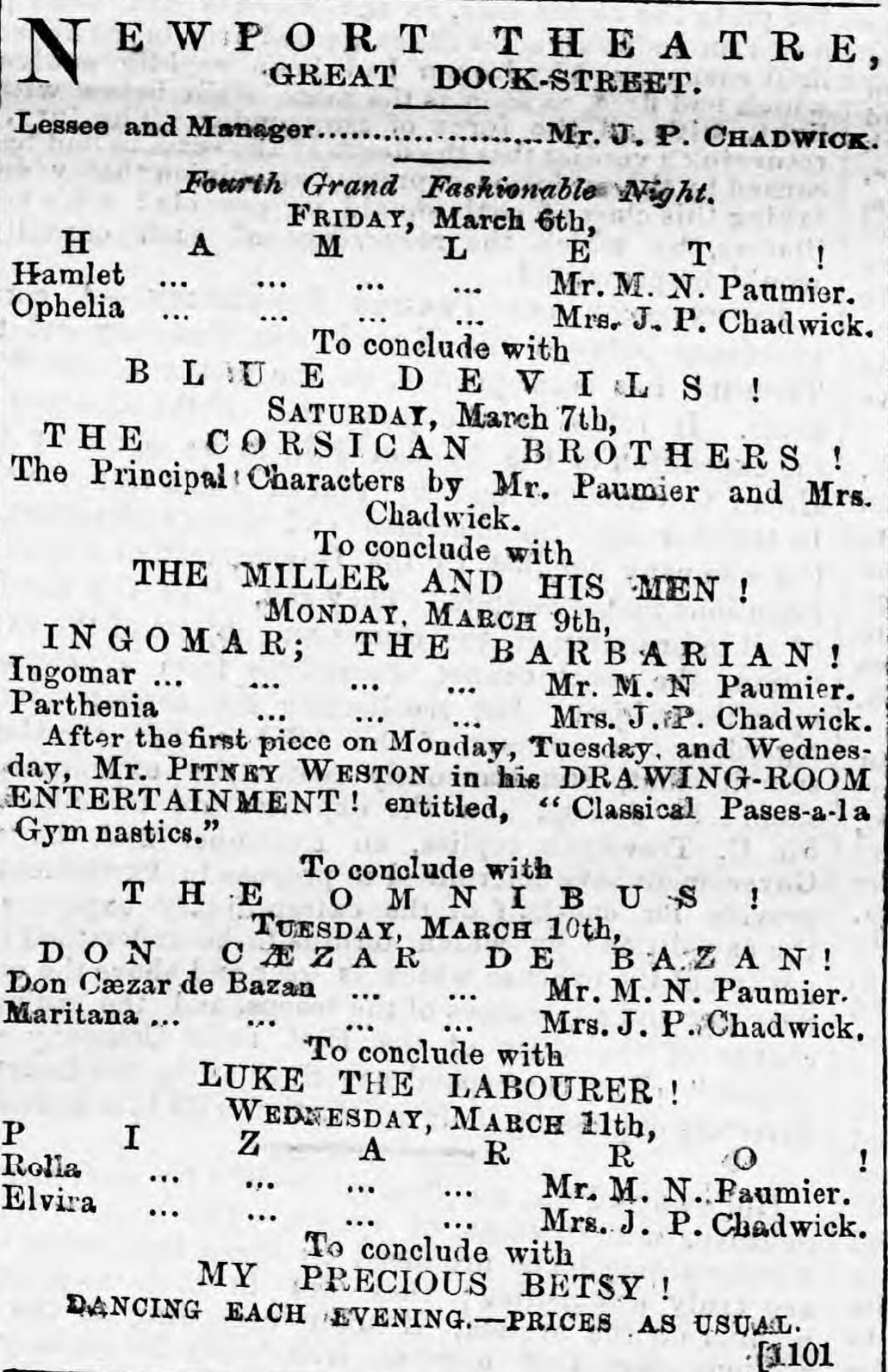
The Corsican Brothers was a famous 19th-century stage melodrama about twin brothers with a psychic link. It originated from Alexandre Dumas père's 1844 French novella Les frères corses, which was first adapted for the Paris stage in 1850 and later popularised globally by Dion Boucicault’s English adaptation in 1852.
Ingomar the Barbarian was a five-act romantic and historical melodrama about a fierce tribal leader tamed by love for a Greek maiden. Written in English by British writer and former actress Maria Ann Lovell, it premiered in London in 1851 and became a massive theatrical hit across the English-speaking world for the rest of the 19th century.
"Luke the Labourer" was a popular two-act domestic melodrama written by John Baldwin Buckstone. It premiered in October 1826 at the Adelphi Theatre. The play remained a staple of regional and colonial theatre repertoires, appearing frequently on playbills and touring house schedules across Britain and the empire.
Attempted Suicide
On Monday morning last some persons at the bottom of Llanarth-street observed a man dressed as a mason deliberately throw himself into the canal at that place. He was immediately taken out, and conveyed to the station-house, where he was recognised as a person who had, on the previous evening, obtained admission into the House of Refuge, and who had stated that his name was James West, and that he was a mason out of work.
Soon after he was brought to the station, Mr. Jehoiada Brewer, surgeon, was sent for, and, upon examination, he pronounced the poor fellow to be insane he was accordingly, on the following day, removed to the Lunatic Asylum at Abergavenny.
— Monmouthshire Merlin, 21st June, 1856


Member discussion